


It's early, the aisle is cold, and you're already doing jacket math. The coat that felt perfect while you tacked up pulls across your shoulders when you pick up the reins. Halfway through warm-up you're sweating, then you're chilled again while you untack. A good Horse Riding Jacket for Women solves that swing. It isn't a street coat with a horse on it. It's a working layer built for a seated, moving rider.
Table of Contents
- Why a Horse Riding Jacket for Women Is Built Differently
- Key Features That Matter in the Saddle
- Matching Jacket Types to Riding Activities and Weather
- English and Western Jacket Styles Compared
- Getting the Fit Right for Women's Riding Jackets
- Caring for Your Riding Jacket So It Lasts
- How to Choose Your Next Riding Jacket
Why a Horse Riding Jacket for Women Is Built Differently
Your regular winter coat is cut for walking. Arms hang down, torso stays fairly straight, and a long hem is a bonus. In the saddle your arms sit forward, your elbows bend, your shoulders rotate, and your hips flex. A hem that's cozy on the ground can bunch under you, catch on the cantle, or ride up and leave your lower back exposed to the wind.
That difference in posture is the whole reason this category exists. A riding jacket is shaped so the back stays covered when you're mounted, the front doesn't pool in your lap, and the shoulders let you follow the reins without fighting the fabric. Vents, gussets, and two-way zippers aren't decoration. They give the jacket somewhere to go when you sit down in the saddle.
Women drive this design work because women drive participation. A 2023 literature review of 39 studies of horse-related trauma reported females as the most frequently involved group in 20 studies, with female shares ranging from 52% to 93.7%, and cited a 74% female participation rate reported by British Equestrian. That same review points to recreational riders in their late 20s to mid-30s as the group most commonly represented in the injury evidence. In plain terms, women's jackets aren't a scaled-down afterthought. They're built for the majority of people riding, schooling, competing, and doing barn chores.
Equipment First, Fashion Second
Think of your jacket the way you think of your boots. Style matters, and you'll wear it to the feed store, but the first questions are practical.
- Movement: Can you mount, trot, and reach forward without the shoulders binding?
- Weather: Will it block wind and rain without turning into a sauna?
- Compatibility: Does it layer cleanly over or under the safety gear you already wear?
One boundary matters from the start. A jacket, however sturdy, is safety-adjacent, not safety equipment. It complements a certified helmet and a body protector or air vest. It never replaces them, and no amount of padding in a fashion or schooling jacket turns it into certified protection.
Key Features That Matter in the Saddle
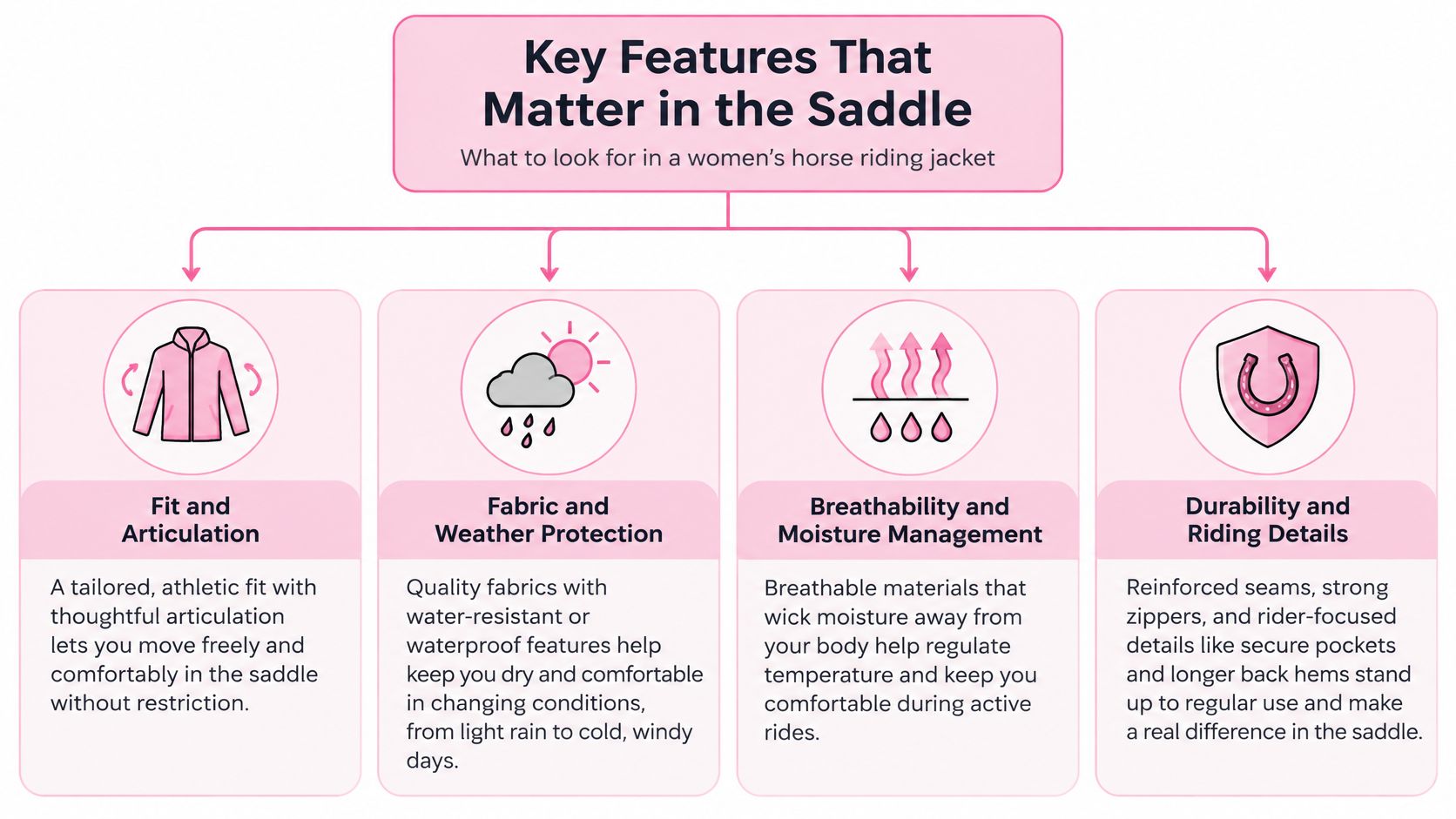
Picture reaching for the reins as your horse steps off, only to feel your jacket tug across your shoulders. A riding jacket needs to work with that forward posture, fit comfortably over or under your protective gear, and stay out of the way as you ride. Four feature groups help you check whether it will.
Fit and Articulation
Test a jacket in a riding position. Reach both arms forward as if holding reins, bend your elbows, rotate your shoulders, and hinge slightly at the hips. If the fabric pulls across your shoulder blades or the zipper presses into your stomach, that discomfort will follow you through the lesson.
Articulated sleeves are shaped to accommodate bent elbows. Stretch panels under the arms or across the back provide extra reach, without making you size up into a loose jacket that bunches in the saddle.
Fabric and Weather Protection
Waterproof ratings give you a useful point of comparison. Hydrostatic-head testing under ISO 811 reports resistance in millimeters of water column, with roughly 5,000 to 10,000 mm suited to light-to-moderate exposure and severe-weather outerwear exceeding 20,000 mm. For regular wet-weather riding, ISO 811 guidance points to at least 10,000 mm as a practical target.
Breathability is measured separately under ISO 11092, which reports evaporative resistance, or RET. Lower RET values mean greater breathability. Under ISO 11092, a RET below 6 is highly breathable, and 6 to 13 generally suits active use, which is exactly the zone many riders need.
Practical rule: Waterproof fabric, breathable fabric, and sealed seams are three separate things. A jacket can perform well on the first two and still let water through needle holes at the shoulder seams.
Check for fully sealed seams alongside the waterproof rating. If a retailer describes a jacket as waterproof, ask whether the claim is based on testing of the finished garment or only the fabric.
Safety-Adjacent Construction
Construction details can reduce distractions and snag points. A nationwide Swedish register study found falls from horseback accounted for 84% of incidents, reported an overall incidence of 8.98 injuries per 1,000 registered riders per year, and calculated a relative risk of 2.71 for women, whose incidence was 9.47 per 1,000 compared with 3.49 per 1,000 for men](https://pmc.ncbi.nlm.nih.gov/articles/PMC11373387/). The Swedish figures describe riding injuries in general, not jacket performance, so they cannot show that a jacket prevents trauma.
Look for closures that stay secure, cuffs that fit around gloves without adding bulk, and pockets that fasten so contents stay put at a canter. Abrasion-resistant fabric can also hold up where the jacket rubs against fences, stall doors, and tack. These details help keep your attention on your horse.
Matching Jacket Types to Riding Activities and Weather
You step out for a chilly walk to the arena, warm up into a trot, then cool down while untacking. One jacket has to cope with a quick change in effort, so choose by how you ride as well as by the forecast.
For changing conditions, look for a front you can unzip with gloves on, cuffs that loosen easily, and fabric you can pack or tie around your waist. If a jacket starts to feel hot during a working trot, open the front and loosen the cuffs before you get uncomfortable. When a heavier coat feels like too much by mid-morning, a light shell over a midlayer is easier to adjust. This guide to layering with horse riding sweaters explains how to combine those pieces.
| Jacket Type | Best Weather | Best Activity | Breathability | Layering Role |
|---|---|---|---|---|
| Lightweight packable shell | Mild, changeable | Warm-up, trail rides, show grounds | High | Outer wind layer over a sweater |
| Waterproof shell | Steady rain, wind-driven rain | Wet schooling, trail, barn chores | Moderate | Outer layer, sized to fit insulation under it |
| Softshell | Cool, dry to light drizzle | Schooling, lessons, everyday barn work | High | Outer layer in cool weather, midlayer in deep cold |
| Insulated jacket | Cold, dry or snowy | Stationary barn work, slow winter hacks | Lower | Heaviest outer layer, often worn over one thin base |
A softshell suits active schooling in cool weather. It blocks wind, sheds light drizzle, and stretches as you reach, while allowing more airflow than an insulated jacket. It is not made for a downpour. For sustained rain, choose a waterproof shell with sealed seams and a vent you can open while riding. Check that it fits over any insulation you plan to wear, and make sure the extra layer does not restrict your mounted posture or conflict with a body protector.
Insulation is useful when you are standing around. It can feel too warm once you start posting, so keep it for feeding rounds, watching lessons, or slow winter hacks when you are generating less heat. A packable shell works well when the weather may change during a trail ride or while you are at the show grounds.
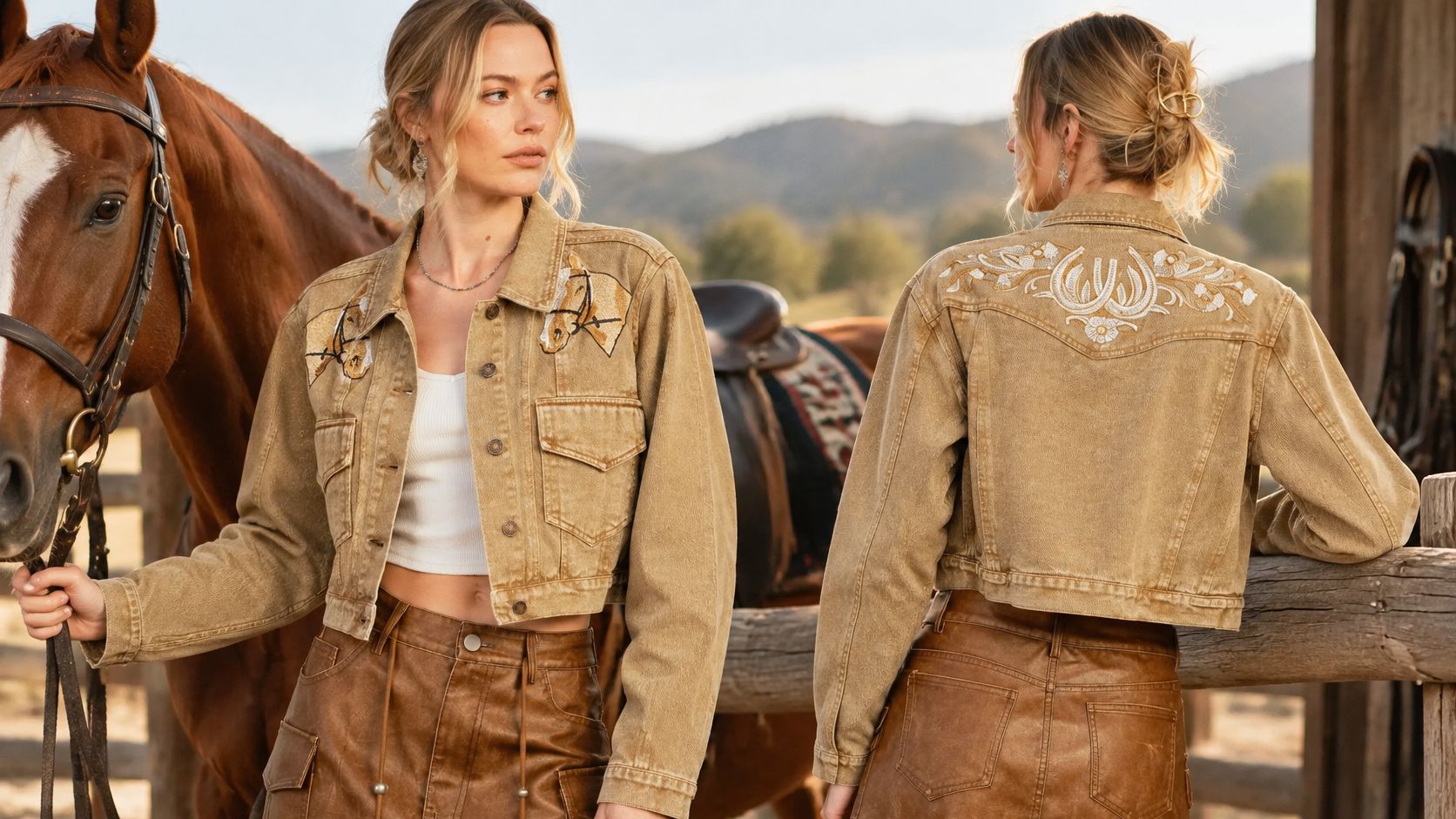
Some jackets work for barn-to-town wear rather than technical riding. The Horseshoes & Horses Embroidered Denim Jacket has a cropped cut, button-up front, flap pockets, horse embroidery on the front, and floral horseshoe embroidery on the back. It is a casual denim layer, not rain gear, so do not expect it to keep you dry in a downpour.
The warmest jacket in the tack room may be useful for standing still, but a lighter, adjustable layer often works better when your ride shifts from warm-up to active schooling.
English and Western Jacket Styles Compared
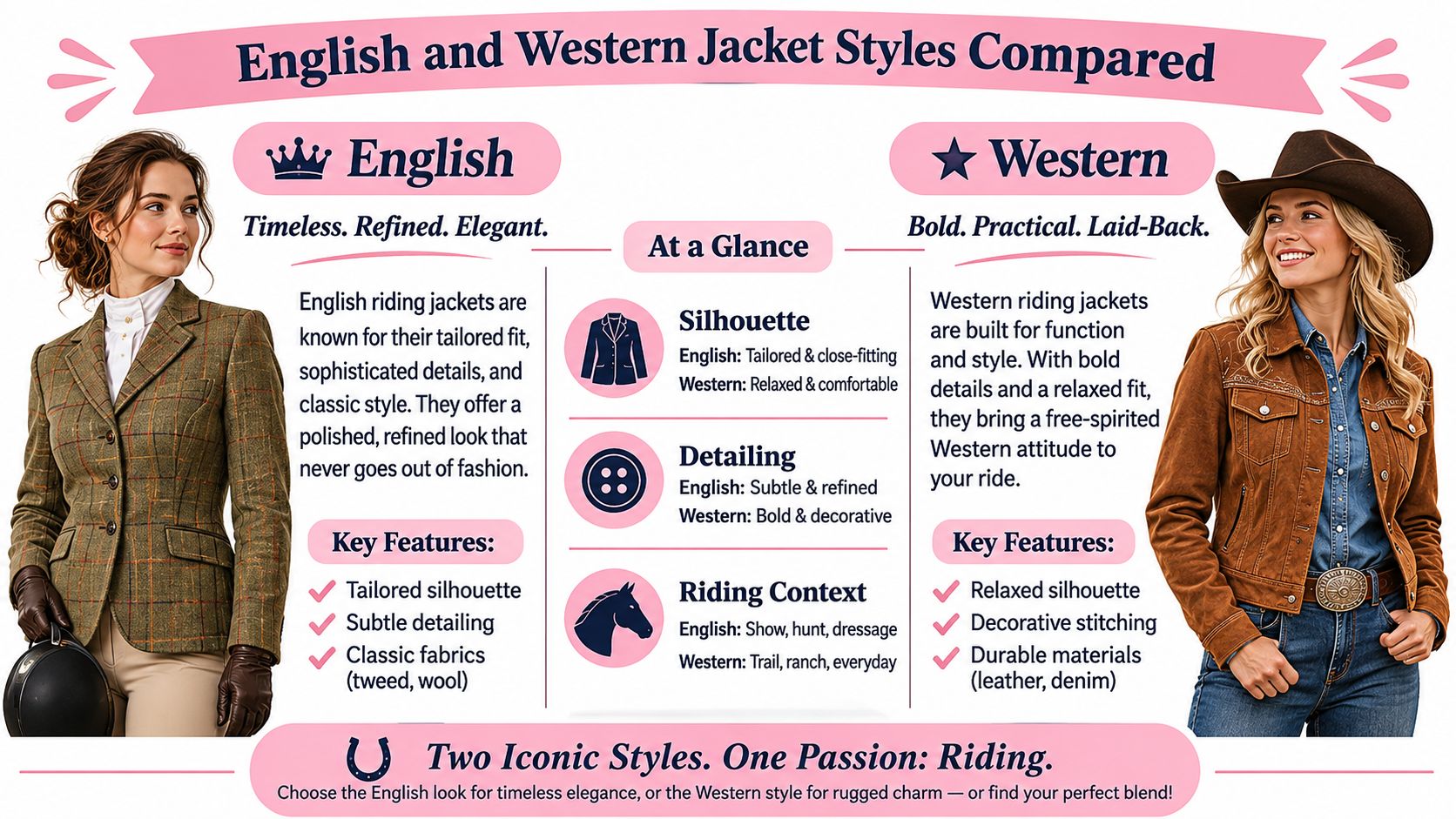
Sooner or later you'll stand between two racks and feel the fork in the road. English jackets look refined and quiet. Western jackets look relaxed and expressive. Neither is the correct answer. They're two coherent traditions, and the right one depends on your saddle, your discipline, and where else you'll wear the jacket.
The English Silhouette
English styling runs close to the body, with structured shoulders, a shaped waist, and conservative colors like navy, black, and charcoal. That trim cut isn't only tradition. In a close-contact saddle, extra fabric has nowhere to go, and a clean line keeps the jacket from interfering with your seat or bunching against the pommel. Schooling jackets borrow the same silhouette in softer, washable fabrics, while competition coats add the polish judges expect. If you lesson weekly, show, or like a neat profile, this tradition will feel natural.
The Western Silhouette
Western jackets give you more room and more personality. Denim, embroidery, fringe, snap closures, and bolder color show up here, along with cuts that sit comfortably in a deeper Western saddle and transition to the truck, the fairgrounds, or dinner without a costume change. The roomier fit also layers easily over flannel or a hoodie on a cold trail morning. Our guide to building a Western riding wardrobe for women covers how these pieces sit alongside jeans, boots, and hats.
Choosing Between Them
Ask three honest questions. Which saddle do you ride in most weeks? Does your discipline or barn culture lean one way for lessons and shows? And will this jacket spend most of its life in the arena or split time between the barn and town? Plenty of riders end up with one of each, a classic jacket for lessons and competition and an expressive one for trail rides and barn days. That's not indecision. It's matching the tool to the day.
One caution applies to both racks. Decorative elements should stay secure and close to the body while you're mounted. Long fringe, dangling hardware, or anything that flaps can distract a green horse and catch on equipment. Save the boldest pieces for ground work and going out if your horse is the suspicious type.
Getting the Fit Right for Women's Riding Jackets
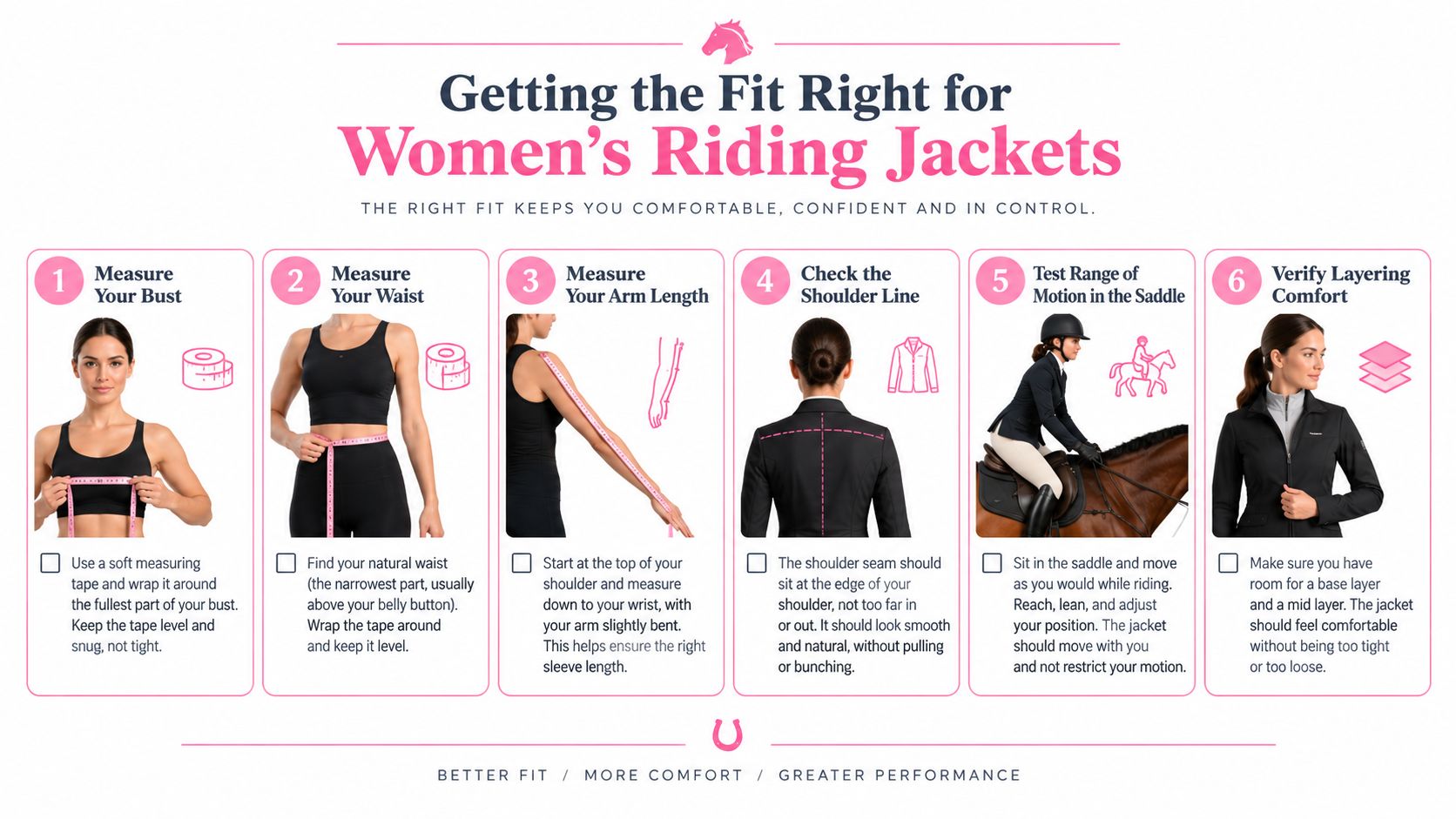
Fit is where a good jacket on the hanger becomes a bad jacket at the twenty-minute mark. Static fit, standing in front of a mirror, tells you almost nothing. You need a routine that copies riding, and you can run it in a tack shop aisle or your living room.
Measure, Then Move
- Measure first: Take bust, waist, and arm length over the layers you'll ride in, then compare against the brand's chart rather than your usual dress size.
- Take the mounted posture: Arms forward, elbows bent, shoulders rotated, slight bend at the hips. Reach as if you're giving with the reins over a fence.
- Check the back hem: It should still cover your lower back in that position, without so much length that it would bunch beneath the saddle.
- Sit down: A chair works. The front shouldn't ride up to your ribs or pool heavily in your lap, and a two-way zipper should let you open the bottom for room.
- Work the details: Fasten and adjust the cuffs with your riding gloves in mind, and confirm pockets sit clear of your hip and waist so they don't dig in when you bend.
ISO 24232:2024 lists water-penetration resistance, water-vapor resistance, and mechanical properties including tensile, tear, and bursting strength as relevant criteria for rain-protective clothing. In everyday terms, that's the fabric's ability to keep rain out, let sweat vapor escape, and survive being hauled over a fence rail twice a day. Where a retailer publishes that kind of data, it's worth more than a flattering photo.
Fitting Around Body Protectors and Air Vests
Here's where the usual advice to buy a trim fit can backfire. If you ride in a body protector or air vest, try the jacket with it on, in the order you'll wear them. A jacket worn over a protector needs genuine room and stretch, with low-profile seams that don't stack pressure points on top of protective panels. A jacket worn under a vest needs to be slim and smooth so the vest sits as its maker intended.
More fitted is not always better. Outerwear that squeezes protective equipment can restrict your movement and create pressure exactly where you least want it.
The compatibility question is an active one in the sport. The FEI established an Equestrian Safety Vests Working Group in June 2025 to evaluate air vests and body protectors and improve testing standards, and notes that research on real-world fall performance remains limited. Given that uncertainty, the honest approach is simple. Follow your vest manufacturer's guidance on layering, never assume a jacket adds fall protection, and be wary of any listing that implies otherwise. For broader context on building outfits that work as a system, our overview of riding clothes for women covers how tops, breeches, and outerwear interact.
Caring for Your Riding Jacket So It Lasts
A riding jacket lives a harder life than a commuter coat. It collects arena dust, horse sweat, hay chaff, and whatever your horse just rubbed on your shoulder. That grime isn't only cosmetic. Packed into the fabric, it interferes with the durable water-repellent finish, or DWR, that makes rain bead and roll off. A jacket that suddenly soaks through often isn't worn out. It's dirty.
Wash It Like Technical Gear
Use a dedicated technical cleaner rather than standard detergent, which can leave residues that attract water and work against the finish. Close zippers and fasteners first so they don't snag the lining, and follow the garment's own label when it conflicts with general advice. Denim and other non-technical jackets are simpler, but they still last longer washed inside out and kept away from high heat that fades embroidery and shrinks cotton.
After washing, check whether water beads on the surface again. If the jacket still wets out, a spray-on or wash-in re-waterproofing treatment can restore the finish on technical shells. Many DWR finishes also respond to gentle tumble-drying on low heat, which helps reactivate the treatment. Again, the label on your specific jacket outranks any blanket rule.
A Simple Seasonal Rhythm
- Before the wet season: Wash the jacket, re-treat it if water no longer beads, and run every zipper up and down.
- Mid-season: Inspect seam tape for lifting edges and check cuffs and hem drawcords for wear.
- End of season: Clean it before storage, since stored sweat and dirt keep degrading finishes.
Store the jacket hanging in a dry space rather than crushed into a locker or a stuff sack, which can stress coatings and insulation over months. Hanging also lets you spot trouble early, a seam starting to peel or a zipper pull bending, while a repair is still cheap.
Know when to stop reviving and start replacing. If seam tape is delaminating in several places, the shell fabric itself is worn thin at the shoulders, or repeated washing and re-treatment no longer restores beading, another bottle of treatment won't fix a structural problem. A cobbler-style outdoor repair shop can often replace a zipper or patch a tear, and for a jacket you love that's money well spent. Multi-point seam failure is different. That's the jacket telling you its waterproof years are done, though it may serve happily as a dry-day barn layer.
How to Choose Your Next Riding Jacket
A jacket can feel perfect in the tack room and still tug at the shoulders once you mount. Choose it as part of your riding setup, then use four questions to narrow your options.
What do you ride? Start with your discipline and where you ride most. A show-ring jacket needs to suit the setting, while a trail jacket should give you room to move and handle everyday wear. If you split your time between both, prioritize the activity where a poor fit would bother you most.
What weather do you ride in? Base the choice on a typical month, not an unusual storm. If rain is part of more than one ride in four, choose a waterproof shell with sealed seams; for mostly cool, dry rides, a softshell may be enough. Long periods standing at the barn call for more insulation than an active schooling session.
What goes under or over it? A body protector or air vest changes how much room you need. Check that the jacket fits over your protective gear without restricting your arms. If the hem stays in place when you post at a sitting trot, the layers are working together.
Where else will it go? For arena-only use, prioritize function. If you'll wear it around town too, choose a cut and details you enjoy off the horse.
When you're ready to compare options, Bridle Up Hope Shop carries women's jackets and riding attire across English and Western traditions. The shop offers free U.S. shipping on orders over $99 and donates 100% of annual net profits to the Bridle Up Hope foundation, which supports girls and women through horses and habits. Choose the jacket that suits your riding routine first, then consider how often you'll wear it beyond the barn.
Browse women's jackets, riding attire, and horse-themed apparel in both English and Western styles at Bridle Up Hope Shop, where your purchase supports the foundation's work with girls, women, and horses. Take the fit checklist from this guide with you, try your favorite in the mounted posture at home, and choose the layer you'll reach for on cold, ordinary, wonderful barn mornings.
Deje un comentario