


You've just finished a lesson, caught your reflection in the tack room mirror, and you're tugging at your belt for the third time. It looked perfect standing still, but in the saddle it pinches, twists, or slides against your breeches. That small frustration is where choosing equestrian leather belts properly begins.
Table of Contents
- Why the Right Equestrian Belt Matters More Than You Think
- A Short History of Leather Belts in the Equestrian World
- Understanding Leather Grades, Tanning, and Construction
- Western and English Belt Styles Side by Side
- How to Size and Fit an Equestrian Leather Belt
- What Sustainable Leather Really Means for a Belt
- Caring for Your Equestrian Leather Belt So It Lasts
- Quick Answers and a Final Checklist
Why the Right Equestrian Belt Matters More Than You Think
A rider I helped last spring came in holding two belts. One was a stiff fashion belt she loved with jeans. The other was a soft, narrow strap that disappeared under her show coat but stretched at the hole she used every ride.
Neither was a bad belt. Both were asked to do the wrong job.
Fashion Fit Is Not Riding Fit
A fashion belt mostly has to look right while you're upright. A riding belt has to stay flat while you post, fold into two-point, sit a trot, and bend to adjust a stirrup. Buckle bulk, strap width, and hole placement matter because you're moving, not posing.
A good riding belt should disappear while you ride and reappear when you look in the mirror.
That distinction explains most disappointments. A belt that's too stiff can dig in at the hip. One that's too narrow can concentrate pressure and twist in the loops. One with a proud, chunky buckle can press under a jacket or safety vest.
The Two Questions to Ask First
Every sensible purchase comes down to two questions.
- Which belt suits your riding and your life: Do you school daily, show on weekends, wear jeans at the barn, or mostly want the equestrian look away from horses?
- How will you live with it: Can you measure it where it will sit, care for the leather, and repair hardware instead of replacing the whole belt?
Answer those questions and the details stop feeling overwhelming. Leather grade becomes about wear at the holes, not a label. Western or English styling becomes about your discipline and wardrobe. Sustainability becomes about tanning, lifespan, and repair, not a buzzword.
By the end of this guide, you'll be able to read a strap, measure over breeches, and spot construction that will still feel right years from now.
A Short History of Leather Belts in the Equestrian World
Leather and horses grew up together because leather solves the problems riders face. It's flexible enough to bend around a body, strong enough to take repeated stress, and repairable when a strap or fitting wears. Harnesses, girths, reins, and belts all come from that same practical logic.
The timeline below gives you the broad arc before you look at modern buckles and finishes.
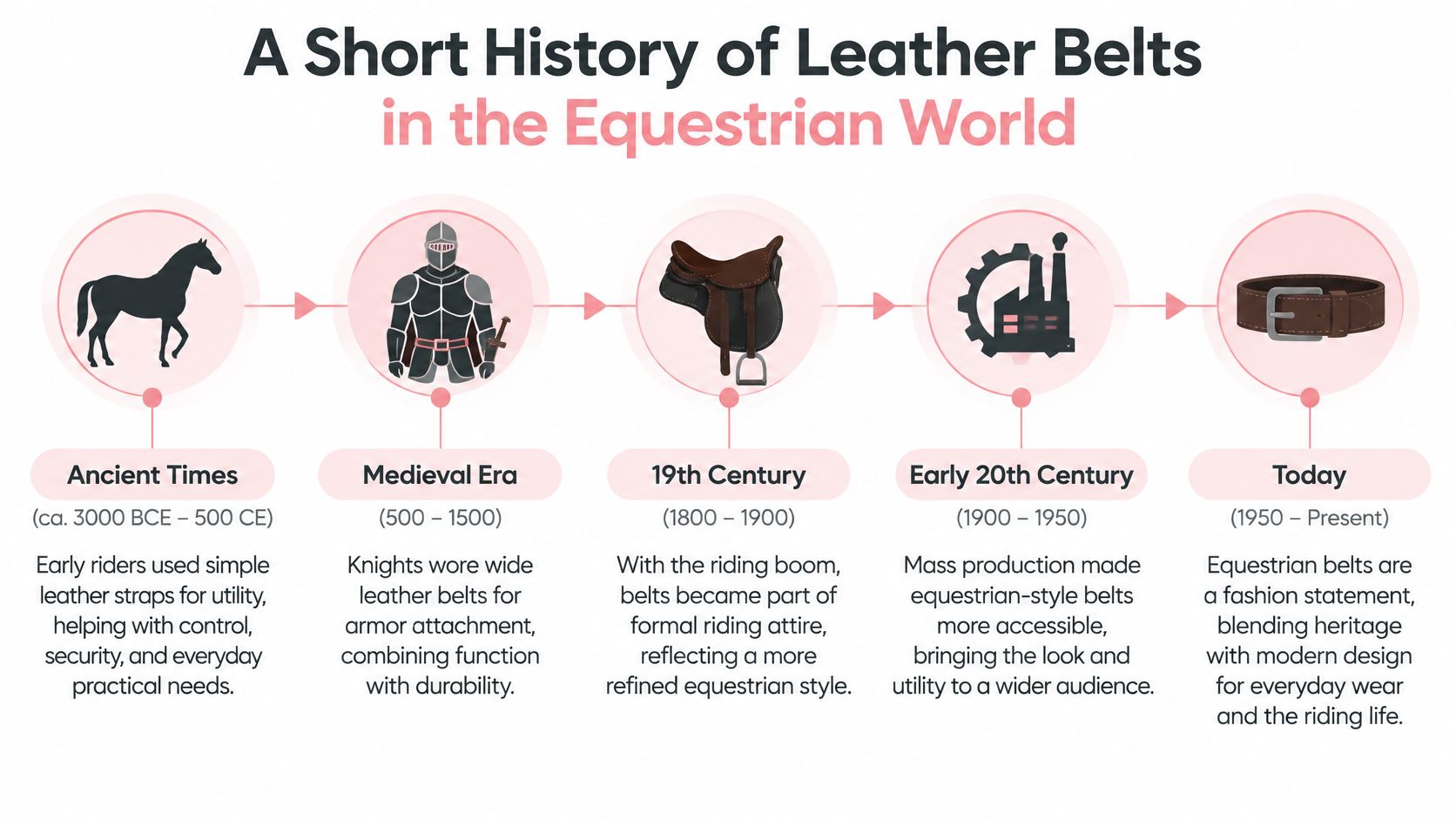
Museum objects make that continuity concrete. The Metropolitan Museum of Art's record for a Tibetan belt with suspension loops classifies it as “Equestrian Equipment”, dates it broadly to the 18th–19th century, and lists leather with iron, gold, and silver. At 28.5 inches, or 72.4 centimeters, it wasn't a flimsy decoration. It was a substantial piece built to carry and suspend items, with metal doing the fastening and reinforcing work leather alone couldn't do.
Function Came First, Ornament Followed
That mixed construction is the key idea. Leather formed the durable base that sat against the body. Metal handled stress points and, when the owner could afford it, signaled status. You'll still see that division today in a tooled Western buckle or a polished stirrup buckle, even when the belt no longer carries tools.
The Met also records a possible Roman leather horse-tack button from approximately the 1st–4th century, a small reminder that leather harness systems were already established nearly 2,000 years ago. Belts for riders developed inside a much older world of straps, fittings, and repair.
Why This Matters in a Modern Shop
That history gives you a useful quality test. Ask where the stress goes, how the buckle attaches, and whether the edges are finished to be handled daily. Those questions matter more than whether a belt merely looks heritage inspired.
Leather also sits inside a large modern industry. A 2024 PACRA report on the global leather industry estimated the broader leather sector at USD 444.1 billion in 2023, compared with USD 441.0 billion in 2022. That figure covers far more than belts, but it explains why quality, provenance, and construction vary so widely. You're buying from a global supply chain, not a single craft tradition.
Understanding Leather Grades, Tanning, and Construction
Labels confuse buyers because they sound like rankings when they're really descriptions of which part of the hide was used and how it was finished. Learn to read the strap itself and the label becomes secondary.
Leather Grades at a Glance
| Leather Grade | Feel and Appearance | Durability | Aging | Best For |
|---|---|---|---|---|
| Full-grain | Natural surface, visible character, firm hand | Highest resistance to stretching and surface wear | Develops patina and softens gradually | Daily riding and long-term wear |
| Top-grain | Smoother and more uniform, lightly corrected | Strong, with a more even finish | Ages neatly, less dramatic patina | Polished English looks and shows |
| Genuine leather | Real leather, often from lower layers, heavily finished | Moderate, depends heavily on construction | Finish may wear before leather softens | Occasional wear and budget purchases |
| Bonded leather | Fibers reconstituted with binder, very uniform | Lowest, prone to cracking at bends | Tends to peel or split at holes | Short-term fashion use only |
Full-grain keeps the tightest outer fibers, which is why it resists stretching at the buckle hole. Top-grain is lightly sanded for a cleaner look, a sensible trade if you want a smooth show finish. Genuine is the term that trips people up most. It means real leather, but it tells you little about strength.
What the Strength Numbers Actually Mean
Tanning turns hide into stable leather, and different methods change feel and aging. Vegetable tanning uses plant tannins and tends to produce a firmer strap that darkens with handling. Chrome tanning is faster and often softer from day one. Metal-free processes aim for similar stability without metal-based tanning agents.
Numbers help if you treat them as benchmarks. In a comparative study using ISO 3376 tensile testing and ISO 12947 abrasion testing, vegetable-tanned leather averaged 16.2 N/mm² tensile strength and 24,000 abrasion cycles. Recycled leather averaged 11.5 N/mm² and 18,000 cycles, while mycelium-based leather averaged 9.8 N/mm² and 12,500 cycles.
For a belt, that difference shows up as hole elongation, edge wear, and how the strap behaves after repeated bending. It doesn't guarantee a service life, because thickness, finishing, and moisture matter too. If a seller quotes strength, ask for the test method, sample thickness, and conditioning details before comparing figures.
Construction Details Worth Checking in Hand
Run your thumb along the edge. A finished edge shouldn't feel fuzzy or catch on fabric. Look at how the buckle attaches, whether by snap, screw, or a sewn loop. Screws and snaps let you swap buckles and make repairs easier. A sewn loop can be very secure, but check that stitching is even and doesn't skip near the fold.
Shop-floor check: Bend the strap gently near a hole. The leather should flex without surface cracking, and the hole should keep its shape when you release it.
Finally, check that thickness feels consistent from buckle to tip. A strap that thins noticeably will usually show wear first where you fasten it every day.
Western and English Belt Styles Side by Side
Once you understand the strap, style becomes easier. Western and English belts aren't just decorated differently. They're shaped for different clothes, different saddles, and different ideas about how visible a belt should be.
This comparison shows the silhouette difference at a glance.
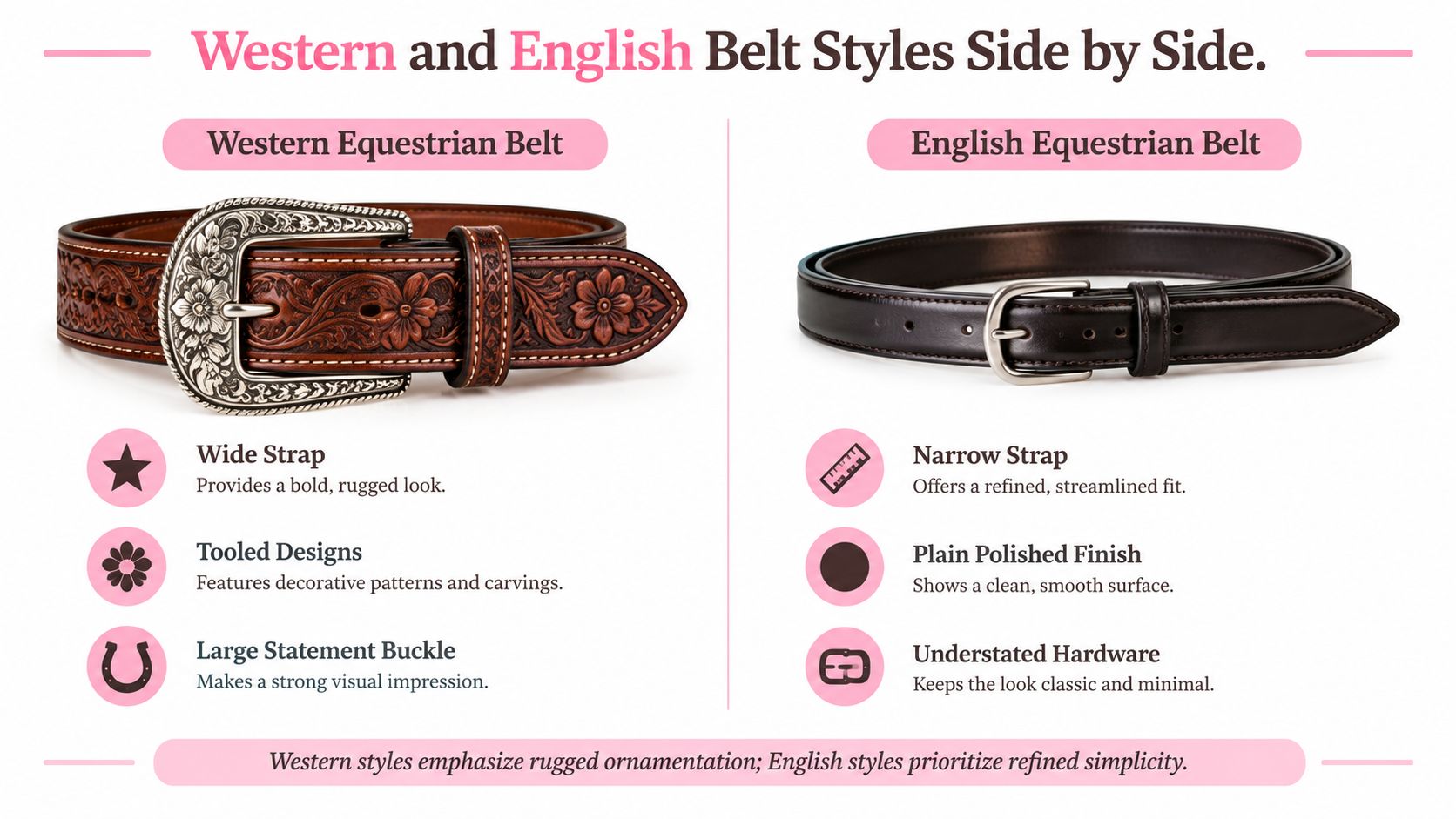
Western belts usually run wider, with room for tooling, embossing, contrast stitching, and a larger buckle that is meant to be seen. They sit naturally with jeans, boots, and open shirts or vests. For layered Western outfits, this guide to women's Western riding apparel is useful context for keeping the whole silhouette in one tradition.
English belts are typically narrower and smoother, with a small frame or stirrup buckle that lies flat. They're designed to thread through breech loops and stay quiet under a tucked shirt, show coat, or vest. The polish is in the restraint, not the ornament.
Western vs English Belt Characteristics
| Feature | Western Belt | English Belt |
|---|---|---|
| Strap width | Wider, fills jean loops | Narrower, fits breech loops |
| Buckle | Large, often engraved or trophy style | Small frame or stirrup, low profile |
| Surface | Tooled, embossed, or contrast stitched | Smooth and polished |
| Best pairing | Jeans, boots, felt hat, vest | Breeches, button-down, blazer or show coat |
| Visual role | Focal point of the outfit | Finishing detail |
A layered Western outfit might pair a tooled belt with the Allover Western Horse Vest, a jacquard vest with a woven western horse scene, a V-neckline, and a pointed front hem. Notice how the vest and belt share the same visual language. Mixing a statement Western buckle into a formal English show outfit creates the opposite effect, drawing the eye where judges expect quiet polish.
The short video below is helpful if you want to see how buckle scale and strap finish read on a moving outfit rather than a product photo.
Many riders who cross between barn work, trail rides, and lessons end up owning one of each. That's not indecision. It's matching the belt to the clothes it has to work with.
How to Size and Fit an Equestrian Leather Belt
Most sizing mistakes happen before the tape measure comes out. People measure their natural waist, order that number, then wonder why the belt feels wrong over mid-rise breeches. Measure where the belt will live.
A Riding-Specific Measuring Method
- Put on your riding breeches: Include the shirt or base layer you'll normally tuck in.
- Thread a tape through the loops: Measure near the hip bone for low and mid-rise breeches, or higher for high-rise styles.
- Aim for the middle hole: Choose a size that fastens comfortably near the center, leaving room for winter layers and small changes.
- Check the tail: You want enough length to pass through the keeper and lie flat, not so much that it flaps or doubles back awkwardly.
Riding-specific belt guidance from Equestco recommends measuring over riding breeches near the hip bone, not at the natural waist, and allowing extra length for buckle overlap. That single change fixes most fit complaints.
Width deserves the same attention. Belts around 2.5–3.5 cm generally balance pressure distribution with breech compatibility, according to the guidance noted above. Much narrower and the strap can dig in over the hip during a long schooling session. Much wider and it may bunch beneath the waistband or bind in the loops.
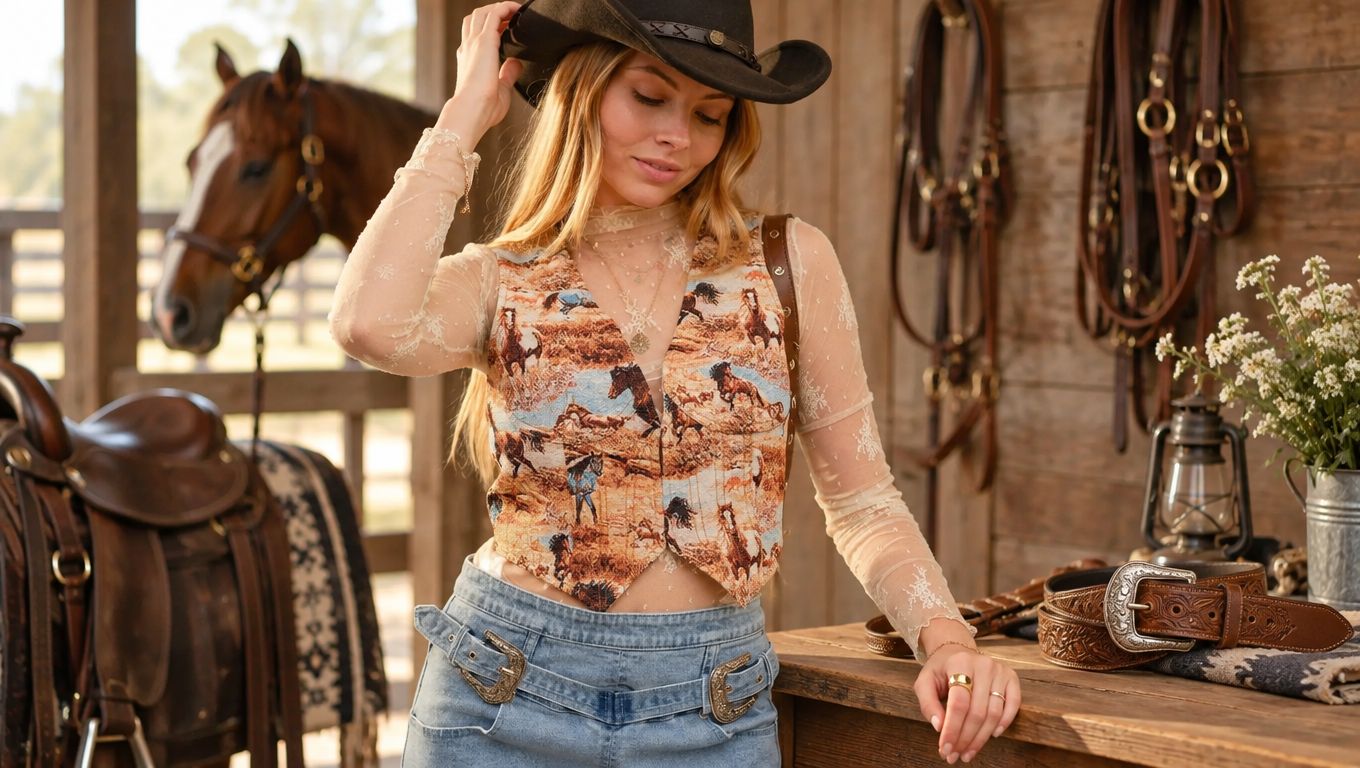
The image here shows why layering matters to your measurement. A vest or winter top changes where the belt sits and how much tail you'll need.
Holes, Buckles, and Movement
Hole spacing controls fine adjustment. Closer spacing gives you more precise options between a summer shirt and a winter layer, while widely spaced holes can leave you choosing between slightly loose and uncomfortably tight. When you try a belt on, sit down, bend forward, and mimic posting. A low-profile buckle shouldn't press into you when you fold at the hip.
If you notice the buckle while sitting in a chair, you'll notice it more in two-point.
The same principle applies outside riding, which is why advice on how to style golf belts for your outfit also starts with proportion and where the belt sits. Different sport, same lesson. A belt chosen only by standing waist size rarely performs well in motion.
If you're between sizes, prioritize landing near the middle hole over your thickest usual riding outfit. A belt worn permanently on its last hole has nowhere to go when layers change.
What Sustainable Leather Really Means for a Belt
Sustainability labels on leather are often too neat for a complicated material. A belt can use a lower-impact tanning process and still come from a poorly traced supply chain. Another can be chrome tanned, worn daily for years, repaired twice, and replaced far less often than a fragile alternative.
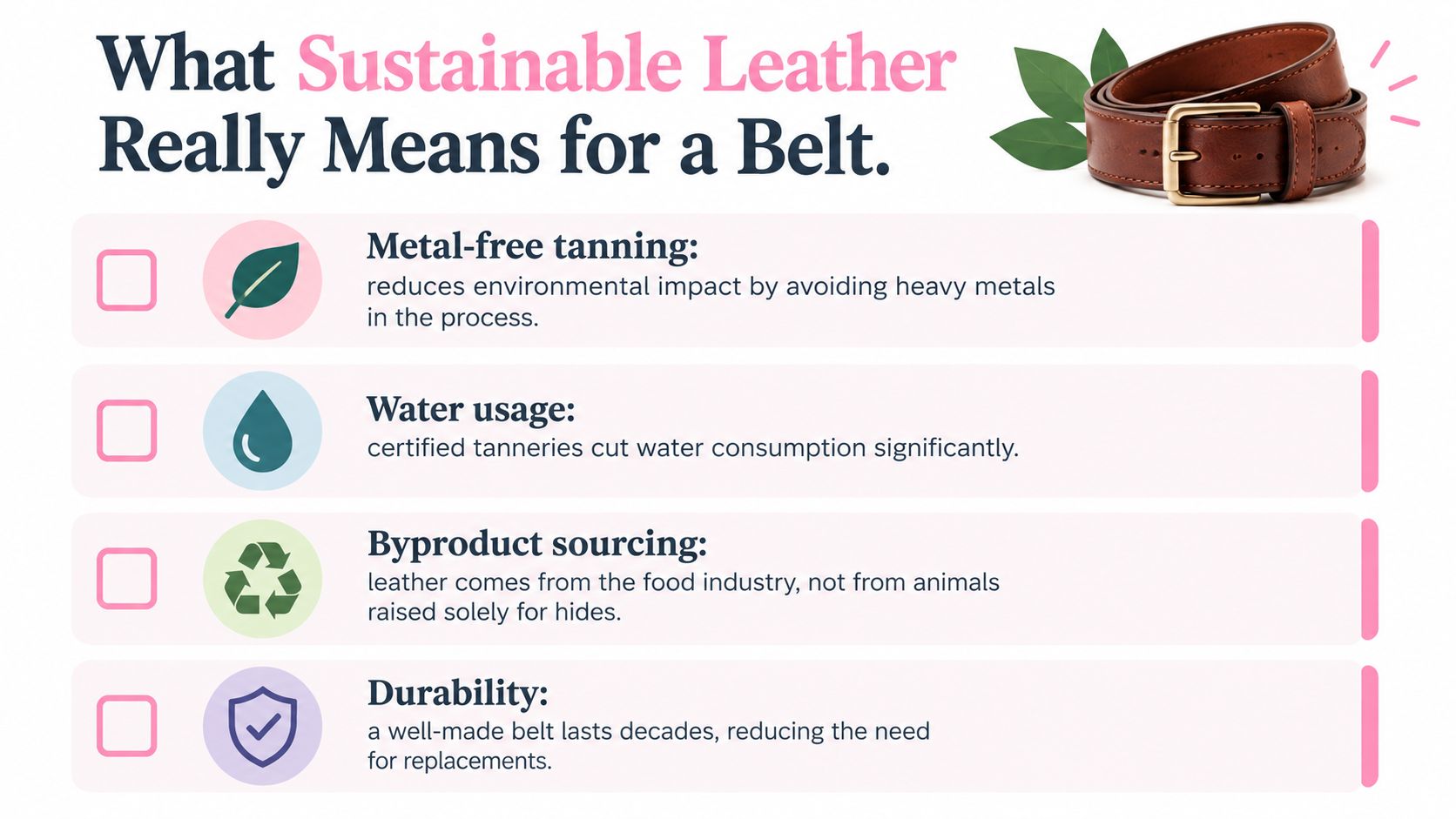
You need a way to compare claims, not just collect them. The checklist image below frames the questions worth asking.
What the Tanning Research Shows
Recent life-cycle research indexed on PubMed found that a metal-free tanning process reduced overall environmental impacts by 18.4% compared with chrome-based tanning. The same research reported reductions of 25% in particulate-matter impacts, 31% in non-carcinogenic toxicity, 56% in carcinogenic toxicity, and 29% in acidification.
Those are meaningful differences, but they describe tanning, not the whole life of a belt. Cattle production can contribute substantially to several impact categories, and finishing, transport, care, and disposal all add to the picture. Long service life matters because it spreads the impact of making the belt across more years of wear.
That is also why outfit longevity matters beyond the belt itself. If you're building a riding wardrobe you intend to keep, guidance on choosing an English riding jacket pairs well with the same buy once, maintain properly approach.
A Buyer Checklist That Cuts Through Greenwashing
- Tanning chemistry: Ask whether the leather is vegetable, chrome, or metal-free tanned, and what that means for care.
- Traceability: Ask what the seller knows about hide origin and tannery practices, and notice when the answer is only a vague label.
- Repairability: Look for replaceable buckles, available keeper loops, and stitching a local repairer can restitch.
- Care guidance: A seller who explains conditioning and storage is planning for the belt to last.
- End of life: Ask what happens when the strap finally wears out, and whether hardware can be reused.
Vegetable tanning isn't automatically impact free, and chrome tanning isn't the only factor that decides whether a purchase was wasteful. The most defensible choice is usually a well-made belt you'll wear often, maintain properly, and repair rather than replace.
Caring for Your Equestrian Leather Belt So It Lasts
Leather care sounds fussy until you understand what you're preventing. You're managing moisture in a fiber structure that stiffens when it dries out and deteriorates when it stays damp. A few steady habits handle most of it.
The Numbers Behind Storage
Conservation guidance from the Canadian Conservation Institute warns that relative humidity below 30% can remove moisture and embrittle leather, while humidity above 65% increases the risk of mould and hydrolytic degradation. It recommends a stable 45–55% relative humidity and 18–20°C.
You don't need museum equipment at home. You need to avoid extremes. Don't leave your belt in a humid tack room, a hot vehicle, or sealed plastic packaging. Store it loosely coiled or flat in a breathable place, away from radiators and direct sunlight.
The same storage logic protects other leather you ride in, which is why advice on vintage leather boots makes a useful companion if you're setting up one care routine for your whole kit.
A Simple Routine You Can Repeat
After a dusty ride, wipe the strap with a soft, slightly damp cloth and let it dry naturally. Clean with a suitable leather product when dirt builds up, then condition lightly. Over-conditioning is a common mistake. It can leave the surface greasy and may distort finishes, so use less than you think you need.
For a more detailed walkthrough of cleaning frequency and product choice, this guide on how to maintain your leather belt covers the same restraint principle from a leather-accessory perspective.
- Weekly in heavy use: Wipe off sweat and dust, then check the hole you use most.
- Seasonally: Clean, condition lightly, and inspect stitching around the buckle fold.
- After a soaking: Stuff nothing into it, add no heat, and let it dry flat at room temperature before conditioning.
- Before a show: Check the keeper, buckle screws or snaps, and edge finish while you have time to fix them.
Never fold a belt sharply for storage. Repeated localized bending concentrates stress, especially near holes. If you see deep cracks at the fastening hole, torn stitching at the buckle, or a hole stretched into an oval that no longer holds the prong securely, take it for repair or retire it. Good care can't rescue poor construction, but it prevents most avoidable cracking, hardening, and mould.
Quick Answers and a Final Checklist
Short Answers to Common Questions
Should a riding belt sit at my natural waist or my hips? It should sit where your breeches put it. Low and mid-rise breeches place the belt nearer the hip bone, while high-rise styles sit higher. Measure that belt path, not an abstract waist number.
How often should I condition it? Condition when the leather looks dry or feels stiff after cleaning, not on a fixed calendar. Light, occasional conditioning protects flexibility. Heavy, frequent conditioning can leave the finish greasy.
When should I repair rather than replace? Repair loose stitching, a worn keeper, or replaceable hardware. Replace the belt when cracks run deep at the main hole or the strap has stretched so much that no hole holds securely.
What's the safest first purchase? Choose a smooth, mid-width strap in a color that matches your boots, with a flat buckle you can forget while riding. You can add a statement Western belt later.
Your Buying Checklist
- Grade: Full-grain or quality top-grain for regular riding.
- Tanning: Know which process was used and how to care for it.
- Width: Match your breech or jean loops, and test it seated.
- Fit: Measure over breeches and aim for the middle hole.
- Hardware: Prefer smooth, flat, replaceable buckle fittings.
- Care plan: Store it breathable, loosely coiled, and away from heat.
Equestrian tradition has always favored buying once and buying well. Choose for movement first, and the style tends to hold up too, because a belt that fits your riding life is the one you'll still reach for years later.
Visit Bridle Up Hope Shop to browse equestrian apparel, accessories, jewelry, and horse-themed gifts in both English and Western styles, including belts and layering pieces to complete your riding outfit. Every purchase supports Bridle Up Hope through its charitable model, so the belt or gift you choose can do good beyond your own wardrobe.
Deje un comentario