


You're comparing two rings that seem equally Western: one has a blue-green stone in a broad silver setting, and the other has a stamped band with no stone at all. Both appeal to you, but the photographs don't tell you which will feel comfortable beside your wedding band, clear your knuckle, or survive your usual routine.
Western style rings are worn objects, not just recognizable motifs. Understanding the design is the starting point. Choosing well also means checking the metal, the stone's treatment, the setting, and how the whole ring sits on your hand.
Table of Contents
- Western Ring Motifs and Materials at a Glance
- Where Western Ring Design Came From
- Choosing Sterling, Gold or Plated Metal
- Turquoise Treatment and Silver Care
- Sizing and Stacking Western Rings for a Good Fit
- Choosing a Western Ring for Your Occasion
Western Ring Motifs and Materials at a Glance
A useful way to read a Western ring is to separate stone, metal, and motif. The stone supplies color and shape, the metal forms the structure, and the motif connects the design to Southwestern jewelry, ranch equipment, or popular Western imagery. A ring doesn't need all three elements to look Western.
A smooth turquoise stone surrounded by silver suggests Southwestern silverwork. A horseshoe or boot makes a more direct reference to ranch and riding life. An engraved band can communicate the style through its surface alone, particularly when the pattern resembles decorative metalwork on cowboy gear.
Recognizing the main motifs
Core Western ring motifs, origins and materials
| Motif | Tradition | Typical metals and stones | Look on the finger |
|---|---|---|---|
| Turquoise cabochon | Southwestern Native silverwork | Natural or stabilized turquoise in sterling silver | Smooth blue-green dome in a silver setting |
| Horseshoe | Ranch and equestrian life | Sterling silver, brass or gold-tone plate, sometimes with stones | Curved bar, often engraved or set with small stones |
| Stamped or engraved band | Silversmith tradition and cowboy gear | Sterling silver or brass | Repeating border, cross-hatching or geometric lines |
| Concho or dome | Saddle and belt hardware | Sterling silver or brass | Round or domed face with a stamped rim |
| Cowboy hat or boot motif | Popular Western iconography | Sterling silver or plated metal | Raised silhouette charm or figure |
A cabochon is a stone cut with a smooth, rounded surface rather than facets. A concho-inspired face borrows the round decorative form associated with saddle and belt hardware. These terms describe shape and design, not a guarantee of material quality or maker identity.
Silver tone is a recurring thread across the style, but it isn't a requirement. Warm brass and gold-colored finishes can carry the same horseshoe, engraved border, or boot motif. Likewise, a silver-colored ring isn't necessarily sterling silver.
Reading the whole design
Many designs combine motifs: a turquoise cabochon might sit inside an engraved border, while a horseshoe may appear on a stamped shoulder. Look at the ring's outline before focusing on the decoration. A broad dome occupies more finger space than an open horseshoe, even if both look similar in a tightly cropped photograph.
Use a short visual check:
- Stone: Is there a smooth colored centerpiece, and how far does it rise?
- Border: Is the surrounding metal stamped, engraved, twisted, or left plain?
- Icon: Can you recognize a horseshoe, hat, boot, or another Western reference?
These questions help describe what you like. They don't establish authenticity, durability, or provenance, which require more than appearance.
Where Western Ring Design Came From
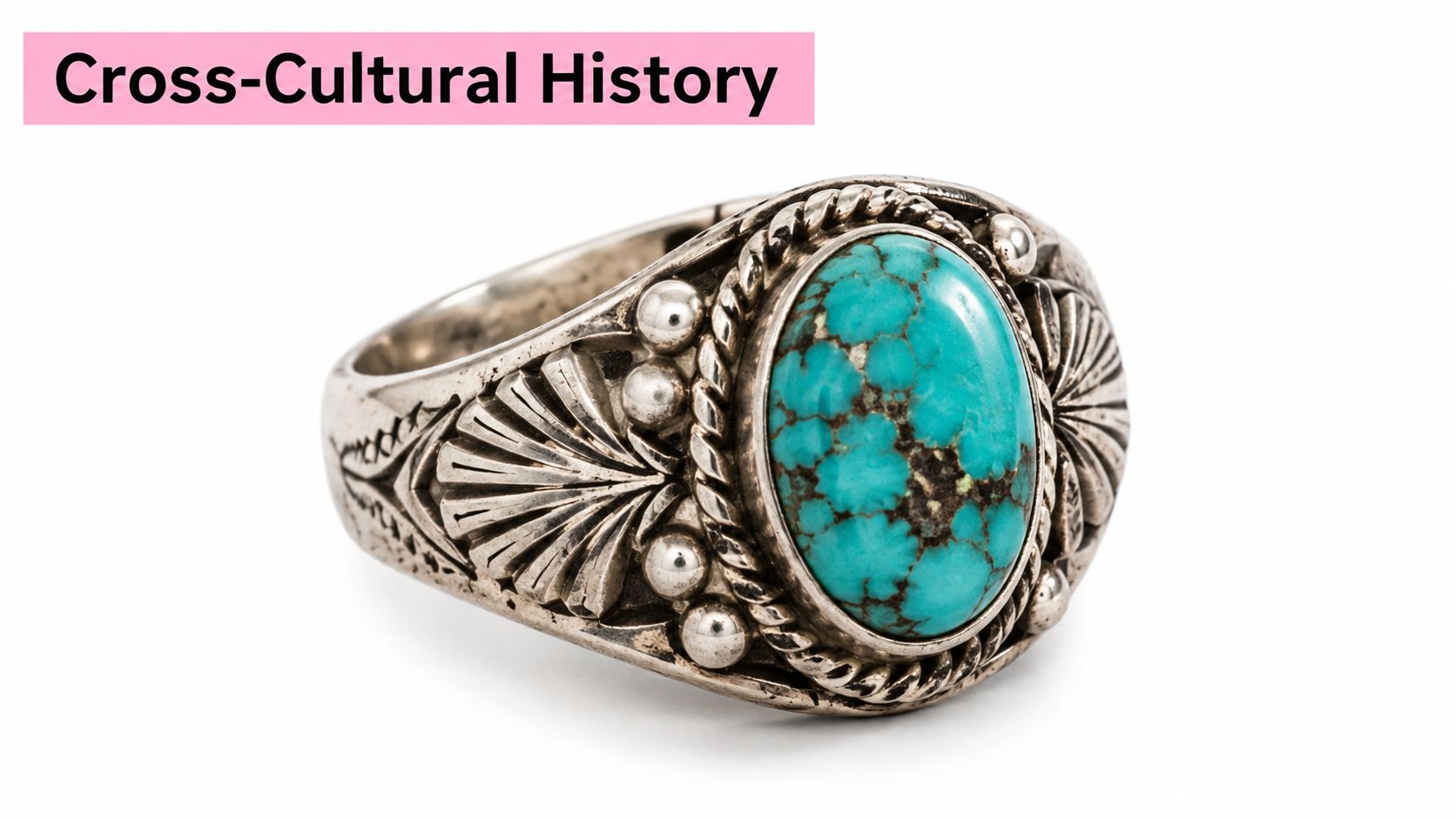
A Western ring can hold a compact piece of cross-cultural history. Consider an oval turquoise ring with a silver-colored border: its appearance connects a widely traded gemstone with the distinctive jewelry traditions of the American Southwest.
Turquoise wasn't exclusive to the American West. The Gemological Institute of America's turquoise history describes turquoise jewelry in ancient Egypt and turquoise carving in China more than 3,000 years ago, while explaining that Native American peoples used the stone as both a ceremonial gem and a medium of exchange. Its value extended beyond decoration.
The familiar combination of color and metal is easy to recognize in a substantial turquoise ring.
A tradition shaped by making and exchange
Southwestern communities worked turquoise into beads, carvings, inlays, amulets, and jewelry. A stone could be valued for its appearance, its cultural significance, and its role in exchange. Those uses shouldn't be reduced to a generic cowboy theme.
Metalworking also involved adaptation. Native artisans incorporated traded materials and repurposed available metals into adornment, shaping new objects from materials that had previously served other purposes. That resourcefulness matters when reading Western jewelry: the tradition includes both continuity and invention.
Design insight: A Southwestern-looking ring describes an aesthetic. It doesn't, by itself, identify an Indigenous maker, community, or place of manufacture.
For a shopper, the distinction is practical. If a seller identifies a ring with a particular maker or Native community, look for clear attribution rather than treating turquoise and geometric decoration as proof. A design description and a provenance statement answer different questions.
Reading the references without flattening the history
Turquoise remains closely associated with Southwestern jewelry, including among buyers drawn to the region's imagery from elsewhere. Yet ranch imagery contributes another recognizable vocabulary: horseshoes, riding equipment, hats, and boots.
Our guide to horseshoe nail rings offers a more specific example of how an equestrian object becomes a jewelry design. It's useful when you prefer a reference to horse equipment rather than a stone-centered look.
Read a ring as a combination of clues, not a definitive historical label. Turquoise and geometric stamping suggest Southwestern influences; a hat or horseshoe suggests ranch and popular Western imagery. When these appear together, the ring combines references that deserve to be understood separately.
Choosing Sterling, Gold or Plated Metal
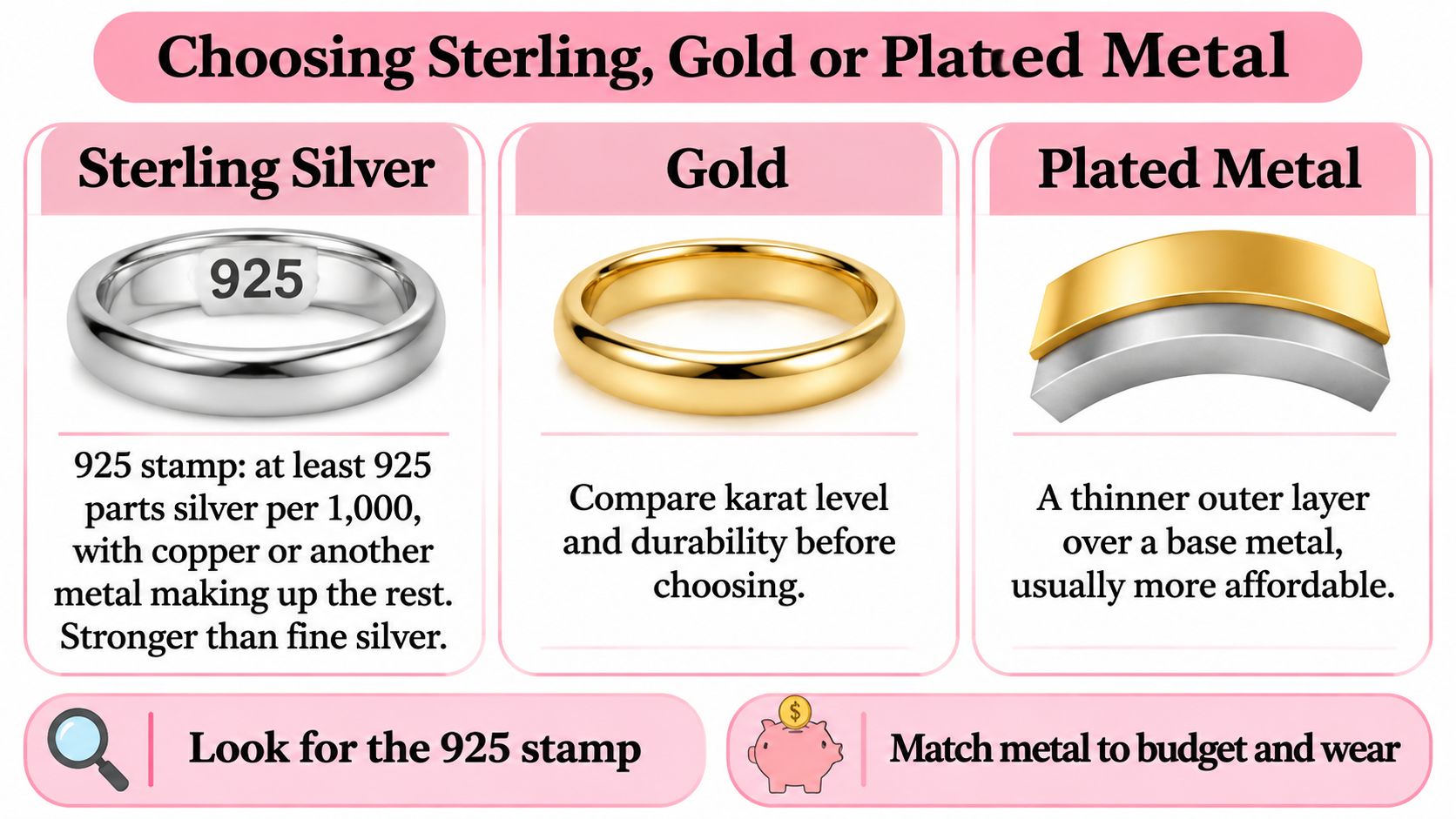
The 925 stamp is a useful starting point, not a complete quality report. According to Goldiew's jewelry hallmark guide, sterling contains at least 925 parts silver per 1,000, usually with copper making up the balance; gold uses a 24-part scale, with 14K containing about 58.3% gold and 18K containing 75%.
Those alloying metals help make sterling more resistant to deformation than fine silver. Look for a sterling designation and a maker or importer mark, then inspect the ring itself. A purity mark doesn't tell you whether the casting is sound, the stone is secure, or an added coating is substantial.
The main material choices differ in both construction and upkeep.
Comparing the metal beneath the decoration
Western ring metals compared for daily wear
| Metal | Purity or composition | Daily wear | Tarnish and upkeep |
|---|---|---|---|
| Sterling silver | Silver alloy, usually with copper | Practical for substantial bands and statement designs | Tarnishes; store dry and polish gently |
| Fine silver | Essentially pure silver rather than a strengthening alloy | Softer and more prone to bending under leverage | Tarnishes; handle carefully when polishing |
| 14K gold | Gold alloy with more non-gold metal than the higher-karat option below | Generally harder and more scratch-resistant than higher-karat gold | Clean gently; alloy mixture affects color |
| 18K gold | Higher-gold-content alloy | Generally softer than lower-karat gold | Protect from abrasion and deformation |
| Silver-plated brass | Silver coating over a brass base | Coating can wear through at contact points | Avoid aggressive polishing; restoration may require replating |
Gold-tone isn't the same as gold, and silver-plated isn't the same as sterling. A plated ring's outer layer and base metal both matter, especially if you have known sensitivities. Request a composition statement that identifies the underlying alloy rather than relying on the finish name.
Inspecting a substantial ring
Turn the ring sideways and examine its underside. A large decorative face attached to a thin shank can put considerable pressure on the band, so visual size isn't the same as structural strength. Look for smooth joins, adequate support beneath the face, and a setting that doesn't appear distorted.
For stone-set designs, inspect the metal holding the stone rather than judging only the stone's color. Uneven prongs, a lifted edge, or visible movement deserve a jeweler's assessment.
For additional silver-specific upkeep guidance, Evo Dyne Products' resource on maintaining the shine of silver rings is useful alongside any instructions for the ring's stone.
For frequent wear, start by comparing well-made sterling and lower-karat gold designs. For plated pieces, request the coating specification and consider whether eventual replating is practical.
Turquoise Treatment and Silver Care
Ask about treatment before asking whether the blue is the right shade. The GIA turquoise buyer's guide explains that stabilization or impregnation strengthens porous turquoise, helping it withstand cutting and polishing and often producing a more uniform surface.
That creates a useful distinction: untreated doesn't automatically mean more suitable for daily wear. A stabilized stone may be more usable than weak, untreated material. Treatment still matters to identification, care, and resale expectations, so it should be disclosed rather than guessed from a photograph.
Get a clear stone description
Request written answers to these questions:
- Identity: Is this turquoise, a turquoise-containing composite, or a look-alike material?
- Treatment: Is it natural and untreated, stabilized, reconstituted, dyed, or synthetic?
- Setting: How is the stone secured, and which parts remain exposed?
A bezel surrounds the stone's perimeter with metal, helping protect its edge from knocks. It doesn't make the entire stone impact-proof: the top can still stand above that protective rim. A tall cabochon may therefore need more caution than a low-set stone.
Our guide to a turquoise and sterling silver pendant explores the same material pairing in another jewelry format. A ring, however, encounters direct hand contact that a pendant usually doesn't, so don't assume the care demands are identical.
A careful cleaning routine
- Remove the ring before exposure. Take it off before swimming, showering, applying lotion, cleaning, riding, or stable work. This limits contact with chemicals, moisture, impacts, and equipment.
- After wear, wipe the ring with a soft, dry cloth. Pay attention to the underside of the setting, where moisture and residue can collect, but don't force the cloth beneath a stone.
- Polish the silver selectively. Use a suitable soft polishing cloth on accessible metal, keeping polishing compounds away from turquoise. Avoid abrasive pads, and don't try to scrub dark recessed decoration back to bright silver without knowing whether the finish is intentional.
- For the stone, start with a barely damp soft cloth. If its disclosed treatment and the maker's instructions permit mild soap and lukewarm water, clean briefly and dry promptly. Avoid ultrasonic cleaners, steam, soaking, harsh solvents, and high heat unless a qualified jeweler confirms compatibility.
- Store it clean and dry. Use a separate pouch or compartment so another piece of jewelry can't rub against the stone. Choose a dry, low-sulfur storage environment and avoid leaving the ring against rubber or wool.
- Have a jeweler inspect the setting when it catches, looks distorted, or feels different. Ask for a maintenance schedule suited to the construction and how often you wear it rather than assuming every ring needs the same timetable.
Stop home cleaning if you notice persistent dullness, a color change, or a loose edge. More vigorous polishing won't correct a treatment problem or a failing setting, and it may make either harder to repair.
Sizing and Stacking Western Rings for a Good Fit
Size uncertainty is a significant source of online jewelry returns, according to Corso's guide to jewelry returns. The guide also notes that wider bands generally fit tighter than narrow ones, which is why a familiar size from a delicate ring may not transfer comfortably to a broad Western band.
Match the sizing tool to the band you're buying. A jeweler's wide-band sizing set is more informative than a narrow loop when the intended ring covers a substantial area of the finger. A printable guide can help with initial screening, but printer scaling and measurement technique can introduce errors.
Use width as a fitting question
Band width and expected fit for Western rings
| Band width | Expected fit | Adjustment |
|---|---|---|
| Narrow band | Often closest to the fit of a narrow sizing ring | Confirm comfort at normal temperature |
| Medium-width band | May feel snugger than a delicate band | Compare adjacent sizes using a similar-width sample |
| Broad Western band | More finger contact can make it feel tighter | Ask for wide-band fitting guidance and test knuckle clearance |
There isn't a universal size increase that works for every broad ring. Interior shape, shank taper, and your finger anatomy also affect comfort. Treat a seller's sizing recommendation as a starting point, then verify it against a comparable band.
Measure when your hands are at a normal temperature, not immediately after exercise or coming in from cold weather. Fingers can change with temperature, time of day, age, and weight changes, so check fit under ordinary conditions rather than relying on an unusually swollen or cold hand.
Check the knuckle and the neighboring fingers
Measure both the finger's base and its knuckle if the knuckle is substantially larger. The ring must pass over the joint without becoming so loose at the base that its decorative face constantly rolls sideways. A jeweler can assess whether an interior adjustment would help that particular design.
Try ordinary hand movements while wearing a sample:
- Close your hand: Make a relaxed fist and check whether the band pinches.
- Bring your fingers together: Notice whether the setting presses into a neighboring finger.
- Handle a glove: Check for catching without forcing fabric over protruding details.
- Let your hand hang: Watch for excessive rotation or a ring that feels ready to slip off.
A ring that clears your knuckle but hurts when you close your hand isn't a successful fit.
Test the complete stack
Fit a stacked combination as a combination. Your wedding band and Western ring occupy more space together, and adjacent settings can rub or obstruct each other. Wear the companion ring during fitting rather than estimating from separate measurements.
For online purchases, request face dimensions, shank width, and a side-profile photograph. On-hand images help distinguish an expansive top from a wide band. If the design can't be resized, confirm the available sizing options and exchange terms before committing.
Choosing a Western Ring for Your Occasion
The best choice depends less on how Western a ring looks than on what your hands will be doing. Separate a ring for town, work, or gifting from jewelry you might wear around horses. A protective setting doesn't remove the risk of a ring catching on equipment.
Match construction to the situation
For riding and stable work, leave the ring safely stored. If you want a horse-inspired ring to wear before or after those activities, consider a substantial sterling design with a low, protected setting. Don't use durability claims as a reason to keep jewelry on while handling reins, tack, or machinery.
For office and town wear, a plain or lightly stamped sterling band offers a restrained option without an exposed stone. If you prefer turquoise, compare low-profile settings and consider whether the face will interfere with typing or reaching into pockets.
For stacking, let a stamped band accompany a simpler wedding band, but test the pair for rubbing and comfort. Keeping a dominant motif is a styling choice, not a rule, and spacing matters more than whether the patterns match exactly.
For a gift, start with the recipient's preferred finger and current fit rather than guessing from their existing jewelry. Our jewelry gift ideas can help when you're deciding whether a ring is the right format at all.
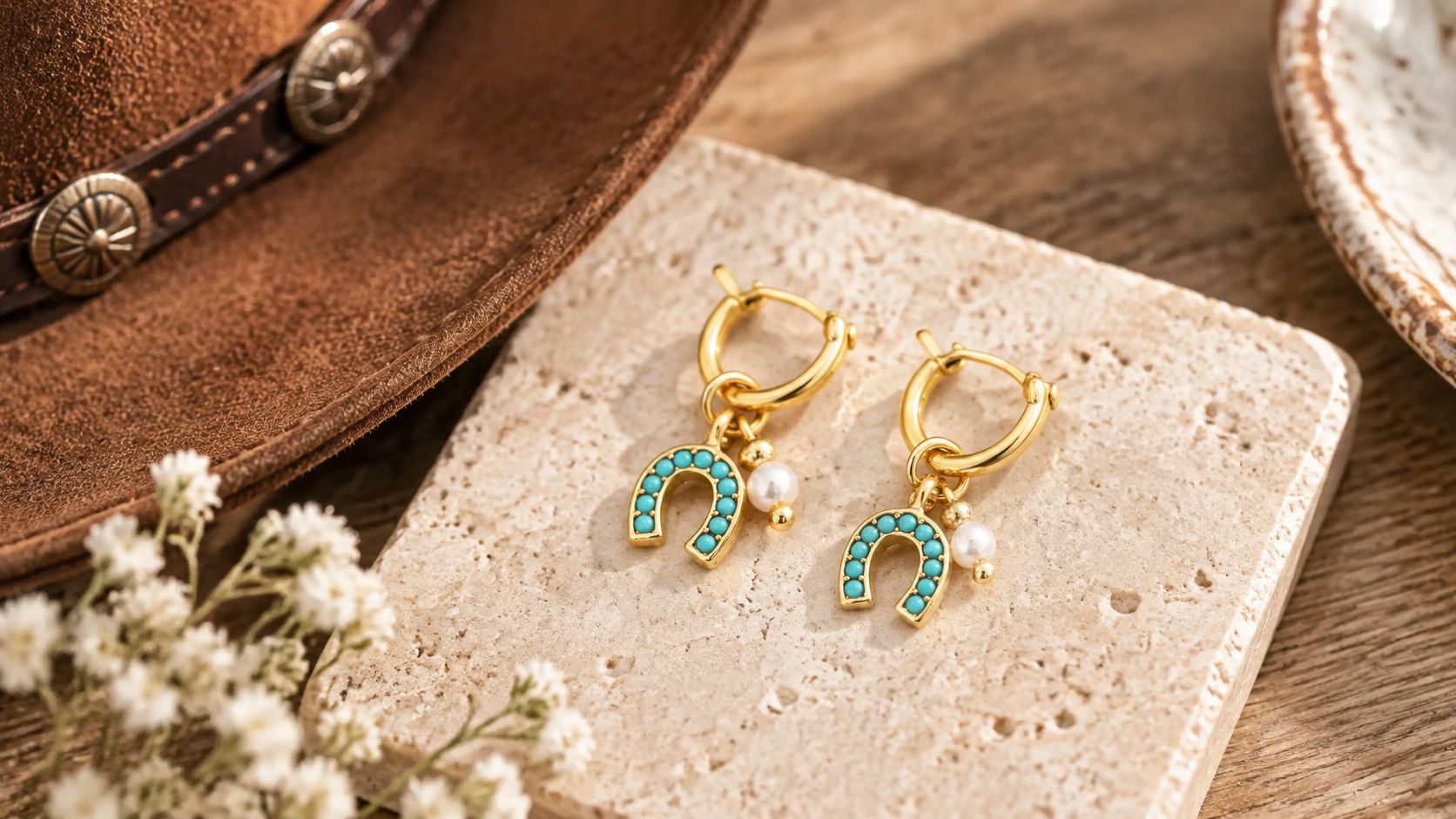
A non-ring option can carry the same equestrian imagery. The Turquoise & Pearl Horseshoe Earrings combine turquoise-studded horseshoes and pearl accents on gold-dipped hoops.
Buy for longevity, not a vague label
The Marketintelo sustainable-jewelry market overview places sourcing and material choices within a broader sustainability discussion. For an individual purchase, ask for specific evidence behind recycled-metal or sourcing claims rather than treating environmental language as proof of quality.
Repairability, disclosed composition, and a design you'll continue wearing are useful decision criteria. For plated pieces, request the plating specification and find out whether refinishing is possible. For sensitive skin, identify the base alloy as well as the visible finish.
Before ordering, confirm the metal identification, stone disclosure, setting condition, fit, and return terms. Our online-exclusive products with limited quantities can be returned or exchanged only according to our Refund Policy, so review those terms before choosing a size-dependent gift.
Bridle Up Hope Shop offers equestrian jewelry and horse-themed gifts in English and Western designs. Visit Bridle Up Hope Shop to explore pieces that reflect your connection to horses, then choose with the same attention to materials, fit, and everyday practicality that you'd give any well-used accessory.
Leave a comment