


You don't need fringe, turquoise jewelry, and a cowboy hat to dress Western. That familiar shopping list can distract you from what makes an outfit wearable: jeans that sit comfortably, a shirt that hangs well, and boots you can walk in. Modern Western outfits for women work best when you build around your proportions and routine, then add a distinctive detail rather than a complete theme.
A durable capsule gives you more freedom than a closet full of statement pieces. Start with clothes you already reach for, identify what fits, and use Western elements to add character without replacing your personal style.
Table of Contents
- Core Western Pieces and How They Pair
- Balancing Classic and Contemporary Pieces
- Fitting Western Staples to Your Body Proportions
- Choosing Western Boots by Toe Shape and Heel
- Buying New, Vintage and Secondhand Western Pieces
- Build Your First Modern Western Outfit This Week
Core Western Pieces and How They Pair
Use this formula today: one Western signal, one modern base, and one grounding layer. The signal might be embroidery or a tooled belt; the base could be a plain knit and dark jeans; the layer could be a clean-lined jacket. You're choosing a focal point, not assembling a costume.
Core Western pieces, classic versions and modern pairings
| Piece | Classic Western version | Modern pairing | Rule of thumb |
|---|---|---|---|
| Base top | Pearl-snap or plaid Western shirt | Fitted knit tee or silk blouse | Tuck only at the front with high-rise jeans |
| Bottoms | Bootcut or straight jeans | Wide-leg trousers or midi skirt | Pair denim with a structured top |
| Dress | Prairie or fringe-hem dress | Slip dress with denim jacket | Keep one Western signal per outfit |
| Outer layer | Suede or wool-blend jacket | Tailored blazer or cropped denim jacket | Cropped length works best with high-rise bottoms |
| Belt | Tooled leather belt | Thin leather or chain belt | Wear at the natural waist |
| Jewelry | Turquoise or horseshoe pieces | Simple gold hoops with one statement piece | One statement piece at a time |
| Hat | Felt cowboy hat | Straw or wide-brim hat | Use only with an otherwise minimal outfit |
Read the table from the top down as alternatives, not a list of things to wear together. A pearl-snap shirt can replace your usual blouse, while wide-leg trousers can replace jeans. Likewise, a slip dress with a denim jacket is a quieter alternative to a prairie or fringe-hem dress, not another dress to layer underneath it.
Let one detail lead
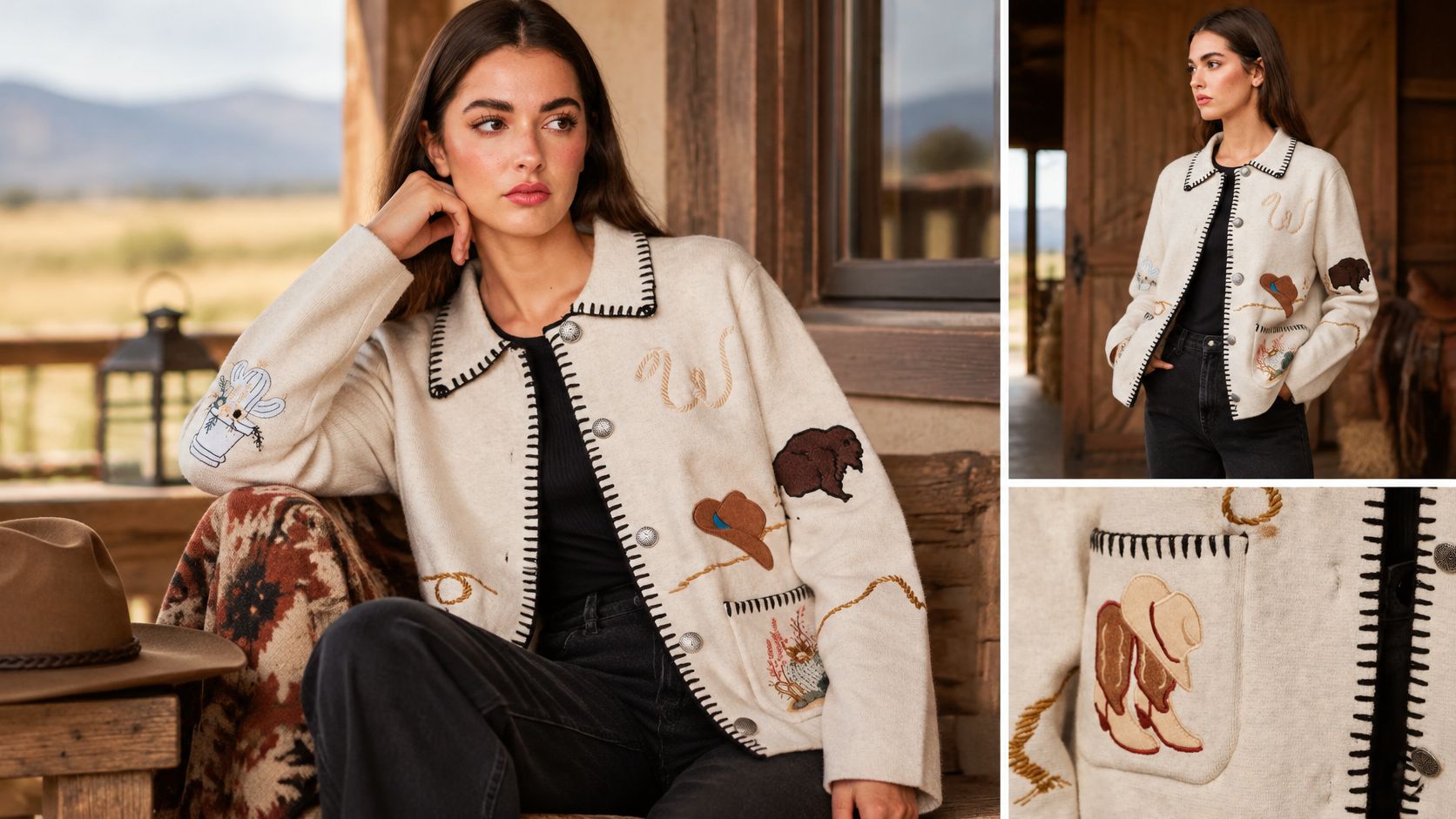
The Western Wool Sweater Jacket illustrates how an outer layer can provide the entire Western reference. Its cowboy hat, boot, cactus, bison, and rope embroidery gives you enough detail to work with over a plain knit. Keep the accompanying trousers and jewelry simple rather than repeating every motif elsewhere.
The embroidered layer is the focal point in this example.
Practical rule: A fringe belt over a white shirt and dark jeans reads as Western. Fringe, turquoise, and a felt hat together can read as costume when your intention is everyday dressing.
This isn't a ban on expressive outfits. It's a useful starting point when you're learning what feels like you. Before leaving the mirror, ask whether you can name the outfit's main Western signal in a word: embroidery, buckle, fringe, or hat. Footwear deserves a separate fit decision, not an automatic addition.
Balancing Classic and Contemporary Pieces
Start contemporary, then add character. A plain blouse or ribbed knit gives a detailed belt, boot, or jacket a quiet background. If a pearl-snap is your focal piece instead, these practical ideas for how to wear a Western shirt offer another starting point.
Balance works like seasoning: most of the plate is plain, and the strong flavor comes from a small share. Use a roughly six-parts-modern to four-parts-classic split by visible area as a rough guide you check in the mirror. Plain trousers and a simple top can occupy most of the outfit while a Western jacket supplies the detail. A small ornate buckle can attract more attention than its size suggests, so judge by eye rather than calculating percentages.
Work with texture and occasion
Contrast a smooth blouse with suede, denim, or wool knit. The difference makes the pairing look deliberate without requiring extra ornament.
For a laid-back travel example, tuck a plain ribbed knit lightly into the Western Cowboy Relaxed Pants, which have an elastic waistband, pockets, and a relaxed silhouette. A tooled belt and plain suede jacket can work if the belt sits comfortably without bunching the waistband. Treat the trousers as the focal signal and keep the other details quiet; remove the belt if it competes.
For office days, choose a structured blazer over fringe and limit the Western accent to a belt. Outdoors, prioritize dense, non-sheer fabric covering the shoulders and upper arms. The UPF classification accompanying AATCC's textile UV-transmission testing guidance identifies UPF 25–39 as very good protection; look for that band or higher for prolonged exposure, remembering that laundering and wear can change protection. Fashion styling doesn't replace activity-appropriate riding or workwear.
Keep these common mistakes in check:
- Matching denim everywhere: Break up identical washes with a plain layer in a different shade or fabric.
- Piling on hardware: A pearl-snap shirt already carries decorative snaps and yoke stitching, so pair it with a plain belt rather than a tooled one.
- Shopping for one event: Ask how you'll wear the piece afterward.
Use this visual reminder while getting dressed.
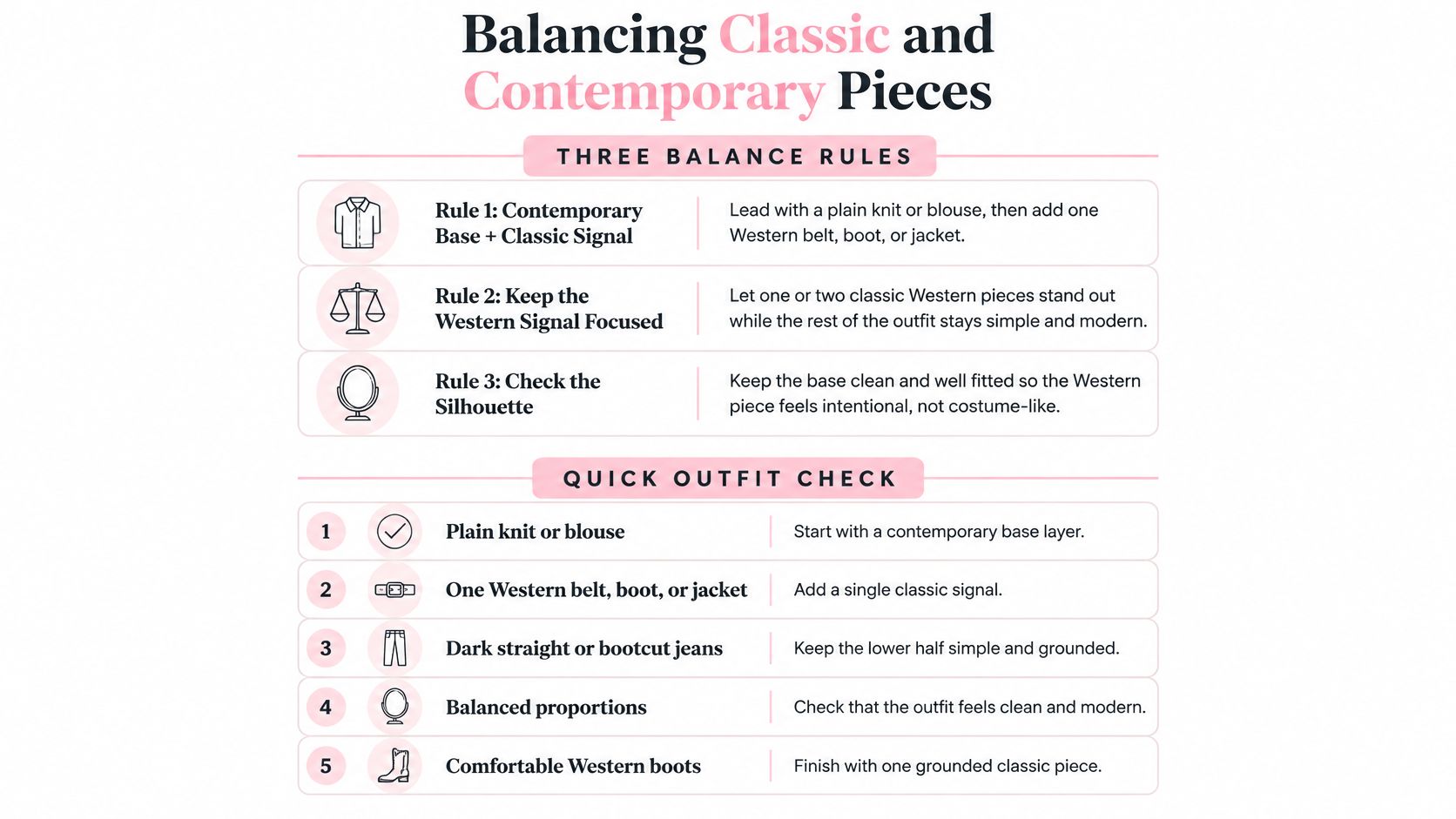
Before leaving, check: one Western signal; the six-to-four visual balance; texture contrast; fit at the hem and belt; sun or weather coverage.
Fitting Western Staples to Your Body Proportions
People with similar height and measurements can still need different jeans, shirts, and jackets. Size describes only part of fit. Where your waist sits, how much length you need through the torso, and where fabric pulls matter just as much.
Don't assume a runway silhouette is the standard you should reproduce. A Vogue Business review of 8,763 looks across 208 shows found 94.9% were straight-size and only 0.8% were plus-size. Use outfit photographs for ideas, not as proof that a garment should hang identically on you.
Measure before choosing a silhouette
Use a flexible tape, a mirror, and well-fitting trousers as a reference.
- Inseam: Measure along the inside leg from the crotch seam to the intended hem. Compare that length while wearing your chosen boots.
- Rise: Measure from the crotch seam to the waistband on trousers that fit. Check front and back separately when comparing garment measurements.
- Torso length: Measure from the shoulder near the neck, over the bust, to your natural waist. Tie a ribbon around your waist to mark the endpoint.
Western staples adapted to body proportions
| Proportion | Jeans fit | Tuck or hem | Belt and boots |
|---|---|---|---|
| Petite | Cropped or hemmed bootcut that clears the boot | Tuck short shirts, keep the hem above the hip | Slim belt, low-profile boot |
| Tall | Longer inseam, straight leg | Shirt hem to mid-hip, untucked if needed | Taller boot shaft, belt at natural waist |
| Long torso | High-rise jeans with a longer rise | Shirt untucked or with a longer hem | Belt at the natural waist, shorter jacket |
| Fuller bust | Mid-rise bootcut with stretch | Open-collar shirt with structured yoke | Belt above the hip, no strained buttons |
| Pear shape | Bootcut with room through the hip | Fitted or yoked top, tucked lightly | Jacket ending below the hip, medium boot |
| Athletic build | Straight leg with defined waist | Tuck full shirts, define the waist | Defined belt, boot with a clean shaft |
Treat these as fitting experiments, not rules for correcting your body. A petite person with a fuller bust might combine a shortened trouser hem with an open-collar shirt. A tall person with a long torso might need both a longer inseam and a higher rise.
Test drape as well as size
A shirt should fall without pulling across the bust or collecting in a thick waistband fold. For a visual explanation of how loose fabric hangs, Display Guru's resource lets you check fabric drape on tailor dummies; follow that with a seated and moving try-on on your own body.
Finish with a practical test: the belt should sit where your waist is. The boot shaft should end below the knee along a comfortable part of your calf, without pinching, and sit cleanly beneath the hem you intend to wear.
Choosing Western Boots by Toe Shape and Heel
Begin with function: the boot should feel snug across the instep and secure at the heel while your toes can move. Slight initial heel slip can be normal as the sole flexes, according to Ariat's first-time buyer's guide to women's Western boots. That's different from a foot sliding forward or a heel lifting so far that walking feels unstable.
Try boots with the socks you'll wear, and walk rather than judging them while seated. Check both feet, bend your knees, and notice whether the shaft rubs when you take a full stride.
Western boot choices by day and look
| Look | Toe shape | Heel | Shaft and pairing |
|---|---|---|---|
| Daily denim | Square toe | Low block heel | Short or mid shaft with cropped or bootcut jeans |
| Long standing or travel | Square toe | Broad walking heel | Shorter ankle boot with dresses or skirts |
| Dressier evening | Round or almond toe | Taller angled heel | Tall shaft with straight-leg trousers |
| Traditional Western | Pointed or round toe | Riding heel | Tall shaft with bootcut jeans |
| Occasional fashion wear | Any comfortable toe | Any manageable heel | Lighter cemented sole; generally not intended for resoling |
Compare comfort with construction
Square toes generally provide more spreading room, while round and almond shapes create a narrower visual line; heel shape also affects stability, as outlined in this women's Western boot comparison. Shape alone doesn't guarantee fit, though. A narrow square-toe boot can still squeeze, and a well-sized almond toe may suit you comfortably.
For daily denim, start with square toes and lower block heels; for dressier looks with less walking, consider narrower toes and taller heels. A traditional riding heel gives a sharper Western profile, but it may feel less relaxed on pavement.
Choose the boot for the day you'll actually have, not just the photograph you want.
Stitched or welted construction may allow resoling; confirm serviceability before treating a pair as a long-term investment. Cemented boots can suit occasional fashion wear, but don't assume repair options are equivalent.
If you prefer a shorter shaft, explore Western-style ankle boot pairings. For a dressier alternative outside the cowboy silhouette, Alexander Noel's wingtip boot guide offers a useful comparison. Choose boot height alongside the dress, skirt, or trouser silhouette, never in isolation.
Buying New, Vintage and Secondhand Western Pieces
A small wardrobe you wear constantly beats a large one you rotate through once. Put your budget into repeat-wear foundations: well-cut denim, a structured shirt, durable boots, and a jacket that works with your existing clothes. Statement accents earn their keep only after those foundations can carry them, so buy fringe or a bold accessory when it fills a styling gap you've noticed.
Secondhand shopping is already familiar to many buyers: a 2024 U.S. study published in Scientific Reports found that 69.4% of respondents had purchased secondhand clothing. The study also noted return problems, particularly online, so measure first and treat the lower price as a bonus rather than the reason to buy.
Choose the buying route by the item
- Buy new for exact requirements: Prioritize this route when you need a particular inseam, dependable boot fit, or clearly documented construction.
- Buy vintage for character: Inspect jackets, belts, and boots for sound seams, flexible leather, and working fastenings. This guide to vintage leather boots provides a focused starting point.
- Buy secondhand for experiments: Try an unfamiliar silhouette or seasonal accent without committing your main wardrobe budget.
Before ordering, compare inseam, rise, and torso measurements with the seller's garment measurements, and read the return terms. Ask for missing measurements instead of guessing from the size tag. For online-exclusive pieces in limited quantities, check the policy first: Bridle Up Hope Shop accepts returns or exchanges on those items only under its Refund Policy.
Build combinations, then maintain them
Here is the arithmetic behind a small wardrobe. Take one pair of jeans, a skirt you already own, a blouse, a jacket, a hat, and a piece of jewelry. Two bottoms, multiplied by two ways to wear the blouse (alone or jacketed), multiplied by three finishes (no accent, the hat, or the jewelry) gives you twelve combinations from a short shopping list. Each piece does several jobs, and that is the true return on a considered purchase.
Care keeps those combinations available:
- Denim: Wash when dirty or odorous rather than automatically after every wear.
- Leather: Clean gently and use a conditioner suited to the finish.
- Hardware: Replace worn buckles or fastenings before they make an item unusable.
- Felt hats: Store supported on a shelf, never folded or crushed.
Build Your First Modern Western Outfit This Week
Start with a plain structured shirt or knit, dark straight or bootcut jeans matched to your measured inseam, and a belt at your natural waist. For daily wear, try square-toe boots with a low block heel. Add a statement piece only if the outfit still has one clear focal point.
That combination works like a control group in an experiment: change one variable at a time and you can see exactly what each piece contributes.
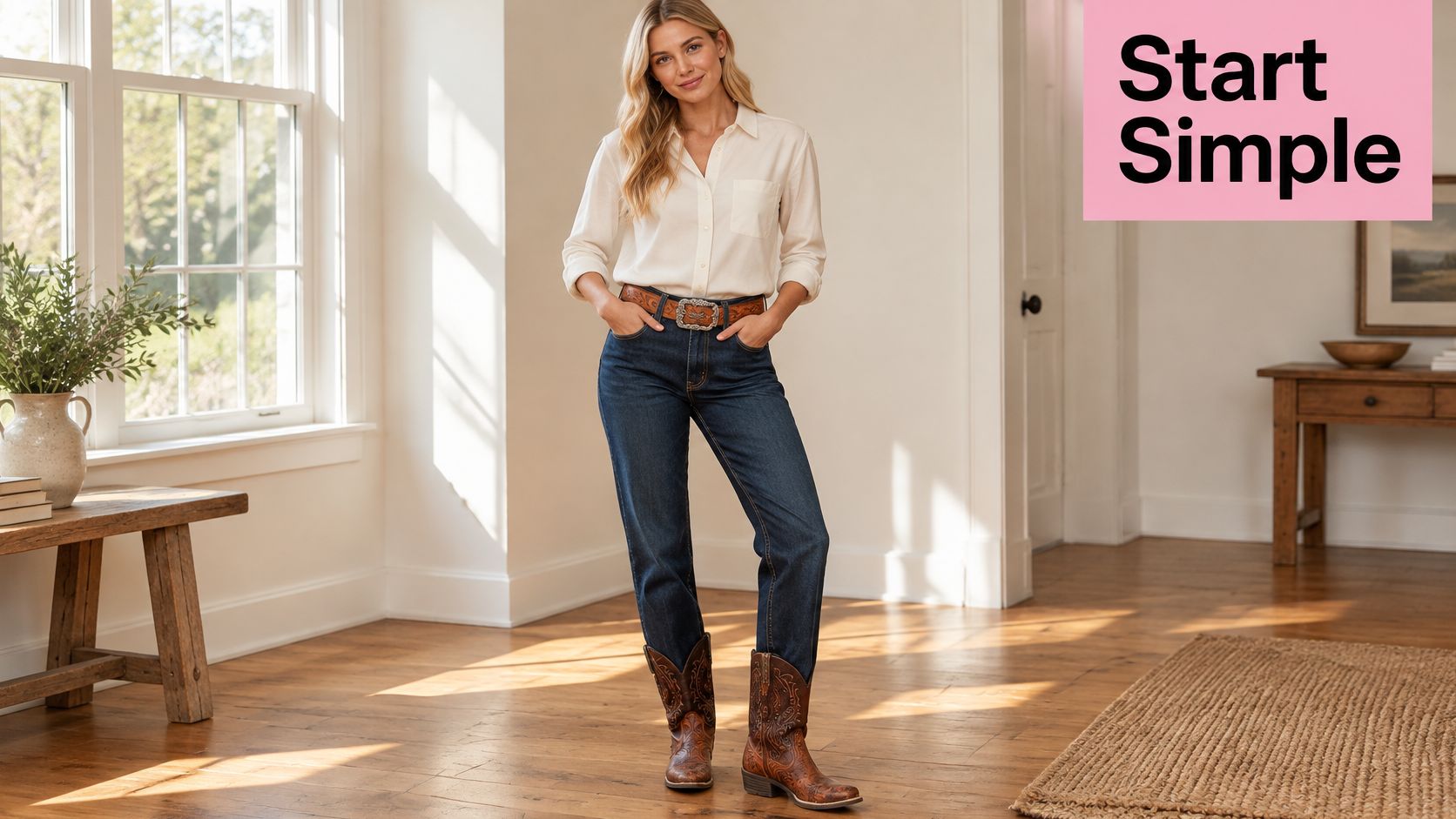
Make the purchase earn its place
Before buying, test the boot's instep and heel security, then name the Western signal each candidate piece carries. Fringe and turquoise are options, not requirements; a boot shape, a buckle, or a tooled texture can do the same job. If you cannot name the signal in a sentence, remove an accessory before adding another.
The Silver Filigree Buckle Tooled Western Belt can serve as that single focal detail, so the rest of the outfit stays plain. If a knit suits your routine better, the Equine Embrace Jacquard Sweater at $68.00 gives you a concrete figure to budget against, while the Vintage Horse Hat at $28.00 shows how a smaller accent can still anchor a look without straining the budget.
Buying checkpoint: Photograph the proposed purchase with clothes you own before deciding whether it fills a real gap.
For an evening involving dancing, test movement as carefully as appearance. You can browse swing dance clothing tips from Danza Academy of Social Dance for occasion-specific considerations rather than assuming everyday boots suit every dance floor.
Use the video as another visual reference, then test your own outfit while sitting, walking, and reaching.
Check our Refund Policy before purchasing. Online-exclusive products with limited quantities can be returned or exchanged only according to that policy.
For the coming week, choose an outfit each day using only pieces you own. Photograph what feels comfortable, note any genuine gap, and make a purchase only when you can show that it creates at least two new looks.
Bridle Up Hope Shop offers women's clothing, jewelry, and accessories in English and Western styles, including pieces you can combine with everyday basics. Visit Bridle Up Hope Shop with your measurements and outfit photographs ready, and choose a piece that earns a place in your capsule.
Leave a comment