


Your boots are still dusty when you drop your ring into the dish by the kitchen sink. By morning the band wears a grey film, and the silver horseshoe pendant that was bright at breakfast looks flat against your sweater.
That's barn life leaking into your jewelry. Sweat, dust, fly spray, sunscreen, hose water, and a tack room that holds moisture all season leave a film on metal that keeps working on it long after you've untacked. The box you drop things into is part of that chain, not a decorative object sitting apart from it.
Choice has grown fast in that corner of the market. A 2023 industry report valued the worldwide jewellery-box market at approximately USD 168 million in 2022 and projected it to reach USD 244 million by 2030, a compound annual growth rate of 5.5% from 2023 through 2030, according to SkyQuest's jewellery box market report. More products to sort through, and more ways to buy the wrong one. So treat an equestrian jewelry box as riding gear: something that has to survive handling, keep metal dry, and hold up inside a tack bag.
Table of Contents
- Buying Checklist for an Equestrian Jewelry Box
- Design Styles From English Tack to Western Motifs
- Compartment Layouts for Each Type of Jewelry
- Protecting Silver From Barn Humidity and Tarnish
- Matching the Box to the Person Who Opens It
- Child Safety and Small Parts
- Confirm Your Storage Needs Before You Buy
Buying Checklist for an Equestrian Jewelry Box
After a ride, a chain dropped beside a ring can knot or scratch before you remember to put everything away. Check how a box separates pieces, closes, and handles daily use before choosing one for its decoration.
| Criterion | What to look for | Why it matters |
|---|---|---|
| Compartment mix | Ring slots, earring cups, necklace hooks, and a padded tray | Keeps pieces from tangling and scratching each other |
| Closure | A lid that stays shut when carried | Helps prevent jewelry from spilling during travel |
| Size | Space suited to the pieces you plan to store | Avoids crowding a small collection or leaving a larger one without room |
| Lid clearance | Enough depth for tall bracelets and watches | Prevents pieces from being pressed under the lid |
| Finish | A surface that can be wiped clean and holds up to handling | Makes it easier to remove dust and everyday residue |
Look inside with your own jewelry in mind. A shallow box can suit rings and earrings, while chains need separate hooks or spaces to keep them from tangling. If you plan to carry the box, check that the lid closes securely and that pieces cannot shift into one another.
Count the types of jewelry you want to store, not just the pieces. Six separate spaces may serve a mixed collection better than one deep compartment, even if the larger compartment looks roomier. Check the interior, closure, and finish together: a secure lid is less useful if everything inside slides into a knot.
For barn-to-bedroom storage, keep the box in a dry room rather than leaving it in a humid tack area. Wipe dust and residue from jewelry before putting it away, then close the box so it is ready for the next wear. A box used for travel should stay latched when packed beside riding gear.
Design Styles From English Tack to Western Motifs
After a dusty ride, a jewelry box moves from barn air to a bedroom dresser. Its style can mark a rider's taste, but the design should also feel at home in the room where it will live.
Horse imagery on jewelry boxes has signalled craft and status for centuries. The Walters Art Museum's jeweled bonbon box was designed by French luxury firm Boucheron in the tradition of the eighteenth-century snuffbox and dated to the eighteenth or nineteenth century. Diamonds form a hunter, two hounds, and a carriage drawn by four horses, set against rock crystal over painted gold relief. Henry Walters acquired it in Baltimore in 1927, and it entered the collection through his bequest in 1931.
That history helps explain why a small motif can carry several associations at once: travel, sport, and family tradition.
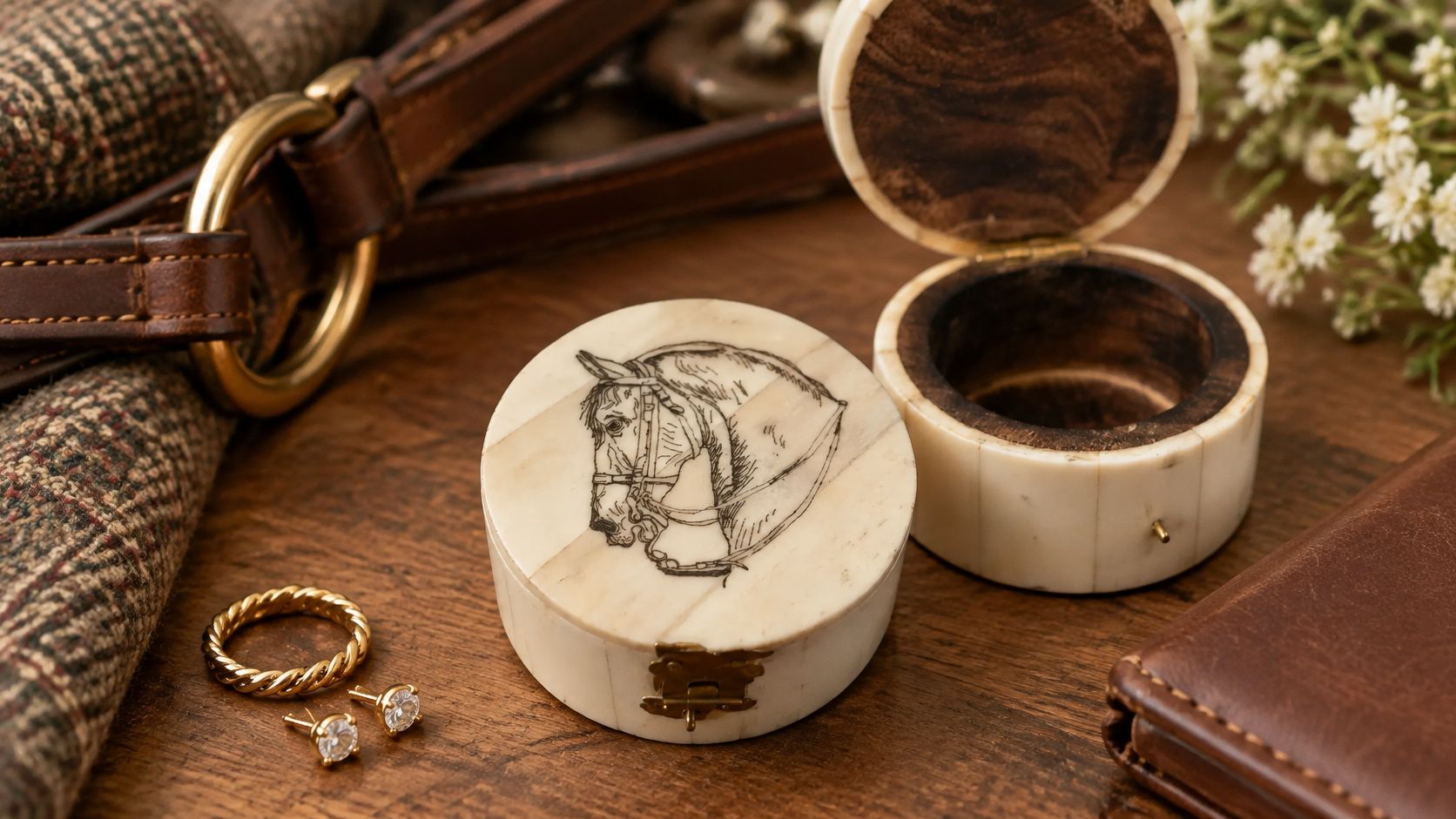
English tack-inspired designs often use compact images of bits, stirrups, snaffle rings, and horseshoes. Western motifs tend toward broader patterns, such as tooling and bolo-tie shapes. Fine-art horse portraits place the horse at the center, making them a natural choice for someone who loves horses whether or not they ride.
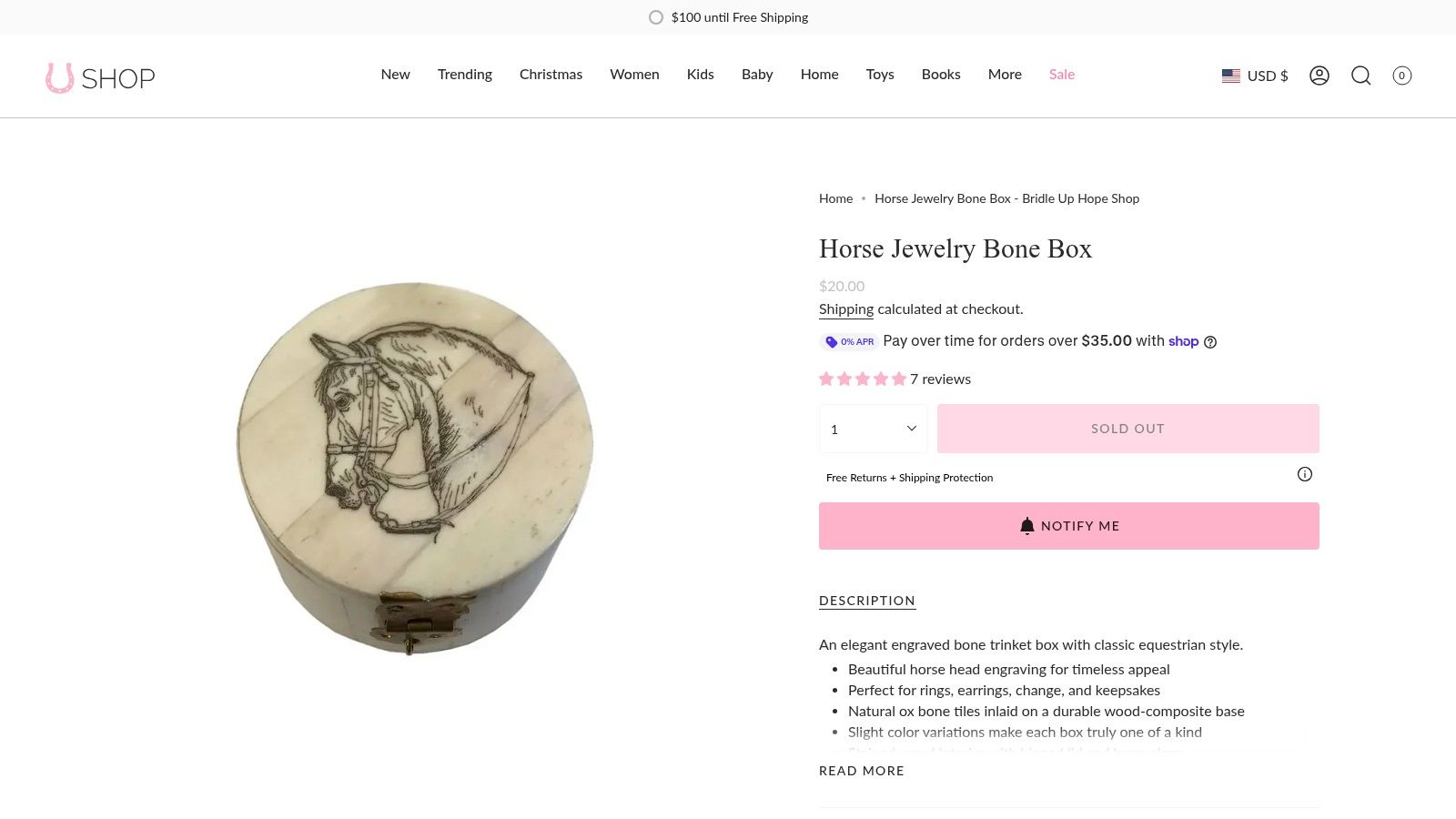
Choose a motif by matching its visual weight to the room. A small tack-inspired detail can suit a restrained dresser, while a portrait can make the box read as decor. The Horse Jewelry Bone Box and Horse Portrait Trinket Box offer examples of these distinct looks; check the product listing for the details that matter to you rather than assuming a material or finish from the style alone.
For inspiration beyond storage, horse jewelry for women shows how equestrian motifs appear in wearable pieces. Try this simple check: place a picture of the box beside the dresser or shelf where it will sit, and see whether its motif and visual scale fit the room.
Compartment Layouts for Each Type of Jewelry
After a ride, a necklace can carry dust and a little sweat from the day. Give each piece its own place before the next outing, so chains do not knot and metal parts do not rub against one another.
| Jewelry type | Best compartment | Mistake to avoid |
|---|---|---|
| Rings | Individual slot or ring roll | Loose in an open tray where bands scratch |
| Earrings | Separate cup or card with post space | Tossed together so posts tangle |
| Necklaces and chains | Suspended hook or hanging bar | Knotted in a flat well |
| Bracelets and bangles | Shallow tray or sleeve | Stacked directly on bare metal |
| Brooches and horse-bit pendants | Padded shallow tray | Pressed under heavier items |
| Watches | Padded slot away from metal fittings | Strap resting against silver pieces |
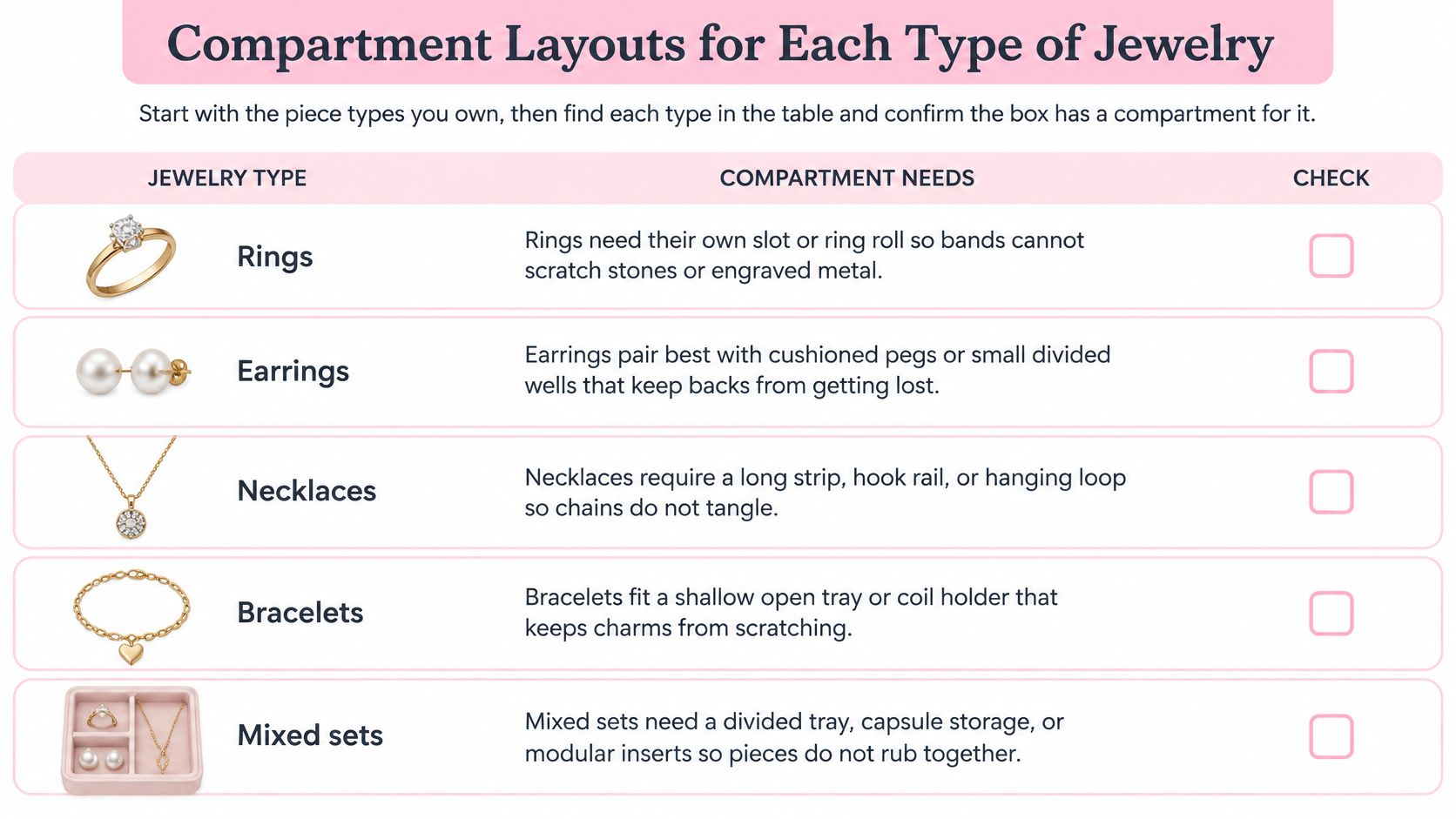
Separation does most of the work. Tiffany's guidance on storing silver recommends tarnish-resistant lining and a separate space for each piece. It also warns that rubber products can tarnish and corrode metal, and advises keeping silver dry. Keep that material warning in mind when choosing a box; humidity and silver care are covered in the next section.
At home or in a store, test the layout by gently tipping the box from side to side. If a chain can slide into a ring slot, it may snag or scratch; removable dividers let you adjust the arrangement as your collection changes. For a barn-to-bedroom routine, return each piece to its compartment after riding, then keep the closed box in a dry bedroom rather than leaving it with dusty tack.
Protecting Silver From Barn Humidity and Tarnish
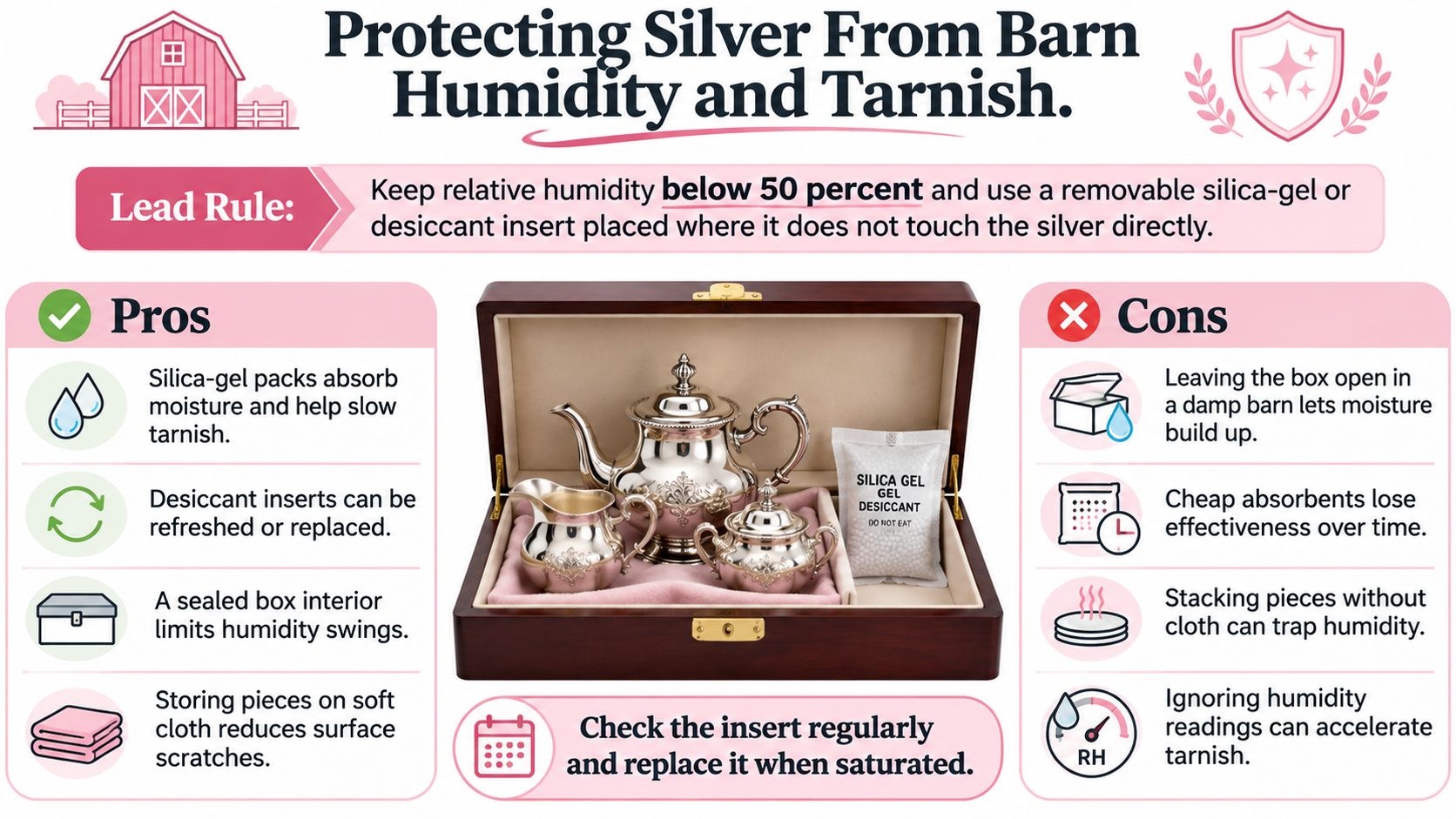
One number drives silver storage: keep relative humidity below 50 percent. The Canadian Conservation Institute guidance on silver tarnish explains the mechanism. Water adsorbs onto the silver and forms a surface film that helps hydrogen sulfide and other sulfur compounds react with the metal, producing silver sulfide, which is tarnish. Raise the humidity and you speed the reaction up.
Which makes a damp tack room a worse home for a silver pendant than a bedroom dresser. A box with a replaceable silica-gel compartment or desiccant insert gives you a buffer, but sealing a box airtight traps damp air inside unless you control the moisture load first. Metal bits, stirrups, horseshoes and engraved silver motifs make this urgent, because tarnish settles into crevices where you can't remove it without risking the plating or the patina.
| Material | Use for silver | Avoid |
|---|---|---|
| Acid-free tissue and acid-free boxes | Wrapping pieces and lining the box | Untreated paper or cardboard |
| Tarnish-inhibiting cloth | Lining compartments and wrapping silver | Rubberized liners or untreated foam beneath it |
| Polyethylene or Mylar bags | Sealed protection when humidity is controlled | Trapping damp air inside |
| Silica gel or desiccant insert | Keeping relative humidity below 50 percent | Placement where it touches jewelry |
| PVC, newspaper or untreated foam | None; keep out of the box | Sulfur release and accelerated tarnish |
| Rubber bands and rubberized inserts | None; keep out of the box | Sulfur that tarnishes and corrodes metal |
The Barn to Bedroom Routine
- Wipe before you box. A soft dry cloth lifts sweat, dust and fly spray residue before it dries onto the surface.
- Let pieces dry completely. Metal put away damp keeps the water film that starts the whole reaction.
- Separate on the way in. Loop chains on their own hook and drop rings into slots, even when you're tired.
- Move the box out of the damp. A bedroom shelf beats a tack-room bench or a trailer shelf that sweats overnight.
Tarnish itself doesn't damage the metal, and Winterthur Museum's silver treatment advice notes it doesn't need to be polished off before storage. Polishing every time you open the box is wasted effort and wears plating thin. Bullion and coin collectors handle the same chemistry at larger scale, and Carat 24's guide to storing silver coins is a useful companion read on containers and handling.
Pieces that sit against skin pick up the most, so sterling like silver horseshoe earrings benefits most from the wipe-and-dry habit.
Matching the Box to the Person Who Opens It
A box that travels in a grooming tote has different demands from one kept beside the bed. Start with the recipient: a child beginning lessons, a competitor with a ribbon collection, a rider with limited hand strength, an older person downsizing, a weekend hacker, or a horse lover who has never ridden. Choose for the person's routines, not just the horse on the lid.
British Equestrian's 2025 participation findings report that women represent 85% of riders, approximately 18% of participants have a disability or long-term health condition, and 14% come from lower-socioeconomic groups. Those figures are a reminder to consider varied needs and circumstances when choosing a gift.
For someone with limited dexterity, look for a lid that lifts with one hand or has a finger notch, drawers that slide without a hard grip, and compartments wide enough for chunkier adaptive pieces. A catch that requires a firm pinch can turn daily use into a struggle.
For a child, fixed compartments and a secure closure help keep belongings organized. For a non-rider, portrait art or a quieter finish may suit a hallway table better than a box styled like a piece of tack.
A jewelry box can also mark a first lesson, a family horse, a recovery, or a memorial charm. That meaning belongs alongside practical needs. Premium should mean well made and easy to open.
Use the three questions from the buying checklist as a final filter: who opens the lid, how often, and whether the box leaves the house. A traveling box benefits from a clasp and compact footprint; a bedside box can make room for more compartments. For someone with arthritic hands, an easy-opening lid may matter more than elaborate decoration.
Child Safety and Small Parts
Nothing about a pony engraved on a lid makes a box safe for a toddler. The federal small-parts ban is codified at 16 C.F.R. part 1501 and applies to children's products intended for children under three when small parts create a choking, aspiration or ingestion hazard, as the U.S. Consumer Product Safety Commission explains. A small part is defined by whether it fits entirely, without compression and in any orientation, into the prescribed small-parts cylinder, which approximates the fully expanded throat of a child under three. Products containing relevant small parts may also need age-warning labels.
Apply that to a horse-themed box and the inspection list is concrete. Detachable charms, beads, miniature horse figurines, removable clasps and loose decorative pieces all fall inside the rule's reach. Check the feet, the hinges and any glued-on ornament as well, because a piece that pulls free after a month of use is the same hazard as one designed to come off.
A horse theme signals who the box is for. It says nothing about whether the box is safe for a three-year-old.
There's a second layer beyond choking. The CPSC's guidance on children's jewelry lists hazards including cadmium exposure from mouthing or swallowing small metal components, chemicals in paints and surface coatings, nickel sensitization, magnets, batteries and strangulation. It also notes that whether an item counts as children's jewelry depends on sizing, themes, marketing, packaging, appearance, and the dexterity needed to wear it, not just on what the seller calls it. A box styled for kids can be treated as child-directed on presentation alone.
The practical rule is simple. Keep adult storage with small detachable pieces out of reach of toddlers, and for any child's box choose secure closures and fixed compartments over loose charms. If you're shopping for a young rider, horse gifts for kids work far better when the box itself has nothing that comes off in a small hand.
Confirm Your Storage Needs Before You Buy
A jewelry box that works at home also needs to suit the journey from barn to bedroom. After riding, wipe sweat and dust from jewelry before storing it, then close the lid to limit exposure to room humidity. Keep the box in a dry spot rather than beside damp riding gear.
Let your daily routine set the box's size. If you carry a few pieces between home and the barn, choose a compact box that keeps them from shifting. A larger collection needs enough separate compartments to stop chains tangling with bracelets and rings. Leave room for the pieces you wear, rather than buying extra space that makes small items harder to find.
Bridle Up Hope Shop is a gift shop for horse lovers, with English and western designs. At the end of every year, it donates 100% of its profits to Bridle Up Hope, a charity that supports girls and women through horses and habits.
Before ordering, check the box's dimensions against the space where it will live and the jewelry you plan to store. If that spot stays humid, use a desiccant insert and replace it as needed. The routine is simple: clean and dry each piece after riding, store it in its own compartment, and keep the closed box away from damp tack.
Bridle Up Hope Shop carries horse-themed jewelry boxes, apparel, home goods and gifts in English and western styles. Browse the Bridle Up Hope Shop for current offerings. At the end of every year, 100% of the shop's profits go to Bridle Up Hope.

Leave a comment