


You're comparing two horse sticker packs: one has big, simple ponies, while the other has tiny glittery saddles and raised decorations. Both may look fun, but the better choice depends first on your child's age, how the stickers are made, and what they might do with them. Start with those checks, then choose a horse design your child will enjoy.
Table of Contents
- Choose Horse Stickers by Age First
- Sticker Materials and How Strongly They Stick
- Safety Checks Before You Buy for Young Children
- Horse Designs and Themes Children Actually Love
- Caring for Stickers So They Last Longer
- Creative Ways to Use Horse Stickers
- Confirm Your Pick Before You Buy
Choose Horse Stickers by Age First
| Age band | Sticker format | Suggested size | Peel strength | Supervision |
|---|---|---|---|---|
| Under 3 | Large, flat, single-layer vinyl or paper with no loose parts | Wider than 32 mm in two directions as practical shopping guidance | Low to medium, easy for small fingers | Adult within reach at all times |
| 3 to 4 | Medium single horses or simple scenes on peel-and-place backing | Roughly 3 to 6 cm | Medium | Adult nearby, checks small pieces |
| 5 to 7 | Detailed horse and tack sheets, some foil or light texture | Roughly 2 to 5 cm | Medium to high, for careful placement | Occasional check-ins |
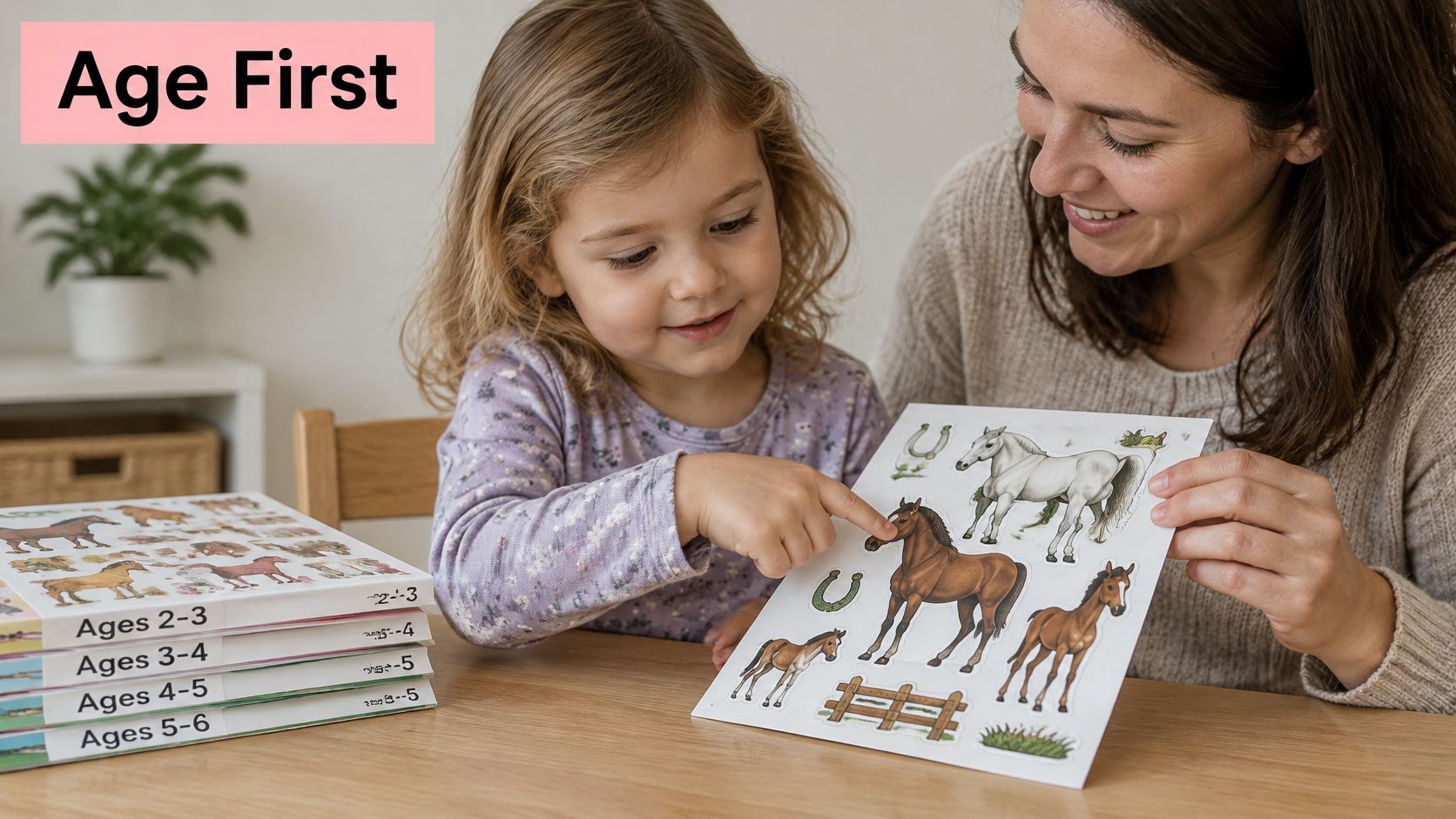
The size suggestions are practical shopping guidance, not legal thresholds. What matters for safety is whether small pieces can detach and whether a product is appropriate for the age stated on its packaging. The safety checks below explain how to assess that.
For a child under three, favor stickers that are large, flat, and made as a single piece. A simple horse silhouette is easier to grip and position than a sheet of tiny horses with separate decorative details. Keep an adult within reach throughout the activity, even when the stickers appear uncomplicated.
Children aged three to four may be ready for medium-sized horses or simple scene stickers, but an adult should still check the pieces and stay nearby. Older children can usually manage smaller, more detailed designs with occasional check-ins. Age is a starting point, not a guarantee of what any particular child can safely handle.
Quick phone summary: Under three means large, single, and no loose parts. Ages three to four means medium-sized, with a small-parts check. Ages five to seven means detailed designs, with occasional supervision.
Use this order when shopping: choose the age band first, then the material, then the theme. That keeps a charming picture from distracting you from the practical details.
Sticker Materials and How Strongly They Stick
Buyers who compare only the artwork often overlook what the sticker is made of. Material decides how easily a child can peel it, how well it holds up to handling, and whether it suits the surface underneath. The same horse printed on thin paper and on vinyl will behave very differently in a child's hands, so read the material line on the pack before the design wins you over.
| Material | Peel and stick | Durability | Best use | Watch for |
|---|---|---|---|---|
| Paper, matte | Low tack, tears if peeled quickly | Low to medium, fades in strong light | Scrapbooks, journals, cards | Tears, not suited to wet surfaces |
| Vinyl, gloss or matte | Medium tack, clean release | High, resists water and sun for months | Water bottles, lockers, laptop cases | Can be hard to remove from painted surfaces |
| Puffy foam | Medium to high tack, backing can lift | Medium, compresses over time | Decor and tactile play for older children | Small raised parts, not for under-3s |
| Glitter or foil | Check the backing and finish for loose material | Medium, glitter sheds | Cards and crafts | Shedding particles, supervise use |
| Static cling or reusable | Low tack, no adhesive residue | High if kept clean and dust-free | Windows, tiles, reusable play | Dust reduces grip, wash gently |
| Repositionable | Low tack, designed to lift and reapply | Low to medium, loses stickiness with repeated use | Learning boards and play scenes | Grip weakens after several reuses |
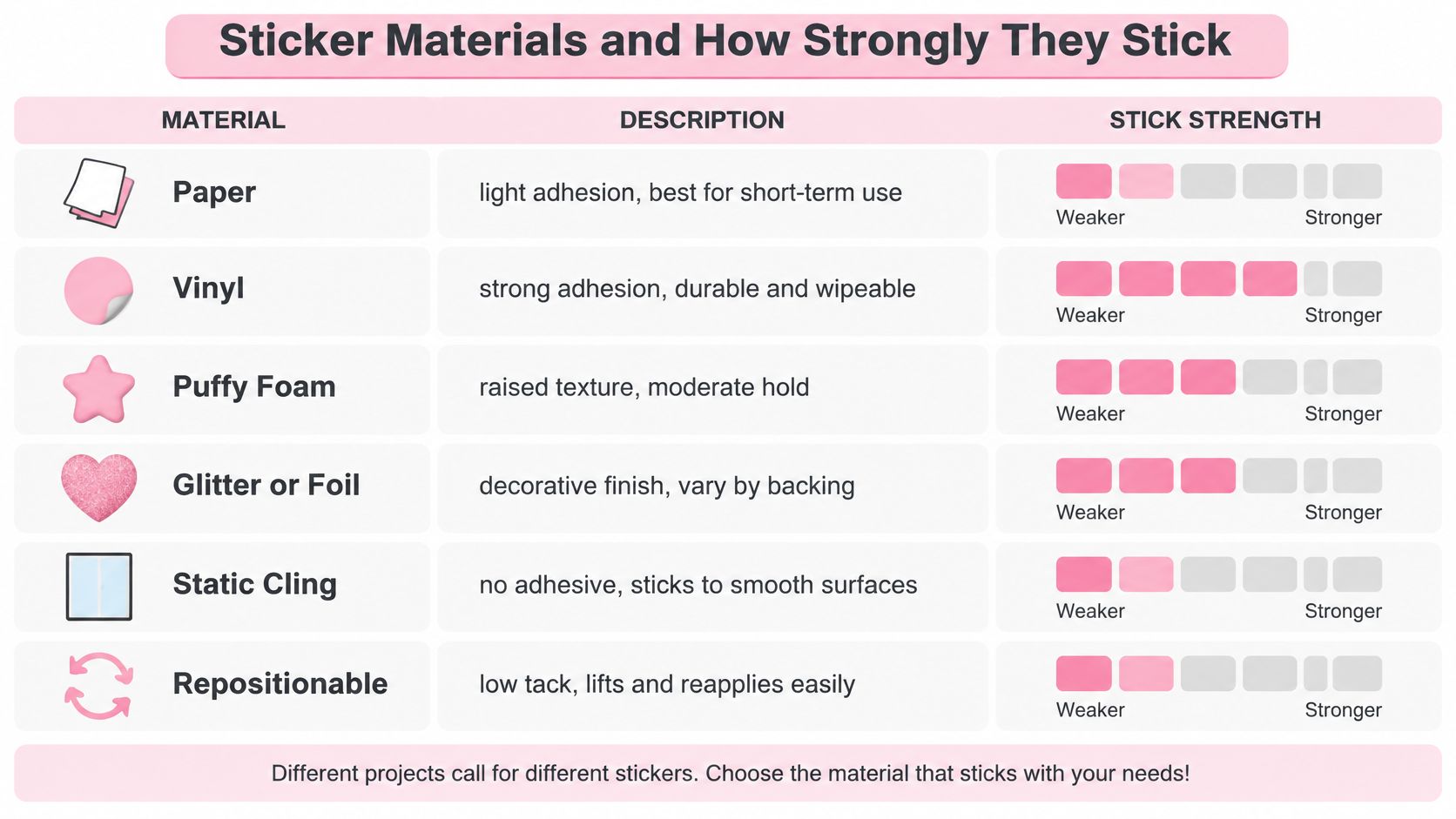
Adhesive tack means how firmly the sticker grips its surface, and both the adhesive layer and the backing material affect that grip. Tack works like a handshake. A light grip releases easily but may let go too soon, while a firm grip holds longer yet can pull paint or paper off with it when you finally separate them. That trade-off is why "sticks well" is only half the question. The other half is whether it comes off cleanly.
Test the peel before committing
Try one sticker on a hidden spot of the intended surface, such as the inside of a cabinet door or the back of a locker shelf. Leave it in place for a day, then peel it slowly. A sticker that releases cleanly without tearing or lifting the surface is a workable match. A sticker that shreds, or one that takes paint with it, tells you the adhesive is too strong for that surface or the sticker itself is too fragile for the job.
Size follows the same logic as material. Small, detailed horses suit scrapbook pages and journals, where a child can take time placing each image. Large single horses are easier to see and position on a locker or water bottle. Puffy foam and glitter add tactile and decorative appeal, but raised elements can catch and lift, and glitter tends to shed. Reserve those finishes for older children using them under supervision.
A workable shorthand is matte vinyl for school items, paper for craft books, and static cling for reusable play. Whatever pack you pick, three questions apply: What is it made of? How strongly does it stick? Can any part of it come loose? Those questions matter for a dinosaur sheet or a unicorn pack just as much as for horses, because the material decides the safety and the lifespan, and the theme only decides the smile. If you are weighing decals for a trailer rather than a child's craft surface, choosing horse trailer stickers raises a separate set of questions about outdoor placement and long-term durability.
Safety Checks Before You Buy for Young Children
Safety depends on whether a small piece can come loose and be swallowed or inhaled, not on the horse picture or the paper on the backing. A cheerful pony on the front of the pack tells you nothing about what happens when a toddler peels a gem off the sheet.
The U.S. Consumer Product Safety Commission (CPSC) defines a small part as an object that fits completely inside a standardized small-parts cylinder, a device designed to approximate a young child's airway. Products intended for children under three cannot contain small parts or produce them during reasonably foreseeable use and abuse testing. Products for children aged three to six may be allowed to contain small parts but generally need the prescribed choking-hazard warning. The CPSC's small-parts and choking-hazard guidance lays out these U.S. requirements.
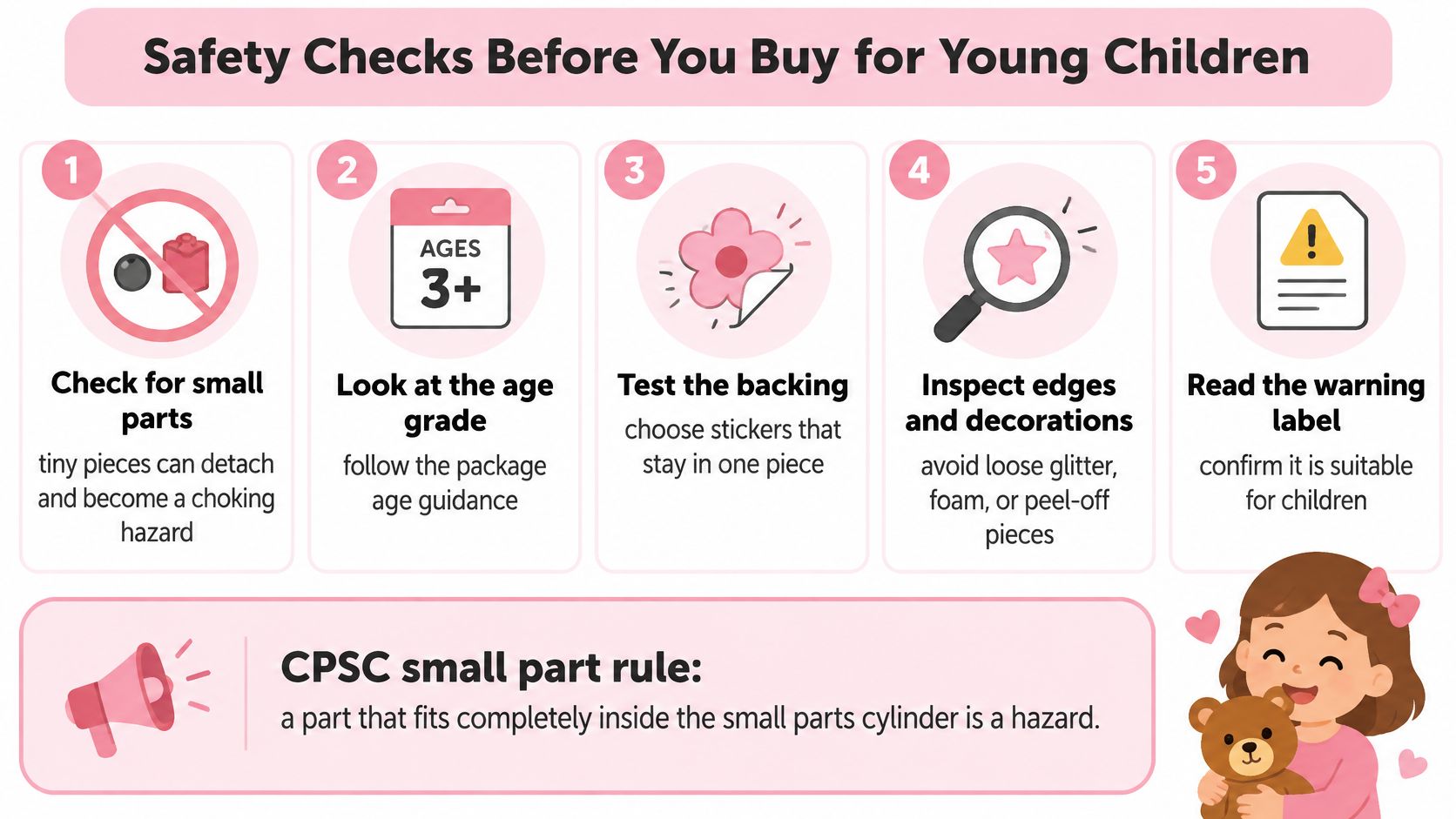
One short routine removes most of the guesswork. Run this checklist on the pack and, when possible, on a sample sticker. It works on any sticker pack, not only horse-themed ones.
- Read the age grade. Go by the package's stated minimum age rather than the theme or the look of the material.
- Inspect decorative extras. Look for loose glitter, raised foam emblems, peel-off charms, tiny gems, perforations, or small backing pieces.
- Peel one sticker slowly. The image, adhesive, and decorative layers should stay together as a single piece.
- Look for the choking warning. Products intended for children aged three to six that contain small parts should carry the prescribed warning, and warning requirements can also apply to advertising, not only packaging.
- Check the whole package. Clips, cardboard decorations, and other extras can pose a risk even when the stickers themselves are flat.
- Ask for documentation. If age guidance or materials aren't clear, ask the seller for safety information before buying.
Labels like "non-toxic" and "eco-friendly" sound reassuring but say little on their own. Ask for specifics about the adhesive, inks, backing, and testing standards, plus any relevant allergen considerations. Products intended for young children in the United States must be assessed in light of their stated age, marketing, and foreseeable use, not just whether the main sticker is paper.
Rules differ by market, so buyers outside the United States should check local requirements and the manufacturer's safety documentation. For background on choosing sizes and materials across sticker types, see this guide to sticker materials and sizing tips. If you're comparing stickers with other toddler activities, horse toys for toddlers can help you weigh age-appropriate options.
Horse Designs and Themes Children Actually Love
Children who enjoy collecting often want a set that feels complete. That appeal fits a long-running sticker tradition: organized sticker albums made collecting, searching for missing pictures, and trading duplicates part of the activity, as the history of stickers and sticker collecting describes. For a child who loves horses, a coherent theme family can make a small sheet feel like a world to explore.
- Breeds and foals. A pony, an Arabian, a Shetland, and a foal can make a varied set. Cartoon horses and foals often suit younger children, while a child who knows breeds may prefer realistic markings and proportions.
- Tack and equipment. Saddles, bridles, horseshoes, and halters work well for children interested in riding. Simple shapes are easier for younger children to recognize. Older children may enjoy stickers with more detailed tack.
- Places and scenes. A stable, pasture, show ring, or beach ride can turn a sheet into a story. Use a placement board or blank paper scene so the child can decide where each horse belongs.
- Art style. Cartoon, realistic, pastel, and sparkle designs each create a different mood. For sparkle finishes, check for loose decorative material before handing the sheet to a young child.
Match the designs to the child's horse world
English and Western tack aren't interchangeable details. English designs may show a snaffle bit or close-contact saddle, while Western designs use a different style of saddle and bridle. A child who rides may recognize the difference and have a clear preference. Matching the sticker sheet to a riding lesson, a favorite book, or a stable the child visits can make the pictures feel familiar rather than generic.
The artwork also affects how easily a sticker reads. Bold, high-contrast horses with simple outlines are easy to spot on a busy page or from across a room. Fine line art and pale colors can be attractive for older children who enjoy slower, detailed placement, but they may be harder for younger children to see and handle precisely.
Caring for Stickers So They Last Longer
A sticker sheet behaves a lot like a slice of bread: fine when stored flat and dry, ruined quickly by heat and damp. Store sheets flat in a resealable bag, away from radiators, humid bathrooms, and direct sunlight. Bent sheets curl at the edges, and heat or moisture can weaken the backing and adhesive before the stickers are ever used. Keep them on their original sheets until the child is ready for them.
The table below covers the surfaces parents ask about most. Read the middle two columns together: a surface that grips well is often the same surface where removal causes damage.
| Surface | Adhesion risk | Safe removal | Note |
|---|---|---|---|
| Painted walls | High, paint may lift | Warm gently, peel at a low angle | Test a hidden spot first |
| Glass and windows | Low | Warm water and soap, plastic scraper | Static cling works well here |
| Laptops and tablets | Medium, residue likely | Slow peel, then a gentle residue remover | Use reusable cling instead |
| Lockers and metal | Low to medium | Warm water and soap | Matte vinyl lasts longest |
| Wooden furniture | Medium, finish can dull | Slow peel, mild oil for residue | Test the finish first |
| Books and journals | Low, paper tears easily | Peel very slowly from one corner | Store flat to prevent curling |
Remove carefully and protect the surface
Warm an adhesive sticker slightly with a hairdryer on low, then peel it back slowly at a low angle. Pulling straight upward is the move that tears paper and lifts paint, so resist the tug even when the sticker seems loose. If residue remains, put a small amount of mild oil or a specialist adhesive remover on a cloth, test it on a hidden spot, and clean the area afterward.
How long a sticker lasts depends on both the material and where it lives. Matte vinyl on a water bottle may survive months of washing, while a paper sticker in a dry scrapbook can stay put for years. Puffy or glitter stickers gradually lose their raised look, so keep those for places where the flattening will not bother the child. For reusable stickers, wipe dust off the backing before resticking, since dust is what kills the grip.
Treat screens cautiously. Adhesive stickers leave residue on laptops and tablets, so reserve those surfaces for static cling. Glass windows and tiles are also good cling spots when the goal is removable play rather than permanent decoration.
One upkeep habit is worth building anywhere in the house: run a finger over stickers that get touched, walked past, or sat near every few weeks. Press lifted corners back down, and remove any sticker whose edge will no longer stay flat. On floors and stair treads especially, a curling edge underfoot is a trip hazard, so a sticker that has started to lift there should come off rather than get another chance.
Creative Ways to Use Horse Stickers
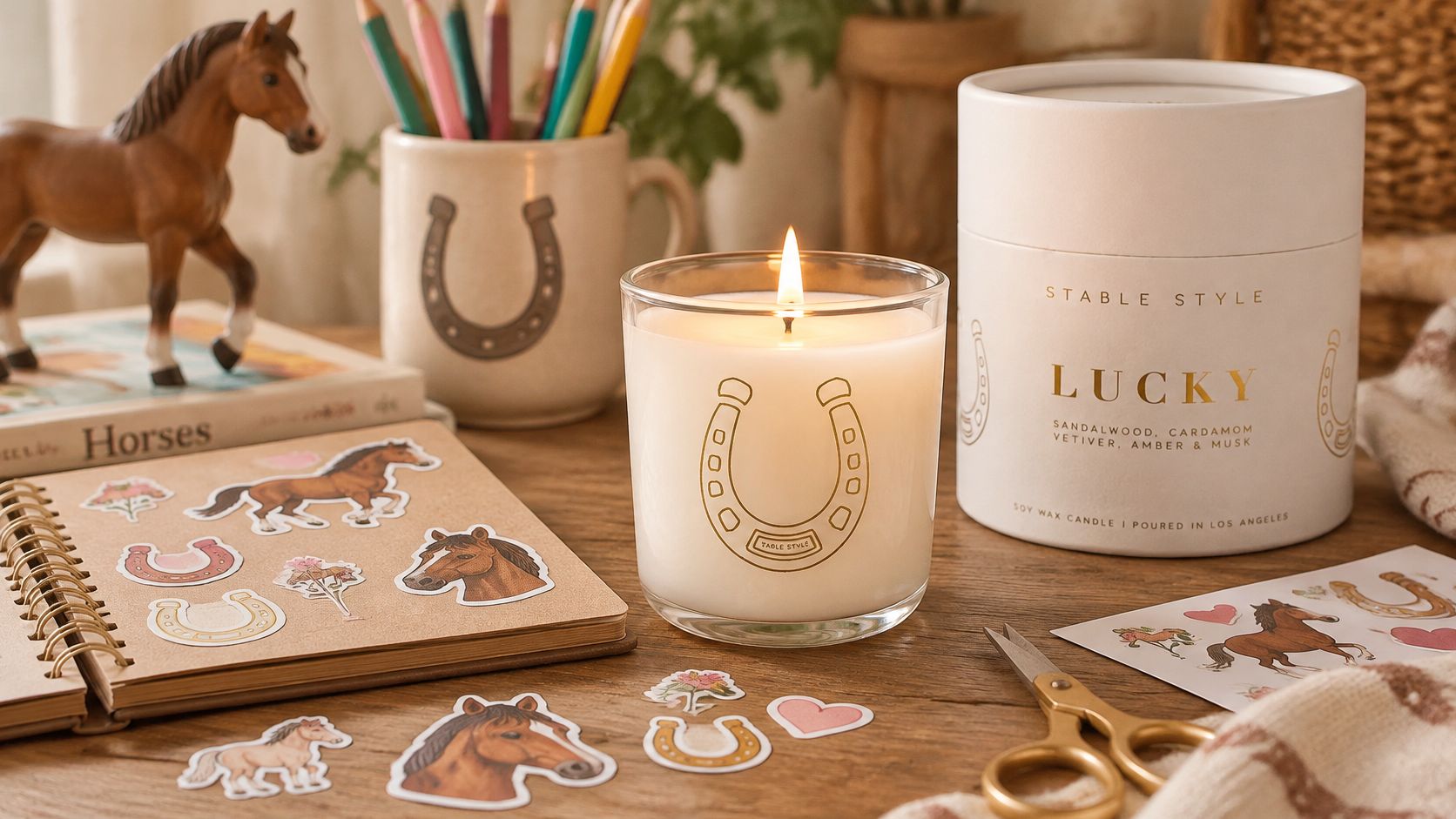
Your child wants a horse-themed bedroom, but you don't want to paint. Stickers can add small, changeable details instead. Try a line of horses along a door frame at the child's height, a trail of hooves across a window in static cling, or a stable scene arranged on the side of a bookshelf. Cling suits glass because it lifts away cleanly, while vinyl holds up better on furniture that gets touched and wiped.
For crafts, use horse stickers on bookmarks, greeting cards, or a paper stable scene. Give the child a blank sheet, a few paper strips for fences, and a small group of horse and pasture stickers, then let them arrange everything before pressing anything down. That dry run matters more than it looks, because paper stickers rarely survive a second peel. For a ready-made set to practice with, see the Eyelike Horses sticker book.
Make placement the activity
Peeling, orienting, and pressing each image onto a chosen spot uses finger control and visual-motor planning, so a sticker session can double as quiet skills practice. In a 2024 study of sticker-board activity with children aged five to six at Tunas Harapan Kindergarten in South Kalimantan, Indonesia, 93% of participating children reached a "Very Good Developed" score for correctly sticking pictures and the instructional medium received a 96% feasibility rating, according to the Journal of Early Childhood Care and Education study. Those results describe one activity and one group of children, so read them as encouraging rather than as proof that any sticker pack builds skills.
Match the task to the child's hands. Beginners do better with large, high-contrast horse silhouettes, while a more confident child can handle smaller stickers matched to printed outlines on a scene board. A stable, pasture, or riding ring gives the child a clear target without making the sticker itself harder to handle. Stay close enough to help if a sticker resists peeling or a decorative piece comes loose, since a detached piece small enough to swallow ends the activity for children under three.
Stickers also work as party favors. Slip one sheet into each treat bag with a short note, choosing flat designs with no add-ons for younger guests, and skip any pack containing small parts if children under three will attend. For the table itself, a long paper strip decorated with a horse trail makes a simple centerpiece. Apply stickers only to cups or plates that are dry and free of grease, since adhesive lets go on a slick surface.
Whatever the project, the same three checks decide which pack to buy: the right age band, a material matched to the surface, and nothing small enough to come loose. Those checks work on any sticker pack, whatever its theme.
Confirm Your Pick Before You Buy
Use this sequence to compare packs without getting distracted by the artwork:
- Confirm the age band. Start with the child's age and the format they can manage safely.
- Match the material to the job. Choose paper for a journal, vinyl for an item that needs more durability, or static cling for removable play on glass.
- Check the safety details. Read the age guidance and warnings, inspect the decorations, and peel a sample sticker to see whether anything separates.
- Choose the theme. Pick a breed, tack, setting, or style that reflects what the child likes.
- Test the peel. Try one sticker on the intended surface before applying a whole sheet.
For example, a four-year-old wants horses on a car window and a school folder. Choose a medium-sized, medium-tack matte vinyl pack without loose parts for the folder, then use a separate static cling sheet for the window. The cling can be removed from smooth glass without leaving adhesive residue, while the vinyl is better suited to a school item that gets handled.
Check each retailer's listing for current price, stock, material, and age guidance. This article doesn't confirm those details for any individual pack. Before you order, write the child's age band and intended surface on your shopping list, compare two options against the checklist, and choose the pack that passes every item.
Bridle Up Hope Shop offers horse-themed stickers alongside equestrian gifts, toys, books, and home goods, so you can compare options for a young horse lover in one place. Check the listing for the specific sticker's material and age guidance before buying by visiting Bridle Up Hope Shop.

Leave a comment