


You're comparing shirts online, and they all seem to have the same pointed yokes, chest pockets, and snaps. But a shirt made for barn chores can feel stiff and protective, while a decorative pearl-snap may be better suited to a casual outing or event. The useful question isn't just what a Western shirt looks like. It's what you need it to do.
The types of Western shirts make more sense when you sort them by use, then compare the details that affect movement, durability, and comfort. Start with the overview, then look more closely at how each feature changes the buying decision.
Table of Contents
- Western Shirt Types at a Glance
- The Parts That Make a Shirt Western
- Snap Closures and Where They Came From
- Fabrics and Weights From Denim to Gabardine
- Fits and Cuts for Women, Men and Youth
- Styling and Care for Each Western Shirt Type
- Choosing the Right Western Shirt for Riding or Casual Wear
Western Shirt Types at a Glance
| Type | Closure | Typical fabric | Signature detail |
|---|---|---|---|
| Work denim shirt | Snaps or buttons | Denim, typically 6–10 oz | Double-layer yoke and heavy stitching |
| Chambray ranch shirt | Snaps or buttons | Cotton chambray | Light, soft feel for mild-weather ranch work |
| Plain cotton twill work shirt | Snaps or buttons | Cotton twill | Unadorned, durable everyday build |
| Dress gabardine Western shirt | Snap front, often with covered snaps | Gabardine or fine poplin | Fitted cut and sharp yoke |
| Pearl-snap casual shirt | Pearl or poly-top snaps | Cotton, cotton blend, or plaid | Two-tone yoke and pointed pocket flaps |
| Embroidered show or rodeo shirt | Snaps | Poplin, twill, or stretch blend | Embroidery, piping, or rhinestones |
| Performance riding shirt | Snaps or buttons | Poly-cotton or synthetic blend | Lightweight build with fast-drying fabric |
| Youth Western shirt | Snaps or buttons | Cotton or cotton blend | Scaled-down yoke, chest, and sleeve |
Read the table as a set of jobs bundled into one shirt. The closure tells you how the front opens. The fabric sets weight, softness, and drying speed, from sturdy denim to light performance blends. The signature detail points to reinforcement or presentation: a double-layer yoke and heavy stitching lean toward work, while embroidery, piping, rhinestones, or a two-tone yoke lean toward show and casual wear. Cotton twill sits plain and durable, chambray stays softer for mild weather, gabardine and fine poplin look smoother, and youth sizing scales the same parts down.
Two axes organize the rows: work construction and style or presentation. Work shirts start with sturdy cloth and straightforward stitching. Style shirts are recognized by a fitted cut, contrast yoke, embroidery, or decoration. The middle ground is real: a plaid pearl-snap can be an everyday casual shirt, and a plain snap-front can handle light chores.
Closure hardware is only one clue. Snaps and buttons show up on work-oriented and dressier shirts alike, so read fabric, fit, and seams together before deciding which row a shirt belongs in.
The Parts That Make a Shirt Western
A Western shirt's most important feature is often the one that's easiest to mistake for decoration: the yoke. This shaped panel runs across the shoulders and upper back, where reaching, handling reins, and manual work can put strain on the shirt. A second layer can reinforce that area and spread the pull across more fabric. A single-layer yoke is lighter; a double-layer yoke generally gives the shoulder area more structure.
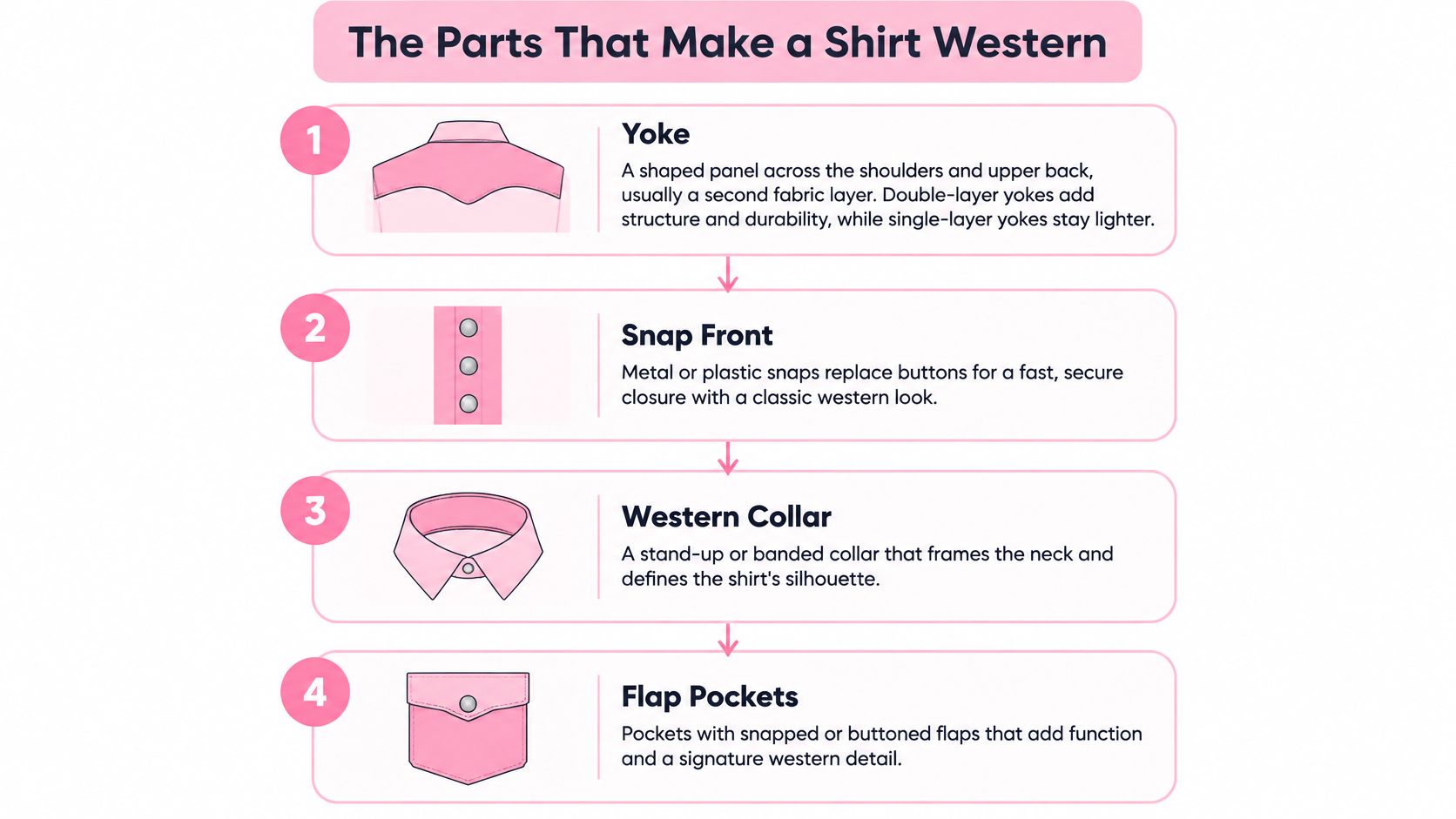
Chest pockets come next. Look for pockets with flaps, often pointed or shaped like a smile, and check whether their corners are reinforced. A flap helps cover the opening, while sound stitching matters if you expect the shirt to be worn frequently for work. The shape is part of the Western look, but the stitching and fabric determine how well the pocket holds up.
The collar and cuffs frame the shirt and affect how it sits on the body. A pointed or stylized collar can sharpen the silhouette; cuffs may close with snaps or buttons. Piping adds a contrasting line along the edge, but it's a finish detail, not proof that the shirt is built for strenuous use.
The front placket carries the snaps or buttons. The closure changes how the shirt opens and how it looks, but doesn't tell you by itself whether the fabric or seams are work-grade. The long shirttail has a practical purpose too: extra length helps keep a shirt tucked during horseback riding. Western shirts grew from working clothes worn by vaqueros and American ranch workers, with yokes, long sleeves, pocket flaps, and long tails among their recognizable features. Those details combine practical construction with a regional style, as described in the history of the Western shirt.
A quick construction test: A shirt can have a yoke and pearl snaps yet still be a fashion piece if its fabric is thin and its seams are lightly finished. Judge the full build, not the visible details alone.
The yoke is the feature that most clearly separates a Western cut from an ordinary casual button-down. For a broader overview of the clothing and accessories associated with the style, see what Western attire includes.
Snap Closures and Where They Came From
A snap can be opened with one hand while the other holds reins or equipment. If the shirt catches on a branch, fence, saddle horn, or livestock, the closure can release under force instead of holding the wearer in place. A buttoned shirt can be harder to open quickly, and a caught button may pull on the fabric. That makes snaps a practical choice for riding and some kinds of ranch work, not just a signature look.
| Criterion | Snap closure | Button closure |
|---|---|---|
| One-handed operation | Yes, works with reins or gear in the other hand | No, needs both hands and time |
| Release under force | Pops open when the shirt catches on a branch or fence | Holds, can tear fabric or pull the wearer |
| Repair | Replace the snap with a setting tool | Re-sew the button |
| Visual identity | Signature Western look, with pearl or enamel covers | Standard casual or dress look |
The snap-front Western shirt took shape as a practical alternative to conventional button fronts. Commercially produced snap shirts became available to working cowboys in 1939, and Papa Jack Weil is credited with introducing the design and popularizing it through Denver's Rockmount Ranch Wear, according to the account of snap-front Western shirt history. The release function mattered when a shirt caught on brush, a fence, or tack.
In 1946, Weil moved to pearl-style snaps and added or standardized pointed pocket flaps and distinctive yokes. A pearl-like cap doesn't necessarily mean the snap is made from shell. Real shell could crack under heavy use and laundering, and synthetic poly-top snaps became common during the 1950s, as the same history explains. That distinction is useful when you're buying a modern shirt: the finish can be pearl-like without being mother-of-pearl.
Choosing between snaps and buttons
Snap shirts often use snaps down the front and at the cuffs. More formal versions may have covered fasteners, while premium or decorative styles may add pearl- or enamel-style covers, piping, or embroidered yokes. A close, fitted cut tends to emphasize presentation; a relaxed cut with longer tails gives more room and coverage for work or riding. These differences are why a snap shirt isn't automatically a work shirt. The design and fit matter alongside the closure, as the comparison of practical and show-shirt details explains.
A worn snap is typically replaced using a snap-setting tool; a loose button is sewn back on. A button-front Western shirt can still suit a dressier occasion when you prefer a clean front. For riding and work, choose snaps for quick operation and their ability to release when caught. For a polished setting where a release feature isn't the priority, buttons remain a reasonable option.
Fabrics and Weights From Denim to Gabardine
Fabric changes how a shirt feels through a long day, but it doesn't tell the whole story. Western shirts are better judged by their construction as well as their cloth: denim work shirts, dress-oriented gabardine shirts, and embellished show shirts can all use recognizable Western details. The Chicago History Museum's overview of Western wear describes denim as a labor-shirt fabric because its tightly woven cotton tolerates abrasion, while gabardine supports cleaner tailoring.
| Fabric | Feel and weight | Best climate | Durability | Main use |
|---|---|---|---|---|
| Denim | Heavy, stiff at first, softens with wear | Cool to mild | Highest | Ranch and barn work |
| Chambray | Light and soft | Mild to warm | High | Everyday ranch wear |
| Cotton twill | Medium weight, firm | All seasons | High | Everyday work shirts |
| Gabardine | Smooth, medium weight, tailored drape | Warm to mild | Moderate to high | Dress Western shirts |
| Poplin | Crisp, light | Warm | Moderate | Show and casual shirts |
| Poly-cotton blend | Light, fast-drying, wrinkle-resistant | Hot or humid | Moderate to high | Riding in heat |
| Flannel | Soft, brushed, warm | Cold | Moderate | Winter casual wear |
Denim feels substantial and can soften as it's worn. That sturdier hand makes it a sensible choice for barn and ranch work, especially when paired with reinforced seams. A heavyweight shirt may feel warm in summer, though, so durability isn't the only thing to weigh.
Chambray offers a lighter, softer feel for mild-weather ranch wear. Cotton twill is a firm everyday alternative when you want a practical shirt without the heavier feel of denim. For dressier use, gabardine has a smoother drape, while poplin provides a crisp, light option for casual or show shirts.
A poly-cotton or synthetic blend can suit active wear in hot or humid conditions if you want a lightweight shirt that dries quickly. Flannel is a warmer option for cold-weather casual wear or layering. On the other hand, a very light shirt may offer less protection against rough contact with fence wire or tack than a sturdier weave.
Match the cloth to both the task and the climate. For barn work, begin with denim or substantial cotton twill. For warm-weather riding or dressier styling, consider a lighter cotton blend or gabardine. Then inspect the construction: check whether the yoke is single- or double-layered, whether pocket corners are reinforced, and whether the side seams and cuffs are securely finished. Those checks help you judge the shirt as a whole, rather than assuming that a fabric name alone guarantees durability.
Fits and Cuts for Women, Men and Youth
Fit decides how a shirt behaves once you're in the saddle. It controls how much room you have to reach, lean and swing, and whether the tail stays tucked while you do. Choose the cut for the job first; color and trim come after.
| Fit | Silhouette | Shoulder and length | Who it suits |
|---|---|---|---|
| Relaxed ranch cut | Loose body, longer tails | Full shoulder, tail covers the belt | Riders and ranch workers who tuck in |
| Fitted cut | Close at the waist | Narrower yoke, shorter tails | Show and dress Western wear |
| Women's cut | Narrower shoulders, defined waist | Shorter body and sleeve | Women and girls who ride or dress Western |
| Men's standard cut | Straight body | Broader shoulder, longer sleeve | Men who ride or work |
| Youth cut | Proportioned for a smaller frame | Scaled shoulder and tail | Children and teens |
A relaxed ranch cut gives you room to move and a longer tail to tuck. A fitted cut sits closer to the body and often carries a shorter tail, so it presents well at a show but can pull free during a long day of riding. Women's cuts narrow the shoulders, define the waist, and shorten the sleeve or body; men's standard cuts leave more room through the shoulders and arms. Youth cuts scale the same pattern down to a smaller frame.
Tail length is the detail that decides whether a tucked shirt stays put. If the shirttail works loose when you raise your arms or lean forward, look for a longer hem or a cut designed to stay tucked. When ordering online, measure the chest, shoulders, and sleeve rather than trusting the size label alone, since brand charts aren't interchangeable. A youth shirt should leave room to grow and move without letting the snaps sit out of alignment.
Trim and cut work together on a women's Western shirt. One example pairs a navy base with blue and cream floral details across the yoke and cuffs, cream piping, pearl snaps, and chest pockets. Piping and a contrast yoke frame the shoulders and draw the eye upward, which is why they appear so often on fitted and dress cuts.
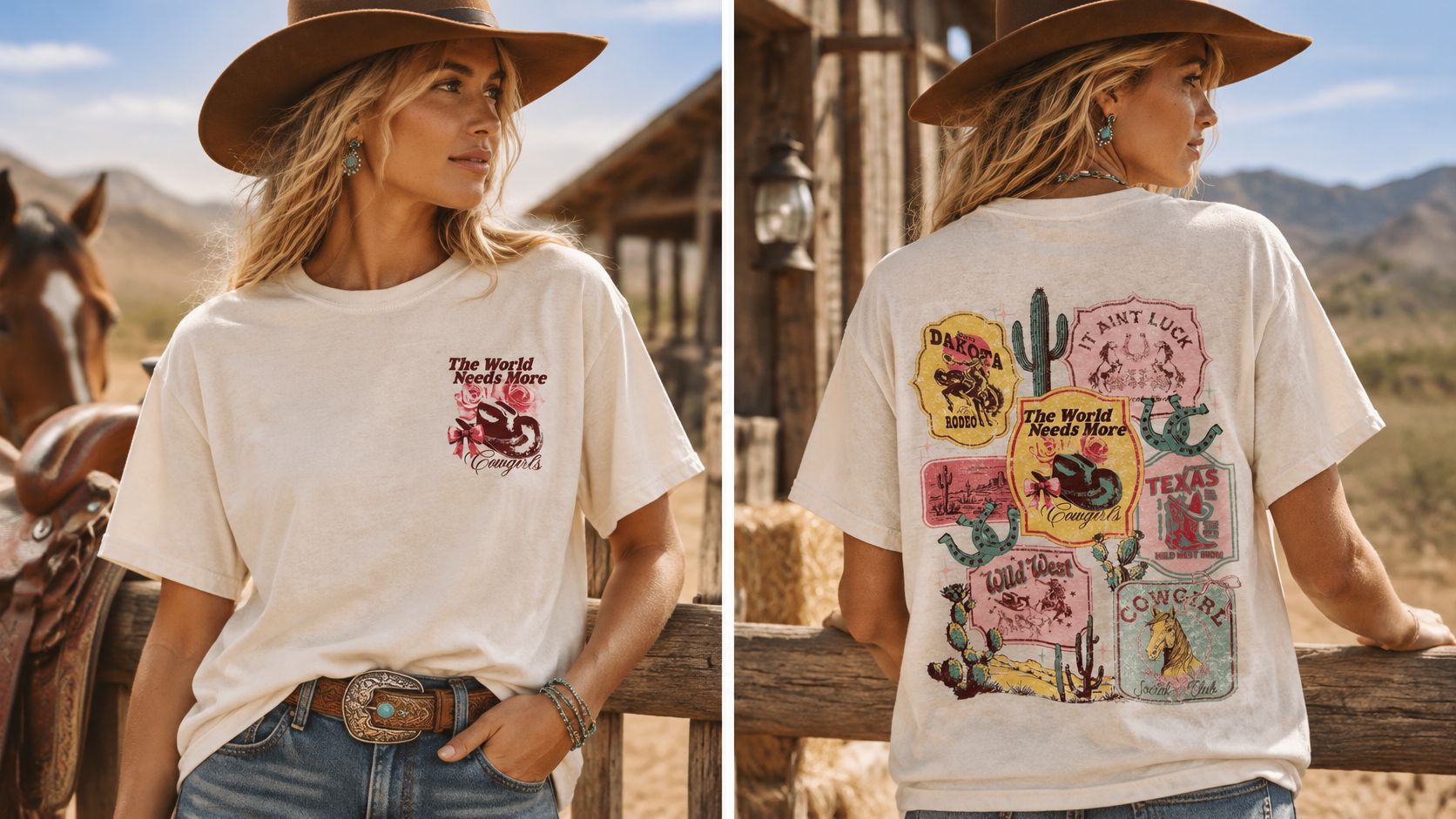
A Western graphic tee serves casual, everyday wear. The More Cowgirls Western T-Shirt is an off-white, relaxed oversized cotton tee with a small front graphic and a larger Western collage across the back. For a shirt you plan to ride in, run a quick fit check: look at where the shoulder seam sits, raise both arms, and confirm the chest snaps neither gape nor pull.
For additional ideas on selecting a women's riding cut, read this guide to Western riding apparel for women.
Styling and Care for Each Western Shirt Type
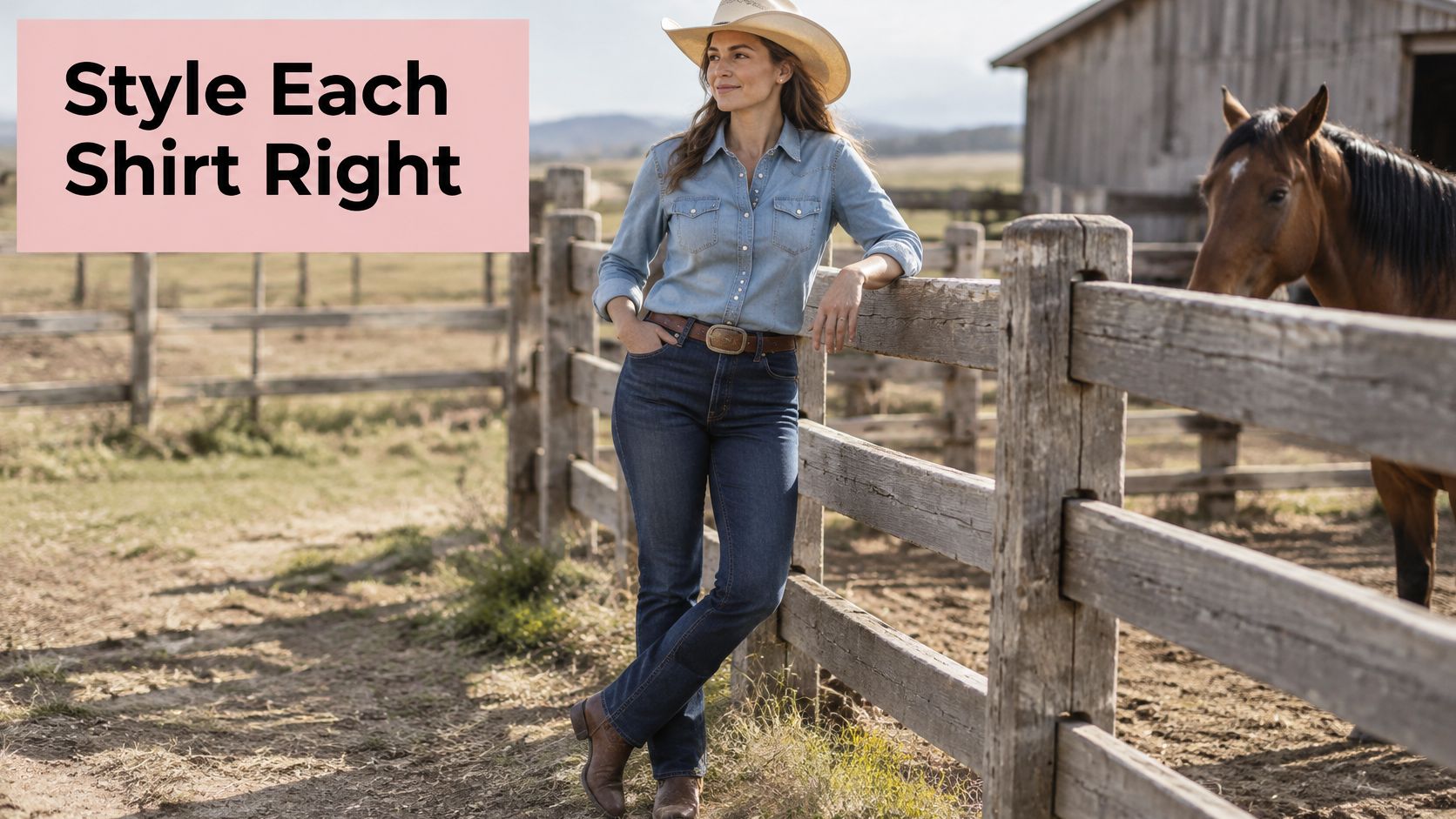
Wear a ranch or work shirt tucked in when riding, so the longer tail stays covered by the waistband as you move. A fitted shirt can be worn untucked for casual use if its hem is designed for it. Pearl-snap shirts pair naturally with denim, boots, and a belt buckle; a plain chambray shirt also works as a simple layer under a vest.
Treat care as part of the buying decision, especially when a shirt has decorative stitching or special fasteners. For garments with delicate trim or care instructions you're unsure about, compare the label with this practical overview of fabric suitability for wet cleaning from CleanOnline, North York's Premium Dry Cleaners.
- Denim: Wash cold and inside out to help limit fading, then air dry.
- Pearl-snap and poly-snap shirts: Close the snaps and use a gentle wash cycle.
- Real shell snaps: Hand-wash or use a gentle cycle, since shell can crack.
- Embroidered or rhinestone shirts: Turn inside out for washing and avoid bleach.
- Gabardine and poplin: Iron while slightly damp; use light starch for a dress shirt.
- All Western shirts: Use low heat rather than high-heat tumble drying, and hang the shirt to help the yoke keep its shape.
For a decorative button-front example, the Wild Grace Horse Embroidered Blouse is a sand-colored rayon blouse with horse embroidery on the front. It can be styled with denim, boots, or a skirt, but embroidery is a visual feature rather than evidence of workwear reinforcement.
The video below offers another look at Western shirt styling and details.
Care choices protect the features that give each shirt its purpose: the yoke, the closures, and the fabric itself. Use the garment's label as the final guide when its material or trim needs special handling.
Choosing the Right Western Shirt for Riding or Casual Wear
Start with the job the shirt needs to do, then match its features to that job. Embroidery, piping, rhinestones, and a contrasting yoke create the Western look, yet none of them add riding function on their own. A shirt can photograph like ranch wear while being built like a fashion piece, so judge it by construction.
| Use case | Feature that matters most | What to check before buying |
|---|---|---|
| Trail riding in warm weather | Lightweight, breathable cloth | Snap front, tail long enough to stay tucked |
| Ranch work and barn chores | Abrasion resistance | Double-layer yoke and reinforced seams |
| Everyday casual wear | Easy styling | Comfortable fabric that pairs with jeans and boots |
| Dressy events and shows | Neat presentation | Fitted look and sharp yoke |
| Cold-weather riding | Warmth without bulk | Enough room for layering under a jacket |
| Youth riding | Scaled proportions | Snaps the child can open and close |
Check what the shirt must handle
For a riding or work shirt, ask six practical questions. Can you reach forward or swing a rope without the upper back pulling? Does the tail stay tucked when you are mounted? Can you bend and extend your elbows without the sleeves binding? Do the pockets stay secure when you lean forward? Will the cloth stand up to contact with tack or fence wire? Is the fabric comfortable in your local climate?
Then inspect the garment itself rather than relying on its pattern. For demanding work, look for a double-layer yoke, reinforced pocket corners, and fabric suited to your climate; for hot-weather riding, a lighter performance cloth trades some abrasion protection for comfort. For a show shirt, a close fit and decorative yoke may be exactly the point, as long as you judge it as presentation rather than workwear.
Match the shirt to a real day
A trail rider in warm, humid weather might choose a lightweight poly-cotton snap-front with enough tail to stay tucked. The lighter cloth suits the climate, and the snaps provide a practical closure. A ranch worker doing barn chores may be better served by denim or heavy twill with a reinforced yoke and seams. For a young rider, check that the cut fits the chest and sleeves and that the child can operate the snaps.
Casual wear puts less demand on abrasion resistance. Chambray or a plaid pearl-snap works with jeans and boots without the extra structure of a heavy work shirt. For a dressier event or show, gabardine or poplin gives a neater line, while embroidery adds a visible Western accent.
If you are comparing clothing for riding, the guide to Western riding apparel can help put the shirt choice in the context of the rest of an outfit. A shirt earns its place when its construction matches the day you have planned, whether that day involves a saddle, a show ring, or a pair of boots and an easy afternoon.
Bridle Up Hope Shop offers equestrian and Western-style apparel alongside accessories, gifts, and goods for children and the home. Explore Bridle Up Hope Shop to find pieces that fit your everyday style, riding life, or gift list.
Leave a comment