


Ask a search engine which style you should ride and you get photographs. A flat English saddle and tall boots on one side, a horned Western saddle and a wide fender on the other. Pictures don't answer the question a beginner has, which is whether one of these will be safer, more comfortable and more affordable to learn with the body, the budget and the local barn you happen to have.
That gap is worth naming, because the two traditions were never built to be compared on looks. Each was designed for a different job, and those jobs still decide what a style asks of your hips, your hands and your calendar. Treat horse riding styles as sets of goals and physical demands, and the choice gets much easier to make.
Table of Contents
- Horse Riding Styles at a Glance
- Origins, Tack and Attire by Style
- Seat, Balance and Control in Practice
- How Each Discipline Is Scored
- Choosing Your First Style: A Practical Test
- Book Your First Lesson and Gear Up
Horse Riding Styles at a Glance
Two families cover almost everything you'll meet at a local yard. Here's the map, with the judging rules left for later.
| Style | Discipline | Main purpose |
|---|---|---|
| English | Dressage | Precision and obedience of movements |
| English | Show jumping | Clearing a course cleanly and quickly |
| English | Eventing | Versatility across three phases |
| English | Hunt seat | Horsemanship and form over fences and natural terrain |
| Western | Western pleasure | Relaxed, well-mannered gaits |
| Western | Reining | Precise patterns of spins, stops and sliding |
| Western | Trail | Obstacles met on the trail |
| Western | Working cow horse | Controlled work around cattle |
English riding pairs a light, close-contact saddle with formal competition and a long history of hunting and military horsemanship. Under that umbrella sit dressage, show jumping, eventing and hunt seat, and each one rewards accuracy plus a rider who can stay out of the horse's way.
Western riding comes from the American ranch horse. Its saddles are built for long hours and practical control, and its classes run from the loose gaits of Western pleasure to the deliberate patterns of reining and the cattle work of working cow horse.
Participation tells you something the discipline list can't. The 2025 American Horse Publications equine-industry survey reported pleasure or trail riding as the leading activity at 69.5% of respondents, with dressage among the most frequently reported structured activities at 25.1% and lessons or training at 22.5%. Recreational riding is the largest doorway into the sport. Competition is a side room.
Pick by goal, not by photograph: find the row whose purpose you'd still enjoy on a wet Tuesday in February.
Many riders never enter a show. A style, in practice, is a set of goals and a set of physical habits, not a personality type. Find the row above that matches what you want from a horse, then read the rest of this comparison with that row in mind.
Origins, Tack and Attire by Style
Why do the saddles and clothes differ so much between English and Western riding? Each style developed around different work. English riding grew from British hunting and military practice and later developed into disciplines such as dressage, show jumping and eventing. Western riding drew on Spanish and Portuguese horsemanship brought to the Americas, then adapted to long days working livestock (a chapter on equestrian history).
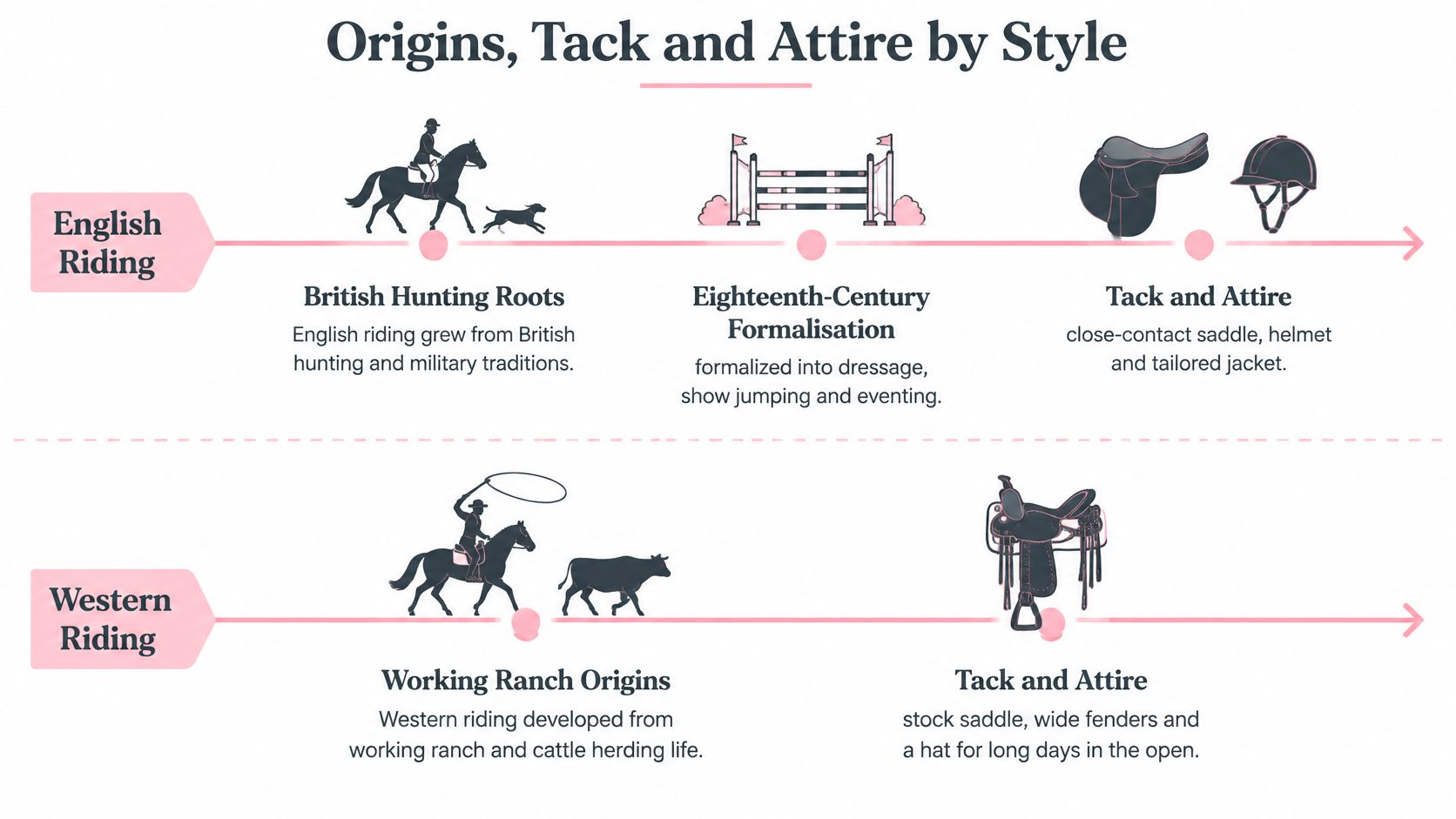
The Western saddle's horn suits rope work, while its deeper seat and heavier build accommodate long hours in the saddle. The lighter, flatter English saddle allows closer contact between horse and rider. For a beginner, those differences affect how the saddle feels and what local lessons may provide. They do not determine which style is easier to learn.
| Item | English | Western |
|---|---|---|
| Saddle | Lighter, flatter, closer rider-horse contact | Deeper seat, prominent horn, heavier construction |
| Bit | Snaffle common in dressage and jumping | Shanked curb bits seen in some advanced classes |
| Riding clothes | Coat, breeches and tall boots in competition | Long-sleeved shirt, jeans or chaps and heeled boots |
Bits, Boots and Helmets
Bit choices depend on the discipline. A snaffle is common in English dressage and jumping; some advanced Western classes use shanked curb bits for neck reining and one-handed riding. Neither type suits every horse or rider, so ask an instructor what a particular class requires before buying equipment.
Clothing can be simpler for lessons than for competition. English show attire may include a coat, breeches and tall boots; Western riders commonly wear a long-sleeved shirt, jeans or chaps, and heeled boots. A heel helps keep the foot from sliding through the stirrup.
A 2025 study of 357 collegiate equestrian athletes, including 297 English riders and 60 Western riders, found that 92.5% of English riders reported always wearing a helmet, compared with 23.3% of Western riders (the study's PubMed record). A fitted, certified helmet should come before visible style choices.
Practical rule: choose a helmet you will wear on every ride, in either discipline, before buying items people will notice.
Gear That Works in Both Traditions
For riding leggings and an upper layer, focus on fit and comfort before choosing a style label. The Lucky Horseshoe Riding Leggings and Lucky Horseshoe Riding Shirt (Navy Blue) are options from Bridle Up Hope Shop, a gift shop for horse lovers with English and Western designs. Its guide to Western riding apparel explains how clothing layers work around a saddle horn. Outfit details can vary; instruction, fit and access to local lessons matter more when choosing where to start.
Seat, Balance and Control in Practice
The body comes before the tack. Here's the layer most style comparisons skip entirely.
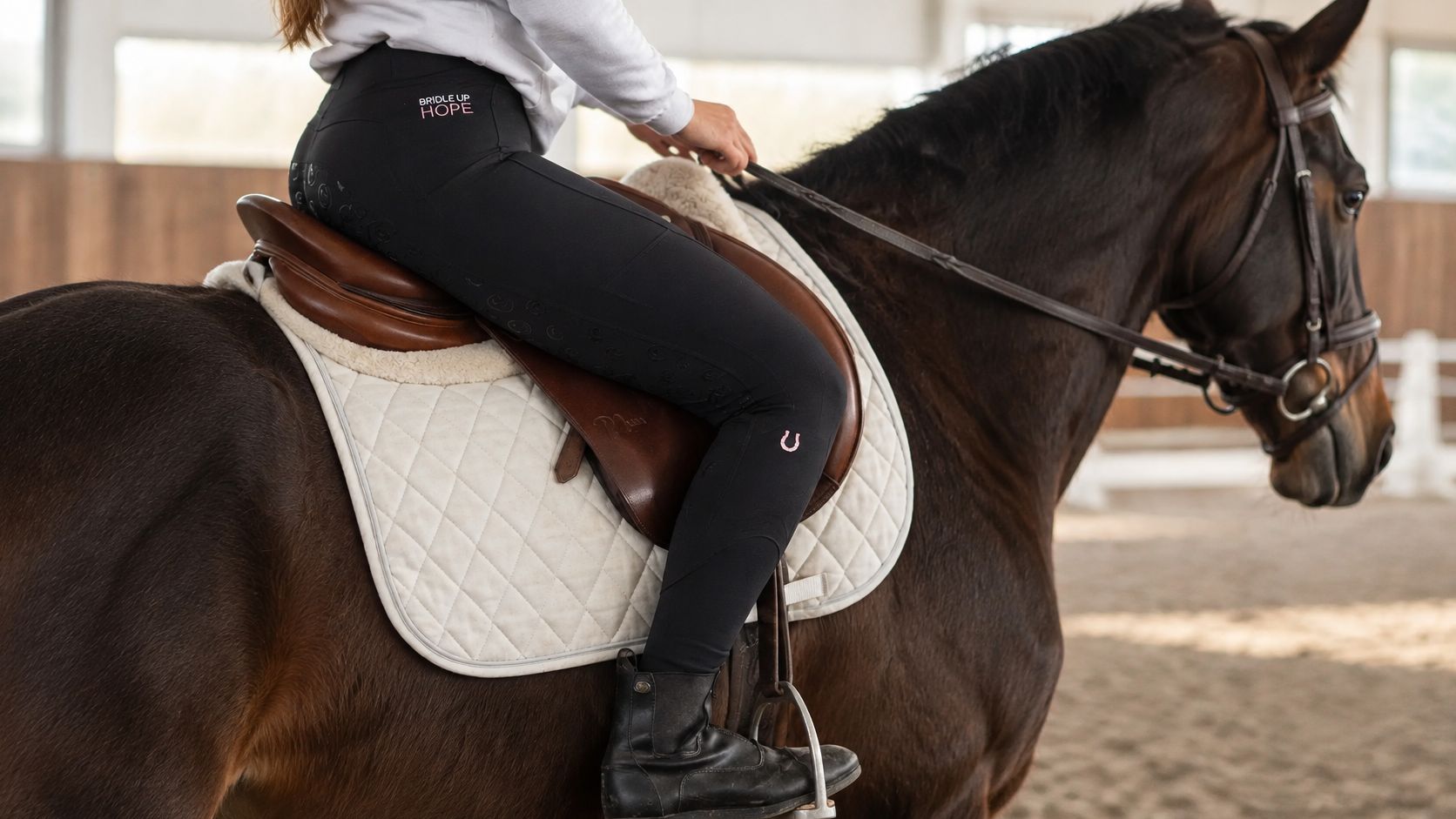
English work, particularly dressage, jumping and eventing, runs on precise control of your center of mass, pelvic orientation, trunk stability and rein-seat-leg coordination. Biomechanical research shows a neutral pelvis, dynamic trunk control and symmetrical weight distribution improve saddle-pressure distribution and gait quality, and riders who keep their center of mass closer to the horse's own produce lower peak saddle pressures (review of rider biomechanics). Shift your weight forward and you load the forelimbs and disturb balance.
On the flat, aim for a balanced, vertically aligned torso. Over fences or in faster work, use a controlled two-point position. Evidence comparing seating styles shows two-point produces a more consistent back-loading pattern and avoids the higher peak forces associated with sitting trot.
Western riding asks for a deeper, more relaxed seat and stretches the same balance problem over hours instead of seconds. Steady, quiet cues matter more than visible effort, because a horse that has to filter out constant noise stops answering clearly.
Why Skilled Riders Look Like They're Doing Nothing
Skill is coordination, not strength. A study comparing advanced and novice riders during walk, rising trot and canter found advanced riders used three principal muscle modes against five in novices, with greater core engagement, stronger contralateral coordination and a faster drop in unnecessary overall muscle activity (PLOS ONE study of rider muscle activity).
Effective control comes from timing and selective activation. Constant muscular tension is what a horse feels as noise.
Three Drills That Build the Same Skill in Either Saddle
- Independent aids: separate your leg, seat and rein so you can change one without moving the other two. Ride a transition with your hands still, then repeat it with your legs still.
- Transitions within a gait: shorten and lengthen the walk or trot a few steps at a time. This teaches you to adjust balance without speeding up.
- Controlled balance shifts: move your weight slightly forward and back while keeping your upper body relaxed, then return to neutral. Notice how quickly the horse's back responds.
Gripping and rigid posture hurt gait quality in both traditions and increase uneven loading. Saddle fit, stirrup length and rider balance are welfare variables, not matters of appearance, which is why a lesson on position pays off long before a lesson on a test. If you want the positional detail spelled out, our guide to riding English style walks through the same fundamentals from the ground up.
How Each Discipline Is Scored
A score can describe a movement, a fault or the result of a whole phase. In dressage, judges mark each required movement from 0 to 10: 0 means it was not performed, 5 is sufficient, 7 is quite good and 10 is excellent. The marks combine into a percentage, and the highest percentage wins the class (FEI guide to dressage scoring). Freestyle tests also receive an artistic score for choreography and music.
Show jumping uses faults and time rather than movement marks. Under the FEI jumping rules, jumping an obstacle a third time can lead to elimination or the loss of points assigned to it. The rulebook defines how refusals and other disobediences affect a round.
| Discipline | What judges score | Penalty example | What it rewards |
|---|---|---|---|
| Dressage | Each movement 0-10, combined to a percentage | Wrong movement costs 2 marks, then 4 more; a third error can eliminate | Precision and obedience |
| Show jumping | Faults and time | Refusals and knockdowns add penalties; a third jump at one obstacle can eliminate | Clean, efficient rounds |
| Eventing | Dressage marks plus jumping penalties | Knockdown costs 4 penalties; first refusal costs 4; second disobedience eliminates | Versatility across phases |
| Working Western Riding | Gait quality, lead changes, response, manners | Maneuver scores kept separate from penalty points | A responsive, well-mannered horse |
Eventing combines dressage with jumping phases, so riders need to understand which rules apply at each stage. At a specified cross-country obstacle, for example, a first refusal carries a 20-penalty consequence. The 2025 FEI Eventing Rules set out how errors and penalties are recorded.
Working Western Riding focuses on gait quality, lead changes at the lope, response to the rider, manners and disposition. Under USEF Western division rules, judges score maneuvers separately from penalty points.
Read the rulebook before you read the results: the same mistake can affect marks, faults or eligibility in different ways.
For a beginner, the useful comparison is practical: check how each rulebook defines errors, how penalties accumulate, and whether a mistake can end a round. Those details show what the rider must manage under pressure, beyond the discipline's name or appearance.
Choosing Your First Style: A Practical Test
A style label doesn't keep you safe. In a retrospective study of equestrian injuries, experience and formal riding qualifications appeared protective. Helmet use was associated with an estimated 50% reduction in risk, although that result was not statistically conclusive in the study sample (study of equestrian injuries).
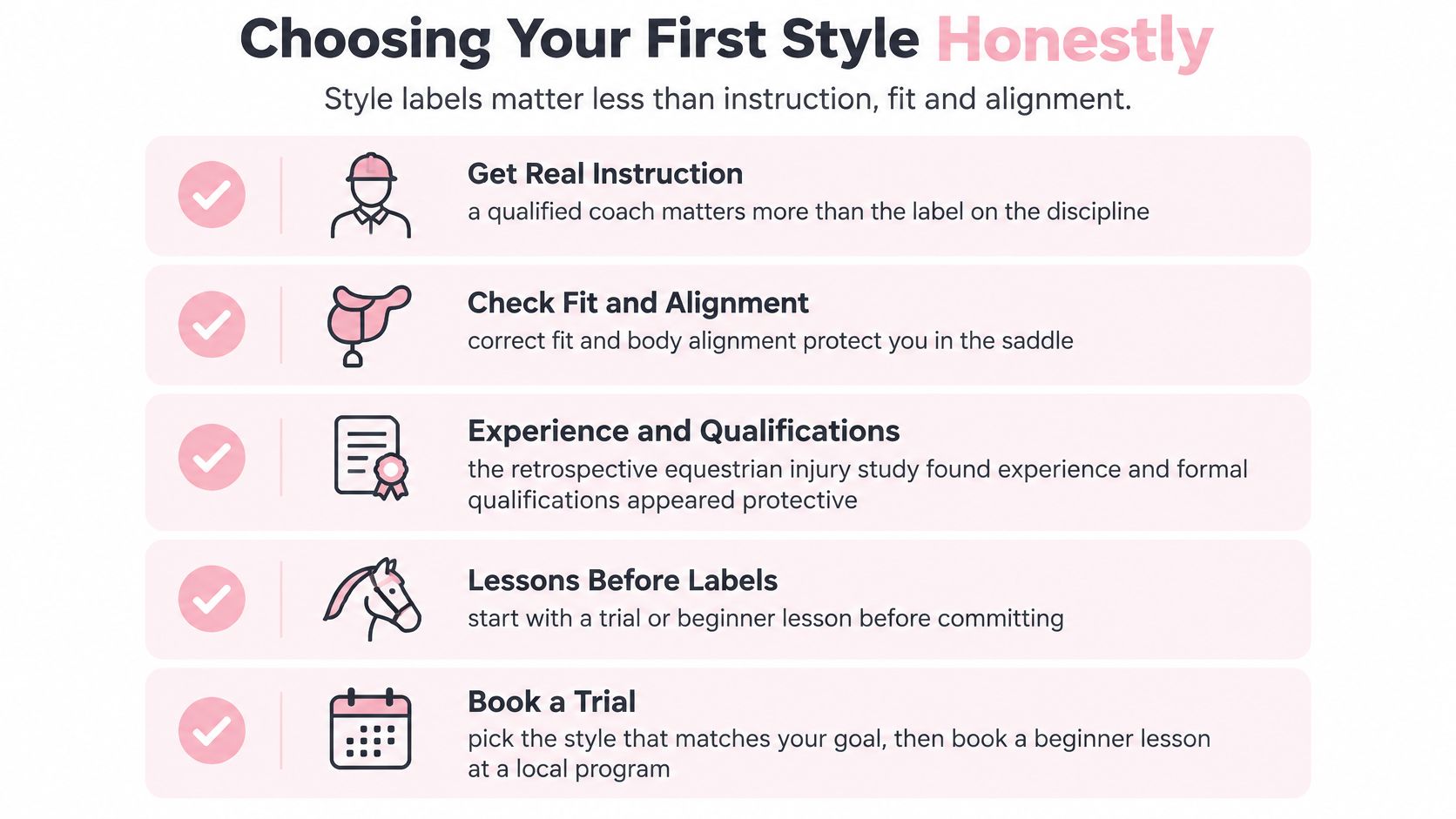
The same research found that stirrup design generally has little effect on rider position or the forces reaching a horse's back, though some differences appear at particular gaits. Western tack is not automatically steadier, and English riding is not harder. For a beginner, instruction, equipment fit and alignment matter more than the style label.
Access Decides More Than Preference
British Equestrian's 2025 State of the Nation report counted roughly 177,400 children riding weekly in England and 740,700 adults riding at least annually. It also reported that 18% of participants had a disability or long-term health condition (British Equestrian State of the Nation 2025). The report described rising operating costs and fewer local facilities as barriers to access.
So compare styles by what you can learn nearby. A suitable program should offer instruction that fits your needs, equipment you can use, and a horse matched to your size and experience. If you need mounting aids or a quiet, steady horse, ask about those when you contact the program.
A Checklist to Run Before You Commit
- A reachable lesson program: Travel and scheduling affect how often you can ride, and regular practice supports progress.
- An instructor who starts with balance: Position gives you a stable base for learning control. Ask how the instructor introduces it.
- A suitable horse: The horse's size and temperament, along with the program's assessment of you, matter more than the saddle's style.
- A fitted helmet and a saddle that fits the horse: A helmet protects your head; a properly fitting saddle helps avoid putting pressure on the horse.
- Shared or rented equipment while you decide: Borrowing boots, half chaps and a helmet can help you postpone larger purchases.
- The full cost of taking lessons: Include transport, facility fees, lesson frequency and renewals, not just the price of an introductory offer.
Ask two local yards the same questions about beginner lessons, adaptive options and helmet policy. Comparing their answers can reveal which one is prepared to teach you safely and consistently.
Choose the style that fits your body, budget and access to instruction. The look of a discipline matters less than the quality and fit of the lessons you can sustain.
Book Your First Lesson and Gear Up
If you have a style in mind, use it as a starting point, then choose a nearby program that can teach it well. Ask how many riders share each lesson, how the school matches horses to riders, and whether the instructor checks your position before asking you to go faster.
Your first lesson is a chance to learn how the instructor teaches and whether the horse feels manageable. A short video can help you see what a lesson may involve: Watch a horse-riding lesson.
After two lessons, if you want to continue, ask your instructor to assess your balance and check that the saddle fits the horse before you buy riding gear. Estimate a full month's costs, including travel and lesson frequency, with this guide to horse riding costs.
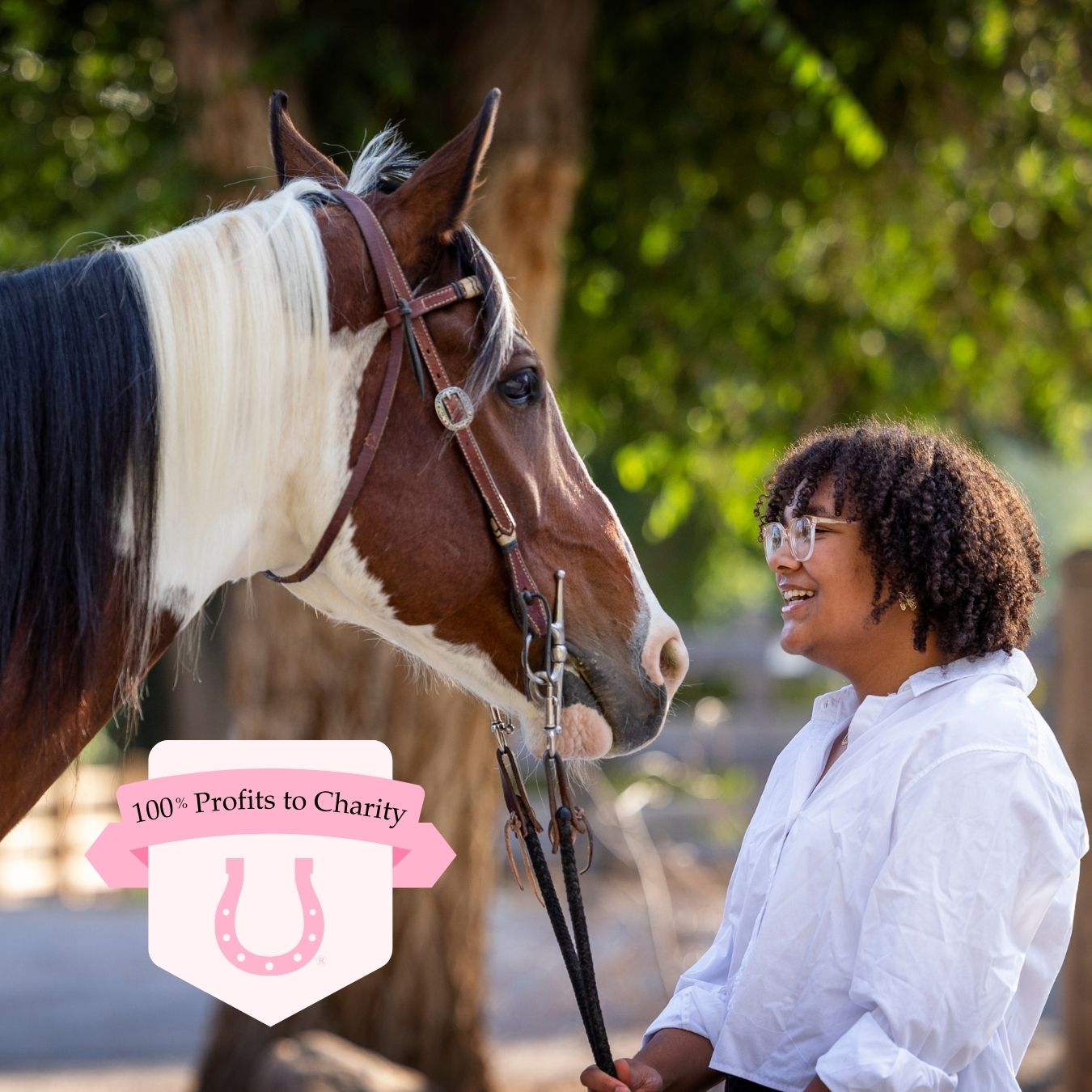
For clothing, Bridle Up Hope Shop is a gift shop for horse lovers, with English and Western designs. Its Lucky Horseshoe Riding Shirt is one option, but clothing can wait while you decide whether lessons suit you. A properly fitted helmet and instruction come first. The shop donates 100% of its profits to Bridle Up Hope, which supports girls and women through horses and habits.
Book one lesson, learn how the program works, and decide what to buy after you have ridden. The style label matters less than good instruction, a suitable horse and equipment that fits.
Leave a comment