


You're probably here because you've got a spot in your home that feels almost finished. The chair is right. The blanket is right. The room still doesn't feel like you. If horses have always been part of your life, a pillow cover is one of the simplest ways to bring that identity into a room without turning the whole space into a tack-room parody.
That's why I like horse pillow covers so much. They're low commitment, easy to swap, easier to wash than a whole pillow, and surprisingly good at making a room feel personal fast. They also travel well, which matters if you like to refresh a guest room, a dorm, a cabin, or even the couch at the barn office.
Table of Contents
- Why Horse Pillow Covers Belong on Your Shopping List
- Choosing a Fabric That Holds Up in Real Homes
- Getting the Size and Fit Exactly Right
- Horse-Themed Design Styles Worth Knowing
- Styling Horse Pillow Covers in Any Room
- Care and Washing Without Ruining the Print
- DIY and Personalized Horse Pillow Cover Ideas
- Gifting Horse Pillow Covers That Give Twice
Why Horse Pillow Covers Belong on Your Shopping List
A horse pillow cover does a job that framed art and bigger furniture usually can't. It adds personality without locking you into one decorating decision for years. If you love English style, Western details, racehorse imagery, or simple horse sketches, you can test that look on a chair, bench, or bed in five minutes.
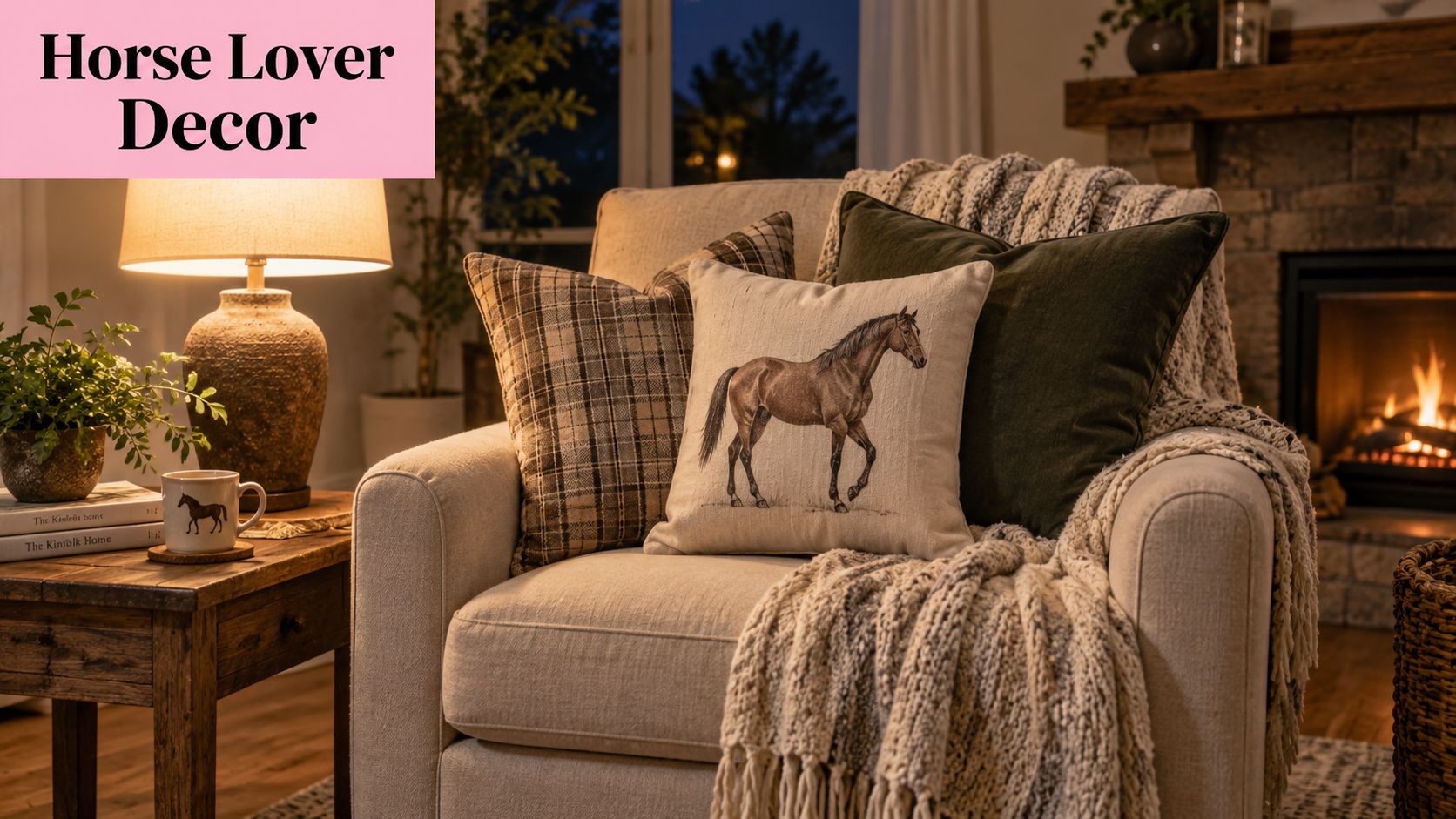
The bigger point is this. Horse-themed home decor isn't some tiny novelty corner anymore. The broader equestrian home decor market was estimated at USD 869.42 million in 2024, rose to USD 920.28 million in 2025, and is projected to reach about USD 1.41 billion by 2032 at a 6.26% CAGR, according to Research and Markets' equestrian home decor market forecast. That matters because it tells me shoppers are treating horse-inspired decor as real home styling, not just gift-shop nostalgia.
Why a cover beats a whole pillow
A removable cover is more practical than a fully built pillow for most homes.
- It's easier to wash. You can pull the cover off instead of wrestling an entire insert into the machine.
- It protects your insert. Good inserts last longer when you only clean the shell.
- It stores flat. That matters if you like seasonal decorating.
- It travels better. A folded cover fits in a tote or suitcase without taking over.
If you're still shaping your overall room, it also helps to look at broader living room pillow covers to see how solids, textures, and equestrian prints can work together instead of competing.
A good horse pillow cover should say something about you. It shouldn't shout over the whole room.
There's also a gift angle I care about. A horse pillow cover is useful, displayable, and personal without being too intimate. It works for riders, trainers, barn moms, horse-crazy teens, and friends furnishing a first apartment. Better still, when the purchase supports a shop built on a 100% net-profit donation model, the gift does more than decorate. It gives back too.
Choosing a Fabric That Holds Up in Real Homes
Most shoppers spend too much time on the artwork and not enough on the fabric. That's backward. If the material is wrong for your house, the cutest horse print in the world won't save it.

Industry guidance on abrasion testing is the most useful filter here. Gessato's Martindale test guide places 6,000 to 10,000 cycles in the low-durability range, notes that residential upholstery typically targets at least 15,000 cycles, and explains that polyester flat-weaves can exceed 30,000 to 50,000+ cycles for more demanding use. My take is simple: if a horse pillow cover is going on a family sofa, don't settle for pretty fabric with no backbone.
What I'd choose for each kind of room
For real homes with kids, dogs, cat claws, barn jackets, and people who sit down, tight weaves win.
- Cotton canvas or sturdy cotton blends work well when you want softness without fragility. They breathe well and usually get better with use.
- Linen or linen blends give you texture and that collected look people love, but they wrinkle and they're less forgiving if you expect a crisp, custom finish.
- Polyester or performance blends are the workhorses. They resist wrinkling, tend to hold printed horse artwork well, and usually deal better with repeated handling.
- Velvet, sateen, or delicate chenille belong on low-contact accent seating, not the pillow everyone grabs during movie night.
If you want a basic refresher on how different fibers feel and behave before you narrow your choice, Joey'z Shopping pillow fabric tips are a helpful companion read.
Shrinkage matters more than shoppers think
Fiber content alone doesn't tell the whole story, but shrink behavior absolutely matters. According to One Affirmation's pillow cover shrinkage guide, 100% linen can shrink about 3% to 10% on a hot wash or dryer cycle, while cotton can shrink up to about 5% unless it's pre-shrunk. The same guidance recommends cold water, low heat or air drying, and gentle agitation to keep shrinkage near zero.
That's not a small issue. A little shrinkage can throw off zipper alignment, stress the seams, and make the insert fit awkwardly.
Practical rule: Match fabric to use, not to the product photo. A family-room cover needs a tight weave, stable seams, and care instructions you'll actually follow.
Small construction details tell you a lot
Before you buy, check for these signs of a cover that will last:
- Hidden zipper with sturdy tape so the closure doesn't twist or snag after a few washes.
- Neat seam finish because raw, weak inside edges tend to fray first.
- Tighter weave if the cover will see pet hair, arena dust, or daily compression.
- Clear care label because vague cleaning guidance usually means more risk, not less.
Equestrian households are hard on textiles. That's normal. Choose like you know that.
Getting the Size and Fit Exactly Right
A beautiful horse pillow cover can still look disappointing if the fit is off. Most online fit regrets come from one of two mistakes. People either buy the exact same size as the insert and end up with a limp, wrinkled look, or they ignore the closure and fight the pillow every time they put it on.
The measuring routine I recommend
Use the insert you already own, not the size you think it is.
- Measure across the middle, corner to corner. Don't measure the seam edge if the insert is already stuffed and rounded.
- Choose a cover slightly larger than the insert if you want a fuller, cleaner look at the corners.
- Check the closure before you click buy. Hidden zippers look the neatest, envelope backs are easy but can gap, and button closures are charming until a pet paw catches one.
Where each size tends to work best
You'll see the same few sizes over and over, and each has a sweet spot.
| Size | Best Use |
|---|---|
| 16x16 | Small reading chair, child's room, layered front pillow |
| 18x18 | Loveseat, accent chair, general living room staple |
| 20x20 | Sofa corners, larger chairs, fuller statement look |
| 12x20 lumbar | Bed layering, benches, entry seating |
Buy for the furniture scale first, then the artwork scale. A detailed horse portrait can disappear on a pillow that's too small.
One more tip that saves headaches. Put the cover on the actual insert and take a quick phone photo before you commit to the room. A photo catches bunching, sagging, and awkward proportions faster than your eye does in real time.
Horse-Themed Design Styles Worth Knowing
Not all horse pillow covers say the same thing. Some feel polished and traditional. Some feel ranchy. Some feel like modern art. If you don't identify the style first, you'll end up mixing pieces that fight each other.
Horse-themed design styles at a glance
| Style | Palette | Signature Motifs | Best Room | Watch Out For |
|---|---|---|---|---|
| Vintage | Sepia, faded green, dusty blue, warm cream | Equestrian art prints, antique maps, old portraits | Library, guest room, layered bedroom | Too many distressed pieces can look staged |
| Modern | Black, cream, camel, soft gray | Line drawings, geometric horse shapes, single-color prints | Minimal bedroom, clean living room, office | Overly stark styling can feel cold |
| Western | Cognac, rust, denim, ivory, weathered brown | Horseshoes, ranch motifs, rodeo lettering, bold horse heads | Leather sofa room, cabin, den, entry | Too much themed signage makes it costume-y |
| English | Navy, hunter green, burgundy, brass-toned neutrals | Bridles, bits, hunt sketches, jump imagery | Traditional sitting room, study, polished bedroom | Bright novelty prints can cheapen the look |
My honest read on each style
Vintage works when you want the room to feel collected. A sepia horse study or muted equestrian print can blend into older wood furniture, books, and wool throws beautifully.
Modern is the easiest style for people who say they don't want a “horse room.” A minimalist horse silhouette on cream cotton gives a nod to your life without taking over the sofa.
Western has the strongest personality. That can be fantastic in the right room. It likes leather, rougher texture, and a little space to breathe. If you stack it with every rodeo phrase and every horseshoe object you own, it tips fast.
English feels well-fitted. Bits, bridles, jumping sketches, and hunt references can look elegant when the palette stays disciplined.
For shoppers leaning ranch-inspired but wanting a room that still feels livable, the ideas in this guide to Western style home decor can help you keep the balance.
The best blends
The most interesting rooms usually blend two styles.
- Vintage + Western gives warmth and history.
- Modern + English feels clean but rooted in tradition.
- Vintage + English suits older homes and layered guest rooms especially well.
The mistake is trying to use all four at once. Pick a lead style, then borrow lightly from one neighbor.
Styling Horse Pillow Covers in Any Room
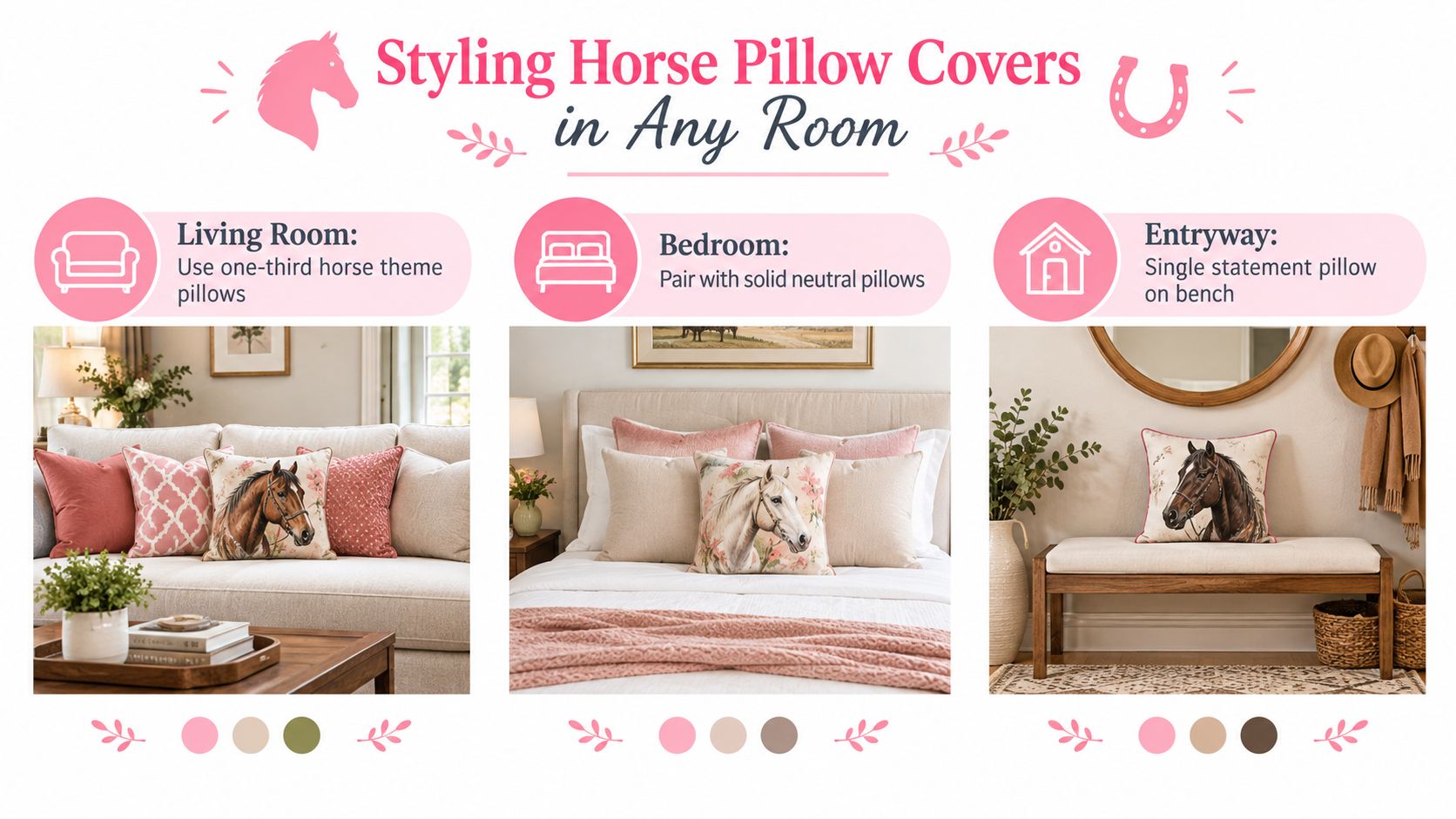
Styling gets easier when you stop treating horse pillow covers like the whole theme. They should be one layer in the room, not the entire conversation. My rule is simple. Keep horse-themed covers to about one-third or less of the full pillow arrangement, then let solids and texture do the rest.
Living room
On a leather sofa, one Western or English horse pillow cover often does more than three. Pair it with solid pillows in ivory, cognac, olive, or a muted plaid. If the horse cover has black linework, repeat that black in a lamp base or picture frame so it feels intentional.
For people exploring made-to-order options, the overview of custom throw pillows from Lewis and Sheron is useful for thinking through fabric and trim choices before you commit.
Bedroom
Bedrooms need a quieter hand. A modern horse sketch or subtle bridle motif works best when it sits with linen shams, a quilt, or a chunky throw. You want the horse reference to read as a layer of character, not the first thing someone notices from the doorway.
If you want more room-specific examples, this collection of ideas on horse throw pillows shows how different equestrian motifs can sit within broader decor.
Pull one accent from the pillow cover and repeat it somewhere else in the room. That's what makes a themed piece look designed instead of random.
Entryway
Entry benches are perfect for horse pillow covers because one pillow can carry the whole message. Try an English hunt-inspired cover with a wool blanket and antique brass hooks nearby. Or use a simple horse silhouette on a bench with boots under it and keep everything else restrained.
Three styling mistakes I'd skip
- Matching the pillow to a horse figurine nearby. It usually reads too literal.
- Buying every horse style at once. The room loses its point of view.
- Using bright neon horse prints in a neutral space. Unless the whole room is built for bold color, it looks dropped in.
Care and Washing Without Ruining the Print
A horse pillow cover only stays charming if you care for it like a textile, not like a gym towel. Most washing mistakes happen before the machine even starts.
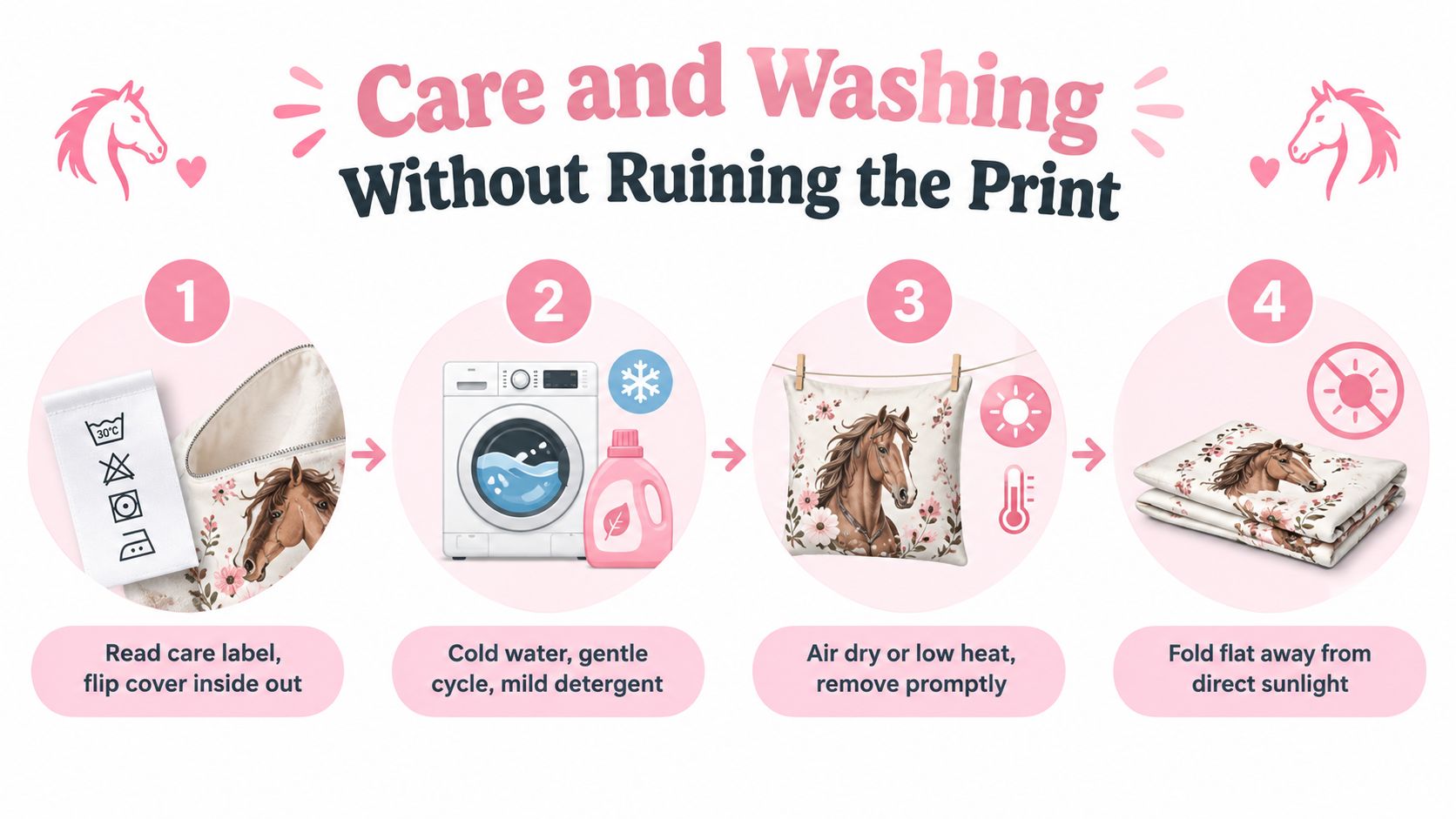
The wash routine that makes sense
Start with three moves every time:
- Read the care label.
- Turn the cover inside out.
- Close the zipper so the teeth don't catch the fabric or printed surface.
For cotton, linen, and many performance blends, cold water and a gentle cycle are the safe baseline. Use mild detergent. If the design is embroidered or heavily printed, a mesh laundry bag adds protection without much trouble.
What actually ruins covers
Heat is the usual culprit. Earlier guidance on shrink control shows that cotton and linen can change size noticeably when people use hot water and high dryer settings, which is why cold wash and low heat matter so much in practice. High heat also makes printed surfaces age harder, especially at fold lines and edges.
Store clean covers flat if you can. Don't bury them under heavy stacks where creases set into the same spots.
For rooms that already lean cozy and horse-inspired, this article on a throw blanket with horses pairs well with the same low-fuss care mindset.
If a cover looks delicate, treat it that way from day one. Damage from heat and rough agitation usually shows up after the fact, not during the wash.
Quick fixes for common problems
- Pilling: Use a fabric shaver lightly, then reduce friction going forward.
- Fading: Keep stored covers out of direct sun.
- Sticky zipper: Clean lint from the teeth and avoid forcing it around tight corners.
- Misshapen cover: Put it back on the insert while slightly damp and smooth the corners by hand.
DIY and Personalized Horse Pillow Cover Ideas
Personalized horse pillow covers make some of the most meaningful gifts I've seen. They can celebrate a first pony, honor a once-in-a-lifetime heart horse, or turn a favorite photo into something useful instead of another file on a phone.
Easiest options for beginners
If you want a custom feel without a big craft commitment, start with add-ons to a plain cover.
- Iron-on horse silhouettes work best on tight-weave cotton or cotton blends.
- Embroidered initials or monograms sit nicely on linen-cotton blends because the texture hides minor imperfections.
- Heat-transfer designs are a smart middle ground for crisp horse graphics and names.
Use your own horse photos when possible. They make the result more personal and avoid the gray area that comes with using random online images. If you work from an illustration, make sure it's licensed or created for you.
Good projects for people who enjoy making things
Hand-stitched appliqué, painted horse portraits, and custom-printed artwork all have their place. The key is choosing the right base fabric.
- Fabric paint behaves best on tight, stable cotton.
- Embroidery likes linen-cotton blends with enough structure to hold stitches.
- Outdoor or barn-office cushions need tougher canvas or performance fabric.
Some techniques survive regular washing better than others. Embroidery and professionally printed covers usually hold up better than craft paint or lightly fused embellishments. Display-only pieces are fine, but decide that before you make them.
How I'd use DIY pieces in a room
Homemade doesn't have to mean homemade-looking. One personalized cover often shines more when it's mixed with simpler supporting pieces. If you've made a memorial pillow with a stitched horse portrait, surround it with solids and texture instead of adding more horse graphics around it.
For gifting, I like a handmade cover paired with one curated equestrian item so the present feels finished. A custom pillow with a horse mug, a neutral throw, or a tote gives the recipient something personal and something practical at the same time.
One factual note worth knowing as you shop. Because decorative pillow covers are heavily mass-produced and widely distributed through global supply chains, they're easy to find in many fabrics and styles. One market analysis estimated that Asia accounts for more than 60% of global production of decorative pillow covers, with China responsible for roughly two-thirds of regional output and 55% to 65% of global shipments in relevant categories, while another source reported that the Canada market is 85% to 95% import-dependent and that seasonal and holiday-themed covers make up 25% to 30% of annual unit sales, with Q4 exceeding 35% of fourth-quarter category revenue in that category, according to IndexBox's decorative pillow cover market analysis. That's one reason a personalized horse pillow cover stands out. It doesn't feel mass-market, even when the base cover is.
Gifting Horse Pillow Covers That Give Twice
Some gifts get opened, admired, and forgotten. Horse pillow covers usually aren't that kind of gift because people can use them. They go on a favorite chair, a guest bed, a porch bench, or the corner of the couch where someone reads every night. That kind of gift stays visible.
They also work across a wide range of relationships. You don't have to know someone's exact clothing size. You don't have to guess whether they wear gold or silver. You just need to know their horse taste and how they live.
Match the gift to the person
A good gift choice starts with the recipient's daily life.
- For a child's bedroom, choose a playful horse silhouette on a washable cover with a forgiving fabric.
- For a barn manager or trainer, go more subtle. A durable cover with a small horsehead motif or bridle detail feels grown-up and useful.
- For someone grieving a lost horse, skip novelty and choose something personal. An embroidered portrait, a name, or a quiet memorial design carries more weight.
- For a housewarming, neutral wins. A linen-look cover with equestrian detailing fits more homes than a loud novelty print.
Presentation matters more than people think
The pillow cover itself does a lot, but the presentation turns it into a story.
Try this combination:
- Use a decent gift box or soft wrapping so it feels intentional.
- Include a handwritten note that explains why you picked that horse motif.
- Add an insert if you want instant display instead of “some assembly required.”
- Pair it with one companion item like a mug, throw, tote, or candle if the occasion calls for a fuller bundle.
That's where the mission side of gifting becomes powerful. A horse-themed home item is already personal. When the purchase also supports programs for girls and women through horses and habits, the gift lands twice. The recipient gets something beautiful and useful. The purchase also contributes to something bigger.
My strongest recommendation
If you're buying horse pillow covers as gifts, don't default to the loudest or cutest option. Buy the one the person will still want on display after the holiday is over. That usually means stronger fabric, cleaner colors, and a motif with some restraint.
One practical place to look is Bridle Up Hope Shop, which carries equestrian home goods and operates with a 100% annual net-profit donation model supporting the Bridle Up Hope foundation. That charitable structure is what makes these gifts feel more meaningful than a generic decor purchase.
The best horse-themed gift isn't the one that screams “horse.” It's the one that fits the person's home so naturally they keep it out year-round.
If you're sending a gift directly, add a note with the order so the package tells the full story. That small step turns a decorative item into something memorable.
If you want horse-themed home decor that feels thoughtful instead of throwaway, take a look at Bridle Up Hope Shop. You'll find equestrian pieces for the home, gifting options that pair well with horse pillow covers, and a purchase model that sends 100% of annual net profits back to the Bridle Up Hope foundation.
Leave a comment