


The most popular advice about a horse pendant is a tidy list: freedom, strength, loyalty, courage. That list is easy to print on a card, and it is also the fastest way to get the meaning wrong. A horse has carried riders, goods, and armies for centuries, so those words are a fair starting sketch. They are not a verdict. The same outline can honor a living horse, a person who is starting over, a child who loves barns, or someone who is grieving. Design, posture, culture, and the wearer's own history decide which reading fits.
Table of Contents
- What a Horse Pendant Usually Means at a Glance
- Where the Horse Symbol Comes From
- Reading the Horse's Posture and Condition
- Protection, Fertility and Status Across Cultures
- Choosing a Pendant for Someone Who Is Not a Rider
- Choose the Pendant That Tells Your Story
What a Horse Pendant Usually Means at a Glance
A horse pendant most often stands for freedom, strength, courage, endurance, movement, and independence. Those associations come from the horse's historical work in transportation, warfare, agriculture, and travel, not from one universal definition, as a guide to horse symbolism lays out. Partnership belongs on that short list too, because a horse and a rider only go well when they trust each other.
Design is what turns that core into a specific message. A galloping horse reads as energy or a new journey. A calm or bridled horse reads as loyalty, discipline, and trust. A winged horse points past ordinary travel toward imagination. A horseshoe is the luck-and-protection mark people already recognize at weddings and new jobs. A horse head is closer to identity, rank, or a bond with horses than to motion. An injured or resting horse is the reading people skip, and it is often the most personal: vulnerability, recovery, and renewal.
A design lookup you can actually use
| Design | Common meaning | Best suited to |
|---|---|---|
| Galloping horse | Freedom, energy, a new journey | Travel, fresh starts |
| Calm or bridled horse | Loyalty, trust, partnership | Friendship, long-term bonds |
| Winged horse | Imagination, transcendence | Creative or spiritual gifts |
| Horseshoe | Luck and protection | Good wishes, celebrations |
| Horse head | Identity, status, a bond with horses | Riders, heritage pieces |
| Injured or resting horse | Vulnerability, recovery, renewal | Remembrance, healing journeys |
Use the table as a starting point, not a stamp. Two sisters can wear the same galloping horse. One means a move across the country. The other means the mare who taught her to canter. The wearer's relationship with horses stays at the center of horse pendant meaning, and a culture that ties the horse to the sun will not tell the same story as a barn kid in Ohio.
Practical rule: Pick the two meanings you want the piece to carry, then choose the single design that can show both. A horseshoe plus a calm horse can hold luck and trust. A galloping horse fights a remembrance note unless you explain the journey in writing.
Where the Horse Symbol Comes From
Hold one object in mind before the slogans. The J. Paul Getty Museum records an Italic horse-head pendant dated to 500–400 BCE. It is 37 mm high, 36 mm wide, and 18.5 mm deep, and it weighs 10.8 g. Small enough for a cord. Heavy enough that the wearer felt it.
That classical piece is late in the story. The museum notes that equine-head imagery was already known in Neolithic amber amulets from the Baltic region, so the horse motif is substantially older than the Mediterranean example. People were carving horse heads to wear long before anyone wrote a symbolism chart.
Why a horse head read as rank
In the ancient world, owning horses and riding with mounted elites signaled political and religious status. A horse-head pendant could communicate rank, wealth, and closeness to authority. Think of it as a badge on a uniform. The badge doesn't explain the whole career. It is shorthand for qualities people already tied to horses: the ability to move, to fight, to appear in public with power.
The pendant may also have been worn as a protective amulet, meant to transfer movement, vitality, power, or prestige to the wearer. Related horse-head decorations on ancient vessels are read as funerary, which suggests equine imagery could connect the living, the dead, and religious ritual. A modern shopper doesn't need a tomb theory to use the lesson. The old object already stacks strength, mobility, protection, and social identity.
Horse heads that mean a god, not a rank
Horse-head imagery also leaves the Mediterranean elite and enters sacred art. A useful contrast is the HD Asian Art discussion of Hayagriva, the horse-headed deity in Tantric tradition. There the horse head isn't a badge of a mounted household. It marks a divine form. Same body part, different job. That gap is why a pendant's culture has to be named before its meaning is.
A short look at how wearable horse marks get read in everyday jewelry sits well beside the ancient object.
Reuse the four-part frame when a piece has no story attached yet: strength, mobility, protection, social identity. Then let the actual design narrow it.
Reading the Horse's Posture and Condition
A horse pendant can shift meaning through posture alone. Archaeologist Sigmund Oehrl reads sixth-century Scandinavian gold bracteates showing an injured horse, identified by its hanging tongue, slumped posture, and twisted legs, as illness and distress paired with hope for healing and renewed life. NBC News reported on the kind of gold find that puts these small stamped pendants back in public view. The lesson is practical: read the body before assigning a message.
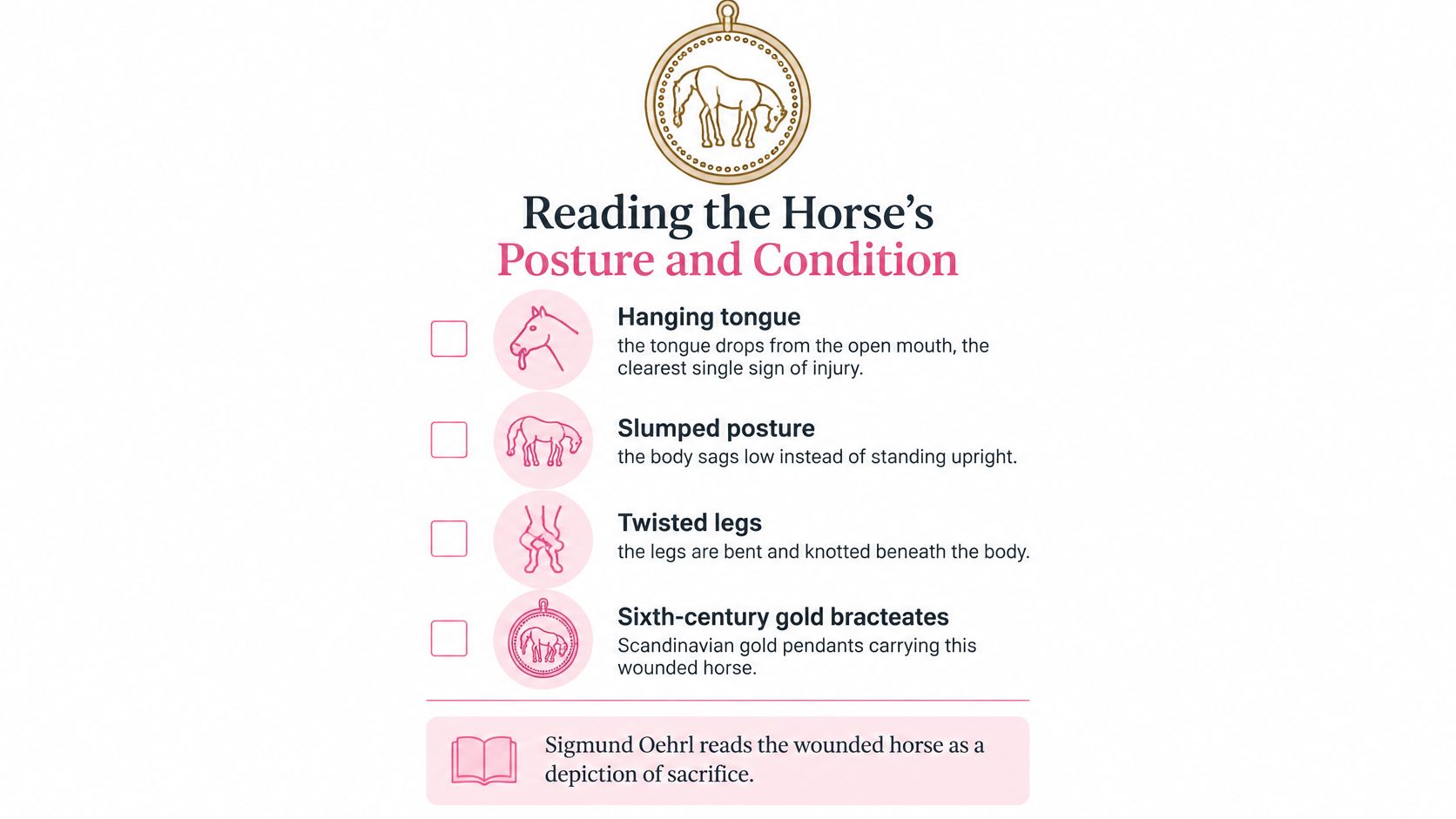
Change the horse's condition and you change the sentence. A vigorous, upright horse can suggest vitality, endurance, or authority. A wounded or restrained horse can suggest vulnerability, recovery, or the passage from suffering to renewal. That is why posture works like punctuation in a sentence. The animal stays the same, but the condition changes how the whole sign is read.
Use four checks when the design is unclear. First, look at the body. Upright suggests vitality or authority, slumping suggests distress, and motion suggests a journey rather than a settled bond. Second, check whether the horse is free or held by a bridle. A free horse leans toward independence, while a bridle adds discipline and partnership, which matters when the gift is about trust.
Third, note any added symbol. A horseshoe or clover stacks another meaning beside the horse, adding luck and protection without replacing the animal. Fourth, consider metal and size. Precious metal often signals status, while a small piece reads more like a keepsake than a public badge of rank.
An upright horse suggests vitality. A slumped horse suggests distress.
That direct reading keeps the symbolism grounded. Modern feelings can sit on top of the design, but they should be treated as interpretation. Healing, protection, fertility, and status belong to particular motifs and cultural settings. A pendant becomes clearer when the wearer's history, the object's design, and its wider tradition are kept separate.
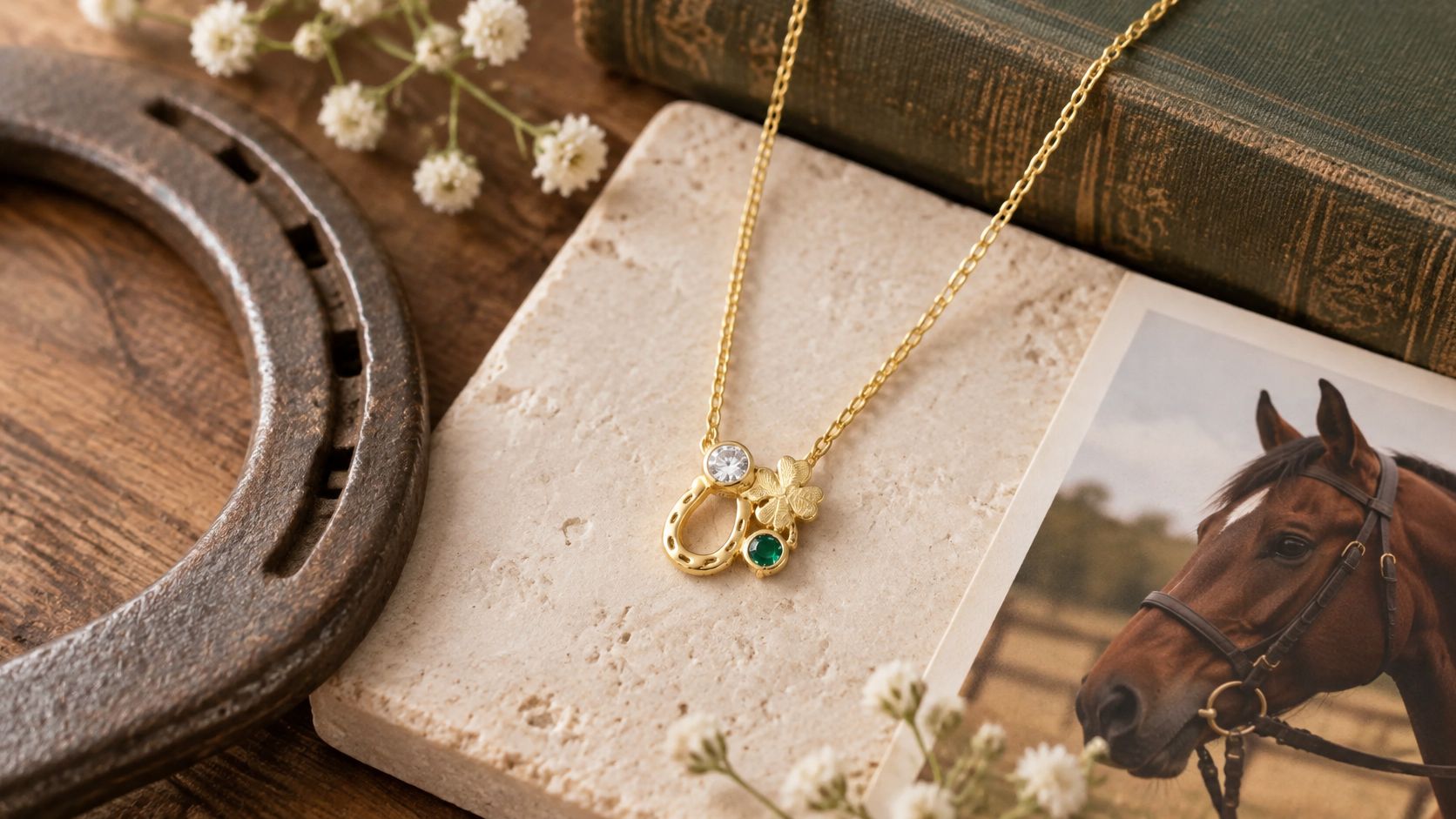
A gold-dipped horseshoe-and-clover pendant works as a compact example. The Lucky Charm Horseshoe Necklace pairs a horseshoe with a clover, and its listed color is gold. On the checklist, there is no horse body to slump or gallop, so posture is absent and the added symbols do the work: horseshoe for luck and protection, clover for an added wish of good fortune. The gold-dipped finish keeps the piece in keepsake range, closer to a personal charm than a ceremonial display. Its meaning rests on the symbols, not on an injured horse or a portrait of one particular animal.
Protection, Fertility and Status Across Cultures
Freedom is the modern headline. Older objects often had a different job: guarding people, guarding herds, and marking who belonged at a rite.
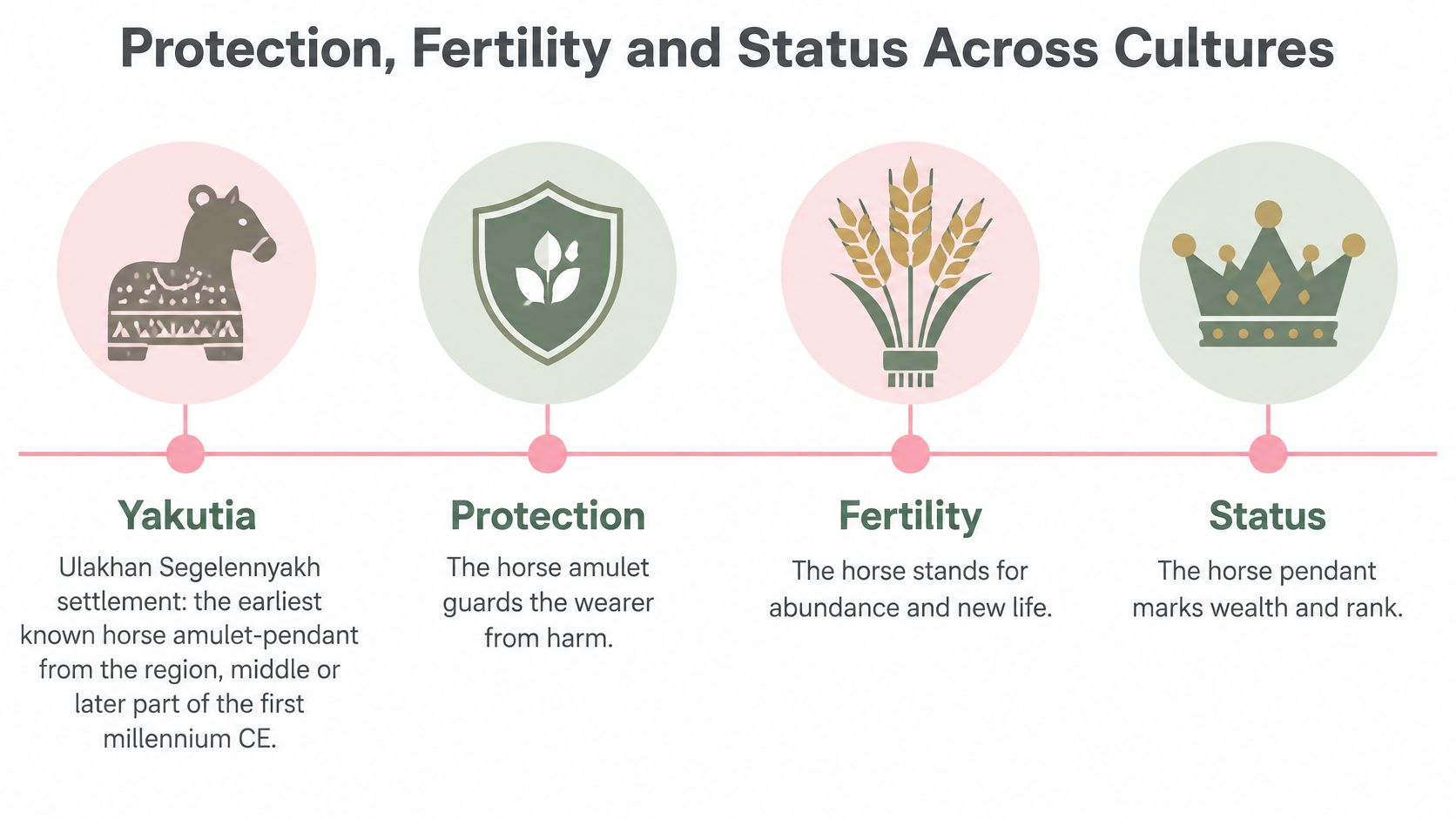
A study of Yakut art places the earliest known horse amulet-pendant from Yakutia at the Ulakhan Segelennyakh settlement, in the middle or latter part of the first millennium CE. The same research documents horse-head pendants in 17th- and 18th-century Yakut burials, with paired horse motifs on clothing and vessels. Some decorated leather koumiss containers used in rites that invoked heavenly deities believed to protect people and livestock. Others were worn on women's festive belts and waistcloths. In that tradition the pendant can mean protection, fertility of herds, a link to celestial powers, ancestry, and ceremonial identity. The study of Yakut art is the record for those objects, and it also notes Egyptian horse amulets cataloged by the Metropolitan Museum of Art from the Ptolemaic or Roman period, about 200 BCE–200 CE, sitting among amulets of baboons, ducks, dolphins, rhinoceroses, and hounds.
What each region actually records
| Region and period | Recorded meaning | Object type |
|---|---|---|
| Egypt, about 200 BCE to 200 CE | Protective amulet | Amulets among other animal figures |
| Yakutia, mid-first millennium CE to the 18th century | Protection, herd fertility, ancestry | Pendants, leather containers, belts |
| China, traditional | Energy and success | Traditional horse emblems |
| Greece and Rome, classical | Divine power, the sun | Depictions of divine horses |
Chinese tradition links the horse with energy and success. Greek and Roman tradition links it with divine power and the sun. Those two lines are broad cultural associations, which a summary of horse symbolism sets beside the archaeological objects above. They are not the same kind of evidence as a burial belt or a museum amulet. Say which one you mean.
A meaning does not travel for free. A Yakut fertility reading does not attach itself to a birthday horseshoe just because both objects show a horse. If you are checking whether a motif is documented, borrowed, or newly invented, the TattoosAI guide to tattoo symbolism is a useful habit: verify the tradition, then decide whether you are using it or only echoing a popular list. Our note on horseshoe necklace meaning stays inside one motif, luck and protection, instead of borrowing a burial rite.
Name the tradition in the gift note when it matters. “This horseshoe is for luck on your first job” is honest. “This is an ancestral herd charm” is a different claim, and it needs a real tie to that history.
Choosing a Pendant for Someone Who Is Not a Rider
Ask what the horse means to this person before you choose. A former rider, a child who loves horses, someone connected to a therapy program built around horses, and someone grieving an animal may all like a horse pendant for different reasons. They are not receiving the same sentence.
That context matters because a symbol works like a word with several meanings. Symblio's horse symbolism overview notes that a pendant may point to one horse, years of riding, recovery, family heritage, remembrance, or the human-horse relationship. A broad meaning can be a starting point, but the best gift note names the person's own connection.
There is a cultural line here too. Native nations have distinct histories and traditions. Generic horse graphics, feathers, or invented “tribal” markings should not be sold or given as authentic Native symbolism. If a design uses those marks without a specific nation and a real source, leave them off the card.
Words that match the occasion
| Intent | Suggested wording | Design to consider |
|---|---|---|
| New beginnings | For a fresh start | Galloping horse |
| Remembering a horse | To honor a beloved horse | Calm or bridled horse |
| Resilience after hardship | To celebrate resilience | Upright horse with horseshoe |
| Riding milestone | To mark a riding milestone | Horse head or horseshoe |
| Encouragement for a child | Luck and hope for you | Horseshoe or calm horse |
Say a grandparent is shopping for a horse-loving girl who does not ride yet. A small horseshoe is easier to explain than a winged horse, and the Precious Pink Horseshoe Necklace keeps the meaning close to luck, hope, and confidence. Bridle Up Hope Shop puts the Pink Horseshoe symbol on many of its products, representing horses, habits, and hope. That makes the symbol useful when the recipient's story is about encouragement rather than a riding résumé.
More occasion matching sits in these jewelry gift ideas.
Three steps before you wrap it
- Name one or two meanings. Use freedom, recovery, luck, partnership, or heritage. Stop at two so the design can carry them.
- Check posture and extra symbols. An upright horse supports resilience. A horseshoe supports good wishes. A slumped horse supports healing, and it is a poor match for a birthday party unless the note says why.
- Write one sentence in your own words. “This is for the gray mare who waited at the gate.” That sentence is the biography. The metal is only the carrier.
A pendant can carry more than one reading, so let the design and the note work together. If the person is not a rider, your sentence gives the horse its place.
Choose the Pendant That Tells Your Story
By now the meaning has a shape: one or two words matched to a silhouette. All that remains is picking the design that carries them without competing with them.
A sentence about strength, independence, or forward momentum wants a full horse body, because a charm crowded with luck symbols dilutes it. The Spirit Horse Pendant Necklace is a horse figure tied to the Year of the Horse, so its cultural note is zodiac hope and momentum rather than the biography of one barn horse. That makes it a natural fit for a recipient born in a Horse year or anyone marking a fresh start. Each purchase also sends 100% of the profits to help the girls, women, and horses at the Bridle Up Hope charity, which gives the gift a second story alongside the zodiac one.
If the choice is still fuzzy because a charm, a pendant, and a bracelet blur together, identify your surprise jewelry piece is a plain-language naming guide that sorts the terms. The distinction matters for gifting, since a bracelet of small horse marks reads differently from one pendant worn close to the heart. Our equine charm bracelet notes compare that format when a single necklace feels like too loud a statement.
The pendant holds the symbol. Your sentence gives it a life. Choose the design that matches the story you want told.
Bridle Up Hope Shop is a gift shop for horse lovers, with English and Western jewelry, apparel, and keepsakes chosen for riders, kids, and anyone who wants a horse close by. A pendant's meaning comes from the design and from the note you attach, and every purchase supports girls and women through horses and habits. Visit Bridle Up Hope Shop and choose the horse pendant that fits the person and the story.
Leave a comment