


Which 7 Habits book do you hand to a 15-year-old who thinks self-help is for her parents, or to a 7-year-old who starts five projects and finishes none? Many guides name one title and stop there, leaving readers unsure which version fits. The 7 Habits books come in three separate lines for different readers, with the same core ideas presented through different vocabulary, length, and artwork.
The books map childhood lessons to adult habits, but reading alone does not create lasting routines. A cue can prompt a habit, and returning to it after a missed day helps keep it going. Follow-through depends on practice and recovery, not a fixed 21-day rule.
Table of Contents
- Which 7 Habits Book Fits Your Reader
- The Seven Habits in Order and What Each One Asks
- Reading the Happy Kids Set Lesson by Lesson
- What the Evidence Does and Does Not Show
- Turning the Habits Into Daily Practice
- Choose Your 7 Habits Book Today
Which 7 Habits Book Fits Your Reader
The fastest way to choose is to look at the reader, not the title. Three lines carry the same ideas at three reading levels, and each one lands differently depending on who opens it.
7 Habits book lineup by reader
| Title | Author | Best for | Reading age |
|---|---|---|---|
| The 7 Habits of Highly Effective People | Stephen R. Covey | Adults in work and life | Adult reading level |
| The 7 Habits of Highly Effective Teens | Sean Covey | Teenagers | Teen reading level |
| The 7 Habits of Happy Kids (boxed set of seven) | Sean Covey | Children and parents reading together | 2 to 8 years |
Nothing changes between those rows except vocabulary, length and illustration. A habit is a habit whether it's explained in a 464-page paperback or a 32-page picture book about a squirrel who won't clean his room. The adult book is the source the other two draw on, so anyone who wants the original framework, including the maturity continuum and the four-quadrant time matrix, starts with Covey.
The rule that settles most decisions: match the book to the reader's age and reading stamina, never to the reader's ambition. A motivated 13-year-old still does better with the teen edition than with the adult original.
Here's the three-part test:
- Adults managing work, a team, a household or a relationship: the original 7 Habits of Highly Effective People. It's the only one of the three that builds the full framework.
- Teenagers: the 7 Habits of Highly Effective Teens by Sean Covey reframes the same seven principles around school, friendships, parents and early decisions about the future. Teen readers tend to accept it because the examples sound like their week.
- Parents and gift-givers for young children: the Happy Kids boxed set, seven short stories meant to be read aloud and reread.
One note on the numbers, because they get quoted carelessly. The adult title was first published on August 15, 1989, and by 2014 had sold more than 25 million copies and been translated into 52 languages, as NBC News reported. Mind Tools put sales at more than 15 million copies in its 2024 write-up. Figures for this book swing widely between sources, so quote the year with the number or don't quote it at all.
The Seven Habits in Order and What Each One Asks
Covey presents the seven habits as a sequence, not a collection of tips. The order traces a path from dependence to independence and then to interdependence, a progression FranklinCovey calls the Maturity Continuum. Habits 1 to 3 make up the Private Victory, with an emphasis on personal responsibility, defining goals and managing yourself. Habits 4 to 6 form the Public Victory, where the focus shifts to relationships, communication and collaboration. Habit 7, Sharpen the Saw, supports the other six through renewal, preserving the energy and skills needed to keep practicing them, as described in FranklinCovey's course outline.
The seven habits, their phase and core question
| Habit | Phase | Core question it answers |
|---|---|---|
| 1. Be Proactive | Private Victory | Am I choosing my response or just reacting? |
| 2. Begin With the End in Mind | Private Victory | What result do I want, and how will I measure it? |
| 3. Put First Things First | Private Victory | Is my time going to important work, not just urgent work? |
| 4. Think Win-Win | Public Victory | Does this agreement benefit both sides? |
| 5. Seek First to Understand, Then to Be Understood | Public Victory | Have I listened before I respond? |
| 6. Synergize | Public Victory | Can we create a result better than either of us alone? |
| 7. Sharpen the Saw | Renewal | What keeps my energy and skills sustainable? |
Why the sequence matters more than the list
Consider a team leader who begins a project meeting with Habit 6, Synergize, but has skipped Habit 2. She asks colleagues to collaborate without defining what a finished project should achieve. They bring incompatible drafts, and the discussion becomes a negotiation over taste. The problem is not a lack of teamwork. They have no shared destination to guide it.
That is why personal mastery comes before collaboration in Covey's sequence. A clear goal gives people a common point to work toward, much as a destination helps travelers choose a route together.
What Habit 3 asks of your calendar
Habit 3 uses a four-quadrant matrix organized around urgency and importance. Urgent work demands attention now and is often easy to notice, like a ringing phone. Important work advances your mission, values or high-priority goals. FranklinCovey's Habit 3 page identifies planning, creative thinking, learning and renewal as examples of important but not urgent activities. These tasks can bring lasting value, yet are easy to leave off a busy calendar.
Habit 2 sets the direction for that calendar. In its announcement of its reimagined course, FranklinCovey describes Habit 2 as defining clear measures of success and making a plan before acting, with goals ranging from the next few hours to an entire lifetime. Habit 3 turns those measures into scheduled work, so the week reflects the mission rather than whichever demands are loudest. Effectiveness here means finishing the tasks that trace back to the mission you wrote down.
A quick self-audit: open last week's calendar. If it contains nothing from the important-but-not-urgent quadrant, Habit 3 has not yet shaped your schedule, however busy the week felt.
Reading the Happy Kids Set Lesson by Lesson
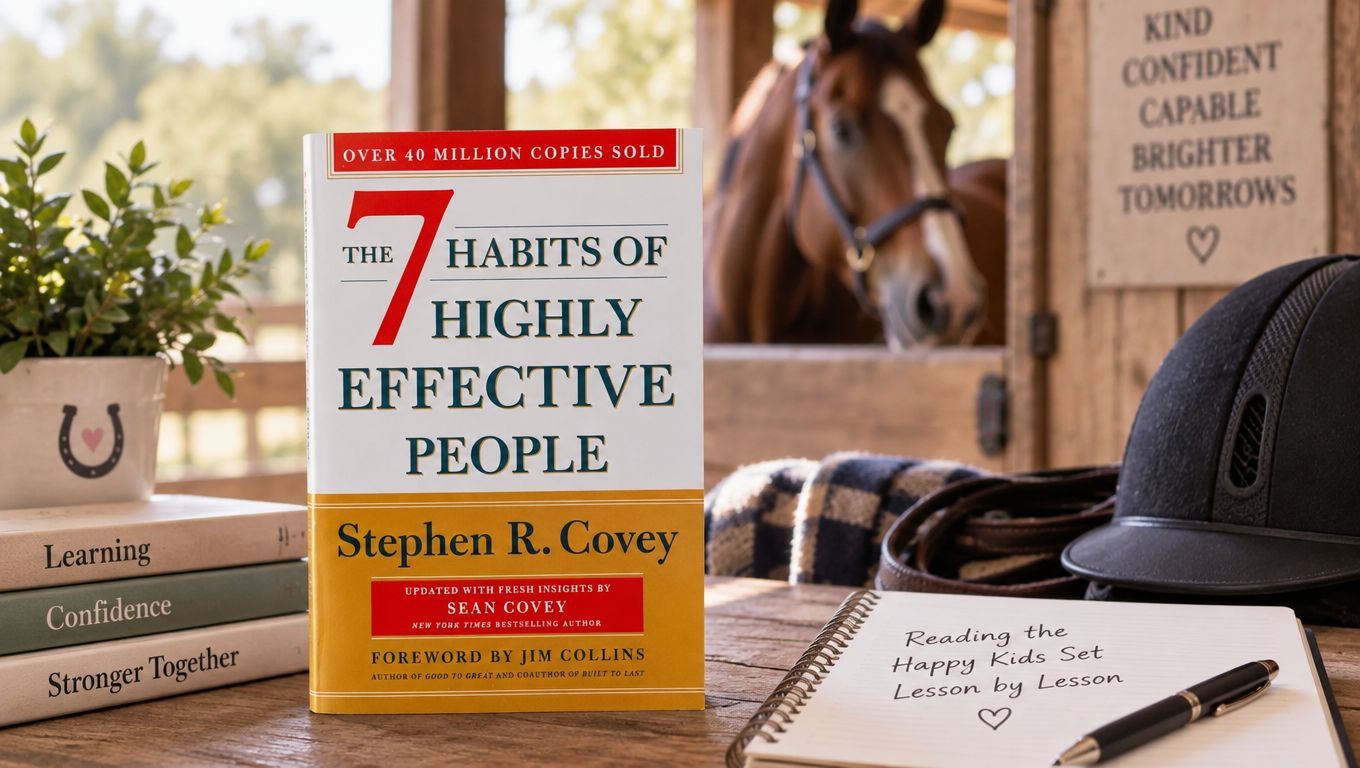
The Happy Kids line is seven hardcover picture books, 32 pages each, written by Sean Covey and illustrated by Stacy Curtis, set in the fictional town of 7 Oaks. The cast rotates: Pokey, Allie, Jumper, Sammy, Lily, Sophie and Goob each carry one story and one lesson, and the reading age runs from 2 to 8 years. The 7 Habits of Happy Kids Collection gathers all seven in one box, which matters because children return to the same story for weeks.
Happy Kids books, lessons and closest adult habits
| Book | Lesson | Closest adult habit |
|---|---|---|
| Just the Way I Am | Being yourself | Be Proactive |
| When I Grow Up | Planning ahead | Begin With the End in Mind |
| A Place for Everything | Staying organized | Put First Things First |
| Sammy and the Pecan Pie | Finding your strengths | No direct match; nearest is Sharpen the Saw |
| Lily and the Yucky Cookies | Listening | Seek First to Understand, Then to Be Understood |
| Sophie and the Perfect Poem | Working together | Synergize |
| Goob and His Grandpa | Valuing friendship | Think Win-Win |
The right-hand column is an editorial comparison, not something the publisher claims. One story sits outside the seven habits entirely: Sammy's search for what he's good at is a strengths lesson rather than a restatement of Covey's framework, and that's fine. Not every good children's lesson needs an adult counterpart.
How to read them aloud without turning it into homework
Start with the title that matches the child's current struggle, not with book one. A child who melts down over mistakes needs Just the Way I Am tonight; a child who leaves boots, books and crayons across three rooms needs A Place for Everything. Read the story, then ask two questions and stop: which character used the habit, and what would you do in that situation next week?
Then repeat the same book for two or three weeks. Children extract the lesson on the fourth or fifth pass, not the first, and rotating through all seven in seven nights teaches nothing except that books end.
For classrooms and family reading time: one book per fortnight beats one book per night. The repetition is the curriculum.
A suggested order for a young child: Just the Way I Am first, because self-acceptance is the floor everything else stands on, then When I Grow Up for planning, then the remaining five as the child's own challenges surface. The boxed set works as a birthday or holiday gift for exactly this reason, since the set lets a family follow the child's development instead of the publication order.
What the Evidence Does and Does Not Show
The 7 Habits books draw on philosophy, character ethics, and practical wisdom. A psychologist's review of the book notes that the framework describes how effective people act, while offering limited guidance on overcoming psychological barriers to follow-through. Readers can use the books as a way to reflect on choices and behavior, rather than as a treatment protocol.
Research on habit formation can help set expectations, though it does not test the books themselves. A 2024 systematic review and meta-analysis covering 20 studies and 2,601 participants reported median habit-formation times of 59 to 66 days, mean estimates of 106 to 154 days, and individual results ranging from 4 to 335 days. The wide range shows why a fixed 21-day rule is a poor guide. Repeated cues and returning to a routine after a lapse are more useful measures of progress than a calendar deadline.
The sales record shows reach, which is not the same as proof. According to Deseret News, the title was the number one business book in Japan in 1997, selling nearly 1 million copies there that year, in a market publishing more than 60,000 new titles annually. Those figures describe how widely the framework was read; they do not establish that it causes lasting behavior change.
Before choosing a book, check three things:
- Reading level: Does the edition suit the person who will read it?
- Purpose: Does the reader want ideas for reflection, or a routine to follow?
- Setting: Is there a stable time and place for practice, or will the ideas stay theoretical?
For parents building routines with a toddler, predictable daily structure can make cues easier to use. This guide to nurturing growth in the first five years discusses routines that support young children's development.
Turning the Habits Into Daily Practice
A book gives you a principle; a plan gives you a way to use it on an ordinary morning. An implementation intention is a precommitted if-then statement that names when, where and how an action will happen. A meta-analysis of 94 independent tests found that implementation intentions improved goal attainment with an effect size of d = .65, a medium-to-large effect, according to the National Cancer Institute's summary of the research. The cue prompts the planned response, so the action depends less on how motivated you feel at the time.
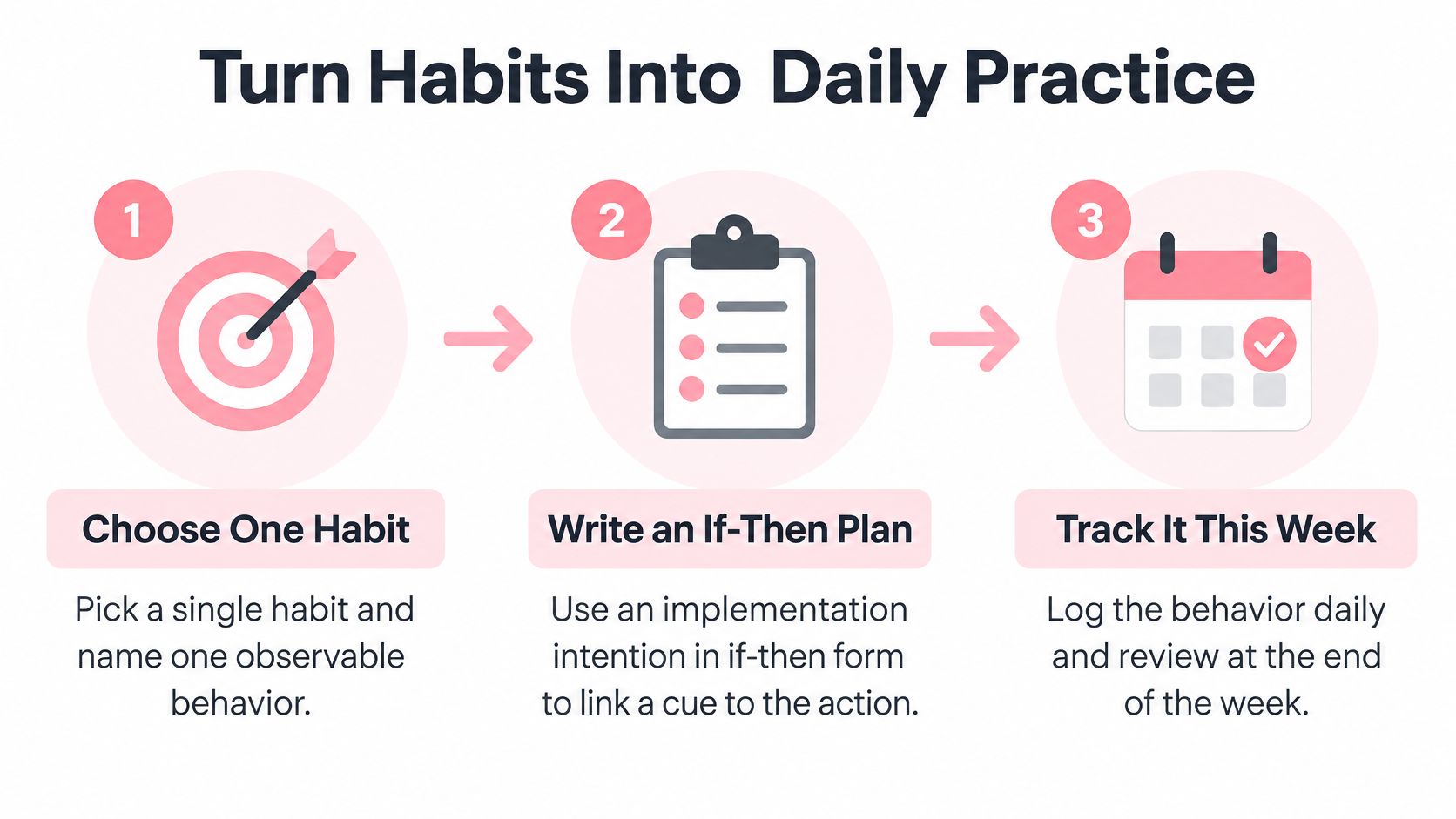
Use these five steps to put one habit into practice this week:
- Choose one habit. Describe a behavior you can observe, such as “send the client update before lunch.” A broad intention like “be more proactive” is harder to track because it does not specify an action.
- Write the if-then plan in full. For example: “If the workday begins at 8:30 a.m., then I will spend 20 minutes identifying my highest-value task before opening email.” The cue tells you when to act; the response says what to do and for how long.
- Set a realistic timing expectation. Habit automaticity builds gradually. In a 12-week study of habit formation, 82 participants' estimated times to reach 95% of their maximum automaticity ranged from 18 to 254 days. Early repetitions brought the biggest gains. Track whether the cue prompts the action, rather than expecting a fixed number of days to make it automatic.
- Plan how to resume after a missed day. Start again at the next scheduled cue. One missed repetition does not erase what you have learned. Repeating an action in a stable context builds the pattern, so a lapse is a reason to resume, not to restart your count or judge your character.
- Review after three weeks. Ask whether the cue appeared, whether you followed through and whether the action felt slightly easier in week three than in week one. If the cue never comes to mind, adjust the cue instead of relying on willpower alone.
A change in routine can also mean sorting through outgrown toys and books. For stuffed animals a child no longer uses, donation advice from Snugglebug explains how to clean and pass them on.
Before you close this page, write one cue, one action and one duration for a workday task or a child's bedtime routine. A specific plan makes a habit easier to try and easier to review.
Choose Your 7 Habits Book Today
Which book will help turn a good intention into a repeatable action? The adult book presents the original framework in full, while the Happy Kids stories echo its ideas in language children can follow. A picture book can give a child a simple cue for practicing a habit; the adult edition can help a parent explain the idea and model it.
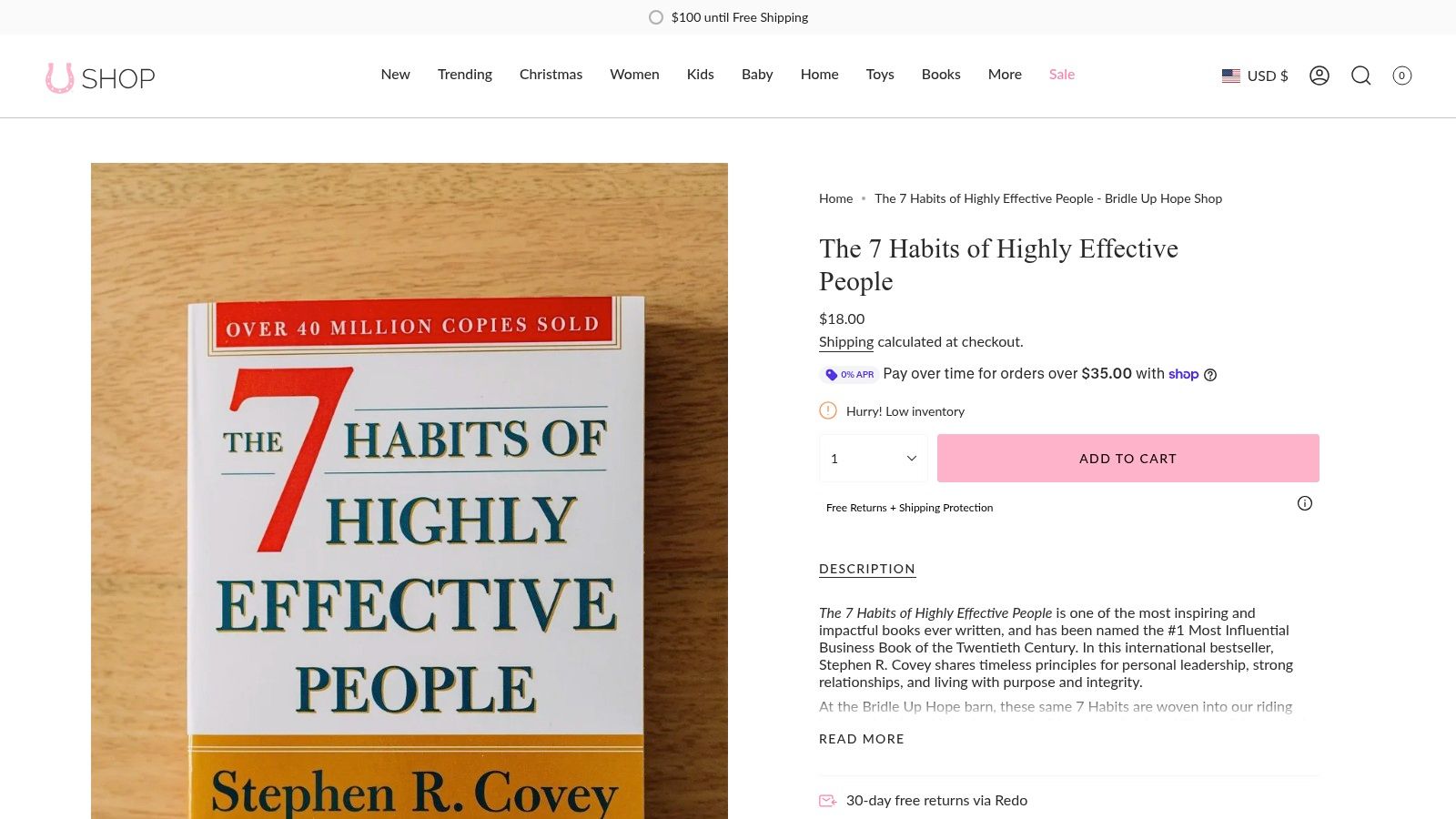
At Bridle Up Hope Shop's edition of The 7 Habits of Highly Effective People, readers can start with Covey's original framework rather than a summary. Choose one habit, connect it to a familiar daily cue, and plan how to resume after a missed repetition. Follow-through depends on that cue and recovery, not on completing a fixed 21-day countdown.
Bridle Up Hope Shop donates 100% of its annual net profits to the Bridle Up Hope foundation, which supports girls and women through horses and habits. Its horse-themed books sit within a broader catalog for horse lovers of different ages.
Choose one book that suits your reader, then begin with one manageable habit. Visit Bridle Up Hope Shop to browse its 7 Habits books and other equestrian gifts.

Deje un comentario