


The text message says "she's a size 2" and nothing else. Now you're on a website with forty pairs of boots, half of them taller than the child's leg, and a checkout button that assumes you already know what a calf measurement is.
Here's the part no product filter tells you. English riding boots for girls are stirrup equipment before they are anything else. The heel, the sole and the fit decide whether a small foot stays put on the iron and comes free if she comes off. Style comes after that, and price comes after style.
What follows is the order I'd give any parent standing at the counter, gift-giver included. Choose the shape for the riding she does, check the sole and heel numbers before you fall for the leather, measure instead of guessing, then confirm the show rule. It's more measuring than shopping, and it's why a modest paddock boot often beats an expensive tall one for a rider in her first year.
Table of Contents
- Field, Dress and Paddock Boots Compared
- Safety Specs and Sole Rules That Matter
- Fitting Boots for a Growing Rider
- Show Footwear Rules by Division Type
- Materials and Care That Extend Boot Life
- English Boots Versus Casual Wear for Everyday Style
- Order, Returns and When to Replace
Field, Dress and Paddock Boots Compared
A gift-giver who knows only a girl's shoe size can choose an ankle boot more reliably than a tall pair. Tall boots also need a calf measurement, and a growing rider may outgrow the shaft before the foot. Choose the boot shape around how she rides, then check what the venue permits.
| Boot type | Typical shape | Best for | Check before buying |
|---|---|---|---|
| Field boot (tall) | Calf-high shaft, leather or synthetic | Lessons, shows, traditional look | Defined heel, continuous sole, calf fit |
| Dress boot | Tall, sleek, slimmer shaft | Formal and dressage-style classes | Visible heel, shaft height against calf measurement |
| Paddock or jodhpur boot | Short ankle boot with laces or zip | Daily lessons, hacking, younger riders | Heel at least 0.5 inch, ankle support |
| Rubber riding boot | Full-length waterproof rubber | Wet yard work, muddy turnout | Smooth sole and defined heel; Wellington-style boots unsuitable |
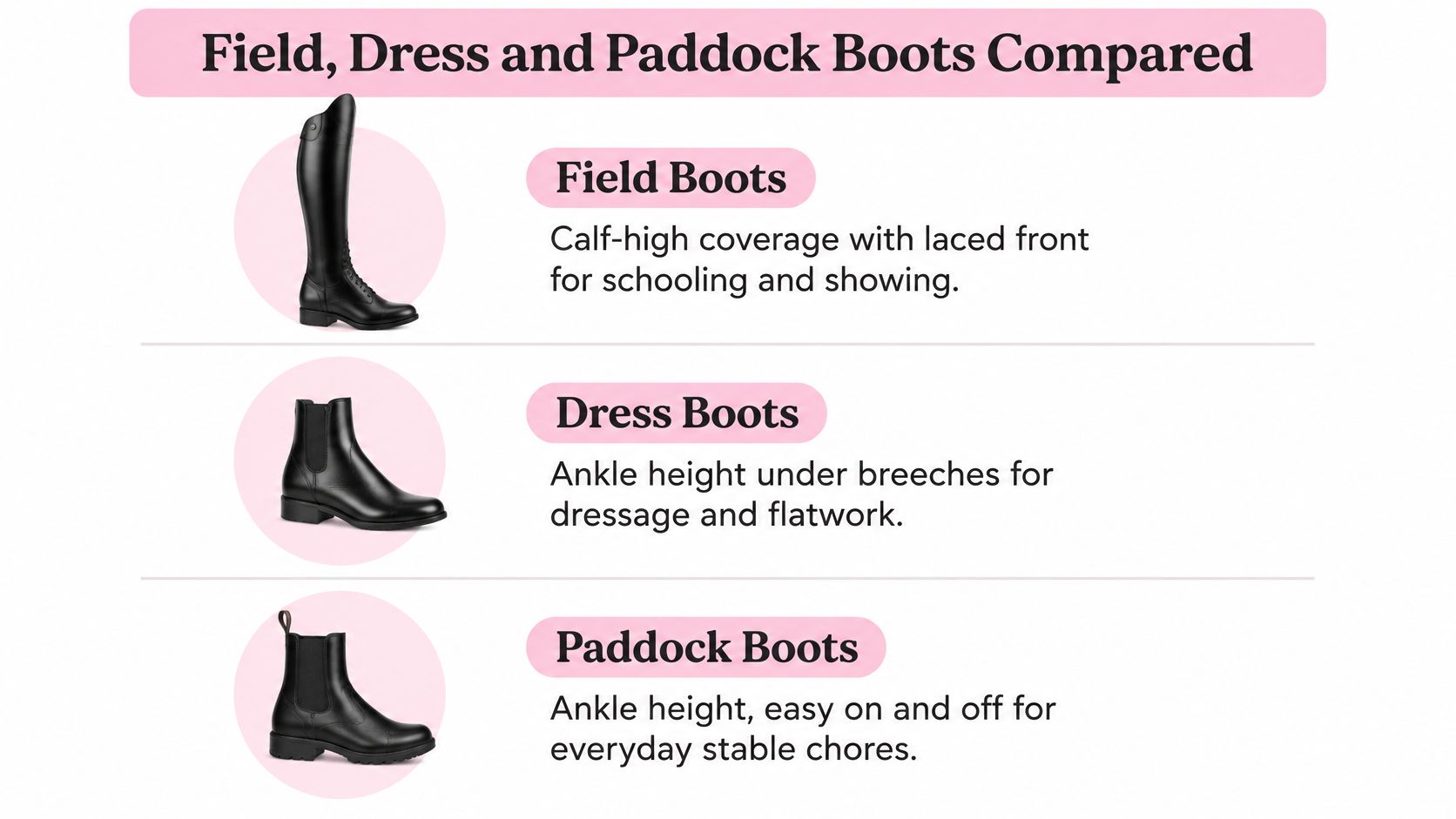
Tall field boots cover the calf and suit traditional lessons and shows. Fit depends on calf circumference as well as foot length, so measure the widest part of the calf before ordering. Lacing at the instep allows more ankle flex, which can help when the rider's position changes over a jump.
Dress boots have a sleeker cut and slimmer shaft for formal and dressage-style classes. Check the shaft height against the rider's calf measurement. Their fit can be less forgiving as a child grows, so they are rarely a practical first pair.
Paddock or jodhpur boots stop at the ankle and fasten with laces or a zip. Riders wear them with jodhpurs or half chaps for lessons and hacking. They are often a practical choice for a growing rider: replacing a short boot does not require matching a new calf measurement to a tall shaft. For a fuller look, pair them with half chaps for horse riding.
Rubber riding boots suit wet, muddy yard work, but the pair must still have a smooth sole and defined heel. Wellington-style boots may work for mucking out; they are unsuitable for riding.
The history of riding footwear reflects different needs, from protective, stiffened jack boots to lighter boots that allowed easier walking after dismounting. The National Museums Scotland account of British jack boots describes that contrast.
Use this buying order:
- Start with paddock boots for a first year of lessons. They are easier to fit as feet grow and work with half chaps.
- Choose tall field or dress boots when a class or show calls for them. Measure the calf while the rider wears breeches, not leggings.
- Check the venue's footwear rule before paying. A boot can suit riding and still fail a show's requirements.
Safety Specs and Sole Rules That Matter
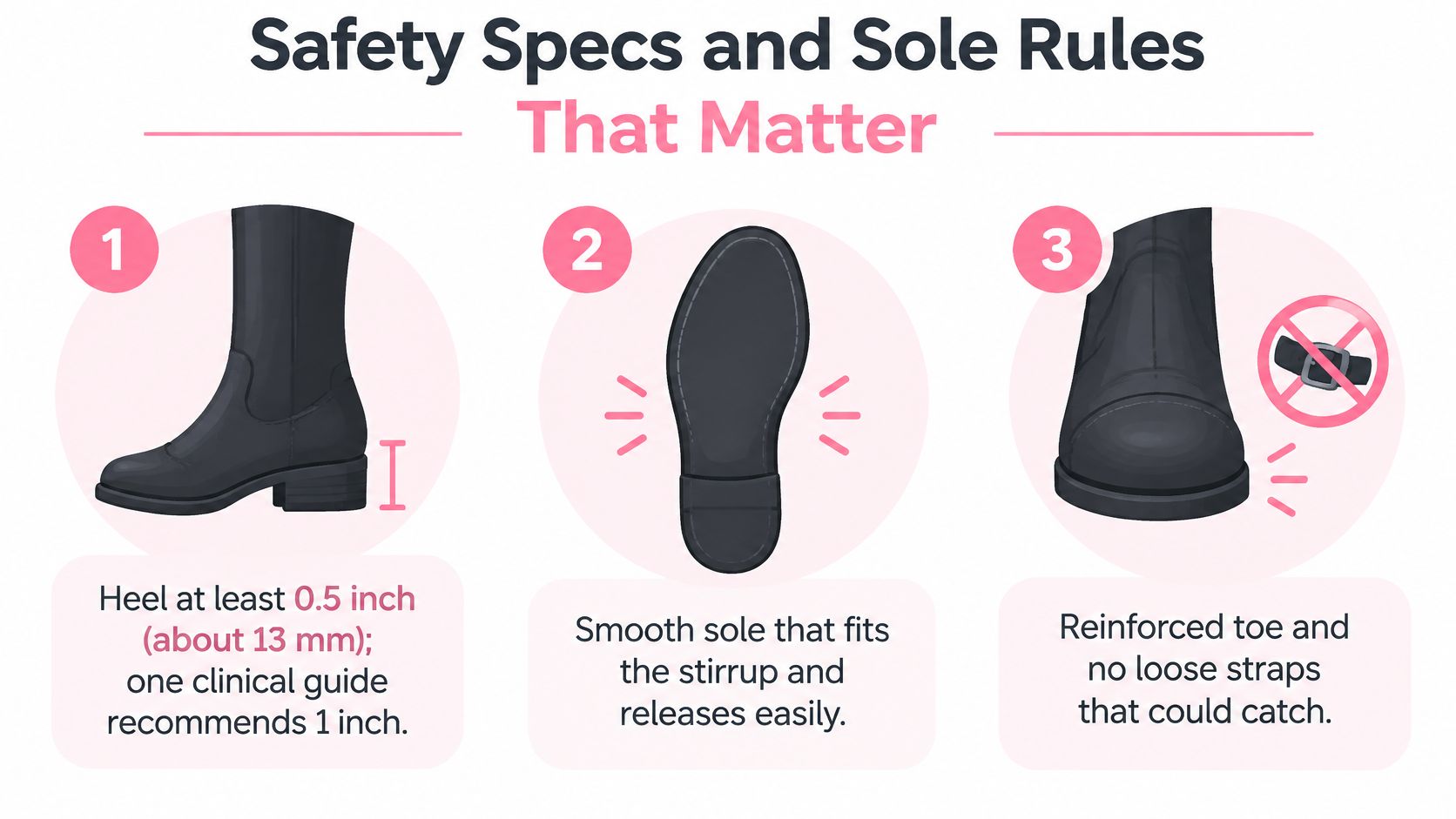
A boot is stirrup safety equipment before it is riding attire. Check the heel, sole and fit against the stirrup, because a poor match can trap a foot during a fall.
| Feature | Working value | Why it matters |
|---|---|---|
| Heel height | At least 0.5 inch (about 13 mm) | Helps stop the foot sliding through the stirrup |
| Sole | Smooth and continuous from heel to toe | Reduces the chance of the sole catching in the stirrup |
| Tread | Offset, not a continuous crosswise ridge | Avoids a ridge snagging on the stirrup |
| Stirrup clearance | About 7 mm (0.25 inch) per side, as specified by BETA's footwear guidance | Gives the foot room to release if the rider is unseated |
| Toe and ankle | Closed toe, ankle fully covered | Protects the foot and supports the ankle |
The British Horse Society's footwear guidance sets a minimum heel height of 0.5 inch, roughly 13 mm. A defined heel helps keep the foot from sliding through the stirrup. The United States Pony Clubs safety handbook also lists practical footwear features for working around horses, including a heel, thick sole, ankle coverage, closed design and secure fastening.
Check the whole sole, not just the heel. A break in the sole or a heavy lug pattern can catch on a stirrup during a fall. Choose a smooth, continuous sole with tread that does not run straight across it. BETA's specification also calls for a solid shank between heel and ball and ankle support. Its stated clearance gives the foot room to release if the rider is unseated.
Toe and ankle coverage provide protection on the ground and in the saddle. A closed toe helps protect against a hoof or dropped equipment, while ankle coverage supports the foot inside the boot. Washington State University's equestrian-safety guidance likewise calls for footwear with a heel that completely covers the ankle for riders using stirrups.
The Three Step Home Check
Use the actual boot and stirrup, not a product photo.
- Inspect the sole from heel to toe. Run a thumb across it. Reject a break, ledge or continuous crosswise ridge that could catch.
- Hold the boot against the stirrup iron. Check that there is space on either side of the boot, rather than a fit that fills the iron.
- Measure the heel with a ruler. A riding-style shape can look defined but still fall short of the stated minimum.
A suitable boot has a continuous sole, a defined heel, a covered ankle and a fastening that stays secure during a lesson. Trainers, lugged yard boots and fashion boots with prominent lugs are poor choices for riding because their soles can snag.
For a gift-giver who knows only the child's shoe size, treat that size as a starting point, not proof of a safe fit. The rest of the horse riding gear for kids should be chosen for its job, too.
Fitting Boots for a Growing Rider
A gift-giver who knows only a child's shoe size cannot reliably choose a tall riding boot. Growing feet and different calf shapes make fit harder to guess than style, so measure before buying.
Have her stand in the riding socks she plans to wear. Measure both feet and use the larger measurement; then check width, toe room and, for tall boots, calf circumference and boot height. Compare the calf and height measurements with the maker's sizing chart. Toes should move freely, and the heel should stay seated when she walks and flexes her ankle.
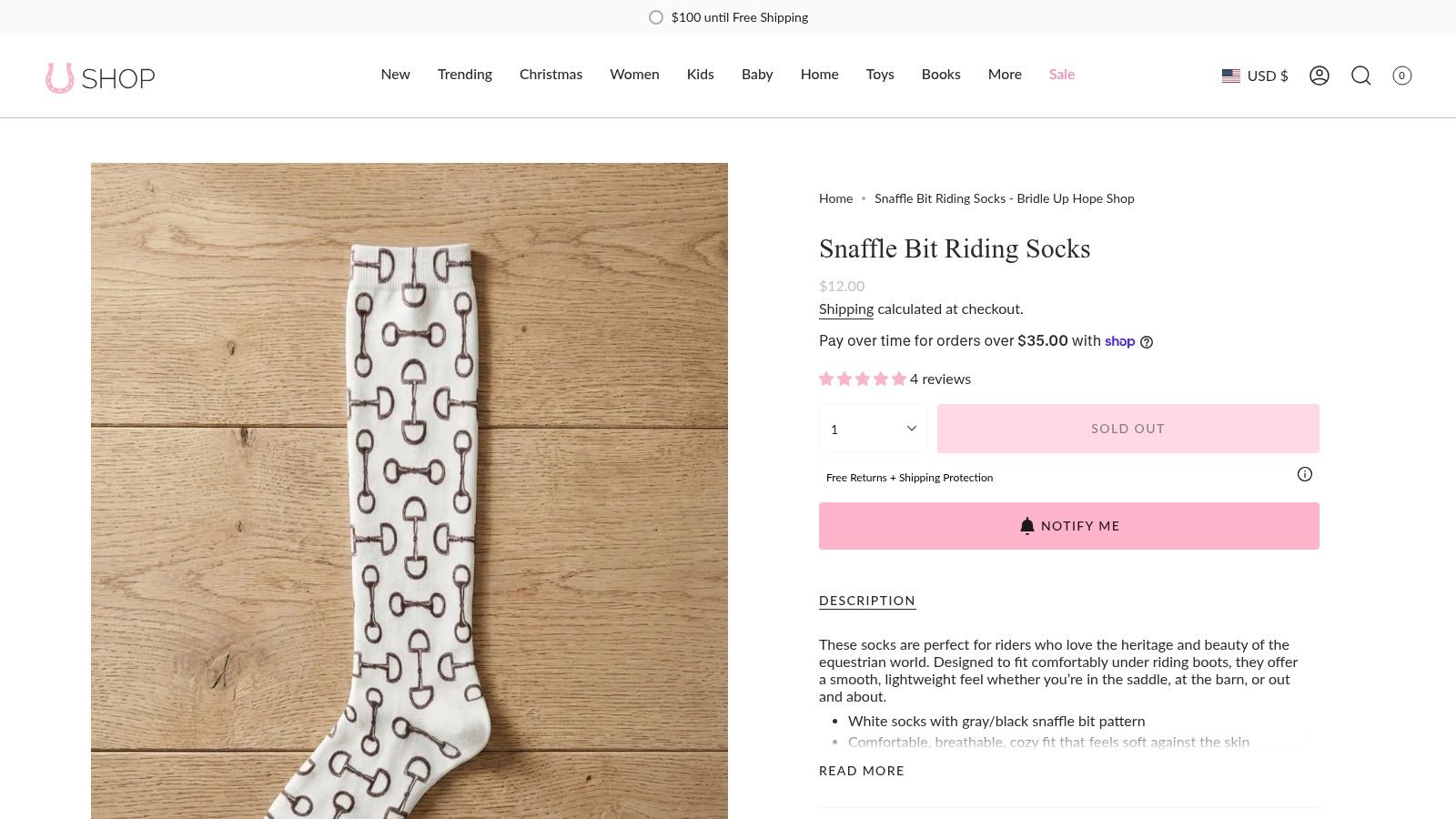
A pair of Snaffle Bit Riding Socks can provide the knee-high layer she will wear under her boots. Measure over riding socks rather than thick winter wool so the fit reflects how she will use the boots.
Pediatric footwear guidance recommends 10–15 mm of space beyond the longest toe, as described in the Cleveland Clinic guide to children's shoe fit. The same guide gives a broader 1–2 cm range and warns that more than 3 cm can let the foot slide inside the shoe.
| Check | Target | If it fails |
|---|---|---|
| Toe allowance | 10–15 mm past the longest toe; 1–2 cm is also within the guide's range | Extra length can let the foot slide and rub in the stirrup |
| Width and depth | Toes move freely without pressure from the upper | Pressure can restrict toe movement |
| Heel retention | Heel stays snug while walking and flexing the ankle | The foot can slide forward in the stirrup |
| Calf on tall boots | Measure circumference at the widest point and boot height | A tight shaft pinches; a loose fit can compromise ankle stability |
| Recheck | Every 4–6 months, or sooner during a growth spurt | A boot that no longer fits can affect stirrup control |
Avoid buying a larger boot to leave room for growth. A 2025 review of children's footwear guidance in PubMed Central notes that commercial sizing is inconsistent and recommendations rely heavily on expert opinion. The school-age study cited in that review found 53.7% of girls wore footwear that did not fit their foot length: 43.7% wore shoes that were too large and 10.2% shoes that were too small. Excess length can cause rubbing and make it harder to keep the foot correctly positioned in the stirrup.
The Growth Clock
Recheck the fit every 4–6 months, or sooner if she has a growth spurt. Keep her foot length, calf circumference and boot height together so you can compare new measurements with the maker's chart instead of relying on the size printed on the box.
For a gift-giver, ask for the length of the larger foot and the widest calf measurement before choosing tall boots. If those measurements are unavailable, a paddock boot is easier to size than a tall boot. Check the exchange terms before ordering, and use this guide to English riding apparel for kids to coordinate the rest of her riding wardrobe.
If riding becomes a family hobby, choosing horses for your riding level is another consideration when planning time in the saddle.
Show Footwear Rules by Division Type
A boot can pass every stirrup test and still be wrong for the class. Competition rules add a requirement of their own.
| Case | Heel rule | What to do |
|---|---|---|
| Standard English-style classes at USEF-governed shows | Boots or shoes must have a distinguishable heel | Choose a boot with a visible heel before entering |
| Listed exception divisions (Arabian, Hackney Pony, Morgan, National Show Horse, Parade, Roadster, American Saddlebred) | Exception wording applies | Read the division's exact rule in the current rulebook |
| Saddle Seat Equitation | Listed exception | Confirm the current rulebook for the class |
| Lessons, pony club and BHS assessments | Smooth sole and defined heel of at least 0.5 inch recommended | Use a riding boot with a continuous sole; BHS footwear is required for assessments |
The United States Equestrian Federation General Rules state that boots or shoes worn while riding anywhere on competition grounds must have a distinguishable heel. That wording is blunt on purpose. A flat-soled fashion boot, a sneaker or a heel-less riding shoe can fail the requirement in a standard English-style division even if it fits beautifully and the child rides well in it.
The exceptions are named rather than implied. Arabian, Hackney Pony, Morgan, National Show Horse, Parade, Roadster, American Saddlebred and Saddle Seat Equitation classes carry their own wording, so the general heel rule does not transfer to them. Read the division you're entering, not the one your friend entered last season.
How to Verify Before You Pay
Three steps, in this order:
- Pull the current rulebook for the specific competition and discipline. Not a forum post from three years ago, and not the version saved on your phone.
- Check the division name on the prize list. The prize list is what the show will judge against, and division names vary between venues.
- Ask the show secretary when a class is unclear. One email in March saves a scramble in the collecting ring in July.
Lessons have their own version of this. Correct riding footwear is required for BHS assessments and the British Horse Society Ride Safe Award, which means the boot your daughter wears to her weekly lesson should already meet the sole and heel standard before a show ever appears on the calendar. Buying a lesson boot that would fail an assessment is a false economy; you'll buy twice.
Before entering anything, answer three questions. What division is she in? Does the boot have a visible heel? Does the sole meet the stirrup rules? If any answer is a shrug, the boot stays at home.
Materials and Care That Extend Boot Life
Material choice matters most at the flex point, where the ankle bends and wear shows first. Full-grain or treated leather holds its shape, softens around the calf over time and resists water reasonably well when conditioned. It also shows scuffs and needs regular care. Synthetic uppers cost less and wipe clean quickly, though they crease at the ankle. For a rider who is likely to outgrow her boots soon, synthetic can be a practical choice. Rubber suits wet turnout and washing off muddy legs, but it is better suited to barn chores than arena riding.
Care by Timing
After every ride
- Wipe off mud with a damp cloth before it dries into the stitching.
- Open zips or laces fully so the inside can dry as well as the outside.
Monthly
- Condition leather, especially at the flex point over the instep, to help prevent cracking.
- Check the sole and heel for wear. A worn heel or smoothed edge can change how the boot sits in the stirrup.
- Clean zip teeth and apply a little soap or zipper lubricant if they begin to stick.
Between seasons
- Stuff the shaft or use boot trees to help it keep its shape instead of folding at the ankle.
- Store boots upright in a cool, dry place, away from radiators and direct sun, which can harden leather.
- Rinse rubber boots and let them dry at room temperature, not against a heater.
Treat the sole as a wear part. When the tread has flattened or the heel edge has rounded, the boot may no longer sit securely in the stirrup.
Replace the boot if the shaft cracks through, the sole splits or breaks, the heel loosens from the boot, or the shaft can no longer hold the ankle upright. These are structural failures, not cosmetic wear. A repair that leaves the boot unstable does not restore its job as riding footwear.
English Boots Versus Casual Wear for Everyday Style
At the school harvest event, her tall riding boots look right with the horsey theme. The gym's smooth tile floor changes the calculation: a riding boot's smooth sole can slip on tile, so she should change into footwear suited to walking indoors.
Casual boots are for pavement; riding boots are for stirrups. Lessons, barn days and show classes call for riding footwear that fits the tack and the rules for that activity. For school, shopping and long walks, choose casual shoes with grip and cushioning.
Styling That Reads Intentional
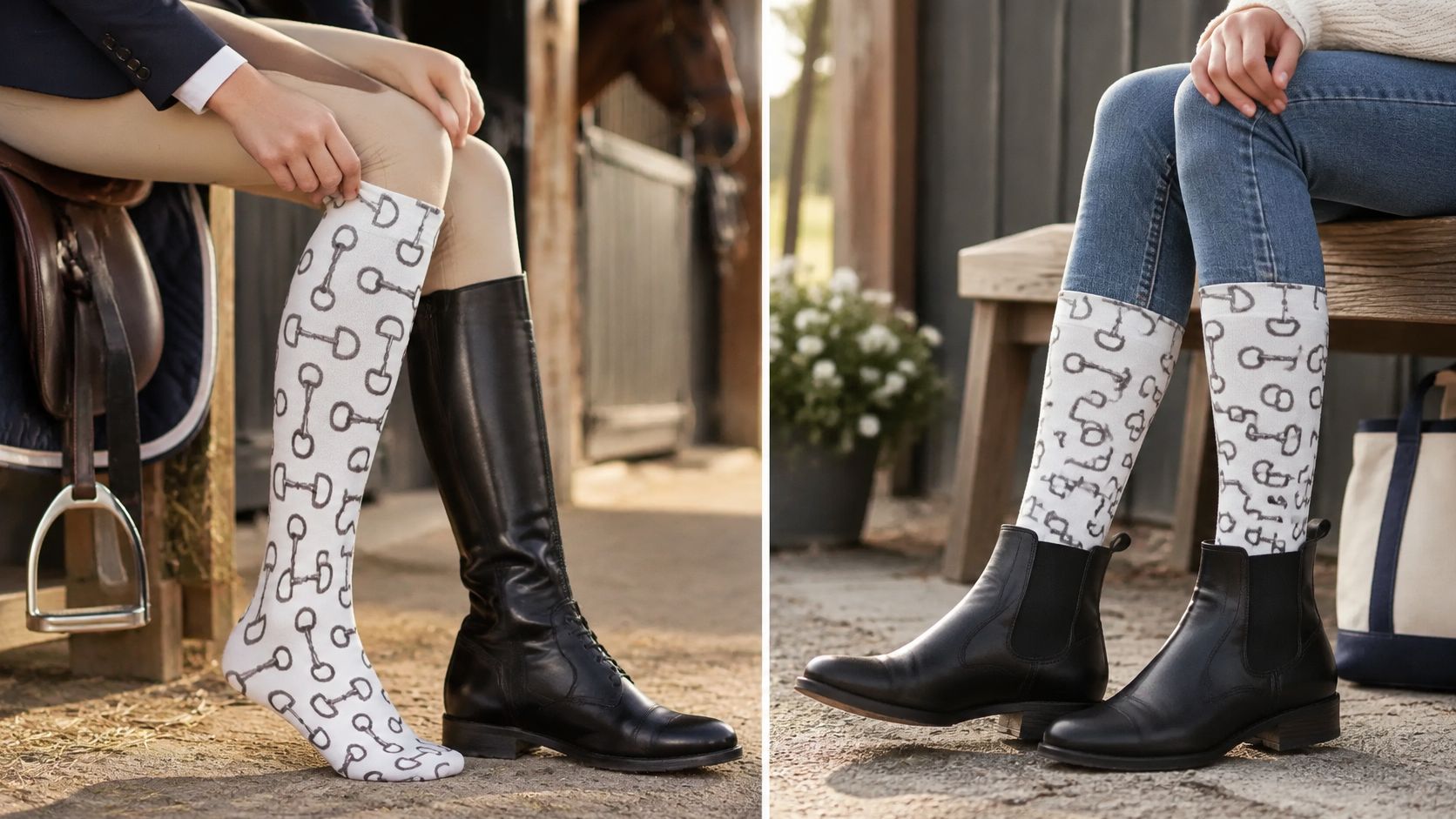
- Paddock boots with slim jeans or leggings and a sweater create a relaxed equestrian look for everyday wear.
- Tall boots with riding-style trousers or a skirt keep the outfit traditional. Keep the rest simple so the boots remain the focus.
- Brown leather tones with a matching belt or bag make a coordinated outfit. Choose pieces that look deliberate together.
Where Casual Footwear Wins
For a long walk around town, a flat-heeled ankle boot is more comfortable than a riding boot. Sneakers suit a school day that includes a run across the grounds. Reserve riding boots for riding, and change footwear when the day shifts to pavement or indoor floors.
Growing feet make style a secondary consideration: a boot that pinches will see little use, however good it looks. For a gift, ask the parent to confirm fit before choosing a pair based only on the child's shoe size.
Order, Returns and When to Replace
Before buying, confirm the boot is English-style, with a sole and heel suited to the rider's stirrups. Bridle Up Hope Shop carries both English and Western designs, so check the product details rather than choosing by appearance alone. Western boots have different heel and sole shapes; the right choice depends on the riding equipment and its requirements.
For limited-quantity online-exclusive products, returns and exchanges follow the Refund Policy. Read its terms before ordering, especially when buying a gift.
For fit measurements, use the guidance in the fitting section. For signs that boots need replacing, see the care section.
Bridle Up Hope Shop is a gift shop for horse lovers, with English and Western designs. It donates 100% of its profits from each purchase to help the girls, women, and horses at Bridle Up Hope, whose mission is to inspire hope, confidence, and resilience through horses and habits.
Deje un comentario