


You packed one pair for a Saturday lesson and a Sunday trail ride, then spent the second hour tugging a waistband that gapped and a hem that stacked over your boot. Standing in the aisle, those jeans felt fine. Once your knee bent and the saddle leather started working the inner thigh, the same pair pulled, folded, and shifted.
The best jeans for horseback riding are not one brand that wins every day. They are the pair that matches the discipline, the hours, and the weather you ride in. Denim can cover skin and take friction. It cannot replace an approved helmet, a boot with a heel, or tested protective gear.
Table of Contents
- Quick Picks by Discipline and Ride Length
- English and Western Jeans Compared
- What Makes Riding Denim Hold Up
- How to Check Fit in the Saddle
- Protective Jeans Versus Everyday Denim
- Choose Your Pair and Keep It Riding-Ready
Quick Picks by Discipline and Ride Length
A rider who buys one pair for arena lessons and trail days usually ends up compromising both. Lessons want a clean leg under tall boots or half chaps. Trail and ranch work want a hem that stays over the boot shaft and seams that survive gates and rope. Hours in the saddle change the answer more often than the logo on the pocket.
Shoppers are not short on options. The U.S. equestrian apparel market was estimated at USD 1.9 billion in 2025, according to Global Market Insights Inc.. More choice does not mean one cut works for every saddle.
Jean styles by riding situation
| Riding Situation | Jean Style | Fit Priority | Key Feature |
|---|---|---|---|
| English arena lessons | Slim or straight stretch denim | Close through thigh and knee | Smooth inner leg that fits under half chaps or tall boots |
| Western trail or ranch work | Bootcut or straight midweight denim | Relaxed seat with full hem | Hem long enough to cover the boot shaft; tough seams for gates and rope |
| Multi-hour trail ride | Midweight stretch denim with reinforced seat | Close seat with mobile knee | Abrasion resistance over long saddle time |
| Wet trail or mountain ride | Riding tights or stretch synthetic blend | Moisture management and quick drying | Denim dries slowly once soaked |
| Hot, dry climate | Lightweight stretch denim | Close fit with less heat under the seat | Breathable weight |
| Protective sessions with green or young horses | Protective riding jeans with abrasion-resistant panels | Close fit over knee and seat | Certified reinforced panels, checked before purchase |
| Barn chores and ground work | Any sturdy denim | Comfortable movement | No loose pockets, chains or decorative holes |
English arena work favors slim or straight stretch denim that slides inside tall boots or under half chaps. A bulky outer seam or a wide flare fights the boot and the stirrup leather.
Western trail or ranch days call for a bootcut or straight midweight with a hem long enough to cover the boot shaft. Tough seams matter when you swing a gate or handle a rope, and a hem that rides up leaves the shaft rubbing your ankle.
A multi-hour trail ride is where heavy raw denim often loses. It can stiffen as the day goes on, and the seat takes continuous rub. A midweight stretch blend with a reinforced seat keeps the knee mobile without turning the jean into a thin fashion fabric.
Wet or mountain rides are a different problem. Utah State University Extension wants full-length, sturdy, close-fitting pants without loose fabric, chains, decorative holes, or protruding pockets, because those details snag around horses and trail obstacles. The same guidance is a poor fit for soaked cotton: denim dries slowly, so riding tights or a stretch synthetic blend manage moisture better when you will be wet and still walking between mounts.
Hot, dry weather suits lightweight stretch denim so heat does not build under the seat. Protective sessions on green or young horses are not a denim problem at all. Those days call for protective riding jeans with abrasion-resistant panels you can verify before you buy. Barn chores can use any sturdy denim, as long as pockets stay flat and there are no chains or decorative holes.
Practical rule: Start with hours in the saddle. Then check expected precipitation, time spent walking between mounts, and whether you want casual versatility or technical performance.
English and Western Jeans Compared
Boot shaft and saddle type set the cut. English riders want a narrow straight or slim leg that disappears inside tall boots or under half chaps, stretch for knee flexion, flatter seams, and a close seat. Western riders need a bootcut or straight leg with enough hem to cover the boot shaft, denim that stands up to coarser leather, a roomier seat, and a hardware check so rivets and belt loops do not become snag points.
Mississippi State University Extension says jeans and pants should be worn when working around horses, particularly when riding, because jeans protect the rider's legs from pinching and rubbing caused by coarse saddle leather. That layer matters most on Western saddles and other saddles with a rougher surface. Shorts leave skin against that leather. Leg coverage is the point.
English versus Western riding jeans
| Feature | English Riding Jeans | Western Riding Jeans |
|---|---|---|
| Leg cut | Narrow straight or slim leg that fits inside tall boots or half chaps | Bootcut or straight leg that clears the boot |
| Hem length | Ends at or just above the boot top without bunching | Long enough to cover the boot shaft without riding up |
| Fabric | Stretch denim or stretch blend for knee flexion | Heavier denim that tolerates coarse Western leather |
| Seat and seams | Close seat with flat, reinforced seams | Roomier seat; check rivets and hardware for snags |
The trade-off runs one direction. A slim English leg leaves little fabric to pass over the boot, so a heavy Western weight fights the boot instead of sitting in it. A bootcut Western jean gives room at the hem, which is wasted inside a tall boot. Pick the weight to match the boot, then confirm the seat.
Try the pair with the boot you ride in. Heel height and shaft shape change where the hem lands. A jean that looks long over sneakers can be the right length over a Western boot, and the same length can bunch inside an English tall boot.
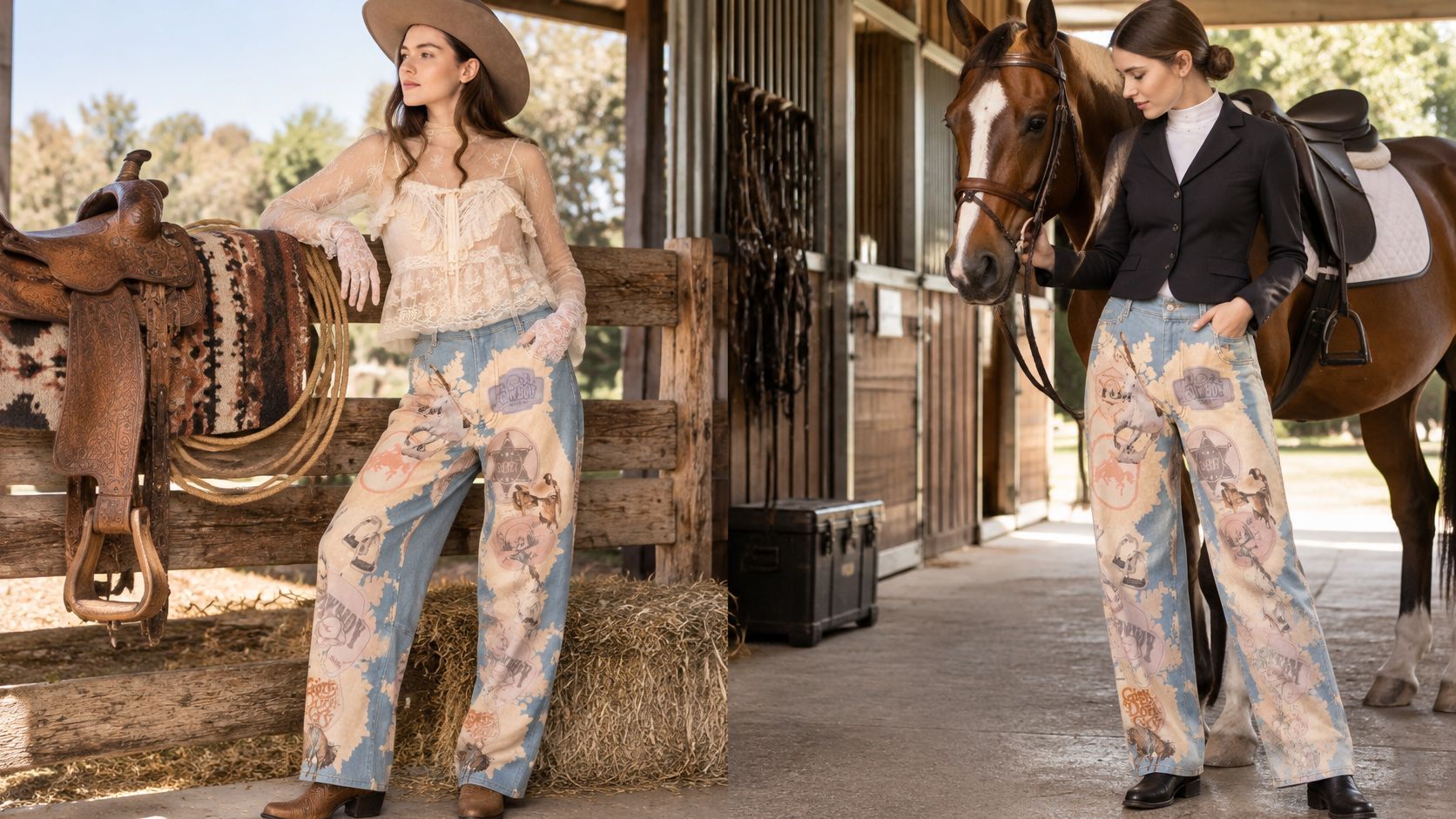
A Western-leaning option in our catalog is the Blue Ribbon Rodeo Jeans, a loose cut with a western motif patch. Style gets you to the page; rise, hem, and inner-leg seams decide whether the pair works in the saddle, and those you check in person. We are a gift shop for horse lovers and we sell English and Western designs, so you can compare leg cut and hem in one place. Our notes on Western riding apparel walk through boot-friendly cuts if that is the saddle you use most.
A patch is style. The hem and the seams are fit.
What Makes Riding Denim Hold Up
Four measures predict how long a seat lasts: abrasion resistance, seam strength, weft tensile strength, and fabric weight. The seat, inner thighs, and knees take the rub because they meet the saddle and the horse on every stride.
The table below compares those measures, with ranges from a White Rose study of jean durability and a textile reference on denim damage.
| Criterion | Benchmark | Why It Matters in the Saddle | What to Ask For |
|---|---|---|---|
| Abrasion resistance | 15,000 to 105,000 rubs across tested jeans; common denim 25,000 to 40,000 Martindale cycles | Seat and inner thighs rub the saddle for hours | Martindale results from the maker or lab |
| Seam strength | 73 N to 550 N | Inner-leg and crotch seams take load when the rider moves | Seam-strength test data, flat or reinforced seams |
| Weft tensile strength | 120 N to 1,300 N | Resists tearing across the fabric when stretched | Tensile test results |
| Fabric weight and grab strength (14 oz indigo) | Warp grab 700 to 900 N; weft grab 400 to 550 N | Gives structure against saddle friction | Fiber content and weight alongside testing data |
| Stretch content | Modest elastane with strong seams; high elastane and weak seams fail early | Supports knee flexion and mounting | Stretch percentage matched to seam strength |
The spread explains why two pairs with the same ounce weight can wear out months apart. A maker can hit the high end of abrasion and still fail at the inner-leg seam if the stitching is thin. Those figures are fabric and seam examples, not a promise about a finished jean. A pair that tests well on a flat sample can still pinch once the seam sits against a saddle flap.
Stretch helps when you mount and when you take a two-point position. High elastane with weak seams buys that mobility by giving up durability. Flat or reinforced inner seams beat bulky ones, because a thick seam becomes a pressure point on a long ride. Reinforced belt loops and secure, flat pockets help for the same reason. I would rate seam construction above stretch percentage when the two conflict, because a split crotch seam ends a ride faster than a stiff knee panel.
ASTM's denim specification covers 100% cotton woven denim for apparel and work clothing. It does not certify riding safety or the life of a sewn pair. Fabric weight sets a baseline, and seam construction decides where the jean fails first.
Ask for lab data from standardized methods: Martindale abrasion, seam-strength testing, and tensile testing. ASTM abrasion options include fabric rupture, mass loss, thickness loss, and breaking-strength loss. Then pick the strongest construction your discipline still lets you move in. The shop's roundup of equestrian apparel brands is a place to compare how makers talk about fabric before you trust a hangtag.
How to Check Fit in the Saddle
A fitting-room mirror only shows you standing. Riding fit shows up when the knee bends. Measure waist, hip, and inseam first, then match the inseam to the boot height you ride in. A short leg pulls the rise. A long leg bunches at the boot. Compare those numbers with the brand size chart, not your usual size, because English and Western cuts differ. Stretch denim should sit close without gaping at the back. A stretch blend can go down a size if the knee still bends cleanly. Rigid heavy denim should be sized for movement, because it gives little. Use the size charts on the Bridle Up Hope Shop catalog pages, then run this check on the best candidate.
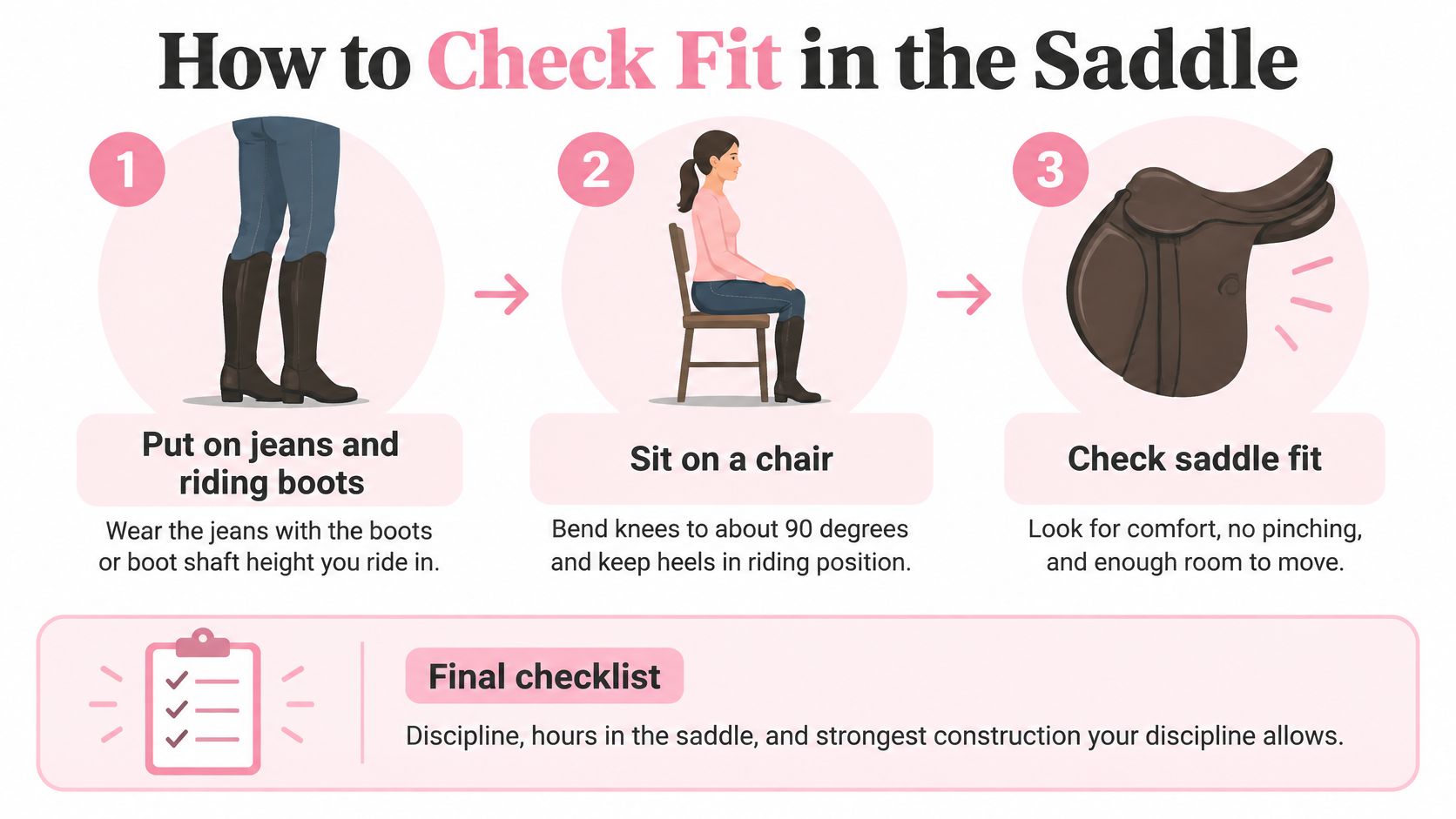
- Put the jeans on with the boots, or with a stand-in for the boot shaft height you ride in. Heel and shaft change the hem, so sneakers lie to you.
- Sit on a chair with knees bent to about 90 degrees and heels down. This is the cheap version of a mounted hip angle.
- Check the front rise for pulling and the back waistband for gaping. A rise that digs while you sit will dig for the whole lesson.
- Check the inner legs and knees for twisting, wrinkling, or hard folds. My Horse University, a Michigan State University-based program, warns riders to avoid pants that twist, wrinkle, or bunch along the inner legs and especially around the knees. A pair that feels smooth while you stand can fold into pressure points the moment the knee bends.
- Stand, walk, and lift one knee as if you were mounting. You are testing stretch and flexion, not how the wash looks.
- Confirm the hem covers the boot top without riding up or stacking into a wad. Too much extra fabric at the ankle catches stirrups, mud, and spurs.
ClothME's guide to better-fitting jeans is useful before you even sit down, because waist, hip, and rise mistakes are easier to catch with a tape than in a rushed fitting room. Once the numbers are close, the chair test still decides.
Pants that are too large may catch on something and lead to injury to the rider or horse. Loose pockets, bulky seams, and metal hardware are the usual snags on tack, a gate, or a fence. Our notes on English riding pants cover the closer leg those boots need.
We offer 30-day free returns via Redo, so you can wear-test at home. Test in a saddle if you can. Chair posture is a screen, not the final word.
Reject any pair that pulls at the rise, gaps at the back, or bunches at the knee. Do not talk yourself into a size that only works while you are standing still.
Protective Jeans Versus Everyday Denim
A hangtag that says "riding" and names no test standard is telling you about fit, not about what happens in a fall. Rider Magazine's guide to riding jeans is blunt that conventional denim does little to protect the wearer during impact. That gap is why the three categories below should never be sold as the same thing.
- Casual denim: Coverage and some abrasion resistance for barn time and steady lessons. Pros: easy to wear all day, lighter, cheaper to replace. Cons: limited help in a fall, inner seams can rub, wet cotton stays wet. A long trail in drizzle is where this category shows its limit.
- Riding-specific denim: Cut for a saddle with flatter seams, a stable seat, and stretch placed where the knee bends. Pros: fewer pressure points on long rides. Cons: not impact protection, and a soft stretch blend can wear through at the seat if the seams are weak.
- Protective garments: Abrasion-resistant fibers such as aramid, UHMWPE, or Covec, sometimes with reinforced panels or impact protection. Pros: a real step up from cotton when a fall is part of the risk. Cons: often heavier, warmer, less flexible, and less pleasant as everyday clothes.
Before you buy, verify five things: which category the product is, where the reinforcement sits, the stretch percentage, any certification claim, and the activity it is intended for.
Use casual riding denim for steady lessons on a horse you already know. Buy protective jeans for green or young horses and other high-risk work. On a hot, dry day with a short lesson, the lighter pair often earns its place; on a wet, cold, multi-hour ride, the heavier protective garment is the one I would choose, provided it still lets you bend.
Choose Your Pair and Keep It Riding-Ready
Pick the row that matches tomorrow's ride, then buy the strongest construction that discipline still lets you bend in. Skip the fit check and a flattering waist becomes a sore inner knee by mile three.
Final checklist:
- Discipline: English, Western, or ground work.
- Hours in the saddle: lesson length versus a multi-hour trail.
- Weather: hot and dry, or wet enough that slow-drying cotton is the wrong tool.
- Leg cut and hem: boot shaft covered, no bunching in the stirrup.
- Seam or abrasion data: lab numbers if the maker has them, flat seams if they do not.
For a Western-leaning day that still needs some give, the Western Barrel Leg Denim Jeans are the barrel-leg option in this catalog. Check the stretch percentage and seam layout on the product page, then size for movement rather than a painted-on fit. Keep them off green-horse days that call for certified panels. English riders should look for a narrower leg in the same catalog instead of forcing a barrel hem into a tall boot.
Care keeps a strong pair from dying in the wash. Turn them inside out, use cold water, skip high heat, and air-dry. Heat and a hot dryer are how rise and inseam shrink out of the fit you bought. Retire the pair when the seat or knee goes thin, seams pucker, or the stretch stops recovering. Thin denim at contact points is a friction problem, not a style.
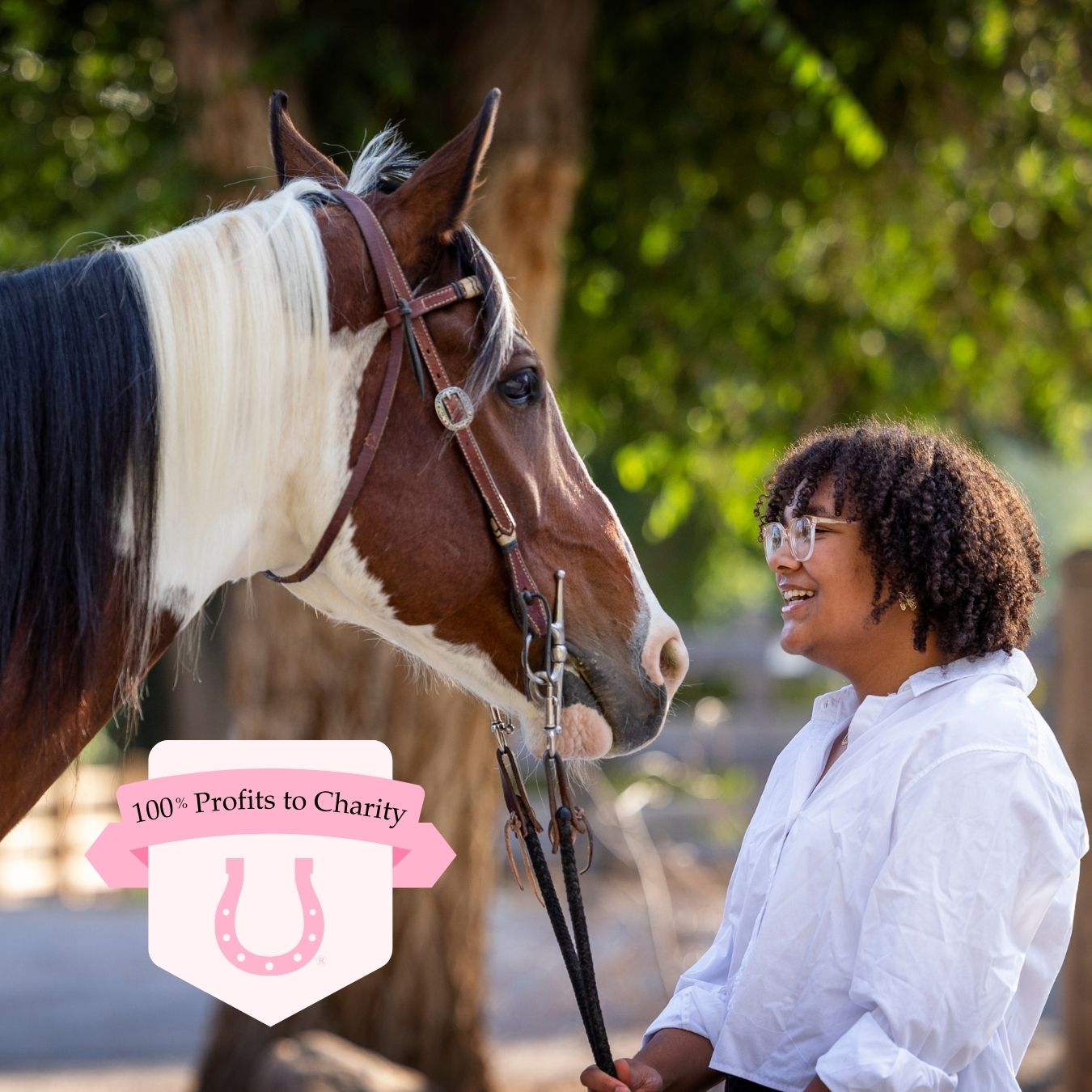
The shop's categories run past jeans into women's fashion, jewelry, accessories, and horse care, so you can order the jeans with the boots you already measured. The 30-day free returns through Redo cover a fit that fails once you sit in the saddle. Bridle Up Hope Shop carries English and Western apparel for horse lovers, and 100% of annual net profits go to the Bridle Up Hope foundation.
Your last step is the laundry routine, not another round of shopping: inside out, cold water, no hot dryer, air-dry.
Deje un comentario