


You're at the kitchen table with a horse-loving child, a small gift in hand, and a few quiet minutes before the next screen asks for attention. The child turns a metal horseshoe over, studies the trapped rings, and immediately wants to know one thing: how do you get the ring out without bending anything?
That's the appeal of a horseshoe puzzle game. It's small, tactile, and easy to share across generations. You don't need a board, batteries, a charging cable, or a large play area. You need the puzzle, a little patience, and a willingness to try a movement that doesn't seem obvious at first.
Table of Contents
- Why a Tiny Metal Puzzle Has Lasted for Generations
- How the Horseshoe Puzzle Game Actually Works
- Main Styles and Formats You Will Find
- Materials, Build Quality, and Durability
- Difficulty Levels and the Right Age Range
- Choosing the Horseshoe Puzzle Game as a Gift
- A Simple Way to Pick the Right One for You
Why a Tiny Metal Puzzle Has Lasted for Generations
A grandparent might slide the puzzle across the table and offer only a gentle challenge: free the ring, but leave the metal exactly as it is. A child usually starts with pulling. Then comes twisting, turning, and perhaps a serious inspection of every gap. The best moment arrives when the child realizes that the puzzle isn't resisting strength. It's waiting for the correct order.
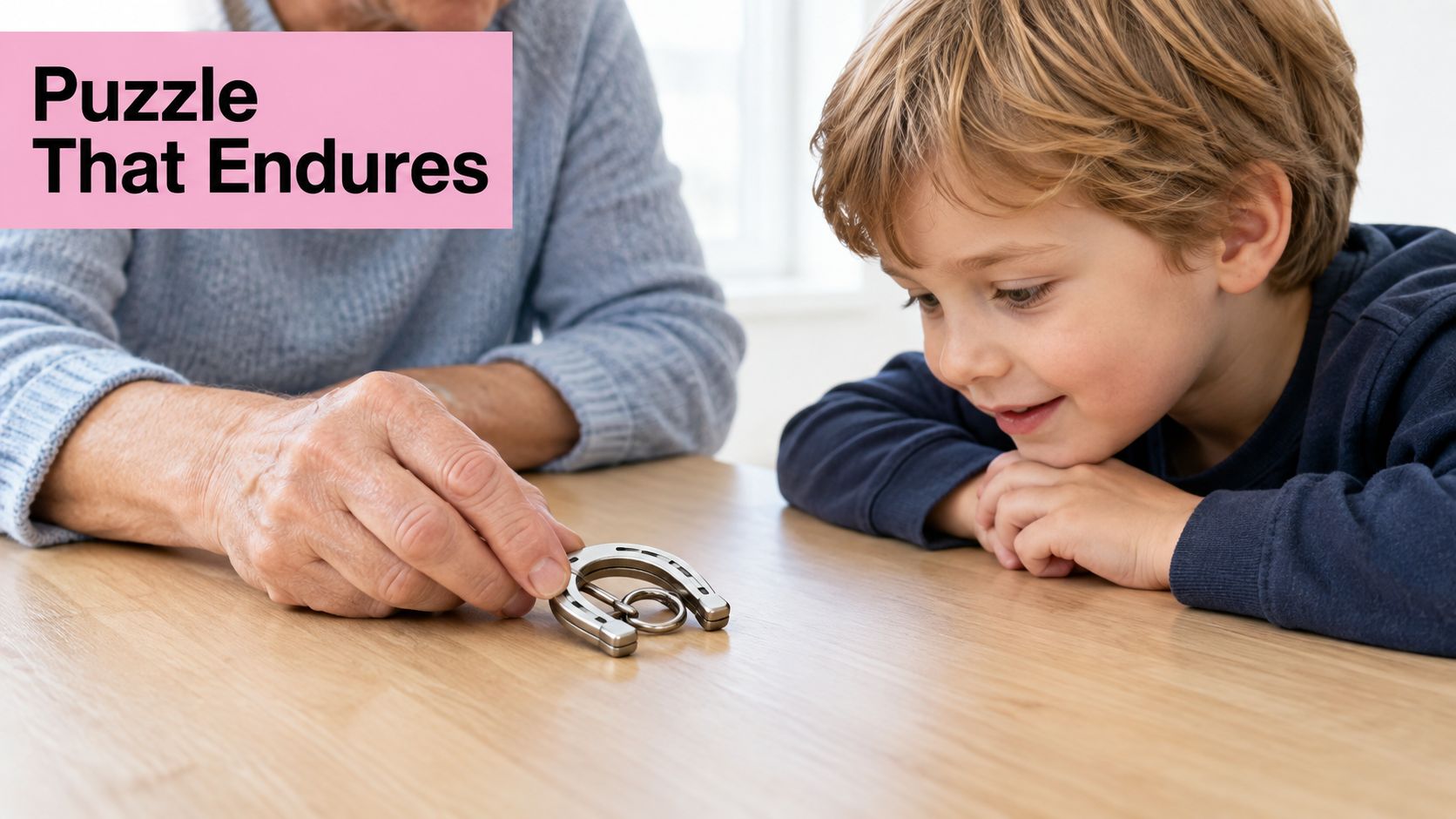
The horseshoe puzzle belongs to the long tradition of 19th-century disentanglement puzzles. Historical puzzle references place popularized forms of these puzzles in Europe and North America during that century, when hand-crafted mechanical and wire brain teasers became popular novelty items at fairs and in private collections. You can find that background in the historical overview of horseshoes and related games).
Its shape also carries a pleasant bit of cultural meaning. A horseshoe suggests riding, barns, luck, and practical farm life, while the rings turn that familiar object into a quiet mechanical challenge. For a family that spends time around horses, the puzzle feels more personal than an anonymous wire maze. A related look at equestrian symbolism appears in this guide to horseshoe necklace meaning.
Why families keep reaching for it
The game lasts because it offers three honest advantages:
- It fits almost anywhere. A small metal puzzle can live in a coat pocket, desk drawer, tack room, or kitchen bowl.
- It works without a screen. Nobody has to download anything, create an account, or wait for a device to charge.
- It rewards patience. A careful solver can make progress by observing movement, not by reacting quickly.
That combination gives the puzzle a different kind of staying power from a disposable plastic toy. Metal rings make a distinct little sound against the horseshoe. The weight gives each movement feedback. Even the failed attempts become part of the memory, especially when a child later teaches the same puzzle to a younger sibling.
If your household enjoys tactile brain games in the Manchester guide from Food Escapes, this belongs in the same screen-free conversation. It suits a coffee table, a gift shelf, or a bench near riding boots because it's both a game and a small piece of horse-themed object design.
How the Horseshoe Puzzle Game Actually Works
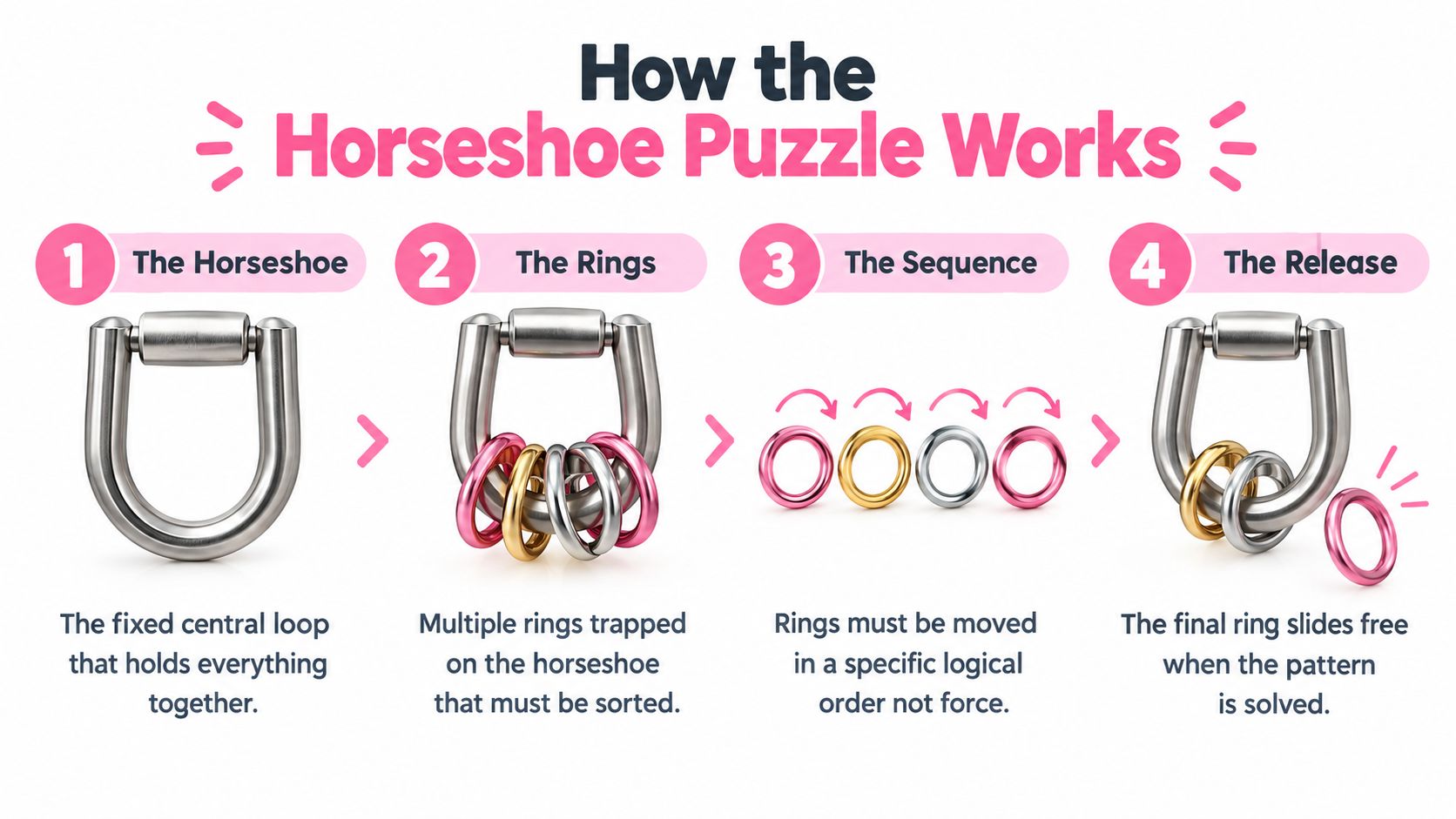
At first glance, the puzzle can look like a miniature piece of hardware rather than a game. Most versions use a fixed U-shaped horseshoe frame, one or more rings threaded along its arms, and sometimes a chain, loop, or figure-eight piece that prevents a simple escape. The exact arrangement varies, but the central idea stays consistent: the pieces can move, yet only a particular sequence creates enough clearance for release.
Think of a keyring carrying several keys. If you pull on the last key without sorting the others, the ring stays trapped. You have to tilt, slide, and reposition each key until the opening lines up. A horseshoe puzzle works in much the same way, except the metal parts are deliberately shaped to make the correct alignment less obvious.
The movement sequence
Start by holding the horseshoe steady rather than gripping every part tightly. Then work through the arrangement slowly:
- Lift the first ring. Look for the point where it can rise over a bend or notch.
- Slide it along one arm. Don't pull straight out. Follow the path that the metal shape allows.
- Rotate the ring. A ring that seems too large may pass when its angle changes.
- Transfer it to the opposite arm. The first piece often has to move aside before another piece can use the same opening.
- Repeat the pattern. Each ring changes the available space for the next one.
- Release the final piece. Once the sequence is correct, the last ring should slide free without force.
Practical rule: If the metal flexes, your hands are solving the wrong problem. Stop, return to the last comfortable position, and search for a new angle.
The reverse process matters, too. Removing the ring is only half the entertainment. Reassembling the puzzle makes the object useful again and gives repeat play a fresh purpose. You may remember the broad idea but forget the exact order, which is why the same piece can return to the table many times.
The first successful movement often comes quickly for a beginner because the puzzle gives immediate physical feedback. Within a short sitting, you can usually identify which ring moves, which gap matters, and which direction creates resistance. For a broader look at organized methods for solving unfamiliar challenges, this resource on structured creative problem solving offers a useful companion perspective.
A demonstration can help if the geometry feels abstract. Watch the following video after trying the puzzle yourself, so you can compare the movement rather than copy it.
Main Styles and Formats You Will Find
Not every product described as a horseshoe puzzle game feels the same in your hand. Some are serious little metal disentanglement puzzles. Others borrow the horseshoe shape for tabletop tossing, travel play, or decoration. The right choice depends less on the label and more on how you expect people to use it.
Four formats, four play experiences
Classic metal disentanglement puzzles are the closest match to the traditional pocket puzzle. A steel horseshoe and several chromed or finished rings feel cool, solid, and slightly weighty. Play is usually quiet apart from the light clink of metal, and the format works best for one person at a time, although family members can take turns studying the same arrangement.
Board-based horseshoe-toss hybrids combine a small target, tabletop board, or scoring surface with a puzzle element. They suit families who want a shared activity rather than a solitary challenge. The physical action is broader, and the game can feel more social, but the puzzle component may be less demanding than a dedicated disentanglement design.
Travel-size and keychain editions are made for backpacks, glove boxes, waiting rooms, and barn visits. They're convenient and easy to carry, though their smaller parts can demand more finger control. Lightweight construction may also make them feel less substantial than a desk-sized steel version.
Wooden or themed collector editions put appearance first. A wooden horseshoe may feel warmer and gentler in younger hands, while an oversized novelty design can become equestrian décor between uses. These versions may be better for display or casual gifting than for repeated pocket play.
A useful comparison looks like this:
| Format | Typical Weight | Best Setting | Skill Focus |
|---|---|---|---|
| Classic metal disentanglement | Light to substantial | Desk, coffee table, quiet evening | Sequence, rotation, spatial reasoning |
| Board-based hybrid | Varies by board and pieces | Family table or gathering | Turn-taking, aiming, casual problem-solving |
| Travel-size or keychain | Very light | Backpack, glove box, barn visits | Finger dexterity and quick experimentation |
| Wooden or themed novelty | Light to moderate | Gift shelf, child-friendly room, décor | Basic manipulation and visual exploration |
The broader world of brain teaser games can help you compare this format with other hands-on challenges. If you're also considering a horse-themed group activity, a board game such as Horse-Opoly offers a different rhythm. It gathers people around shared turns, while the classic horseshoe puzzle gives one solver a concentrated problem.
For quiet evenings, choose classic metal. For a child's casual introduction, consider wood or a larger travel-friendly design. For a gathering, pick a board hybrid only if group participation matters more than the purity of the disentanglement challenge.
Materials, Build Quality, and Durability
A good horseshoe puzzle should feel deliberate. When you turn it in your hand, the rings should move cleanly, the frame should hold its shape, and the edges shouldn't catch your skin. A cheap puzzle often reveals itself before the first solve, through sharp wire ends, uneven bends, loose joints, or a finish that flakes under ordinary handling.
What the main materials feel like
Solid stamped or cast steel is usually the strongest choice for repeated play. It has satisfying weight and can carry a nickel-plated, blackened, or antique finish. Steel tolerates regular handling well, but it still needs protection from moisture, especially if the puzzle lives near a barn or outdoor gear.
Brass and copper alloys offer a warmer appearance and develop patina over time. They're appealing as display pieces and gifts because their color feels less utilitarian than bright steel. Their moderate weight makes them comfortable for desk play, though surface marks may become visible as rings rub against the frame.
Stainless steel is a practical option when rust resistance matters. It suits a tack room, travel bag, or other place where humidity may be present. It may look more modern and less traditionally “antique,” but easy maintenance can matter more than appearance.
Zinc alloy or pot metal keeps manufacturing costs and hand weight down. These pieces can work for occasional play, but rough edges and brittle parts deserve careful inspection. A light puzzle isn't automatically poor quality, yet a very thin casting can feel less dependable.
Wooden variants are gentle and visually friendly. They can be a good choice when you want a softer object for supervised family play, but wood isn't as pocket-friendly and may show wear from moisture, friction, or drops.
Construction checks before buying
Look closely at the places where metal meets metal. Smooth welded joints are more reassuring than glued seams on a puzzle intended for active handling. Rings should have a consistent gauge, with no obvious thin spots or gaps that could snag fingers. The finish should cover the surface evenly, and the ends should be burr-free.
Also consider the intended use. A desk puzzle designed for careful manipulation doesn't need to survive being tossed into a toolbox. A product marketed as a stress-relief fidget should still be checked for smooth movement, because repetitive handling exposes weak joints and sharp edges quickly.
| Material | Weight | Durability | Best For |
|---|---|---|---|
| Steel | Moderate to heavy | High with sensible care | Frequent play and lasting gifts |
| Brass or copper alloy | Moderate | Good, with visible patina possible | Display and traditional styling |
| Stainless steel | Moderate | Strong against rust | Barns, travel, and humid settings |
| Zinc alloy or pot metal | Light | Variable | Occasional use and budget gifts |
| Wood | Light to moderate | Gentle but moisture-sensitive | Younger hands and decorative use |
Keep metal pieces dry and wipe them if they've been handled outdoors. If rings begin scratching one another, store the puzzle in a small cloth pouch rather than loose with keys or tools.
Difficulty Levels and the Right Age Range
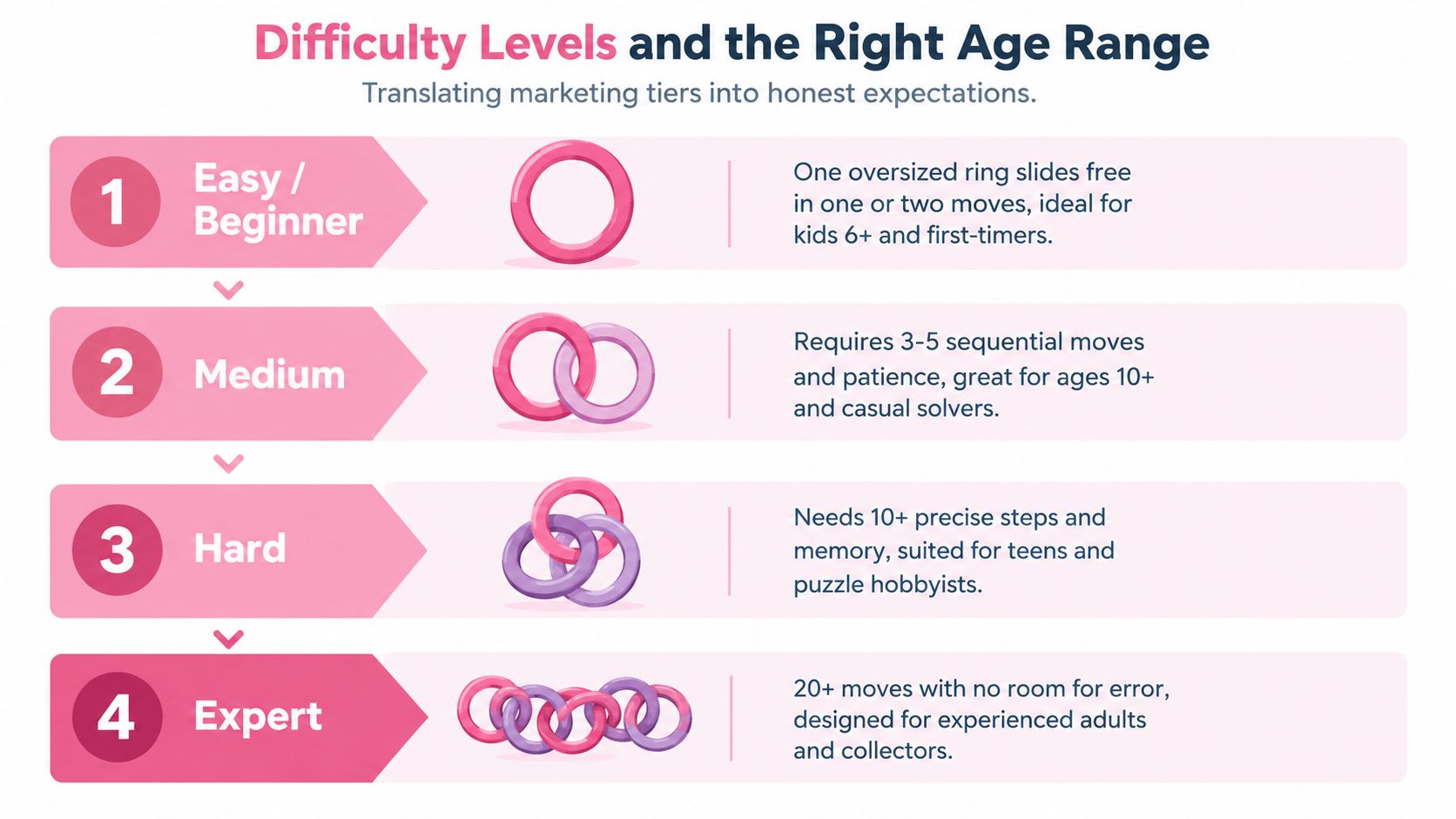
Puzzle packaging often uses words such as easy, medium, hard, and expert, but those labels don't always tell you how the experience will feel. Difficulty depends on the number of moving pieces, the size of the openings, the amount of rotation required, and how easily a solver can recognize the next step.
Matching the challenge to the solver
A beginner puzzle usually offers a large ring and a clear route. The solver may need only a small lift, a turn, and a slide. This is a sensible starting point for a young child who's developing hand control, provided an adult supervises the parts.
An intermediate puzzle adds interlocking rings or a less obvious transfer between the two arms. It suits tweens, teens, and adults who enjoy a challenge but don't want a long session built around repeated dead ends. The best family choice is often here because an adult can model observation without solving the entire problem for the child.
A hard puzzle demands more precise rotations and better memory. The solver may reach a promising position, lose it, and need to retrace the sequence. This level works well for teenagers, experienced adults, and people who already enjoy wire puzzles.
An expert design can be stubborn. Several pieces may need to move in a counterintuitive order, and one careless turn can return the puzzle to its starting arrangement. It's better suited to patient hobbyists and collectors than to someone who wants an instant win.
The provided age guidance in the infographic offers a useful starting point, but age alone isn't enough. A younger child with strong patience may enjoy an intermediate puzzle, while an adult who dislikes fiddly objects may prefer an easy design.
The most successful family session isn't the one where the child solves it first. It's the one where everyone gets a turn to notice something new.
Safety and family adjustments
Small rings and chains can create a choking hazard for children under five. Keep those versions out of reach, inspect the pieces for sharp edges, and supervise younger children even when the design looks simple.
You can make a difficult puzzle more approachable by letting a child explore one ring at a time, demonstrating how to hold the frame, or temporarily separating a removable component when the construction allows it. A horse-themed gift guide for kids can also help you choose an object that matches a child's wider interests, not just the puzzle's difficulty label.
Choosing the Horseshoe Puzzle Game as a Gift
A horseshoe puzzle makes a stronger gift than a generic trinket when the recipient enjoys both horses and hands-on challenges. The shape gives the object a story, while the mechanical problem gives it a reason to stay in use. A horse figurine may sit beautifully on a shelf, but a puzzle invites the recipient to pick it up and do something.
For a horse-loving child, a small steel version can work as a stocking stuffer when the parts are large enough for safe, supervised handling. Look for a simple design with a visible path rather than a tightly packed cluster of tiny rings. The child receives an equestrian object, but also a task that can be revisited.
A teen who likes fidget objects may prefer a mid-difficulty brass puzzle. Brass feels warmer and more decorative than ordinary wire, and the repeated turning provides something purposeful to do with the hands. It's a better fit for a teenager who enjoys figuring out mechanisms than for someone who wants a purely soothing, repetitive fidget.
Gift scenarios that make sense
- For a child who lives at the barn: Choose a sturdy, uncomplicated metal design, then include a short handwritten clue.
- For a puzzle-loving teenager: Pick a more involved arrangement with enough complexity to reward patient experimentation.
- For a host or new homeowner: Select a heavier, antique-finish piece that can sit on a desk or shelf between uses.
- For a playful exchange gift: An oversized or humorous novelty version can create an amusing challenge without pretending to be a serious collector puzzle.
Compared with a Rubik's Cube, the horseshoe puzzle offers a narrower but more tactile challenge. A cube rewards repeated pattern practice across a visible grid, while the horseshoe depends on physical clearance and spatial sequence. Compared with a wire disentanglement puzzle without an equestrian shape, the horseshoe adds an emotional hook for riders, horse owners, and barn-frequent children.
Presentation can make a small object feel considered. Wrap it in twine, attach a horseshoe-shaped gift tag, or write a clue such as “Free the ring without bending the shoe.” Avoid giving the solution immediately. The discovery is part of the gift, and a little uncertainty makes the first try more inviting.
Choose a different present if the recipient dislikes fiddly objects or becomes upset by unsolved puzzles. A good gift respects the person's play style. The horseshoe shape may create instant interest, but the recipient still needs to enjoy slow, hands-on problem-solving.
A Simple Way to Pick the Right One for You
You can narrow the choice quickly by checking three filters: the recipient's age and patience, the play setting, and the amount you want to spend. These filters point toward the format and material without requiring a long product comparison.
For a parent buying for a curious nine-year-old, choose a larger beginner or gentle intermediate puzzle with smooth edges and pieces that are easy to see. Wood can feel approachable, while solid steel offers a more traditional experience. Supervise the first session, then let the child explain the movement back to you.
For a partner who loves horses and enjoys small stocking-stuffer challenges, choose a compact metal design. A travel-size piece works well if they carry a bag or spend time at the barn, while a brass version feels more gift-like on a desk. Make sure the puzzle's small parts suit the recipient's habits and storage situation.
For a grandparent who wants a tactile solo activity during quiet evenings, classic metal is the safest all-around choice. A substantial frame feels satisfying in the hand, and the reverse reassembly challenge gives the puzzle a second layer of play. If frustration is a concern, begin with an easier design rather than choosing the most complicated package.
Quick rule of thumb: Choose classic metal for lasting value, wood or travel-size for casual gifting, and a board hybrid when group play matters more than solo challenge.
The best horseshoe puzzle game isn't necessarily the hardest one. It's the one that matches the solver's hands, patience, surroundings, and affection for horses.
If you're ready to pair a tactile horseshoe puzzle with a thoughtful equestrian gift, visit the Bridle Up Hope Shop for horse-themed toys, books, accessories, and gifts for children, riders, and the home. You'll find options for different ages and styles, with purchases supporting Bridle Up Hope's charitable mission.

Leave a comment