


You're standing in a bookshop with a horse-mad child in mind, but the shelf gives you no easy answer. One cover promises adventure, another hints at history, and a third looks more like a journal than a novel. You want a gift that will be opened, read, and remembered, not merely admired for its horse on the cover.
Horse Diaries books are especially useful because they sit at the meeting point of animal adventure, history, geography, and personal voice. The right choice can give a child a story to enjoy tonight and a starting point for questions about real places, past lives, horse care, and empathy. The trick is to match the book to the reader, not just to the reader's love of horses.
Table of Contents
- Why Horse Diaries Books Make Such Memorable Gifts
- What Horse Diaries Books Are
- How to Match a Horse Book to the Right Reader
- Recommendations by Age and Reading Stage
- Turning a Horse Diary Into a Reading Habit
- A Gift-Giver's Checklist for Buying Horse Books
- From the Page to the Saddle and Beyond
Why Horse Diaries Books Make Such Memorable Gifts
A good horse book often works like a gate in a familiar riding arena. The child enters through the horse, then discovers a wider world beyond it. A story about an Icelandic horse can lead to questions about terrain and settlement. A horse living through a difficult historical period can open a conversation about people, choices, and responsibility.
That layered experience is why the best horse diaries books feel like more than themed stocking stuffers. The diary voice gives the story intimacy, while the historical setting gives it depth. Readers aren't only watching a horse run, compete, or survive. They're following an individual perspective shaped by a particular place and time.
A useful test: Choose the book that gives the child two reasons to return, one emotional and one intellectual.
The series format helps, too. A child who connects with one horse can move into another setting without leaving the familiar structure behind. That continuity is reassuring for a developing reader, while the changing narrators and historical worlds keep the experience from becoming repetitive.
Age alone won't tell you whether a title will land. Two children of the same age may have very different reading stamina, background knowledge, and tolerance for sad or complicated events. A confident reader might enjoy a historically demanding story independently, while another child may need the same book shared aloud and discussed a little at a time.
The most reliable gift decision considers five things: reading level, narrative complexity, historical setting, emotional intensity, and horse-care realism. Those criteria help you distinguish an accessible chapter book from a title better suited to family reading, and a fictional adventure from a practical horse journal. By the end, you'll have a clearer way to match a specific book with a specific reader.
What Horse Diaries Books Are
A child opens one of these books expecting a horse story and finds something more specific. Horse Diaries is a historical fiction series in which each book is told by the horse itself, in a first-person horse narrator voice. The series began with Elska by Catherine Hapka and Bell's Star by Alison Hart, published by Random House Children's Books on March 24, 2009. Bookroo's series history outlines that launch and the broader publication timeline.
That point of view shapes everything. Instead of watching a rider explain what happened, readers stay close to the horse's senses and reactions: movement, touch, routine, fear, trust, confusion, and attachment. For kids who already talk about what a pony “must be thinking,” the diary format feels familiar. It works a bit like a stable journal crossed with a chapter book, which helps the stories feel intimate without becoming hard to follow.
One series, many historical windows
The series also changes setting from book to book, so the reading experience is not just about age level. It is also about historical complexity, emotional weight, and how much real horse life a child wants on the page. Elska takes place in Iceland around AD 1000. Bell's Star moves to Vermont in the 1850s. Maestoso Petra is set in Vienna in 1938, and Darcy in Ireland in 1917. Each title gives the reader a different doorway into history. Instead of receiving a lesson first and a story second, the child meets the period through the horse's daily life.
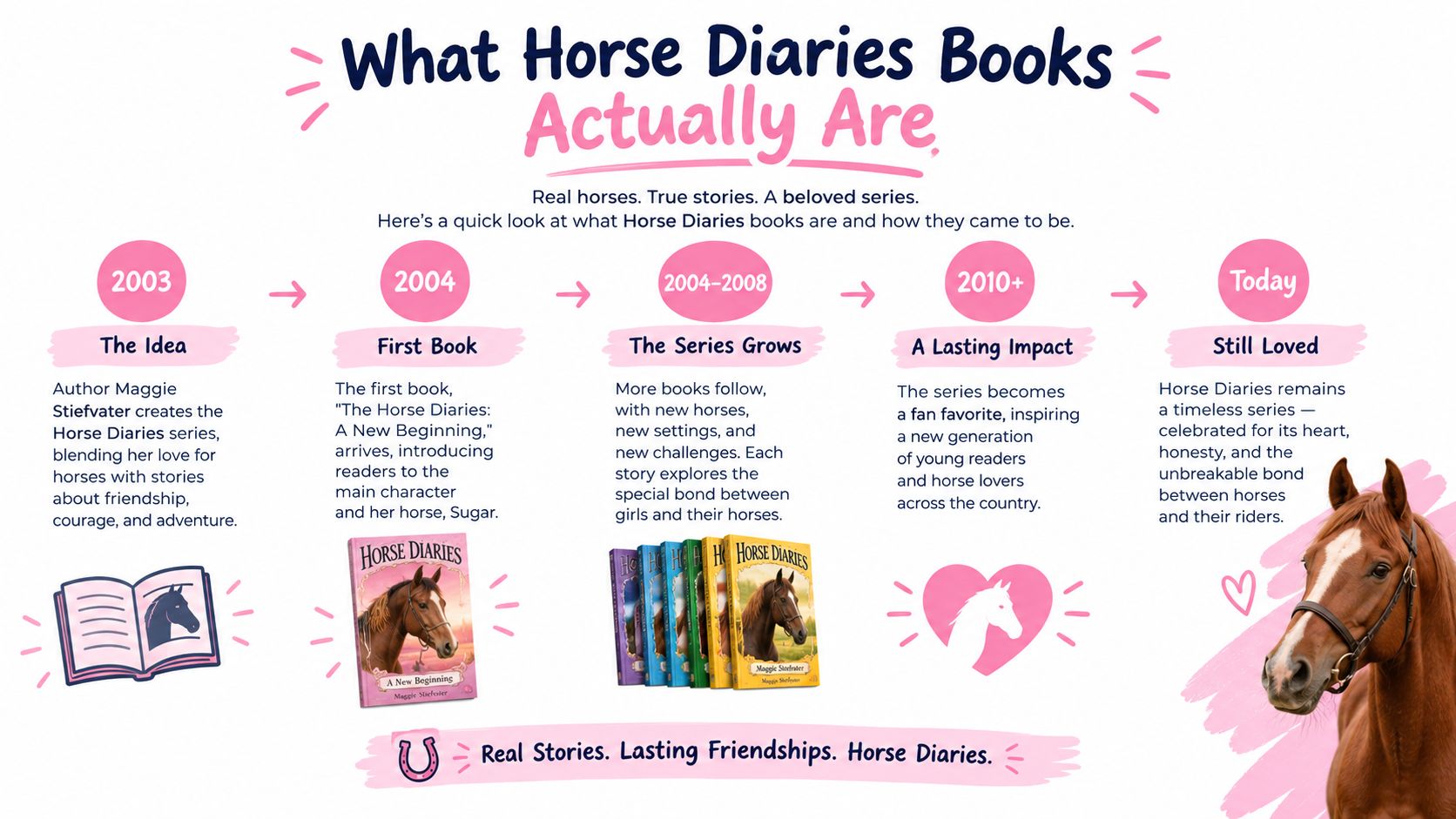
That is why the series makes more sense as a line of related reading experiences than as one repeating formula. After the first titles, books such as Maestoso Petra, Golden Sun, Yatimah, Risky Chance, Black Cloud, Tennessee Rose, and Darcy continued that pattern of pairing a horse-centered plot with a distinct place and time.
For many readers, the strongest fit will be approximately ages 7–11, especially for children who enjoy accessible chapter books and animal stories. Still, age is only one clue. A younger listener may enjoy these as read-alouds, while an older independent reader may stay for the history, the feeling, or the horse-care details.
How to Match a Horse Book to the Right Reader
Use the following questions before you buy. You can answer most of them by reading the back cover, opening to a random page, and checking whether the setting and tone feel inviting rather than intimidating.
Five quick checks in the aisle
Reading level comes first. Can the child read chapter books independently, or do they usually listen to longer stories? A diary-style novel may be a comfortable independent read for one child and a satisfying shared read for another.
Narrative complexity asks how much the reader must hold in mind. Does the story move between personal events and historical context? Will the child recognize why a setting matters, or will they need a short explanation from an adult?
Historical setting affects the kind of conversation the book invites. Iceland around AD 1000 and Vienna in 1938 carry very different background demands. A child who loves maps and “how people lived” questions may welcome that depth. Another may prefer the horse's immediate adventure.
Emotional intensity deserves an honest check. Look for separation, danger, loss, conflict, or frightening changes in the horse's life. A sensitive reader might still enjoy the title, but may need a trusted adult nearby.
Horse-care realism matters most to young riders and serious horse lovers. Does the book show handling, grooming, tack, travel, or training in enough detail to reward an informed reader? Fiction can be engaging without being a manual, but children benefit when adults separate imaginative storytelling from confirmed horse knowledge.
| Matching criteria | What to check | Best fit |
|---|---|---|
| Reading level | Independent chapter reading or read-aloud support | Confident readers, shared-reading families |
| Narrative complexity | Simple adventure or layered historical story | Readers who enjoy straightforward plots or deeper context |
| Historical setting | Familiar background or a place needing explanation | History and geography enthusiasts |
| Emotional intensity | Gentle tension or serious hardship | Sensitive readers, older children, supported reading |
| Horse-care realism | General horse imagery or detailed observation | Horse-curious children, young riders, adult enthusiasts |
For a complementary perspective on choosing horse-related reading, see this horse book review. It can help you think beyond the cover and ask what kind of horse experience the book offers.
The visual below can also prompt useful questions before purchase.
Practical rule: If you can't tell whether the child will manage the text alone, buy for the shared-reading experience rather than an imagined reading level.
Recommendations by Age and Reading Stage
A bookshop conversation often starts with age, but the better question is, “How does this reader like to read?” A child who reads independently may want momentum and a clear first-person voice. A child who resists fiction may need the horse connection to be paired with short chapters, discussion, or a companion journal.
The early independent reader
For a reader around ages 7–11, an accessible Horse Diaries volume can be a strong match when the child already handles chapter books and enjoys animal stories. Start with the title whose setting feels most inviting. Elska may appeal to a child fascinated by Iceland, while Bell's Star may suit someone drawn to nineteenth-century rural life.
The read-aloud family
A first-person horse story can work beautifully at bedtime because each entry gives the adult a natural stopping point. Pause to ask what the horse knows, what it doesn't know, and how the human characters interpret the same event. The adult isn't testing comprehension. They're helping the child notice voice, setting, and feeling.
The reluctant or dyslexic reader
Choose high-interest material, but don't assume a horse label solves every reading difficulty. Check the page design, chapter length, vocabulary, and whether the child prefers listening first. A parent who wants to understand reading assessment more clearly can consult this parents' guide to Lexile testing, then use professional guidance rather than treating one score as a complete picture of the reader.
The teen reader
A teenager may want more than racing and stable routines. Look for historical tension, moral choices, and horse-care details that can stand up to an older reader's knowledge. A teen who has begun riding may enjoy discussing whether a narrator's interpretation of behavior matches what a real observer could know.
The adult rider or horse owner
An adult horse person may prefer a structured observational diary to fictional narration. A useful journal can record the horse, activity, context, behavior, handler response, and outcome. That format is closer to real observation than only writing that a horse was “bad” or “angry.”
For additional ideas aimed at younger readers, browse this guide to horse books for young readers. The strongest pairing is always the one that respects the reader's actual habits, not just the number on a birthday card.
Turning a Horse Diary Into a Reading Habit
The quiet worry behind many book gifts is simple: Will the child read it? A horse diary has a useful advantage because the first-person entries create an immediate relationship. Recurring characters, manageable narrative steps, and questions connected to the reader's own life can make the book feel less like an assignment.
Evidence from an equine-assisted literacy pilot supports that possibility, but it needs careful handling. In the reported age groups, older participants' interest in reading personally relevant material rose from 43% before the program to 63% afterward, while younger participants' positive responses about feeling good about reading and the importance of reading well rose from 27% to 86%. The Utah State University report also makes clear that the pilot involved seven participants in the reported age groups and ran for a short evaluation period.
Those results are promising signals about relevance and emotional engagement, not proof that horse books work as standalone literacy interventions. Treat a horse diary as an engagement-oriented supplement, one that can make reading more inviting while a child continues to receive appropriate educational support.
Small prompts with a large payoff
After a chapter, try one question rather than a quiz:
- Notice the voice: What did the horse observe directly, and what did the narrator seem to interpret?
- Connect to experience: Have you ever entered an unfamiliar place or met someone you didn't trust yet?
- Build vocabulary: Choose one unfamiliar word and use it in a new sentence.
- Open the map: Find Iceland, Vermont, Vienna, or Ireland and compare the setting with today.
- Separate fact from fiction: Which horse-care detail could you verify with a riding instructor, veterinarian, or reliable reference?
The diary structure also invites the child to write. A short entry from the perspective of a real or imaginary horse can practice sequence, sensory description, and point of view without feeling like a formal essay. If your family already uses a daily reflection routine, a daily scripture study guide offers another example of how brief, consistent entries can create a repeatable habit, though the reading prompts here should remain focused on the book and the child's own responses.
A Gift-Giver's Checklist for Buying Horse Books
A thoughtful horse book gift starts with the reader, then adds one small detail that makes opening it feel special.
Before choosing the title
- Confirm the reading situation: Ask whether the child reads chapter books alone, prefers read-alouds, or likes to alternate between the two.
- Check the emotional tone: Look for separation, danger, loss, or historical hardship if the child is sensitive to difficult scenes.
- Decide on fiction or observation: A story suits a child who wants adventure and character. A structured journal suits someone who wants to record a real horse's habits.
- Notice the setting: Choose a familiar-feeling rural world for an easy entry, or a distant historical place for a reader who enjoys maps and research.
- Check the series order: If the child likes continuity, begin with an early volume. If the title stands comfortably alone, it can work as a single gift.
Make the package personal
A horse diary pairs naturally with a bookmark, notebook, stickers, a plush horse, or a small journal. The companion journal is especially useful because it lets the child start a personal diary after finishing a fictional one. Encourage them to record what they saw, what happened before the horse's behavior, and how the horse responded, rather than assigning a quick label.
That distinction reflects established observational practice. Research on equine behavior uses defined categories and repeated observation, and one study of 60 horses drew on at least six months of daily-contact observations to examine patterns connected with feeding, handling, saddling, and riding quality. The observational study supports a simple habit: write “ears pinned during saddling” before deciding what that behavior means. A child's diary isn't a veterinary or professional behavioral assessment, but it can teach careful noticing.
For broader equestrian gift pairings, this guide to the best gifts for horse lovers can help you choose an extra that supports the child's interests rather than cluttering the package. The best addition is usually modest and usable.
From the Page to the Saddle and Beyond
A horse diary can be the first step into a much larger conversation. After reading, a family might look at a map, compare a historical setting with the present day, or ask which parts of horse care are realistic and which belong to the author's imagination. A classroom can turn one entry into a short geography activity. A riding group can discuss how observation differs from assumption.
Social discovery can help a child find a book, but social attention alone won't build a lasting reading habit. Children are more likely to continue when the material feels interesting, personally relevant, and connected to a routine that makes reading easy to begin. A horse is often the doorway, not the entire reason a reader stays.
The decision path is straightforward: identify the reader, check reading level and emotional tone, consider historical complexity and horse-care realism, then add a companion item that invites participation. The best horse diaries book isn't necessarily the most advanced or the most famous. It's the one a child chooses to open again tomorrow.
That makes the gift valuable beyond its pages. It can lead toward better questions about welfare, history, geography, and the responsibilities involved in working with horses. It can also give a young reader a private place to notice, imagine, and write.
Bridle Up Hope Shop offers horse-themed books alongside journals, plush horses, stickers, and other equestrian gifts, making it easy to build a reading-centered package. Visit Bridle Up Hope Shop to choose a thoughtful companion gift, knowing that 100% of annual net profits are donated to the Bridle Up Hope foundation, which supports girls and women through horses and habits.
Leave a comment