


You're hovering over a pendant listing, zooming in on the blue stone and searching the description for something reassuring. Or you're standing at a jewelry counter, pendant resting in your palm, wondering whether the little stamp on the back tells you everything you need to know. The piece looks beautiful, but beauty and a clear description aren't the same thing.
Table of Contents
- The Moment You Start Looking at a Turquoise and Sterling Silver Pendant
- Why Turquoise and Sterling Silver Belong Together
- What a 925 Mark Proves
- Reading the Pendant Before You Buy
- Styling a Turquoise and Sterling Silver Pendant
- A Care Routine That Respects Both Materials
- Ethical Sourcing and Smart Buying Questions
- Your Shortlist Before You Click Buy
The Moment You Start Looking at a Turquoise and Sterling Silver Pendant
Start by turning the pendant over, physically or through the listing photos. Look at the back, the loop that holds the chain, and the edge surrounding the stone. Those less glamorous views give you something concrete to discuss with the seller.
You don't need to memorize a vocabulary of mines, grades, and treatments before shopping. You need to keep the seller's claims separate. A statement about the silver isn't a statement about the turquoise, and a romantic description of Southwestern style isn't documentation of origin.
The front view helps you judge whether you like the proportions and workmanship.
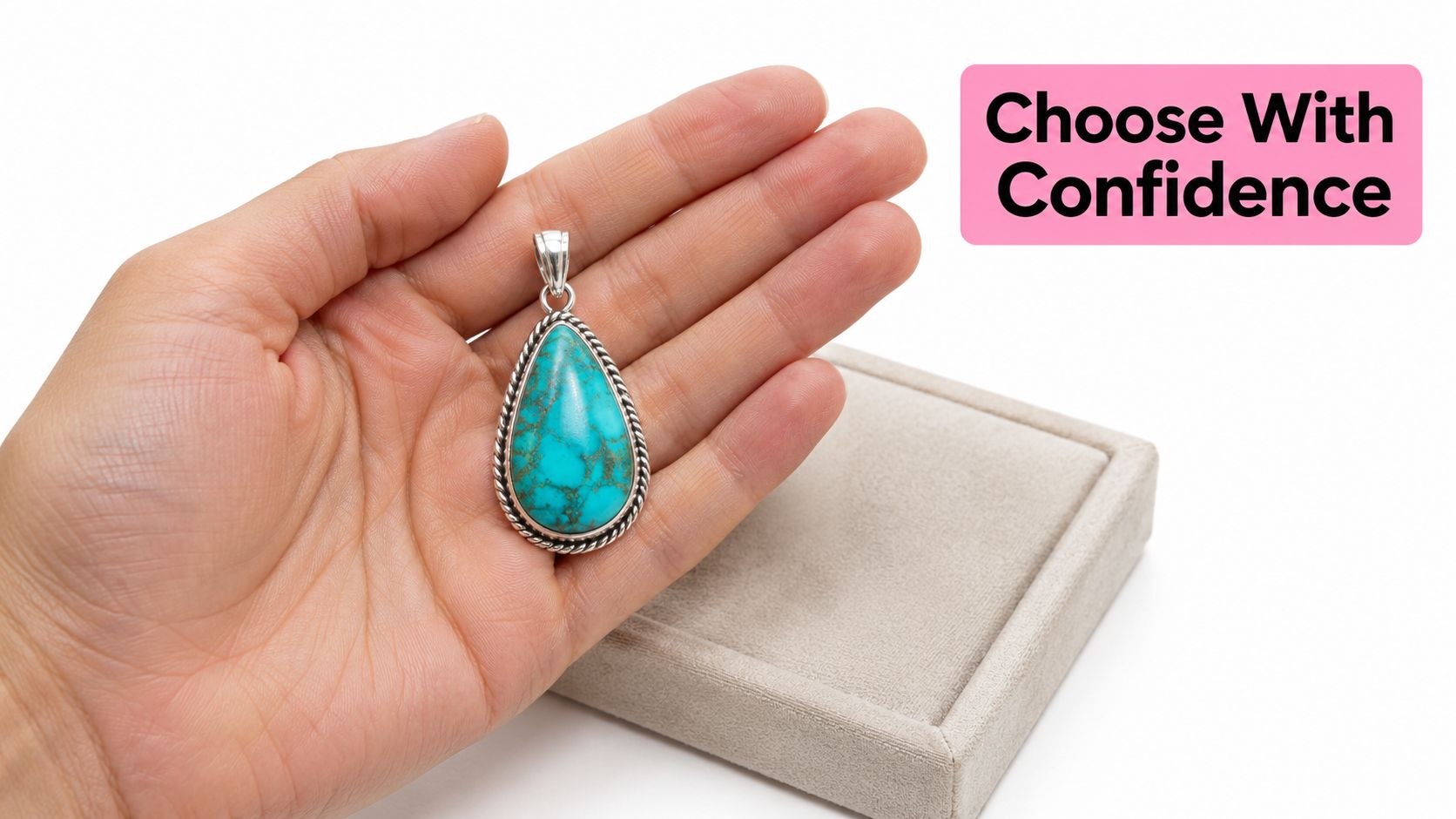
Start with questions you can actually answer
Keep your attention on these practical questions:
- What does the metal claim mean? Look for a stated material, not just a silver-colored finish.
- What exactly is the stone? Ask for its identity and any treatment disclosure in writing.
- Will the pendant suit your life? Consider the setting, chain connection, comfort, and maintenance you're willing to do.
Descriptions such as premium, authentic, and artisan may sound helpful, but ask what each means for the particular piece. A useful answer names a material, explains a process, or supplies documentation. It doesn't add another flattering adjective.
Separate attraction from verification
It can help to look at turquoise outside jewelry. The Astro West hand carved bottle offers a different object to examine alongside a pendant, encouraging you to notice shape, surface, and presentation rather than a metal stamp alone. Treat it as a comparison resource, not evidence about another seller's stone.
You're allowed to love a pendant before you understand every detail. Just pause between liking it and purchasing it. Save the listing, request the missing photographs, and keep the seller's answers with your receipt.
Why Turquoise and Sterling Silver Belong Together
Think of sterling silver as the picture frame and turquoise as the painting. You want the frame to hold its shape and support the artwork, while the painting needs protection from rough handling. Neither material has to do the other's job.
Visually, the pairing is easy to appreciate. Silver's bright, neutral appearance lets a blue or green stone stand out without adding another strong color. A plain setting emphasizes the turquoise, while a decorative border makes the metalwork part of the composition.
A partnership with different strengths
Sterling's strengthening alloy makes it more resistant to deformation than pure silver. Turquoise, meanwhile, has a Mohs hardness of 5–6 and is porous, so scratches, impacts, oils, and cosmetics deserve attention, as described in GIA's turquoise properties and treatment guidance.
A bezel, the metal rim folded around a stone's edge, is worth inspecting because it provides a physical border around the turquoise. Don't assume every bezel offers equal protection. Look at whether the stone's edge is sheltered, whether the rim appears even, and whether a raised corner could catch against clothing.
Practical rule: Judge the setting by what it protects, not just by how much silver it contains.
A large decorative frame may look substantial while leaving the stone exposed. A simpler frame may suit you better if its edges feel smooth and its construction looks careful. That's a design judgment you can make without pretending it proves gemstone authenticity.
History adds context, not a certificate
Turquoise has documented use in the American Southwest and Mexico extending back more than 2,000 years, with extensive Indigenous use from approximately 200 B.C. onward, according to the U.S. Geological Survey's turquoise history. That history helps explain its strong Southwestern cultural and geographic associations.
It doesn't establish the origin of the pendant in front of you. A Western-inspired design can be appealing without being attributed to a particular Indigenous maker or mine.
The useful distinction is between design context and product evidence. Enjoy the color and regional associations, but assess the metal's construction and the stone's description independently. They can look harmonious while requiring different kinds of verification.
What a 925 Mark Proves
You're looking at a turquoise pendant, and a small “925” stamp catches your eye. That mark states the silver content claimed for the marked metal: 925 parts per thousand, or 92.5% silver by weight. The remaining 7.5% is generally made up of strengthening metals, commonly copper, as explained in the sterling silver standard and hallmarking history. It identifies a metal specification, though the stamp alone is not independent testing.
That boundary matters. A stamp gives you a specific claim to check. It does not certify every part attached to the marked silver.
Keep the metal claim inside its boundaries
| Product detail | What you can reasonably conclude |
|---|---|
| A legible sterling mark | The marked component is sterling silver |
| A blue stone above that mark | Its identity still needs a separate disclosure |
| A named mine in the description | The seller is making an origin claim that needs support |
| A maker's name or symbol | Maker attribution should be checked separately |
Formal hallmarking has a long history of verifying metal fineness. England's requirements under Edward I in 1300 concerned the sterling standard and testing of silver wares, as documented in the historical account linked above. They did not certify gemstone identity.
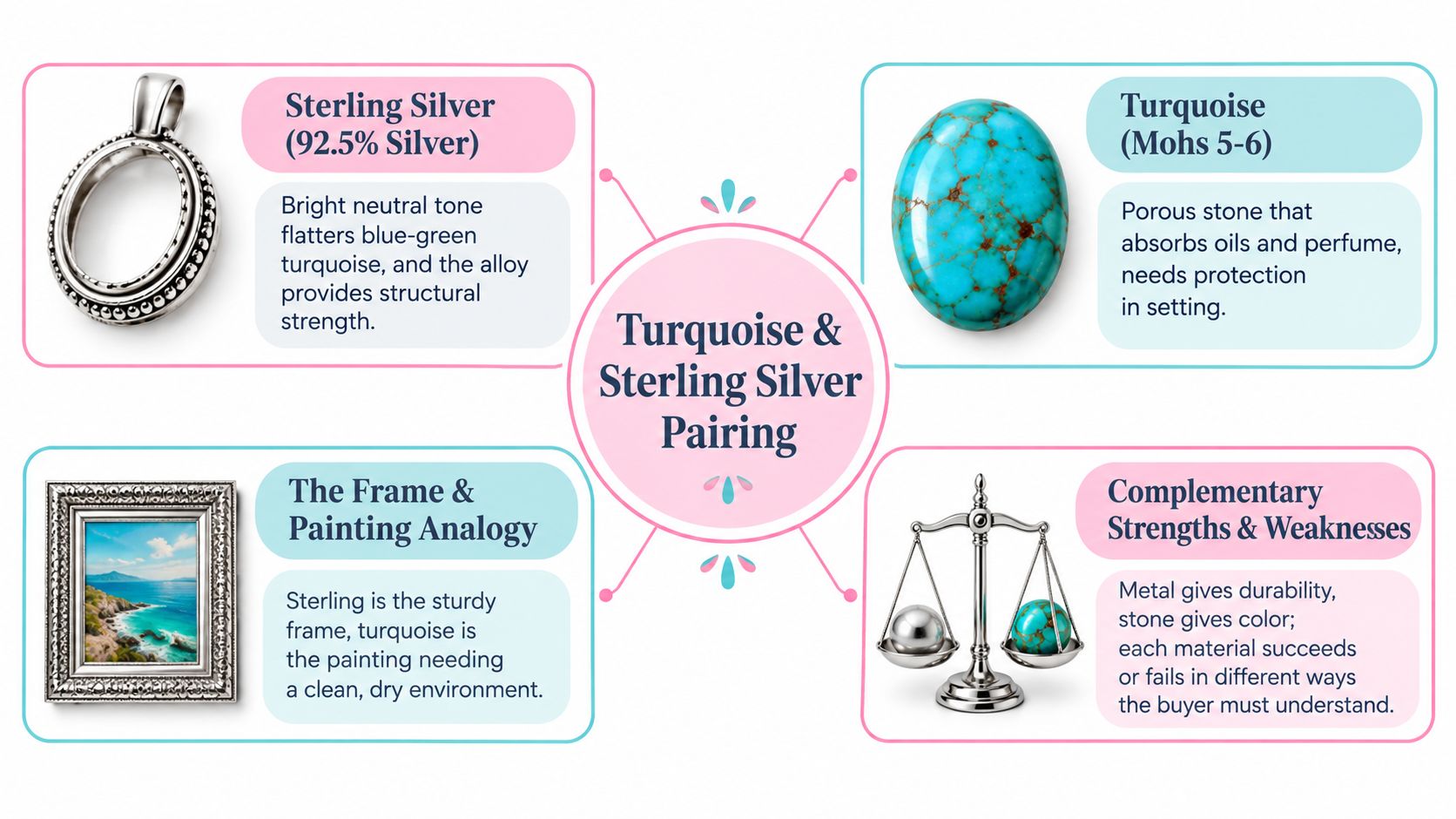
The pairing can make a pendant appealing, but visual harmony is not proof of authenticity. Ask about the stone separately.
Ask for separate answers
A 925 stamp does not establish whether the stone is natural turquoise, stabilized turquoise, reconstituted material, or an imitation. It also cannot identify treatments, a mine, a country of origin, or the pendant's maker.
Stabilized turquoise is not automatically a poor choice. The practical question is whether the seller describes any treatment clearly and whether you understand the care it calls for.
A metal claim cannot substitute for a stone description.
The same distinction applies when comparing the pendant with a sterling silver horse necklace. A metal specification tells you about the marked component; the design tells you something different.
Assess metal, stone identity, treatment, and provenance as separate claims. A seller may have clear evidence for one and limited details for another. Ask what each description covers, and treat honest limits as more useful than a blanket assurance that everything is “real.”
Reading the Pendant Before You Buy
Place the pendant on a clean, soft surface and examine it under ordinary light. If you're shopping online, ask for a clear back view and a close-up of the setting's edge. Don't scratch the stone, bend the rim, or apply chemicals to test it.
The purpose is to spot questions worth asking, not to turn your kitchen table into a gem laboratory. The distinction between visual clues and verification is emphasized in this turquoise buying guide on hallmarks, authenticity, and care.
Use the front view to assess how the stone sits within its frame.
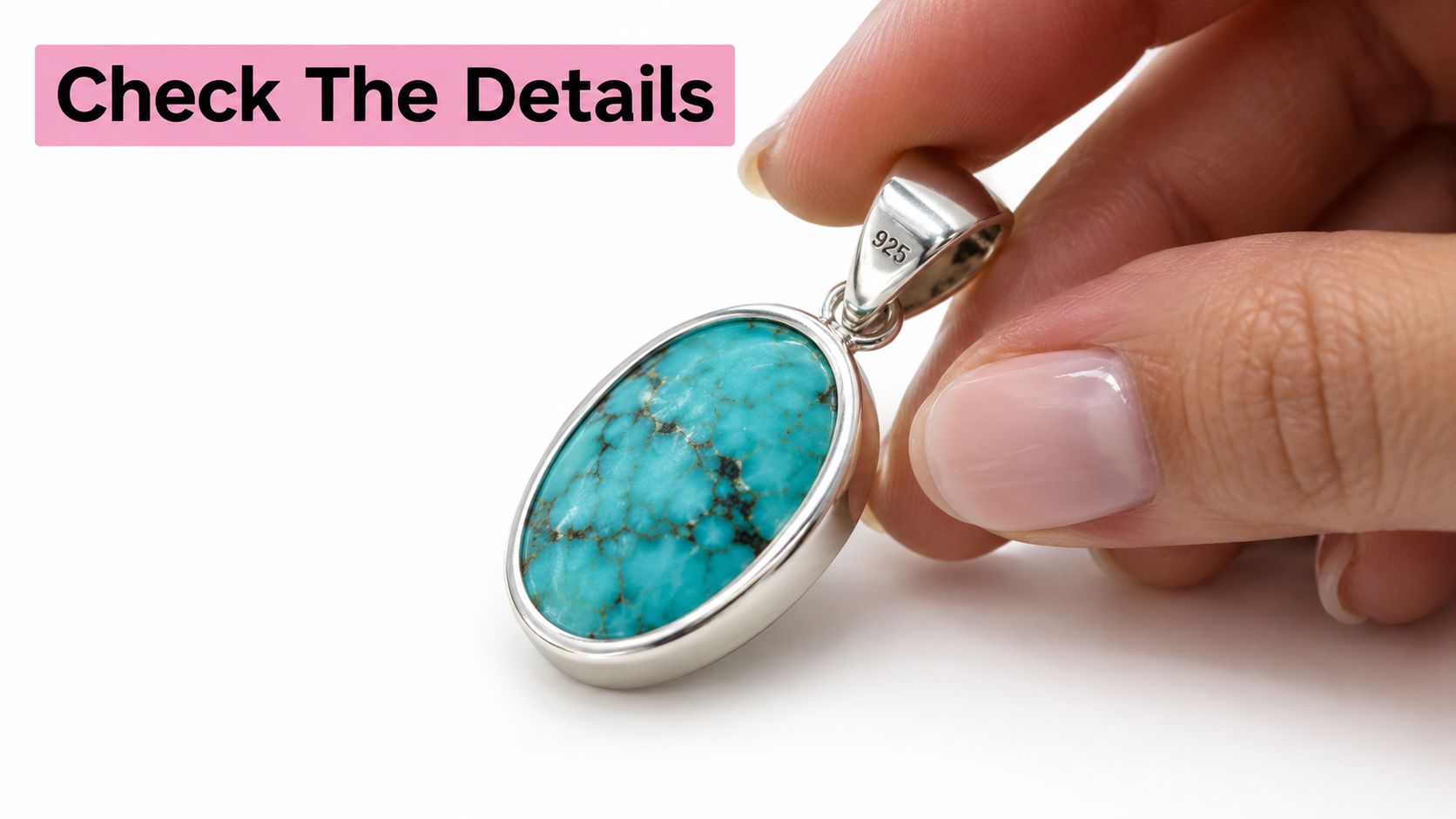
Match each observation to a question
- Marks and placement. Inspect the pendant back, bail, and chain fittings. Ask which components the material description covers; a chain mark shouldn't stand in for information about the pendant.
- Setting fit. Look for uneven edges, obvious gaps, or a stone sitting crookedly. Ask whether anything needs adjustment before purchase.
- Color and matrix. Notice whether the darker pattern appears integrated into the surface or looks superficial. Either impression is only a prompt for clarification, not a verdict.
- Feel and weight. Handle the piece gently if permitted. A cool surface or reassuring heft may influence your impression, but neither settles metal purity or stone identity.
- Documentation. Compare the tag, listing, and seller's explanation. Inconsistent wording deserves a direct question.
Look for clarity rather than perfection
Ask the seller to write down how they classify the stone and whether it has been treated. If the answer changes from “natural” to “stabilized” during the conversation, request a corrected description rather than trying to interpret the wording yourself.
Don't attempt a destructive home test to resolve uncertainty. If the purchase depends on an authenticity claim the seller can't support, seek professional assessment or choose another piece.
A pendant with a modest, accurate description can be a more comfortable purchase than one with elaborate claims and missing details. You're looking for agreement between what you can observe, what the seller says, and what the documentation supports.
Styling a Turquoise and Sterling Silver Pendant
A white shirt is an easy place to begin. Try a small turquoise pendant on a fine cable chain, then adjust the length until it sits either clearly above the neckline or comfortably below it. If it keeps disappearing behind the fabric, change the chain length rather than constantly pulling it forward.
For an English-riding-inspired outfit, keep the surrounding pieces quiet: a crisp shirt, dark denim, and understated silver jewelry. The pendant can provide the color without competing with every other detail.
This simple neckline shows how little styling a turquoise pendant needs.
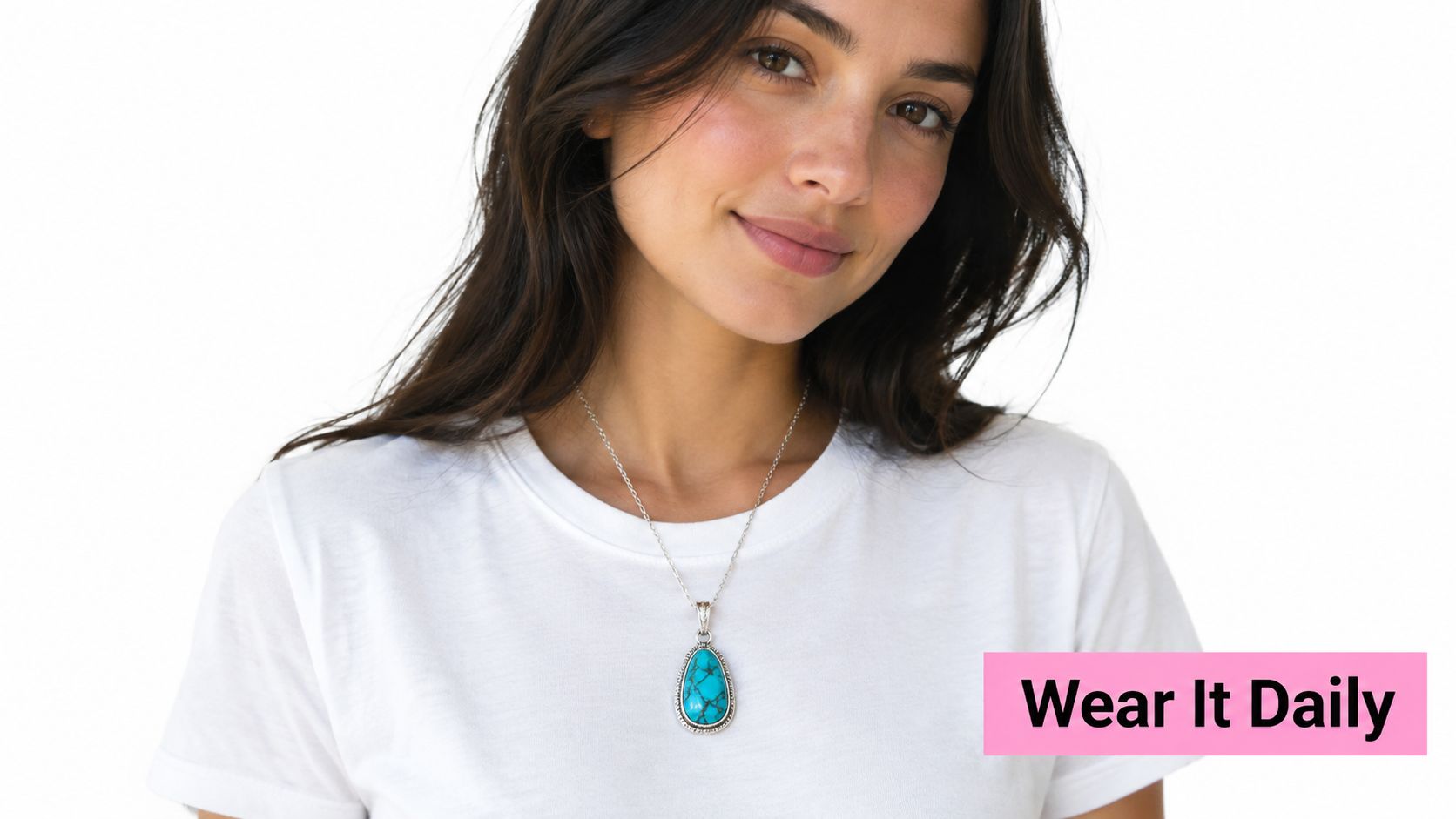
Give a larger pendant breathing room
Over a knit sweater, try a broader pendant with jeans and boots for a Western-inspired look. Check the combination while moving, not only while standing in front of a mirror. If the decorative frame catches the knit or the pendant keeps twisting, choose a smoother garment or a different chain.
The useful test is comfort, not whether the outfit fits a particular style label.
Wear the pendant where you can enjoy it, not where you'll spend the day untangling or repositioning it.
Layer without crowding the stone
For a layered look, start with the turquoise piece and add a longer silver chain. Keep enough separation that the chains don't constantly cross over the pendant's face. Try sitting down and leaning forward before deciding the arrangement works.
These outfit choices can sit alongside the ideas in horse jewelry for women without requiring every accessory to carry a horse motif.
Treat this as everyday social styling, not a recommendation to wear jewelry during strenuous riding or barn chores. Choose the pendant for the café, gathering, or relaxed evening afterward, when you can appreciate it without testing its durability.
A Care Routine That Respects Both Materials
The cleaning challenge is specific: you want to brighten the silver without carrying polish onto the turquoise. Tarnish is generally a surface appearance change, so the gentler approach is preferable to aggressive abrasion, as explained in this sterling silver maintenance guidance.
Set out a clean microfiber cloth and a silver-polishing cloth as separate tools. Use the polishing cloth only where you can control contact with exposed metal. If reaching a darkened recess means rubbing across the stone, leave that area for a jeweler.
Make care part of getting dressed
- Before wearing. Finish fragrance, skincare, and cosmetics first. Put the pendant on after those products have been applied.
- Before wet or strenuous activities. Remove it before showering, swimming, or exercising. I'd also make removal before bed a habit to avoid overnight snagging.
- After wearing. Gently wipe the pendant and chain with the clean, dry microfiber cloth. Don't pull hard on the chain or rub at the stone's edge.
- For storage. Give it a separate soft compartment or anti-tarnish pouch in a low-humidity place, rather than dropping it into a pile of jewelry.
If wiping isn't enough, follow the material-specific cleaning precautions discussed earlier: mild soap, lukewarm water, and a soft cloth, without prolonged soaking or forceful scrubbing. Dry gently before putting the piece away.
The accompanying jewelry-care video is below; keep the pendant's own material requirements in mind when considering any cleaning demonstration.
Know when not to clean
Skip silver dips, steam, ultrasonic machines, toothpaste, household ammonia, and abrasive rubbing across the stone. Do not choose a shortcut because it removes tarnish quickly.
Periodically inspect the bail, the loop carrying the chain, and the jump ring, the connecting ring where one is used. Look for distortion, an opening, or unexpected movement. If the stone feels loose or the setting looks bent, stop wearing it and take it to a bench jeweler rather than applying glue.
For coordinating accessories, the discussion of sterling silver horseshoe earrings offers a separate point of comparison. Don't assume a cleaning method suitable for plain silver is suitable for every stone-set piece.
Ethical Sourcing and Smart Buying Questions
A turquoise and sterling silver pendant can have an appealing story without a fully documented supply chain. The responsible response isn't to dismiss the story, but to ask which parts the seller can substantiate.
Origin, maker attribution, and charitable purpose are separate subjects. A purchase connected with a cause doesn't automatically certify gemstone sourcing, just as a country name doesn't tell you who cut or set the stone.
Ask beyond the label
Use questions that invite specific answers:
- Who made this piece? Ask who cut the stone, who made the setting, and what the seller means by handmade.
- What information follows the stone? Request its stated source and any records supporting a named mine or region.
- What was done to the material? Ask for treatment disclosure rather than assuming an attractive surface is untreated.
- What can you provide in writing? Save an item-specific description, not just a general statement about the shop's values.
An answer such as “we know the supplier, but don't have mine documentation” gives you a clearer basis for deciding than an unsupported claim of complete traceability. Decide which information matters to you before accepting the uncertainty.
Recognize reasons to pause
A vague natural-turquoise claim with no further explanation is a reason to ask more, not proof of wrongdoing. So is a seller who responds to material questions only with comments about beauty or popularity.
If a price seems unusually low compared with similar pieces, ask what explains the difference. Don't compare a simple, disclosed treated-stone pendant with a documented maker-attributed piece and assume price alone reveals authenticity.
For a gift, ask whether the recipient will receive the material description and care instructions. That small practical detail helps them understand what they own and how to look after it. Choose the seller who communicates clearly, whether that's an independent studio, a documented resale dealer, or a charitable retailer.
Your Shortlist Before You Click Buy
Open the saved listing and read it without relying on the main photograph. You should be able to identify what's being sold, what remains uncertain, and whether those limits are acceptable to you.
Use this compact checklist before committing:
- Metal. Confirm the setting's stated material and which components that statement covers.
- Stone. Find an explicit identity, not merely a color or style description.
- Treatment. Keep the seller's disclosure with the purchase record.
- Provenance. Separate documented origin and maker information from decorative storytelling.
- Wearability. Check the chain connection, setting edges, and how the pendant sits with your usual clothes.
- Ownership. Make sure the care requirements suit your habits and that you know where to seek repairs.
Choose clarity over reassurance
A credible sterling claim is relevant, but the familiar stamp isn't a complete buying decision. Equally, the absence of a visible stamp in a photograph is a reason to request information, not an automatic conclusion that the piece is false.
You don't need the most elaborate pendant or the longest origin story. You need a piece you enjoy wearing, described accurately enough that you understand your purchase. If an important answer is missing, send the question before clicking buy and keep the response.
Bridle Up Hope Shop offers equestrian jewelry, apparel, accessories, and gifts in English and Western styles. Visit Bridle Up Hope Shop to explore horse-inspired pieces that could complement your pendant, and use your shortlist to check each item's materials and care needs before choosing.

Leave a comment