


Ask what makes a custom horse hair bracelet worth the money and most buyers point to the braid pattern or the clasp. That's the wrong place to look first.
The two things that decide whether a keepsake holds up are who supplied the hair and how the finished piece behaves against skin, water and sweat. Braid style is the part you can change later. Provenance is the part you can't.
Table of Contents
- What a Custom Horsehair Bracelet Costs
- Choosing Hair Type, Braid and Hardware
- Verifying Where the Hair Came From
- Daily Wear, Water and Sensitive Skin
- How to Care for and Store Your Bracelet
- Gifting, Memorial Orders and Pre-Order Confirmation
What a Custom Horsehair Bracelet Costs
Custom horse hair bracelets run from $70 to $752 across the makers whose bracelet pages list a price, according to Spirithorse Designs and More Than A Horse Keepsakes. That gap has almost nothing to do with how much hair goes into the piece. Spirithorse Designs lists a pewter bracelet at $97 and a sterling-silver cuff at $752 on the same page. Same animal, same braiding skill, eight times the money.
Three variables drive the spread. First, how many horses contribute hair, because a second animal means a second collection and a second braid section. Second, the metal and hardware, where pewter and sterling silver sit at opposite ends. Third, the construction, since a flat cuff takes more material and bench time than a narrow braid with a clasp.
| Maker and option | Starting price | Add-ons | Notes | | More Than A Horse Keepsakes, hair from one horse | $70 | $10 per additional horse | Price listed on its bracelet page | | Spirithorse Designs, pewter bracelet | $97 | Quoted separately, ask before paying | Lowest listed price on its horse-hair bracelet page | | Spirithorse Designs, sterling-silver cuff | $752 | Quoted separately, ask before paying | Highest listed price on the same page |
More Than A Horse Keepsakes is the clearest example of per-horse pricing. Its bracelet page lists $70 for hair from one horse, plus $10 for each additional horse.
What the listed price usually leaves out
Treat every figure in that table as a floor. Shipping, engraving, a clasp upgrade, a memorial charm and a rush deadline are commonly quoted separately. If the maker's page doesn't say whether those are included, you don't know the actual cost yet, and neither does the next buyer.
Bridle Up Hope Shop is a gift shop for horse lovers selling English and western designs, with products including the Lucky Horseshoe Necklace at $24.00, Vintage Horse Hat (Black) at $28.00 and Equine Embrace Jacquard Sweater at $68.00. The shop puts the Pink Horseshoe symbol on many products, representing horses, habits and hope. It treats customers like family, raises funds for Bridle Up Hope charity and operates with a charitable model.
Three budget tiers and what each buys
Under $100 gets you a single-horse braid with base metal hardware. It's a real keepsake and a sensible first order if you're unsure about sizing or wear habits.
$100 to $300 is where metal quality and clasp choice open up. This is the band where most buyers should shop, because the upgrade buys durability at the point that fails.
Above $300 pays for precious metal and bench time, not strength. A silver cuff doesn't survive a wash stall better than a pewter braid.
The one question before you pay: what exactly does the quoted price include, and what will you be invoiced for later?
Choosing Hair Type, Braid and Hardware
Horse hair isn't one material. A wet-fiber study published in the Annals of the University of Oradea measured hard horsehair at 219 micrometers against 162 micrometers for soft hair, and hair diameter varies widely across animals beyond even that gap. You can feel the difference in the finished braid.
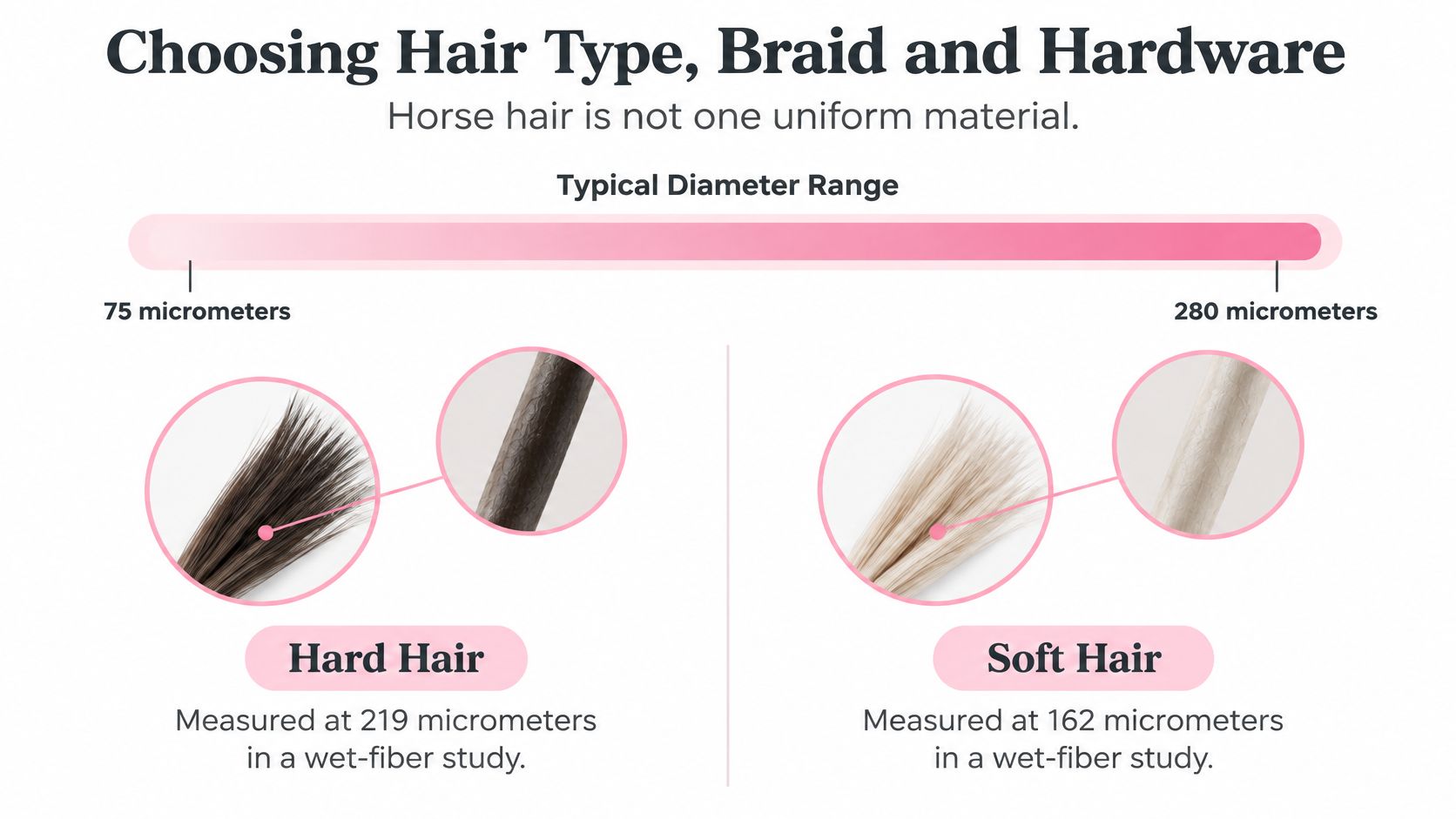
Thicker tail hair braids into something rigid and sculptural that holds its shape on the wrist. Finer hair pulls tighter, drapes softer and reads more like cord than structure. Neither is better. They suit different wrists and different ideas of what a keepsake should look like.
Strength follows the same split. The same study reported incipient-tension resistance of 2.52 N/tex for hard hair and 1.82 N/tex for soft hair, so material choice, not braid pattern alone, sets how much load the piece tolerates.
| Hair type or test | Diameter | Braid and feel | Strength value | | Hard horsehair, wet, thicker tail hair | 219 µm | Rigid, sculptural braid | 2.52 N/tex incipient-tension resistance | | Soft horsehair, wet, finer hair | 162 µm | Tighter braid, softer drape | 1.82 N/tex incipient-tension resistance | | Range across animals and strands | Wide spread, varies by horse | Braid feel follows the fiber type | No single strength figure applies to the full range | | 0.19 mm hair, straight pull | 0.19 mm | Load carried along the strand | 0.5851 ± 0.122 kg | | 0.19 mm hair, knot pull | 0.19 mm | Weakest point at concentrated knots | 0.3998 ± 0.078 kg |
Where a bracelet actually breaks
The Oradea study's biomedical evaluation measured 0.19 mm horsehair at 0.5851 ± 0.122 kg straight-pull strength but only 0.3998 ± 0.078 kg knot-pull strength. Hair carries load well along its length and gives it up at a tight knot.
That single finding should shape the whole order. A maker who ties sharp, high-tension knots near the clasp is building in a failure point. Smooth end caps and crimps with broad contact areas spread the load instead of concentrating it, and they matter for a second reason buyers underrate: whatever hardware you choose sits against your skin for hours. Ask what metal the caps and clasp are made of before you order, because a braid you love is worthless if the hardware irritates your wrist and the bracelet ends up in a drawer.
Multi-strand braiding does the same protective job along the body of the bracelet. Braid geometry distributes stress across several hairs, so one damaged strand doesn't end the piece. Relying on one or two load-bearing hairs is a shortcut you'll notice within a season.
If the aesthetic you're after runs toward stone rather than fiber, this artisan gemstone bracelet gift idea shows how a set stone handles the same stress question, and our guide to an equine charm bracelet covers how metal charms attach without weakening the chain.
Three decisions to make before the maker starts
Hard or soft hair. Choose hard tail hair for a structured cuff, soft hair for a braid that moves with your wrist. If the hair comes from your own horse, ask the maker whether the strands you supplied suit the braid you want, because tail and mane hair don't behave the same.
Multi-strand or thin. A multi-strand braid survives daily wear. A single or double strand suits occasional wear and photographs beautifully.
Occasional or continuous. Say which one out loud. A maker who knows the bracelet will meet horse sweat will build the ends differently, and one who knows you have sensitive skin should steer you toward hardware you can wear all day.
Verifying Where the Hair Came From
A keepsake is only as good as its paperwork. That sounds cold until you consider what you're buying: not a braid, but a claim that these strands came from one specific animal. Nothing in the object itself proves it.
Provenance questions rarely appear on seller pages, which tend to cover braid styles, sizing and care instead. Buyers want to know whether the hair came from their own horse's routine grooming, a memorial source or an unknown donor, whether mane and tail hair behave differently, how much hair is needed, and what happens to the leftovers. A buying guide on horse hair selection recommends documenting chain of custody, including source, collection date, horse information and whether the hair came from grooming or post-mortem salvage. That's sensible, but it isn't an independently validated standard or a certification, so treat it as your own test rather than a badge to look for.
The checklist to send the maker
- Source type: your own horse's grooming, a memorial clipping, or supplied hair from the maker's stock.
- Collection date and horse details: name, barn name, breed, and any marking that ties the hair to that animal.
- Grooming or post-mortem: two different conversations, and the second one needs care.
- Cleaning and packaging method: how the hair was washed, dried and wrapped before it shipped.
- Identity labeling: a tag or record that follows your hair through the maker's bench.
- Photo or certificate option: proof of the finished piece before it leaves the workshop.
- Written consent: for memorial hair, a short statement from whoever collected it.
The rule that matters: a clear written answer on every line above is worth more than a charm, a bead or a metal upgrade.
Customization isn't automatically better. Traceability and explicit consent are the parts that carry the emotional weight, and they cost nothing to ask for. If a maker can't say whether sourced hair is ever substituted, you've learned something about the operation.
Daily Wear, Water and Sensitive Skin
The braid is the strongest part of the bracelet. Adhesives, coatings, clasps and skin contact fail on their own schedule. Durable describes the braid; maintenance-free describes the fittings, which need attention.
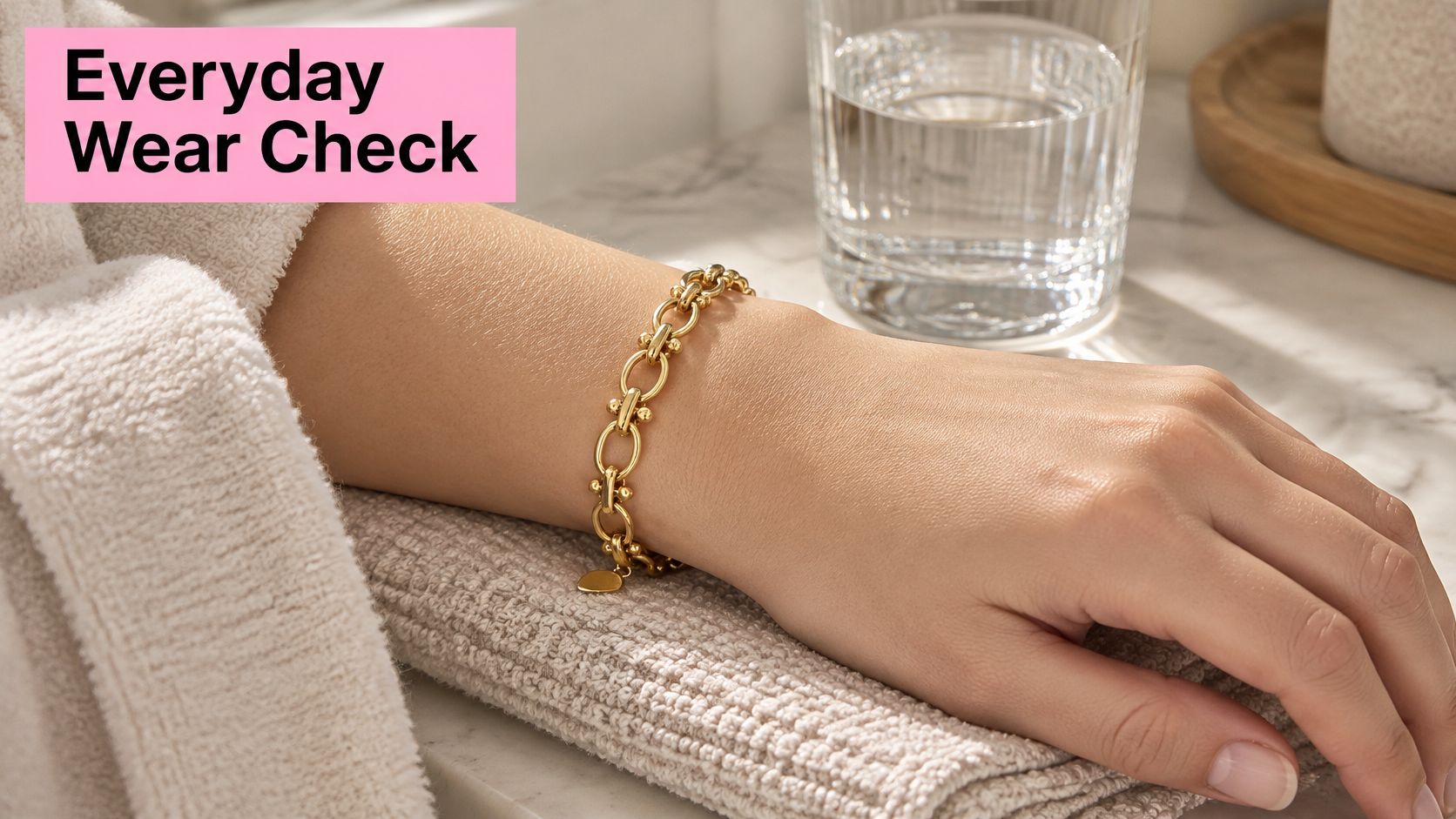
Water guidance is inconsistent. Hoofprints Equine Jewelry's care page takes the cautious line, warning against moisture because water can weaken sealants and dull hardware. Treat that as the working rule. A bracelet that never gets wet cannot corrode, and that matters more for the fittings than the hair.
| Activity | Main risk | Practical call | | Desk wear and errands | Low; dry friction and snagging | Fine to wear daily | | Riding and stable work | Abrasion, dust and sweat on the clasp | Remove for heavy work; check end caps after each ride | | Bathing or washing a horse | Moisture weakens sealants and adhesives; hardware tarnishes | Take it off first | | Swimming or hot tubs | Prolonged water exposure; mildew odor after wetting | Remove before swimming |
Telling hair irritation from metal sensitivity
Horse hair can itch or cause a rash in some wearers, and most product pages never separate that from a nickel or plating reaction. You can. Note where the redness starts. If it follows the band of hair, the fiber is the likely cause. If it clusters under the clasp or end caps, suspect the metal.
Check the metal composition, ask whether the maker uses hypoallergenic hardware, and ask about a skin-contact barrier under the clasp. Stop wearing the bracelet at the first irritation, and get medical advice if symptoms persist rather than self-diagnosing. Provenance matters here too. Hair that was not cleaned carefully before braiding can carry residue against the skin, so ask how the hair was washed and sealed before it reached the bench.
Assume nothing about lifetime wear, and reject any maker who promises it. There is no solid independent durability or dermatological dataset for horse-hair jewelry. What you have are practical limits: a braid can hold up well, fittings can corrode or loosen, and skin response varies. Buy for the risks you can control, water exposure, metal choice and contact with the hair.
For a sense of how the finished piece should sit and move, this short demonstration is useful.
How to Care for and Store Your Bracelet
A five-minute routine once a week keeps a braided keepsake wearable far longer than any coating. The removal rules for bathing, swimming, washing a horse and applying lotion are covered in the daily wear guidance above, and this routine assumes you already follow them. What follows is the upkeep that happens after the bracelet comes off.
- Wipe the braid after every ride. A dry, soft cloth lifts dust and sweat before they work into the strands. Sweat left in a braid dries into a stiff, abrasive residue that grinds the fibers from the inside.
- Spot-clean with a barely damp cloth and mild soap. Then dry it fully at room temperature, away from radiators, hairdryers and direct sun. Heat warps coatings and can shrink the fibers unevenly.
- Check the end caps and clasp monthly. Look for looseness, corrosion or a widening gap where the hair enters the metal. Catching a loose cap early is a small repair. Catching it late is a lost braid.
- Store it flat in a breathable box. A sealed plastic bag traps damp, and trapped damp is what produces odor and mildew. Keep the box out of direct sun so the color holds.
- Photograph damage before you contact the maker. If a strand splits or a cap loosens, take clear close-up photos of the spot, note your order date and the bracelet's measurements, and send both to the maker before wearing it again. Good makers quote repairs faster when they can see the failure, and a photo taken now also documents the problem if it worsens in transit back to them.
Why breathable beats airtight: a cotton pouch or a lined box lets residual moisture escape. Plastic holds it against the hair for weeks.
The same logic applies when you travel, and this guide to moisture control for jewelry on trips covers packing methods that keep humidity away from braided and metal pieces. At home, a dedicated equestrian jewelry box with a flat tray keeps the braid from creasing under other pieces.
Repair and resizing options vary by maker. Ask before you order whether the bracelet can be shortened, re-capped or re-strung later, because a braid joined with adhesive may not be alterable at all. That one question, asked at the quote stage, decides whether a accident in year three means a small invoice or a new commission.
Gifting, Memorial Orders and Pre-Order Confirmation
A bracelet braided from a living horse's mane and one braided from hair clipped after a death carry the same product name and completely different obligations. In the first case the owner hands over hair and gives permission in the same conversation. In the second, whoever collected the hair has to put that permission in writing, and a maker who never asks for it is telling you how they work.
The details to send with the order
Start with the horse's name, the hair source and the collection date, then the wrist measurement and whether hair from a second horse is included. Extra horses add a fee at some makers, so confirm that before the quote is final.
Next, restate the build: hair type, strand count, braid style and clasp. Then ask the commercial question. Does the quote cover shipping, engraving or a memorial charm, and what would a rush deadline add?
Custom makers set their own lead times, so request a completion date in writing and work backwards from the birthday or holiday. Ask for a photograph of the finished piece before it ships. The recipient shouldn't be the first person to see it.
A memorial order, start to finish
Say a buyer wants a memorial bracelet for a daughter's birthday in six weeks. She asks the maker for the consent wording covering the hair she clipped herself, confirms the single-horse price and the clasp metal, and requests a completion date in writing.
Two days before dispatch, a photo arrives showing the braid, the end caps and the engraving. She approves it, the bracelet ships, and the gift lands on time with the paperwork filed alongside it.
Place the order only after every answer is written down. If a maker can't answer the provenance checklist or the completion date, choose another maker. There's no shortage of them.
If the memorial angle is the main purpose rather than a detail, our collection of horse memorial gifts covers keepsakes that don't require sending hair through the post.
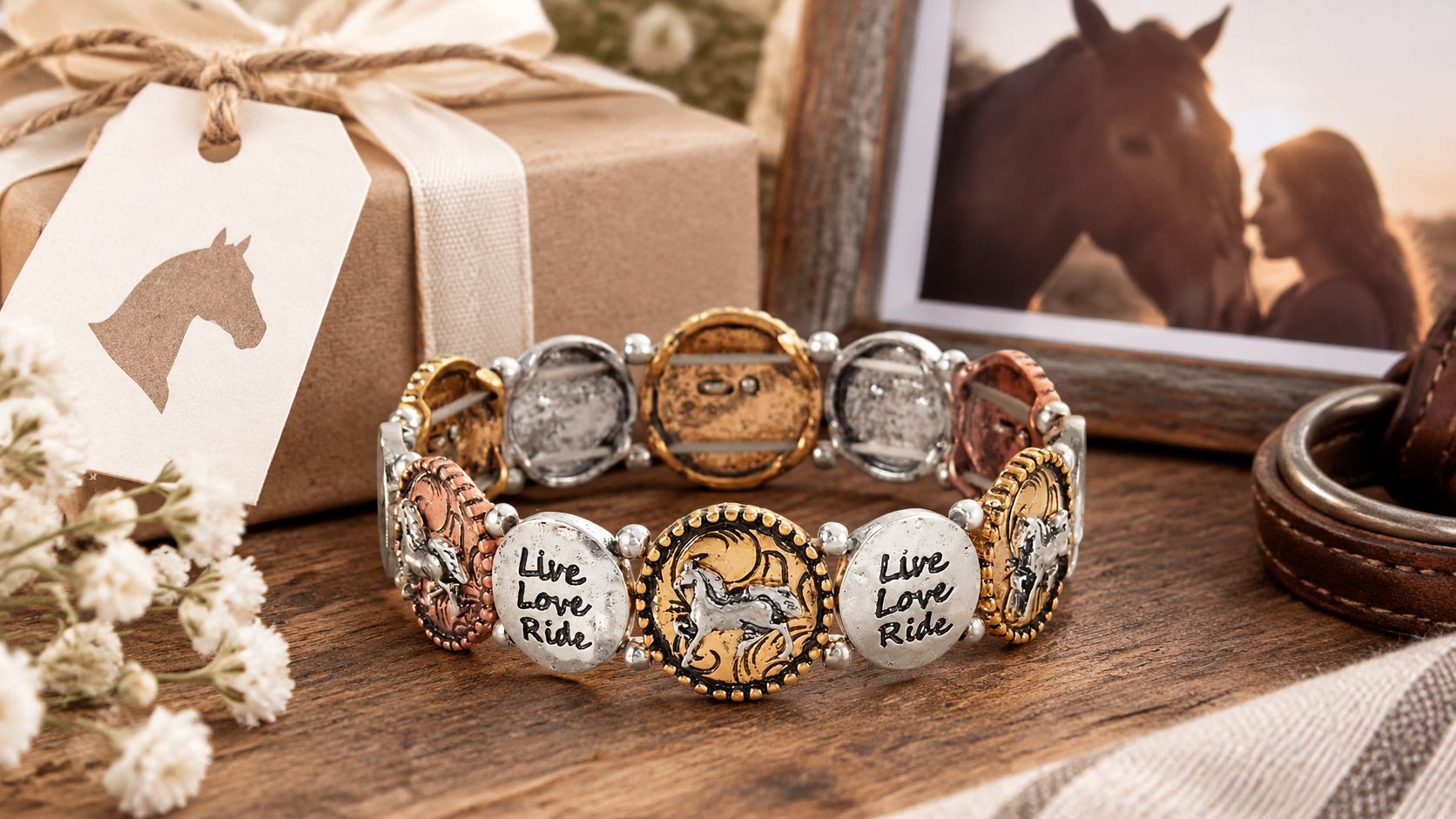
For a simpler gift where the horse is celebrated rather than remembered, the Live Love Ride Stretch Bracelet is a ready-made fashion bracelet rather than a hair keepsake, and it arrives without the lead time or the paperwork a custom braid requires. Bridle Up Hope Shop processes orders within 1 to 2 business days, and for special or expedited shipping requests you can contact customer service at shop@bridleuphope.org, where additional charges may apply. The website is operated by Bridle Up Hope Shop LLC.
If you'd rather start with a piece you can wear this week than wait on a custom braid, Bridle Up Hope Shop carries equestrian bracelets and gifts for women, girls and the home, with 100% of the profits from each purchase donated to help the girls, women and horses at the Bridle Up Hope charity. Browse the collection at Bridle Up Hope Shop and confirm custom availability, pricing and lead time directly with the team before you plan a date.
Deixe um comentário