


The popular advice is to choose the cutest barrel racing sweatshirt and worry about performance later. That's backwards. A sweatshirt can show your Western identity, keep you comfortable through a cold warm-up, and still look polished at lunch, but only if its fabric, cut, and construction suit the work riders do. Treat it as a performance-adjacent barn-to-street layer, not a souvenir hoodie, and your buying decisions improve immediately.
Table of Contents
- Rethinking Barrel Racing Sweatshirts as Functional Apparel
- Fabric and Fit Considerations for the Saddle
- Layering for Early Morning Shows and Cold Weather
- Western Styling Cues and Everyday Wearability
- Gifting Barrel Racing Sweatshirts for Equestrians
- Care and Maintenance for Longevity
Rethinking Barrel Racing Sweatshirts as Functional Apparel
A slogan across the chest doesn't make a sweatshirt useful, and a soft fleece blend doesn't automatically make it comfortable in the saddle. Riders need a layer that handles chores, trailer travel, tack contact, changing weather, and the transition from arena to everyday life without looking like disposable event merchandise.
That shift makes sense in the wider market. In North America, show shirts were valued at USD 0.27 billion in 2025 and were forecast to grow at a 6.2% rate, while polo shirts and tops were valued at USD 0.16 billion with a 6.0% CAGR, according to the North American equestrian apparel market data. Topwear also generated USD 900 million in the U.S. equestrian apparel market in 2025, which gives sweatshirt-style products a substantial category context even when the barrel racing niche itself is specialized.
From arena merchandise to daily equipment
Barrel racing has developed a recognizable consumer ecosystem that extends beyond competition days. A dedicated marketplace for equipment, tack, and gear shows how riders now shop within a specialized community, while mainstream retail listings repeatedly use barrel racing language for graphic apparel. Those products often sit in the roughly $20 to $35 range, as described in North America equestrian apparel market coverage, but price alone tells you very little about saddle comfort or durability.
A better standard is simple. Ask whether you'd wear the sweatshirt for early barn work, a long drive to a show, and a casual meal afterward. If the answer is no, the garment is probably fanwear rather than a useful layer.
Practical rule: Buy the sweatshirt for the rider's routine, then choose the graphic and color.
Look for restrained Western details, clean lettering, dependable ribbing, and a silhouette that works with jeans or riding pants. If you're comparing team or event apparel, resources such as design and order NCAA sweatshirts can also help you think about customization, lettering, and group identity without assuming that a bold graphic equals better quality. For a broader wardrobe perspective, the guide to Western riding apparel is a useful companion.
Fabric and Fit Considerations for the Saddle
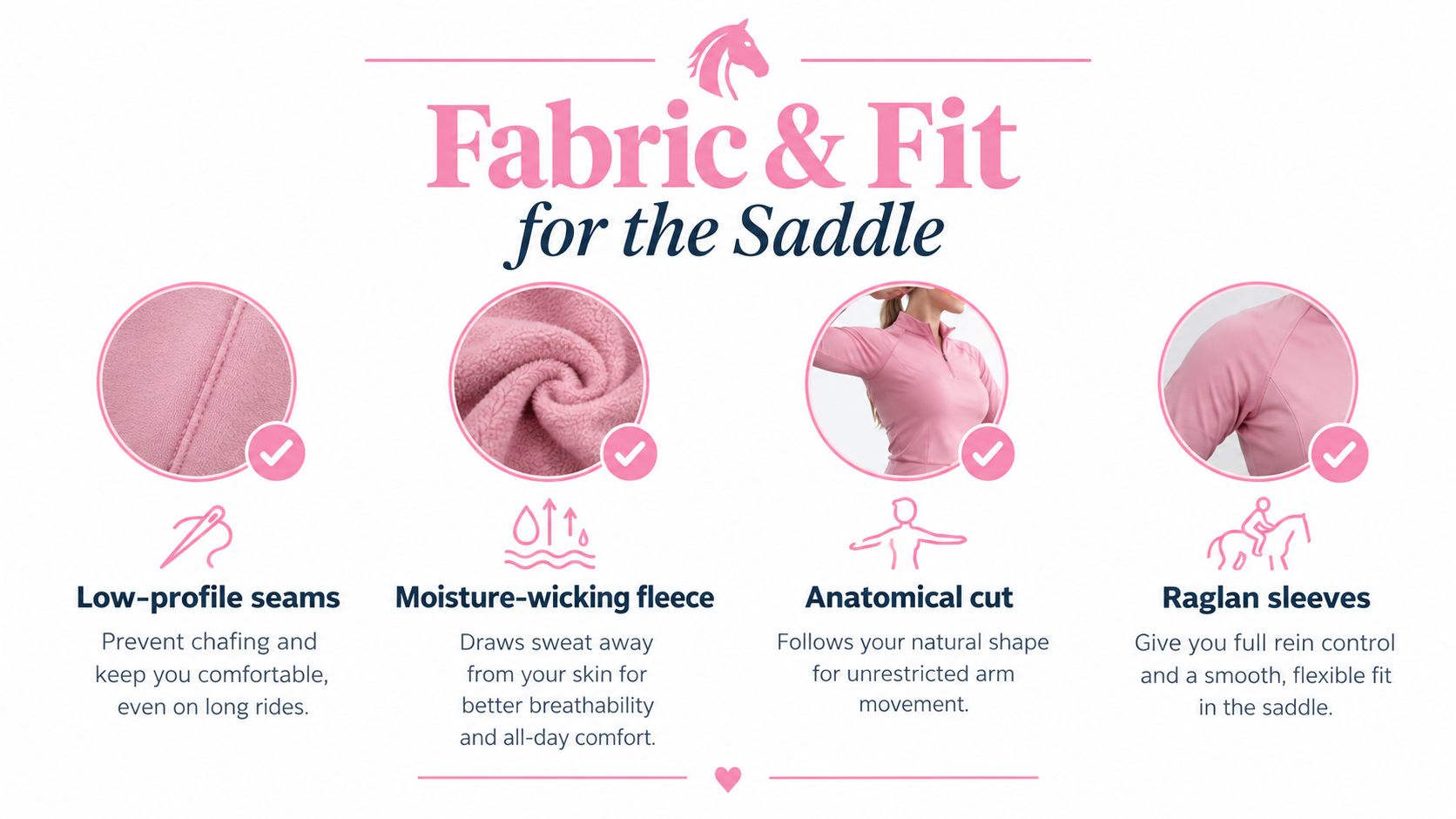
A sweatshirt that feels luxurious in a fitting room can become annoying once you're mounted. The saddle creates constant contact at the seat and hips, reins demand unrestricted shoulder movement, and tack can rub the same areas repeatedly. Your ideal barrel racing sweatshirt should feel stable on the body, not loose enough to catch, bunch, or create pressure beneath another layer.
Choose structure before softness
Polyester fleece remains practical because it offers warmth without the weight of a bulky wool layer, but knit construction matters. Textile research on polyester fleece identifies visible pilling during Martindale abrasion as an indicator of fiber-fragment formation. Another fleece study recorded pilling grades ranging from about 2 to 4 after 1000 rubs, depending on knit structure and fiber blend, with tighter or better-engineered structures generally maintaining stronger fabric integrity. See the textile research on polyester fleece abrasion and pilling for the technical background.
You don't need to become a textile engineer. Run your hand over the inside and outside, inspect the cuffs, and look for a dense, even surface rather than a loose halo of fibers. A smooth face tends to layer more cleanly under a vest or shell, while a lofty brushed interior can feel warmer but may hold more moisture and bulk.
Fit it for movement, not just standing
Size up only when the base layer and outer shell still fit comfortably over it. An oversized body can bunch under your waist, while excessive sleeve fabric can interfere with reins, gloves, or a vest. Choose a hem that stays put when you reach forward, but avoid a long, heavy drop that gathers beneath the saddle.
Use these checks in a fitting room or at home:
- Raise both arms: The shoulders should move without pulling the neckline backward.
- Reach toward a rein position: Raglan or thoughtfully shaped sleeves usually give better mobility than a narrow armhole.
- Sit and bend: The hem should cover without folding into a thick ridge.
- Inspect the seams: Flat, low-profile seams reduce friction where your body meets tack or additional layers.
- Compare measurements: A practical sweatshirt sizing guide from Dirt Cheap Product, Inc. can help you compare garment dimensions instead of guessing from a generic small, medium, or large.
For more cold-weather wardrobe ideas, the discussion of horse riding sweaters offers useful context. The right fit should give you enough room to move, but never so much that the sweatshirt becomes another piece of equipment to manage.
Layering for Early Morning Shows and Cold Weather
A sweatshirt works best as the middle of a system, not as the entire system. Cold arena mornings can turn into sunny afternoons, and riders need to remove or add layers without changing their ability to mount, warm up, or make a run.
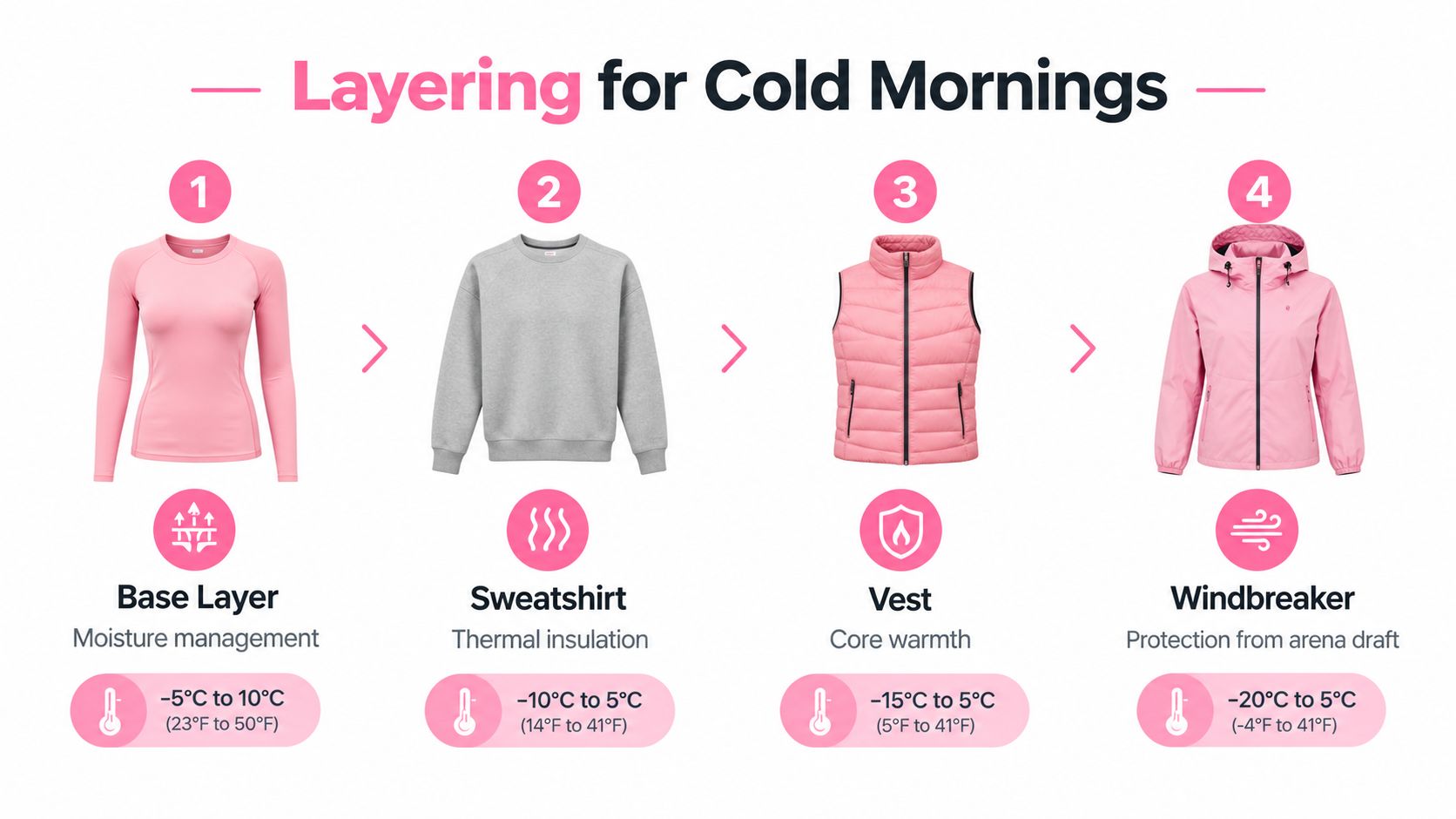
Equestrian layering guidance recommends a moisture-wicking base layer, insulating mid-layer, and weatherproof outer shell. The base moves perspiration away from your skin, the sweatshirt helps trap insulating air, and the shell blocks wind and rain. This structure is explained in the equestrian cold-weather layering system.
Build the system from the skin outward
Start with a close-fitting technical shirt. Avoid cotton as your only base when you expect to sweat, because a damp layer against your skin can leave you chilled as soon as you stop moving. Your base should lie flat beneath the sweatshirt, with no bulky collar or twisted seams.
Add the sweatshirt for insulation. Choose a moderate, flexible fleece rather than the thickest option available. If the sweatshirt makes it difficult to bend your elbows, close your vest, or settle your shoulders, it's too heavy for active riding.
A vest can add core warmth without restricting the arms. That makes it especially useful for barn chores and travel, when your hands and shoulders need freedom. Finish with a windbreaker or weatherproof shell when the arena draft cuts through the layers.
Layering advice: Insulation keeps you warm, but breathability keeps that warmth usable once you start working.
The shell needs more than a water-resistant finish if you'll spend prolonged time outdoors. Performance thresholds cited in equestrian shell guidance include a minimum 10,000 mm water column and 10,000 g/m²/24hr moisture vapor transmission rate, illustrating why wind protection and breathability should be evaluated together. You don't need those specifications for every sweatshirt, but you should understand that a warm garment can still fail if it traps sweat.
Before your run, remove the shell or vest if they limit your arms or create unnecessary bulk. Keep the sweatshirt only if it allows a natural rein position and a clean forward reach.
Western Styling Cues and Everyday Wearability
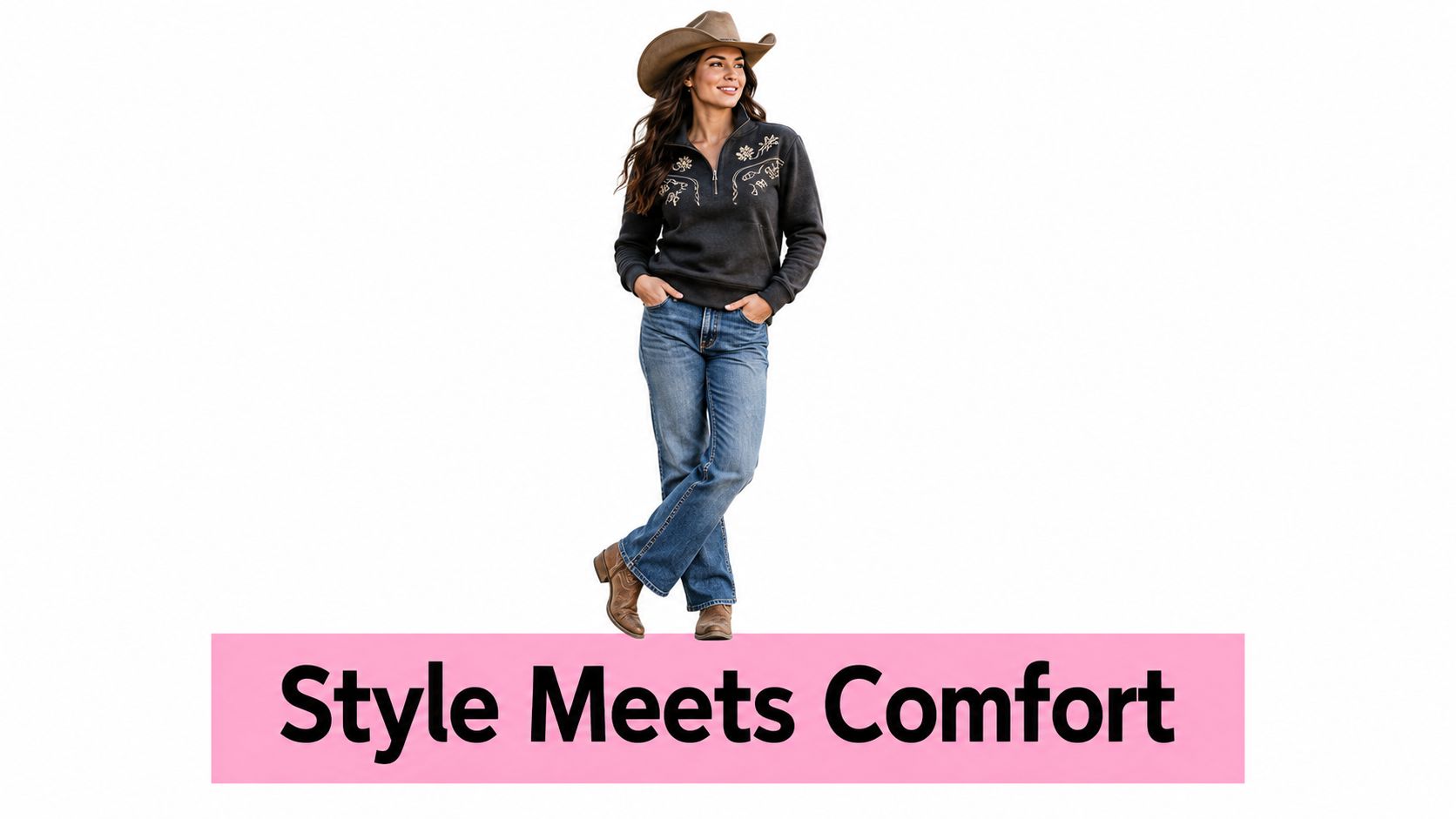
The most versatile barrel racing sweatshirt doesn't need a giant rodeo graphic. It needs one or two clear Western cues, then enough restraint to work away from the barn. Embroidery, a small horse or bit motif, contrast stitching, a vintage-inspired collegiate treatment, or a carefully placed back graphic can establish the identity without overwhelming the rest of your outfit.
Make the silhouette do the work
A shaped shoulder and a controlled hem look sharper than a boxy athletic cut. Charcoal, faded black, cream, denim blue, olive, and warm earth tones coordinate easily with jeans, chaps, boots, and a felt hat. Bright color can work too, but anchor it with neutral denim and simple accessories so the sweatshirt remains the focal point.
For arena wear, pair a fitted sweatshirt with bootcut jeans or riding tights, then add a vest when the weather calls for it. For town, change into clean denim, brush off the boots, and add a structured belt or understated jewelry. The outfit still reads Western, but it no longer looks like you walked directly out of a merchandise tent.
Keep novelty in its proper place
A humorous coffee or seasonal Western sweatshirt can be fun for casual wear. The Farmhouse World coffee lover sweatshirt is an example of that lighter, personality-driven direction. It may suit a coffee run or a relaxed gathering, but a rider who wants one dependable layer should prioritize a design that works across more settings.
Choose decoration that survives your actual routine. Embroidery and high-quality prints should remain legible after repeated washing, while delicate embellishments can snag on gates, tack, or rough barn surfaces. Avoid long fringe, dangling cords, and oversized hardware if you plan to ride in the sweatshirt.
The modern equestrian wardrobe is moving toward functional elegance, barn-to-street styling, and technical comfort rather than purely decorative pieces, as discussed in equestrian fashion trend coverage. That direction suits barrel racers well. Your clothing can honor rodeo culture without sacrificing a clean, wearable silhouette.
Gifting Barrel Racing Sweatshirts for Equestrians
A barrel racer's sweatshirt gift should begin with observation, not a graphic. Think about where the recipient rides, how often she travels, whether she layers under a jacket, and whether her closet leans toward bold Western color or quiet neutrals. The right gift feels personal because it solves a real clothing problem.
Start with the rider's routine
For a rider who spends long mornings at outdoor arenas, choose a breathable mid-layer with enough room for a base shirt and vest. For someone who mostly wears equestrian clothing around town, prioritize a polished cut, durable cuffs, and a design that pairs with denim. A youth rider may need room to grow, but excessive length or sleeve volume can become awkward and unsafe around horses.
Ask a discreet question about preferred brands or usual sizes before ordering. Sweatshirt sizing varies widely, so compare the recipient's favorite garment with the product's measurements rather than relying on the letter size alone. If she prefers a fitted look, don't assume that sizing up automatically improves comfort. If she wears layers, check shoulder and chest room first.
A gift card is the sensible choice when the fit, color, or cut is uncertain. It also lets the rider select a sweatshirt that matches her climate and show schedule instead of receiving a garment that looks appealing but stays in the drawer.
Add meaning to the purchase
Purpose-driven retailers can make a practical gift carry a wider impact. Look for businesses that explain where profits go, describe their community work clearly, and offer useful apparel rather than attaching a vague charitable message to a low-quality novelty item.
A thoughtful presentation can include a handwritten note about the rider's next show, a pair of riding socks, or a small horse-themed accessory. Keep the main garment useful, then add personality around it. The recipient should be able to wear the sweatshirt during travel, chores, and ordinary weekends, not only at a barrel race.
For more ideas across different ages and riding interests, browse this guide to barrel racing gifts. The strongest gift reflects both sides of the rider's life, the practical demands of the barn and the pride she takes in her Western identity.
Care and Maintenance for Longevity
Fleece doesn't become durable just because it feels thick. Saddle contact, tack rub, dust, sweat, and repeated laundering all test the surface. A basic care routine protects the sweatshirt's shape, color, and finish far better than an occasional rescue treatment.
Use a low-friction laundry routine
Turn the garment inside out before washing. This protects the visible print or embroidery and reduces direct abrasion against other garments. Close zippers, remove detachable pieces, and wash the sweatshirt with similar soft items rather than rough denim, hook fasteners, or towels.
Use a gentle cycle and cool or lukewarm water. Choose a mild detergent, and skip fabric softener when the sweatshirt relies on moisture-wicking fibers. Softener can leave a coating that interferes with the fabric's intended performance and may attract more residue over time.
- Shake it out first: Remove loose arena dust outdoors before the garment enters the washer.
- Avoid crowding: Give fleece enough room to rinse clean instead of packing the drum tightly.
- Air dry when possible: Lay the sweatshirt flat or hang it in a way that doesn't stretch the shoulders.
- Use low heat only when necessary: High heat can distort ribbing, shrink blended fibers, and encourage surface wear.
- Treat stains promptly: Dab sweat, mud, or manure marks with a mild solution instead of scrubbing aggressively.
Inspect before storing
Check the cuffs, hem, underarms, and side seams after washing. Early loose threads are easier to trim or repair before they pull further. If pilling appears, use a fabric shaver lightly on a dry garment, keeping the tool away from embroidery and raised decoration.
Don't store a damp sweatshirt in a trailer bag or tack trunk. Let it dry completely, then fold it with the graphic facing inward if the surface is delicate. With consistent washing, restrained drying temperatures, and less unnecessary friction, a well-chosen barrel racing sweatshirt can keep its barn-to-street role for far longer than a seasonal novelty hoodie.
Bridle Up Hope Shop offers equestrian and horse-themed apparel, gifts, and accessories for women, children, and the home, with a charitable model supporting girls and women through horses and habits. Visit Bridle Up Hope Shop to choose a Western-inspired layer that fits your rider's routine and values.
Leave a comment