


The night before a riding lesson, the checklist seems simple: helmet, boots, gloves, water bottle, and pants. Then your daughter pulls on her usual leggings and discovers that the waistband rolls when she bends, the knees bunch under her boots, or the fabric feels uncomfortable against the saddle. Suddenly, the least dramatic item in the gear bag becomes the one thing nobody can ignore.
Riding pants for girls aren't just a barn-fashion choice. The right pair helps a young rider move her hips, keep a consistent leg position, and stay comfortable when a short lesson turns into grooming, tacking up, and extra time in the saddle. This guide separates true riding gear from equestrian-inspired fashion, explains fabric and grip, and gives you a practical way to measure for a growing child without relying on vague “true to size” advice.
Table of Contents
- Why Riding Pants Matter More Than You Think
- Breeches, Tights, and Leggings for Girls Explained
- How Fabric and Grip Features Change Performance
- How to Measure and Size Girls Riding Pants Correctly
- English versus Western Riding Pants for Girls
- Caring for Riding Pants to Keep Grip and Fit
- How to Choose the Right Pair for Your Girl
Why Riding Pants Matter More Than You Think
A rider's clothing affects what she can feel and how freely she can move. If pants twist at the knee or slide down at the waist, she may spend the lesson adjusting her clothes instead of listening to the instructor. A smooth, close-fitting pair gives her a more predictable connection with the saddle and keeps loose fabric away from buckles, stirrup leathers, and other tack.
The difference becomes obvious during a longer schooling session. Ordinary leggings may feel fine while standing in the tack room, but a thin fabric can wear quickly at the knee, a slick finish can move against the saddle, and a bulky inner seam can create an irritating pressure point. Denim may offer durability, yet it often restricts hip movement and can feel stiff when a child needs to sit in depth or post comfortably.
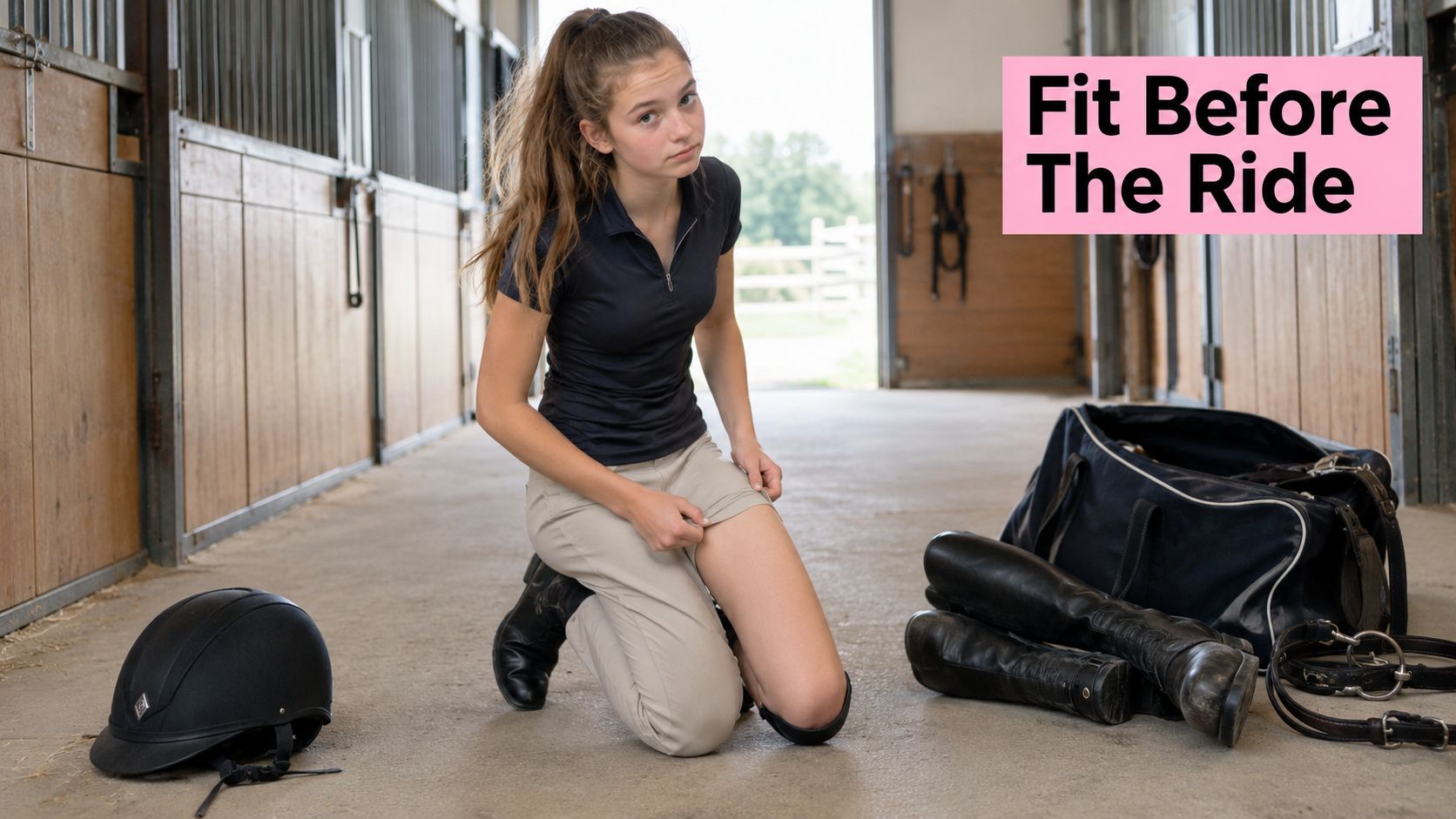
The useful connection between fit and position
A well-fitting pair should sit securely at the waist, follow the shape of the seat without compressing it painfully, and keep the knee area in place as the rider bends her leg. That stability matters because a young rider is still learning to keep her lower leg quiet. Pants that bunch or pull can make a small position problem feel much bigger.
Riding pants also protect the legs from friction. The saddle, stirrup leathers, and barn environment all place demands on clothing that everyday bottoms aren't designed to handle. Long pants provide coverage, while technical riding styles add stretch and construction details where contact and movement are greatest.
Practical rule: If your daughter has to tug, smooth, or pull up her pants during a lesson, the pair isn't doing its job.
Why history still influences today's designs
Modern riding pants grew from jodhpurs, which Maharaja Sir Pratap Singh of Jodhpur helped popularize in England after having riding trousers made in India around 1890. Their fuller hip and thigh shape allowed freer movement while seated, which helped connect the garment with polo and horseback riding. Women adopted jodhpurs in the 1920s as riding moved away from sidesaddle and toward astride riding, and Coco Chanel was among the early high-profile women associated with the style. (The history of jodhpurs)
That history explains why riding pants sit between clothing and equipment. Their shape developed around the rider's position, not just around a fashionable silhouette. The practical question for parents isn't whether a pair looks equestrian. It's whether the cut, fabric, seams, and grip support the way the child rides.
Breeches, Tights, and Leggings for Girls Explained
Shopping pages often use breeches, riding tights, and leggings as if they mean the same thing. They don't. The categories overlap, but each one makes different compromises around structure, grip, durability, and ease of wear.
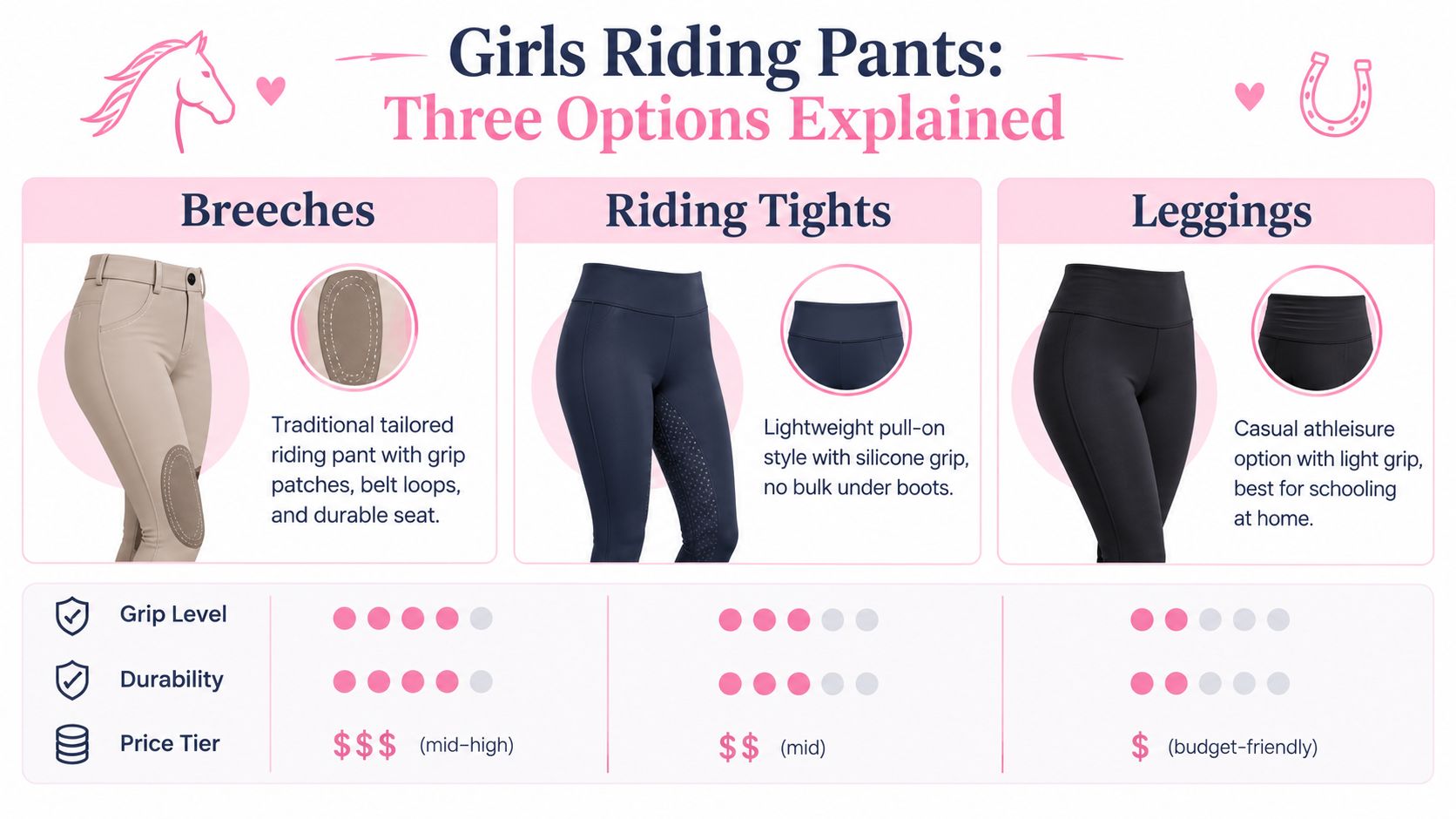
Breeches
Breeches are the traditional lesson and competition option. They generally have a close cut, a secure waistband, belt loops, and patches or panels that add grip at the knee or seat. Some have a structured front closure, while others use a more flexible pull-on design.
Choose breeches when your daughter rides regularly, needs dependable saddle contact, or attends organized lessons where a polished, discipline-appropriate appearance matters. A durable seat and carefully placed seams can also make them more suitable for repeated use than ordinary fashion leggings.
A full-seat breech extends grip across the seat and down the inner leg. A knee-patch breech concentrates grip around the knees, which may feel less restrictive for a rider who wants more freedom to adjust her position. For a helpful explanation of the construction and purpose of this category, see this guide to riding breeches and full-seat designs.
Riding tights
Riding tights use a softer, pull-on construction. They often feel closer to athletic wear than traditional breeches, with a wide waistband and stretch fabric that makes changing at the barn easy. Many include silicone or other functional grip, along with phone pockets or ankle cuffs that sit neatly inside paddock boots.
Tights suit beginners, growing riders, and children who dislike buttons or stiff waistbands. They're also a sensible choice for schooling when comfort and easy movement matter more than a formal appearance. The label alone isn't enough, though. Check whether the product has real knee or seat grip, a boot-friendly ankle, and fabric intended for saddle contact.
Equestrian-style leggings
Equestrian-style leggings borrow the look of riding clothing but may be designed mainly for casual wear. They can include faux pockets, contrast seams, a horse motif, or a stirrup-inspired ankle. Some have light grip, but many don't have a reinforced seat or the abrasion resistance needed for frequent riding.
They can work for barn chores, casual wear, or occasional low-intensity schooling if the fabric stays secure and the instructor approves. They aren't automatically suitable for lessons just because they have an equestrian print or a riding-style name.
If the goal is lesson-ready performance and a boot-friendly fit, start with true riding pants, then consider fashion-inspired styles only when their construction meets the same practical needs.
How Fabric and Grip Features Change Performance
At the barn aisle, two pairs of girls' riding pants can look almost identical. One may be a fashion-forward stirrup style made for casual wear, while the other is built for repeated saddle contact. Your daughter notices the difference when fabric slips, seams rub, or her seat moves during a transition. Fabric blend, weight, seam design, and grip placement determine how the pants behave once she is riding.
Technical guidance generally favors microfiber and other performance fabrics because they can be lighter, more breathable, more durable, and better at moving moisture than basic cotton. Cotton-rich stretch fabric may feel soft at first, yet its fibers can be less tightly packed and more vulnerable to fraying or tearing with repeated use. (Technical guidance on choosing riding pants)
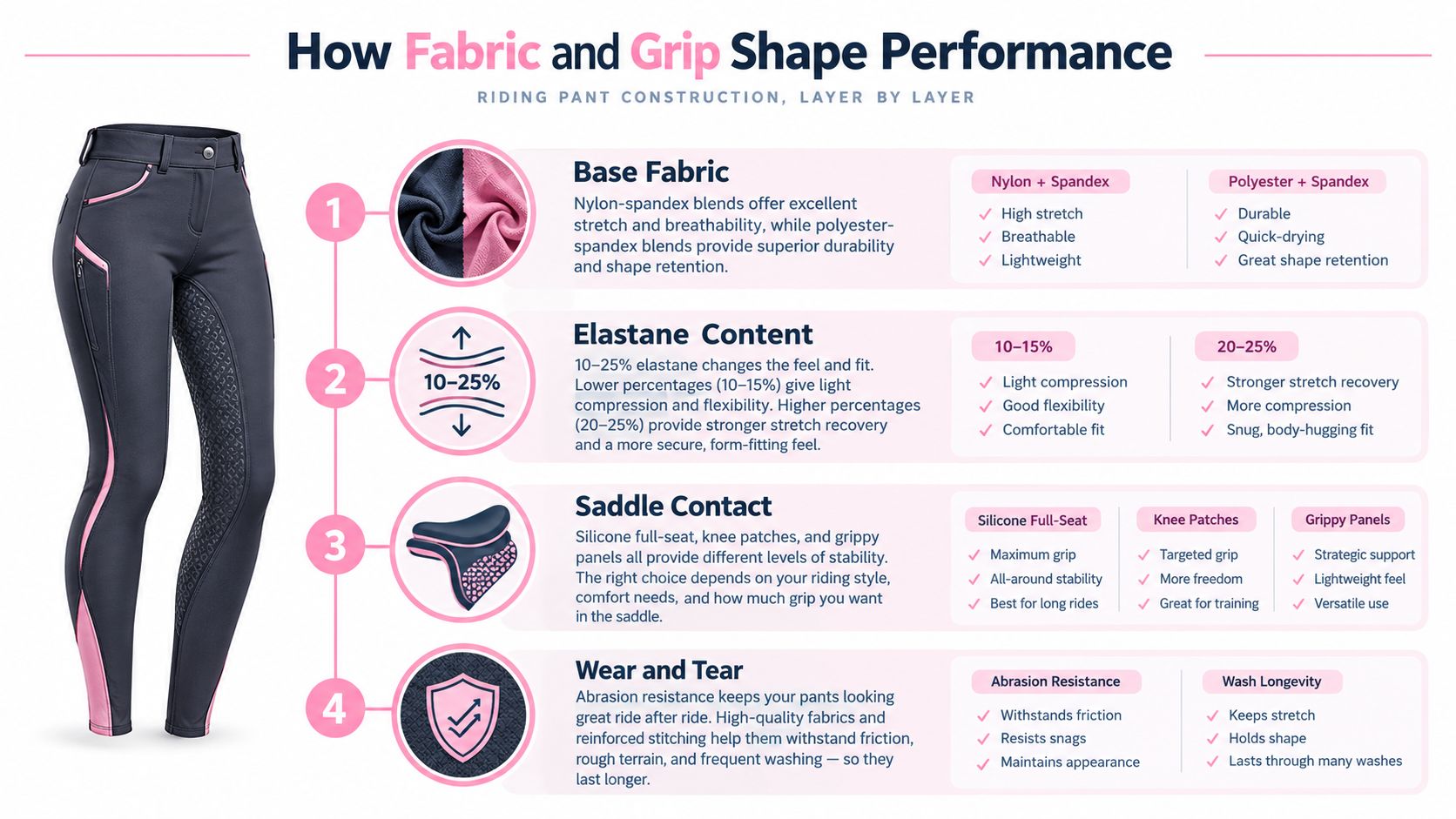
Reading the fabric label
For regular schooling or competition, look for nylon-spandex or polyester-spandex blends. High-performance girls' riding pants commonly use about 3% to 10% elastane. That stretch helps a rider bend at the hip and knee while allowing the garment to return toward its original shape. (Breech fabric and grip guidance)
Stretch is only one part of the fit. The weave, fabric density, and recovery matter too. Pants that stretch easily but remain stretched can become loose at the waist, wrinkle behind the knees, and let the grip shift as your daughter rides. A fashion detail, such as a decorative stirrup or contrast panel, does not indicate that the fabric can handle saddle friction.
For children's breeches, a fabric weight around 200 to 280 gsm is commonly used to balance flexibility and structure. Heavier technical builds around 250 to 300 gsm can add compression, recovery, and durability without necessarily feeling overly warm. Lighter summer fabrics can improve airflow and sweat transfer. (Breech fabric and grip guidance)
If you are comparing natural and synthetic fibers, this perfect fabric selection advice helps you weigh softness, moisture handling, and care requirements.
Matching grip to the rider
Knee patches place grip where the knee contacts the saddle. They can help a beginner keep a steady lower-leg position while leaving the seat and inner leg more mobile. This is often a comfortable starting point for lessons.
Full-seat grip continues across the seat and inner leg. It can support jumping, active schooling, or a rider who needs more security while developing balance. Some children appreciate that held-in-place feeling immediately. Others find it too sticky when they need to follow the horse's movement.
Read past the grip label. Flat seams reduce rubbing, reinforced knee or seat areas address common wear points, and a smooth ankle helps the fabric sit inside boots. If a product description mentions “stretch” but gives no information about abrasion resistance, seams, or contact zones, inspect the construction carefully before treating it as performance riding wear.
How to Measure and Size Girls Riding Pants Correctly
At the barn, a child may fit one brand's riding pants at the waist and another brand's pants at the hips. Age labels offer a starting point, not a dependable fit decision. Children of the same age can have different heights, waists, hips, rises, and inseams, while retailers use different sizing systems. Some listings ask parents to compare measurements with a well-fitting garment; others match age, height, and weight in different ways. “True to size” therefore tells you very little. (Example of differing children's riding-pant sizing guidance)
Measure the child, not the label
Have your daughter stand naturally in a thin base layer. Keep the tape level and comfortably close to her body without pulling it tight. Record the measurements before opening a product page.
- Measure the waist. Place the tape where the riding pants will sit. Do not automatically measure the narrowest part of the torso if the garment has a higher or lower rise.
- Measure the seat. Wrap the tape around the fullest part of the hips and bottom. This helps prevent a waistband that fits while the seat pulls, gaps, or wrinkles.
- Measure the inseam. Measure from the crotch to the ankle bone. You can also measure a well-fitting pair from the crotch seam to the hem. This how to measure for sewing guide shows the basic technique for taking body measurements consistently.
- Record height. Height helps you read the size chart and spot a proportion problem, especially when the waist and inseam fall into different size ranges.
Compare every measurement with the brand's chart. If the waist points to one size and the inseam to another, check the return policy and give priority to a secure waist with a workable leg length. Loose fabric at the waist can shift while mounting or riding. Excess length can bunch inside the boot and distract the rider.
Allow growth without creating a gear problem
Parents often want to buy ahead, but oversized riding pants do not behave like a casual sweatshirt. Extra room at the waist or seat can shift in the saddle, while excessive length may gather around the ankle or interfere with a clean boot fit.
Choose stretch and recovery instead of jumping to a much larger size. Flexible fabric can accommodate some growth while the waistband stays secure. Test the rise with your child seated in a riding position. The back should provide coverage without pulling, and the front should not press uncomfortably into the abdomen.
Use this check before ordering:
- Waist: Does the chart match the measured waist?
- Seat: Is there room to sit and bend without horizontal pulling?
- Inseam: Will the hem overlap the boot without excessive bunching?
- Knee: Does the knee patch sit near the knee when seated?
- Rise: Does the waistband stay in place when she leans forward?
- Return option: Can you exchange the pair if the proportions do not work?
For age-to-size guidance and practical growth-room strategies, see this guide to riding pants for kids. A growing rider needs boot clearance, but that does not justify accepting a loose waist. Choose the smallest size that allows comfortable movement and a stable riding position, then recheck her measurements as she grows.
English versus Western Riding Pants for Girls
English and Western riding ask for different relationships between the rider, the saddle, and the boot. A pair that feels ideal for an English lesson may feel too close or too grippy for a Western rider who spends long periods in a different seat.
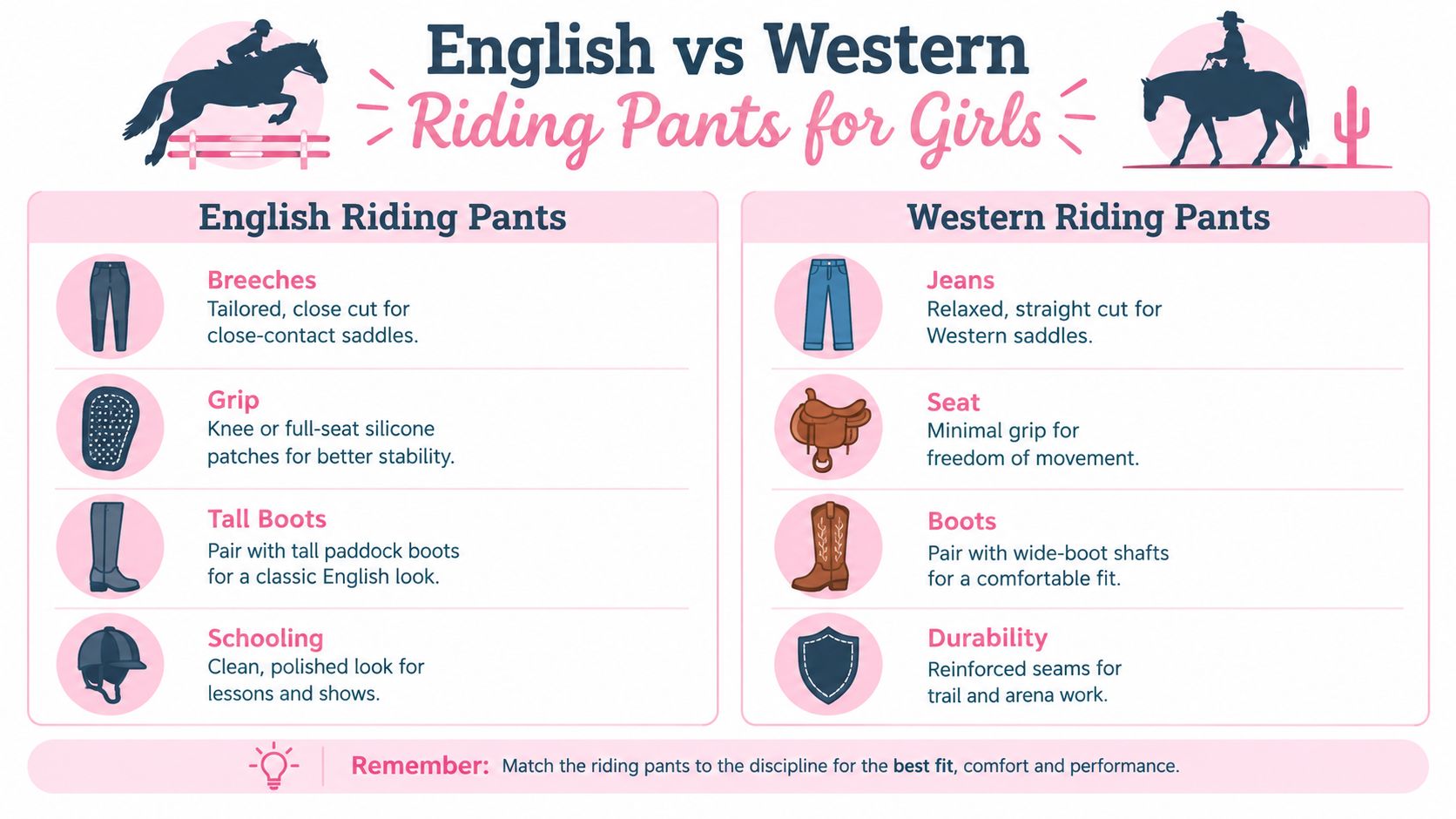
English riding
English breeches and jodhpurs usually have a close, fitted cut. That shape supports close contact with the saddle and keeps fabric from interfering with the rider's leg aids. Knee patches or full-seat silicone can help the rider feel secure, particularly during lessons that include transitions, poles, or jumping.
English pants also need to work with the boot system. Breeches commonly finish above the ankle for tall boots or half chaps, while jodhpurs may extend to the ankle and pair with paddock boots. Check the hem and ankle design before assuming a pair will sit neatly under the intended footwear.
Western riding
Western riding pants often prioritize comfort, durability, and a cut that works with a larger Western saddle and wider boot shaft. A straight or relaxed shape may be more practical for trail rides, arena work, and time spent moving around the barn. Minimal grip can give the rider freedom to adjust naturally rather than locking the seat into place.
That doesn't mean Western pants should be loose or flimsy. Look for secure waist construction, durable fabric, and reinforced seams where the child sits and moves. The pant leg should pair comfortably with Western boots without creating a thick fold or restricting the shaft.
Match the garment to the saddle first. A fashionable silhouette can't compensate for a cut that fights the discipline.
Families who ride both styles can choose a neutral technical tight for casual schooling, then keep discipline-specific breeches or Western pants for regular lessons. A beginner riding occasionally may need only one versatile, comfortable pair. A child training frequently or preparing for competition will benefit from clothing designed around the discipline, boot, and saddle she uses most.
Caring for Riding Pants to Keep Grip and Fit
Good riding pants last longer when the washing routine respects the fabric and grip. Start by turning them inside out and closing zippers, snaps, and hook-and-loop fasteners. Use the care label's recommended water temperature and a mild detergent that rinses clean.
Avoid fabric softener. It can leave a coating on technical fibers and grip panels, which may change how the fabric handles moisture or contacts the saddle. Don't use high heat unless the manufacturer specifically permits it, because heat can stress elastane and damage silicone details.
A simple barn-to-laundry routine
- Remove surface dirt first: Brush off dried arena dust and hay before washing.
- Protect the grip: Turn the pants inside out and place them with similar smooth garments.
- Choose gentle handling: Skip rough wringing, aggressive scrubbing, and overloaded wash loads.
- Dry with care: Air-dry flat or hang from the waistband, away from intense heat and direct sun.
- Store clean: Fold or hang the pants only after they're fully dry.
If the pants feel stiff after washing, review the detergent amount and skip softener. If grip begins peeling, cracking, or losing its texture, stop exposing the garment to high heat and check the manufacturer's care instructions. A clean storage space also matters. Keep grip panels away from rough hooks, Velcro, and damp tack-room surfaces that can catch or degrade the material.
How to Choose the Right Pair for Your Girl
Start with the saddle and the lesson schedule, not the color. An English rider who attends regular lessons will usually get more value from fitted breeches or functional riding tights with knee or full-seat grip. A Western rider who spends longer periods in the arena or on trails may prefer a durable, comfortable cut that works with Western boots and doesn't feel overly restrictive.
Then check the child's measurements and movement. Use the waist, seat, inseam, and height together, test the rise while seated, and choose stretch with recovery instead of sizing up dramatically for growth. If the pants slide, bunch at the knee, or leave too much fabric inside the boot, return to the chart rather than hoping the fit will improve with wear.
Fabric choice should follow use. A lightweight technical pair can suit warm-weather schooling, while a denser build may provide more structure and durability across changing conditions. A beginner who rides occasionally doesn't need every advanced feature, but she still needs secure coverage, comfortable mobility, and a pair that won't distract her from learning.
A child who trains several times each week may justify a more durable breech with carefully placed grip and reinforced contact areas. A child taking occasional lessons may be comfortable in well-made riding tights, provided the product is designed for riding rather than merely styled to look equestrian. Fashion-forward stirrup pants can be useful for casual barnwear, but they shouldn't replace performance pants when friction control, saddle stability, and boot compatibility matter.
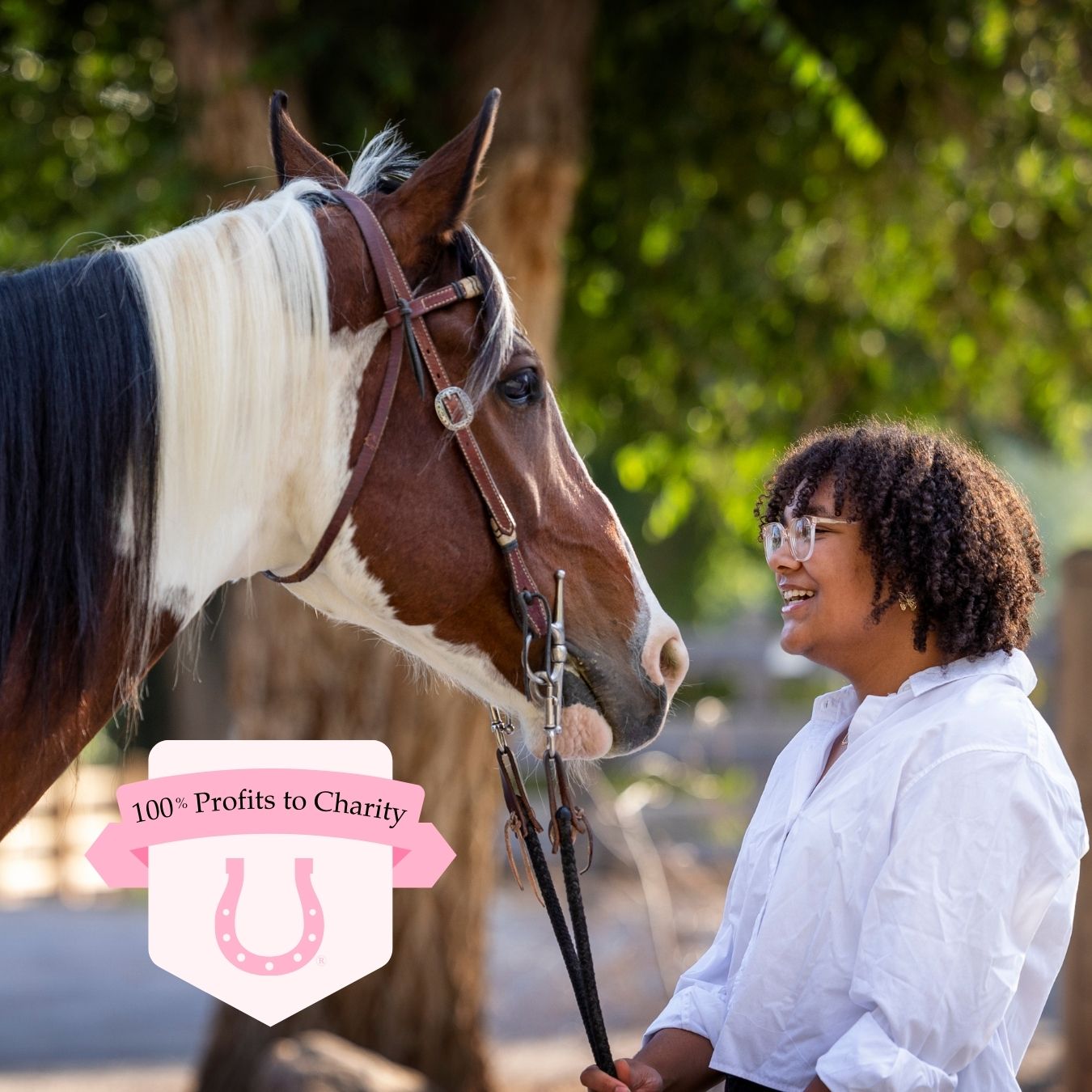
Bridle Up Hope Shop offers equestrian apparel and horse-themed goods for children and families, with collections reflecting both English and Western styles. Its charitable model donates 100% of annual net profits to the Bridle Up Hope foundation, which supports girls and women through horses and habits.
Visit Bridle Up Hope Shop to browse girl-friendly equestrian clothing, gifts, and riding-inspired options for both English and Western families. Use the fit guidance above to check measurements and choose pieces that suit your daughter's discipline, daily barn routine, and next lesson.
Deje un comentario