


You're getting dressed for dinner in jeans and boots, holding turquoise earrings against your ears, and wondering why the simple pair costs more than the elaborate one. With turquoise Western earrings, the useful answers are often behind the blue-green face: the stone's treatment, the setting, and the metal that touches your skin.
Table of Contents
- Turquoise Types Worth Knowing Before You Buy
- Color Matrix and What Supply Changes
- Hoops Dangles Studs and Concho Styles
- Metals Finishes and Ears That React
- Styling Notes and a Simple Care Routine
- Choose a Pair for Your Week and Your Gift
Turquoise Types Worth Knowing Before You Buy
Say you're holding two pairs of oval cabochon earrings. Both have bright blue stones and smooth silver-colored rims, but one listing says stabilized turquoise while the other says only genuine turquoise.
Neither description tells the whole story. Stabilized describes a treatment, while genuine identifies the material without necessarily explaining what's been done to it. Before judging either pair, you need to know whether you're comparing untreated stone, treated stone, a composite, or a turquoise-colored substitute.
Turquoise isn't uniformly hard or dense. The International Gem Society's turquoise guide gives a typical Mohs hardness of 5 to 6, while porous or friable material can fall below 4.5; higher silicate content generally produces denser, harder stone, while clay-rich material is more porous. That distinction matters when a polished cabochon sits exposed above its setting.
Turquoise types in Western earrings
Use this comparison to sort the material description before comparing the decorative metalwork.
| Stone type | What you are seeing | Earring durability | Care consequence | Value signal |
|---|---|---|---|---|
| Natural untreated | Solid turquoise without polymer filling or added dye | Fine-textured, compact stone is preferable for exposed settings | Protect the porous surface from soaking, heat, and chemicals | Pay for documented quality and origin, not the word natural alone |
| Stabilized | Turquoise whose pores have been filled with acrylic or another polymer | Treatment can strengthen fragile material and improve polish retention | Treatment doesn't remove the need for gentle care | A practical jewelry material, not automatically an inferior purchase |
| Dyed | Material with added blue-green color | Added color doesn't establish the strength of the underlying material | Request treatment-specific cleaning instructions | Compare it with other disclosed dyed material, not untreated-color claims |
| Reconstituted or block | Pulverized fragments bound with epoxy | Assess it as a composite rather than a solid natural cabochon | Avoid heat and solvents; request composite-specific care | Don't pay an untreated-stone premium |
| Imitation | A substitute such as dyed howlite, magnesite, glass, or resin | Judge the substitute itself, not turquoise hardness | Follow instructions for the identified base material | Decorative value, not genuine-turquoise value |
The Federal Trade Commission's guide to buying American Indian arts and crafts explains that most turquoise used today is stabilized, describes dyeing and reconstitution, and advises disclosure when treatments affect appearance over time, care requirements, or value. Stabilization can make otherwise fragile turquoise suitable for jewelry. It isn't, by itself, evidence of a fake.
Say you want earrings for a workday followed by dinner. A well-finished stabilized cabochon in a protective bezel may be a more sensible choice than a chalky untreated stone whose main selling point is the absence of treatment.
Buying rule: Choose disclosed material that suits the way you'll wear it, rather than treating untreated as a synonym for better.
Keep the claims separate
Natural, genuine, handmade, sterling silver, and Native American answer different questions. A stone can be genuine turquoise and stabilized; a handmade earring can contain imitation material; a sterling setting doesn't establish who made the jewelry.
Request written support for origin and maker claims when those claims influence your purchase. A Western silhouette alone doesn't establish Native American manufacture or cultural authenticity.
If you're coordinating earrings with a necklace, our guide to a turquoise and sterling silver pendant offers another way to think about the stone-and-metal combination. Matching the treatment disclosure matters more than assuming similar-looking blue stones are equivalent.
Before comparing two prices, ask for the stone type and treatment in writing. Without that information, you're comparing appearances rather than materials.
Color Matrix and What Supply Changes
The first pair catches your eye because it's clear robin's-egg blue. The next is greener, with brown lines crossing the surface, and suddenly you're deciding whether you like a clean field of color or a little geological texture.
Both appearances can belong to turquoise. Copper-bearing formation contributes blue, while iron can shift the stone toward green. Smithsonian's reporting on turquoise describes this chemistry and notes that less than 5% of turquoise mined worldwide has the quality needed to be cut and set into jewelry.
The color comparison below makes those blue and green directions easier to distinguish.
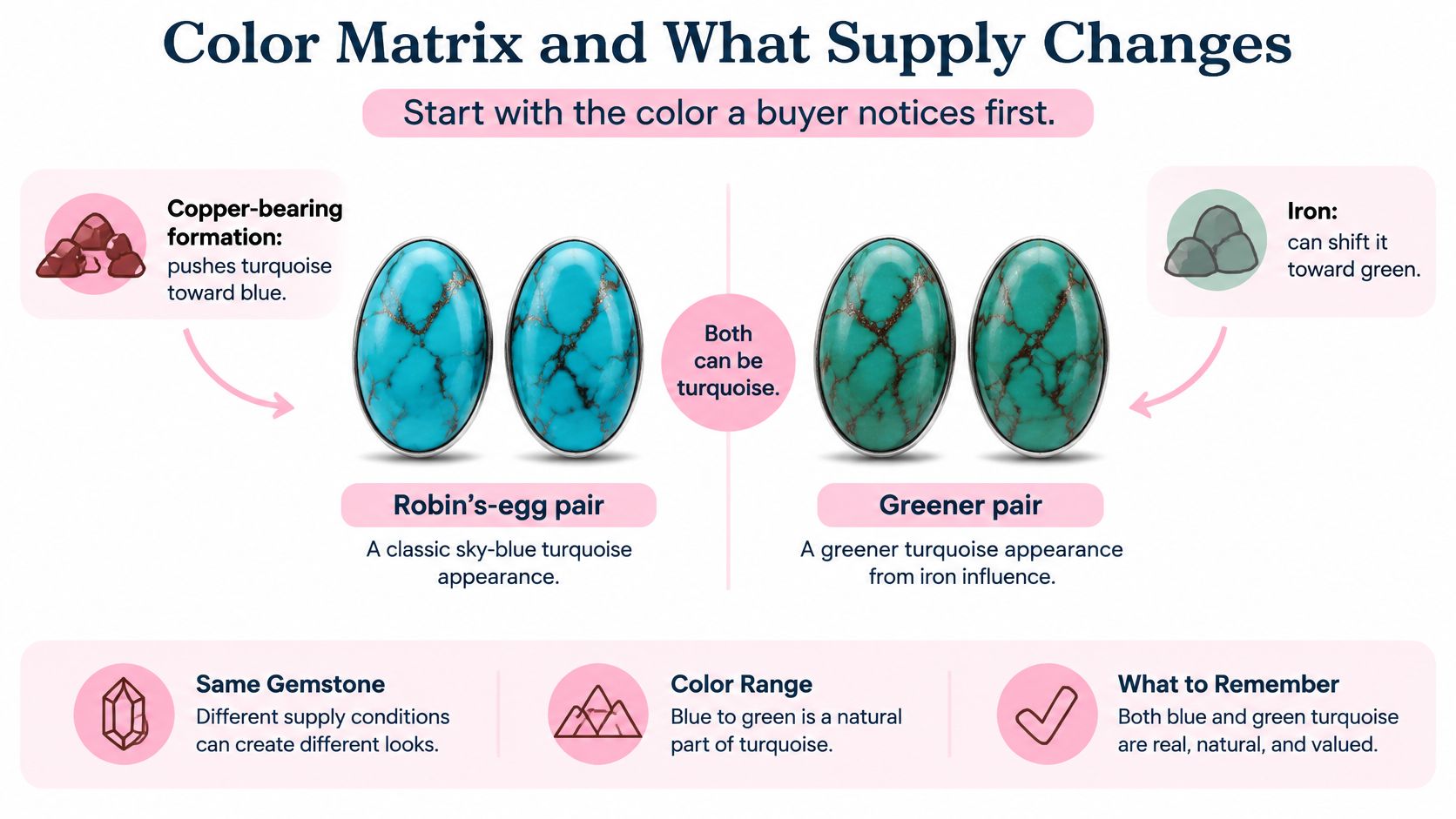
Read the pattern across the pair
Matrix is the surrounding rock visible within the cut stone. It may appear as fine spiderweb lines, broad brown veins, or irregular patches, while another cabochon may show very little visible matrix.
Don't inspect each earring in isolation. Set the pair beside each other and ask whether the overall color, pattern density, and polish feel balanced. Natural variation can be appealing without the stones looking unrelated.
A fine web on one stone and a broad dark stripe on the other might be exactly what you like. If you want a quiet pair for a plain shirt, a more consistent face usually suits you better.
- For a clean appearance: Look for color that reads evenly at arm's length, not only in an enlarged product photograph.
- For visible character: Choose matrix you enjoy across the whole pair, rather than a pattern that's attractive on only one earring.
- For a coordinated set: Compare stones in neutral light when possible, because product photography can make a subtle green look much bluer.
Why a mine name isn't enough
You may encounter Sleeping Beauty as shorthand for even sky blue with little matrix, and Kingman in descriptions of brighter blue stones with more noticeable pattern. Treat those names as prompts for questions, not as a quality ranking or a visual authentication test.
Supply helps explain why attractive cabochons aren't interchangeable, but it doesn't establish the value of an individual pair. The amount of usable stone, the work involved in matching it, treatment disclosure, setting quality, and supported origin all belong in the comparison.
For a closer visual look at turquoise, this video offers another viewing format.
A jewelry case might hold a nearly uniform blue pair beside one webbed with dark veins, both tagged "turquoise." Ask what each stone is, where it came from, and whether it has been stabilized, then pick the face you want to see in the mirror each morning.
Choose pleasing color, balanced matrix, and clear disclosure together. A recognizable mine name shouldn't substitute for a useful description of the earrings in front of you.
Hoops Dangles Studs and Concho Styles
A turquoise stud stays close when you turn your head. A dangle moves against your jawline, while a broad concho shows its silver-colored face even when your hair falls forward.
That movement is a better starting point than deciding whether a pair looks Western enough. You don't need a full cowgirl outfit to wear turquoise, and the most dramatic silhouette isn't necessarily the one you'll reach for most.
Western earring styles compared
Without a specific listing, treat scale as a shape decision rather than assuming every style follows a standard measurement.
| Style | Typical scale | How it feels | Best for | Watch for |
|---|---|---|---|---|
| Studs | Compact face close to the lobe | Often light, though a thick setting adds weight | Office, everyday clothes, understated styling | An exposed soft cabochon striking a hard surface |
| Hoops | A curved frame around or below the lobe, sometimes with a horseshoe charm | Light with slender construction; fuller metalwork adds heft | Casual Western and modern equestrian looks | Charms catching hair |
| Dangles | A suspended element extending beneath the lobe | More noticeable movement, especially with a large stone | Denim, boots, evening outfits | Swinging stone edges contacting hard objects |
| Concho | A disc or scalloped metal face with a center stone | Broad and potentially substantial | Belt-and-boots statements | Contact with stiff collars or scarves |
A bezel setting, with metal surrounding the stone's perimeter, can provide a reassuring edge around a cabochon. Still, inspect how high the stone rises above that rim. A decorative border isn't the same as complete protection.
Studs make sense when you want color without movement. For a young wearer, don't choose by size alone; consider secure fastening, the wearer's activities, and whether they can manage the earrings safely.
Test comfort rather than guessing it
A hoop can look substantial but feel comfortable if its construction is open and the charm is modest. A compact concho can feel heavier than expected because much of its face is metal.
One shop reviewer, Maddie, wrote, “These earrings are EVERYTHING!!! They are so beautiful and lightweight.” That's useful language for a comfort preference, but it isn't a weight specification for every pair.
An earring is comfortable when you stop thinking about it, not merely when the listing calls it lightweight.
For a side-by-side silhouette reference, HonHo Wholesale Jewelry's double row hoops for retail collections illustrate a fuller hoop format. Use the shape as a comparison point, while reading the material description separately rather than assuming turquoise color establishes gemstone content.
Try your preferred silhouette with the hairstyle you wear. A charm hoop may be easy with a low bun but irritating when loose hair threads through its opening. A longer drop might clear your neckline beautifully until you add a thick scarf.
Give the earrings room
For a weeknight meal, try small hoops with a plain knit top and your usual jeans. For a Western event, choose a concho or longer dangle and let the earrings supply the strongest decorative detail near your face.
If you want to assess how much movement you'll enjoy, gently turn your head while trying them on. Notice whether the back presses into your lobe, whether the front pulls forward, and whether the stone touches your collar.
Choose the pair for the evening you'll have. A statement earring that stays in its box isn't more useful than a small pair you happily wear.
Metals Finishes and Ears That React
A 2025 systematic review of nickel allergy and earrings found nickel release above screening thresholds in 31.1% of earrings tested in North America and 34.5% tested in Asia. Those findings describe earrings that were tested, and they cannot predict whether one particular pair will bother your ears.
The numbers make sense once you picture how an earring is worn. A post spends the whole day inside a piercing, so whatever metal it contains gets hours of unbroken skin contact. That is why the useful shopping question is which metal touches your lobe. The turquoise on the front, however beautiful, says nothing about the wire behind it.
Work through the checklist below with your attention on those skin-contact parts.
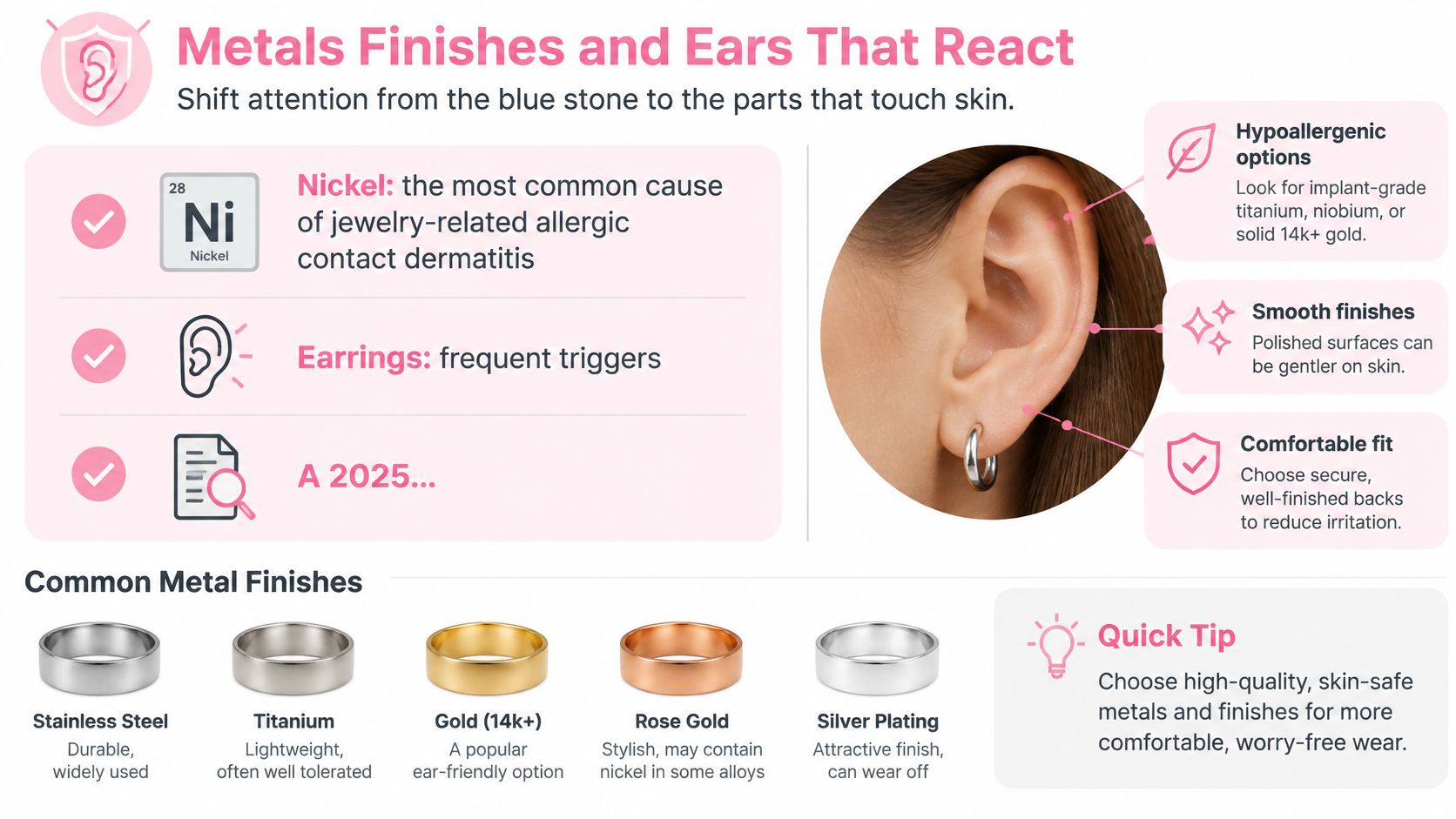
Metals and finishes for sensitive ears
A listing can describe the front of an earring as sterling silver and still leave the post and butterfly back completely undescribed. When that happens, you have half a materials answer, and the missing half is the part that sits inside your ear.
| Metal or finish | Nickel status | Ear-friendly note | Buyer check |
|---|---|---|---|
| Sterling silver | The name alone doesn't establish the entire assembly's nickel status | The decorative front and fastening may use different materials | Request specifications for both post and back |
| Surgical-grade stainless steel | Don't assume nickel-free from the name | A named grade is more informative than a broad label | Confirm the exact grade in writing |
| Titanium | Confirm that the skin-contact components are titanium | A material identification is more useful than a finish description | Ask which components and grade are specified |
| Gold-dipped or silver-tone plating | Nickel-free only when supported by the material information | Plating can wear at the post | Identify the base metal beneath the finish |
| Unspecified alloy | Unknown | There isn't enough information to assess skin contact | Request a specification or nickel-release test, or choose another pair |
A hypoallergenic label is not a test result. On its own, it tells you neither the alloy used nor how the backing is constructed, and it arrives with no test information you can check.
Gold-dipped and shiny silver-tone describe a look or finish. For someone who has previously had itching, redness, or irritation from earrings, neither phrase answers the question that matters.
Make the purchase check specific
Take two listings for the same style of turquoise concho drop. One names sterling silver for the hook and the clutch. The other offers only "hypoallergenic silver-tone." The first gives you something you can verify; the second gives you an adjective.
Ask for the material of the post, hook, backing, and any front surface that rests against the lobe. When you compare stainless steel with titanium, ask for the actual material specification for each, since a general assurance that both suit everyone settles nothing.
A rubber stopper can help keep a dangle in place. It doesn't turn an unidentified metal hook into a known skin-compatible material.
For questions focused on pierced lobes, Piercing Near Me's earring advice for sensitive pierced lobes is a useful supplement. Our guide to sterling silver horseshoe earrings can help when you're narrowing the shape, though material verification still belongs to the individual pair.
Sensitive-ear checkpoint: Read the back of the earring as carefully as you admire the front.
If you've reacted before, speak with a clinician rather than testing unfamiliar alloys through repeated wear. Stop wearing a pair that irritates your skin, and don't assume the stone is responsible just because it's the most visible component.
The useful outcome is a clear materials answer rather than a reassuring adjective.
Styling Notes and a Simple Care Routine
Say a woman reaches for a scalloped concho drop before a Western evening. Dark denim, boots, and a plain shirt give the stone room to work, and one restrained silver-colored piece at the wrist finishes the look. Leave space around the earrings rather than building a competing stack of stones at your neckline.
The same pair reads differently on an ordinary weekday. Small hoops or studs sit easily beside a sweater or crisp, English-inspired tailoring. If you're balancing riding influences, our guide to what Western attire includes can help you choose the clothing without making the jewelry feel like part of a costume.
The styling and care sequence below keeps the look simple and the maintenance manageable.
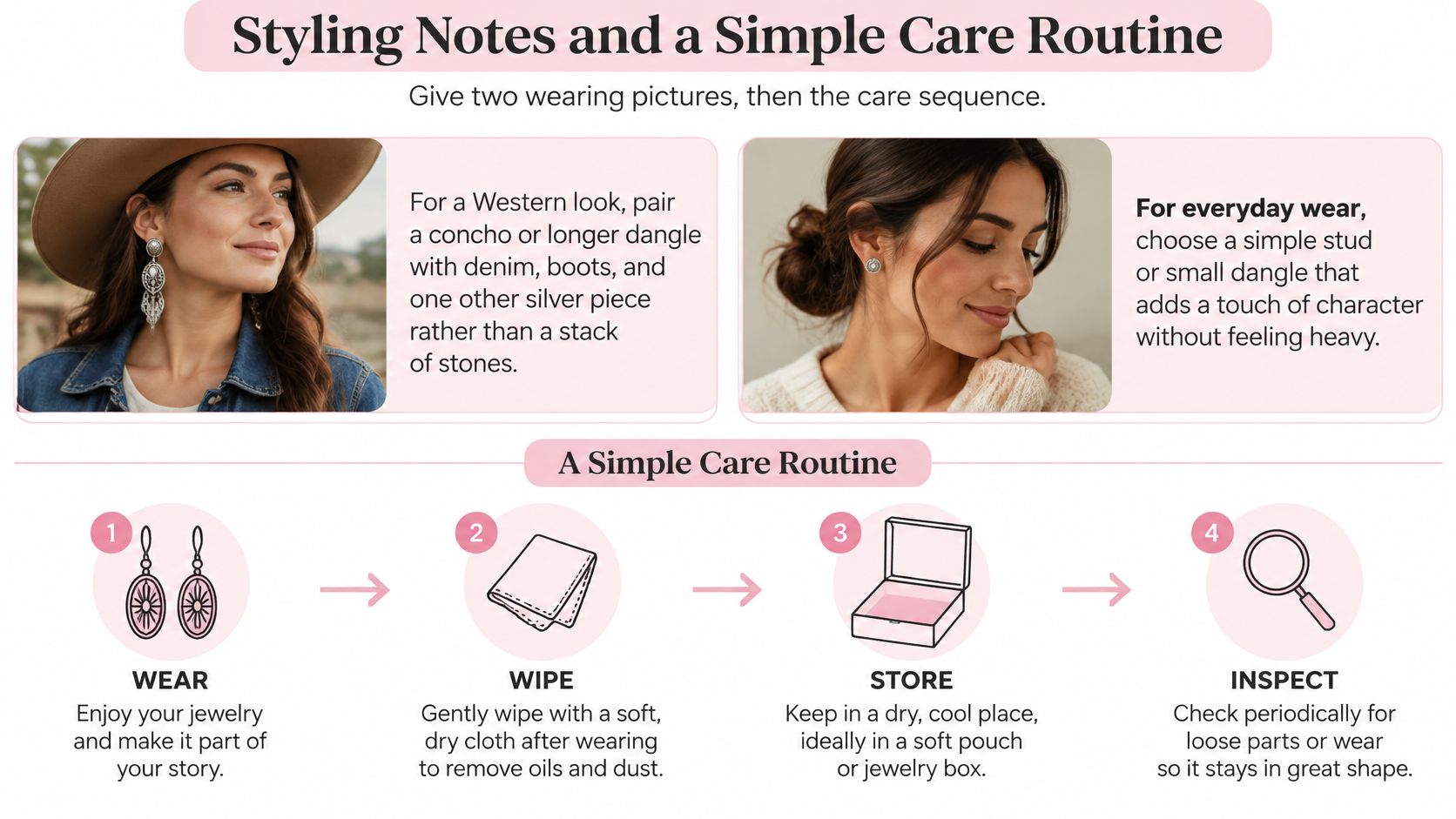
Keep a cloth beside the jewelry box
The GIA turquoise care and cleaning guide explains that turquoise can absorb oils and other substances that affect its appearance, warns against steam and ultrasonic cleaning, and notes that heat and chemicals can damage turquoise or its treatments.
A practical routine begins before the earrings go on.
- Finish cosmetics first. Apply sunscreen, hairspray, perfume, and makeup before putting on your earrings. Keep spray away from the jewelry rather than trying to wipe overspray off afterward.
- Remove them for wet or strenuous activities. Take earrings off before bathing, swimming, exercise, and household cleaning. A dressing-table dish is a better temporary home than the sink edge.
- Wipe gently after wear. Use a soft, slightly damp cloth on the stone, then dry it immediately. Don't scrub a dull patch with an abrasive polishing compound.
- Skip cleaning machines. Avoid steam and ultrasonic cleaners, and keep treated pieces away from solvents and heat. Don't let a general jewelry-cleaning service treat them without identifying the stone first.
- Use soapy water only with piece-specific approval. Warm, soapy water can be suitable for some turquoise, but don't assume an unknown treatment or glued assembly can tolerate it.
- Separate the pair in storage. Give each earring its own soft compartment or pouch, away from diamonds and other hard materials. Avoid dropping them loose into a travel bag.
- Inspect before putting them away. Look for a bent post, an uneven bezel, a loose stone, or a fresh chip along the cabochon edge. Set aside a damaged pair for assessment rather than pressing the stone back yourself.
Protect the setting during wear
Remove earrings before sleeping or sports. A pillow, helmet, or unexpected knock can press jewelry against the ear or expose a projecting stone edge to impact.
For everyday use, look for a smooth, well-polished cabochon in a secure setting, positioned so it won't repeatedly hit hard surfaces. If a seller discloses that the stone is stabilized, treat it as a common, declared treatment and ask what it means for cleaning, since the answer shapes which of the steps above apply. If a pair has ever irritated your lobe, direct that question at the post and backing rather than the stone.
A consistent habit beats an elaborate routine.
Choose a Pair for Your Week and Your Gift
Say your week runs from Tuesday meetings to a Saturday concert under the lights. A small stud or a light hoop carries the first half without asking anything of you, while a longer drop or a concho pair earns its place at night, where extra movement and a wider face are part of the point. Choose the shape for the occasion, then check that the pair stays comfortable across a full evening of wear.
Gifting follows the same logic, tuned to her habits. A friend who wears a phone headset all day will reach for a close-fitting pair; someone dressing for a country concert may want the swing of a drop. Pick the silhouette she will put on, then make sure the details behind it are clear.
Read a listing as a complete description
The Turquoise & Pearl Horseshoe Earrings pair a horseshoe motif with turquoise and pearl accents, and the product page is where the sizing, finish, and fastening details live. A photo can show how the elements sit together; it cannot tell you the stone's origin, whether the turquoise was treated, or which metal touches the ear.
The product image shows how the horseshoe and pearl elements sit together.
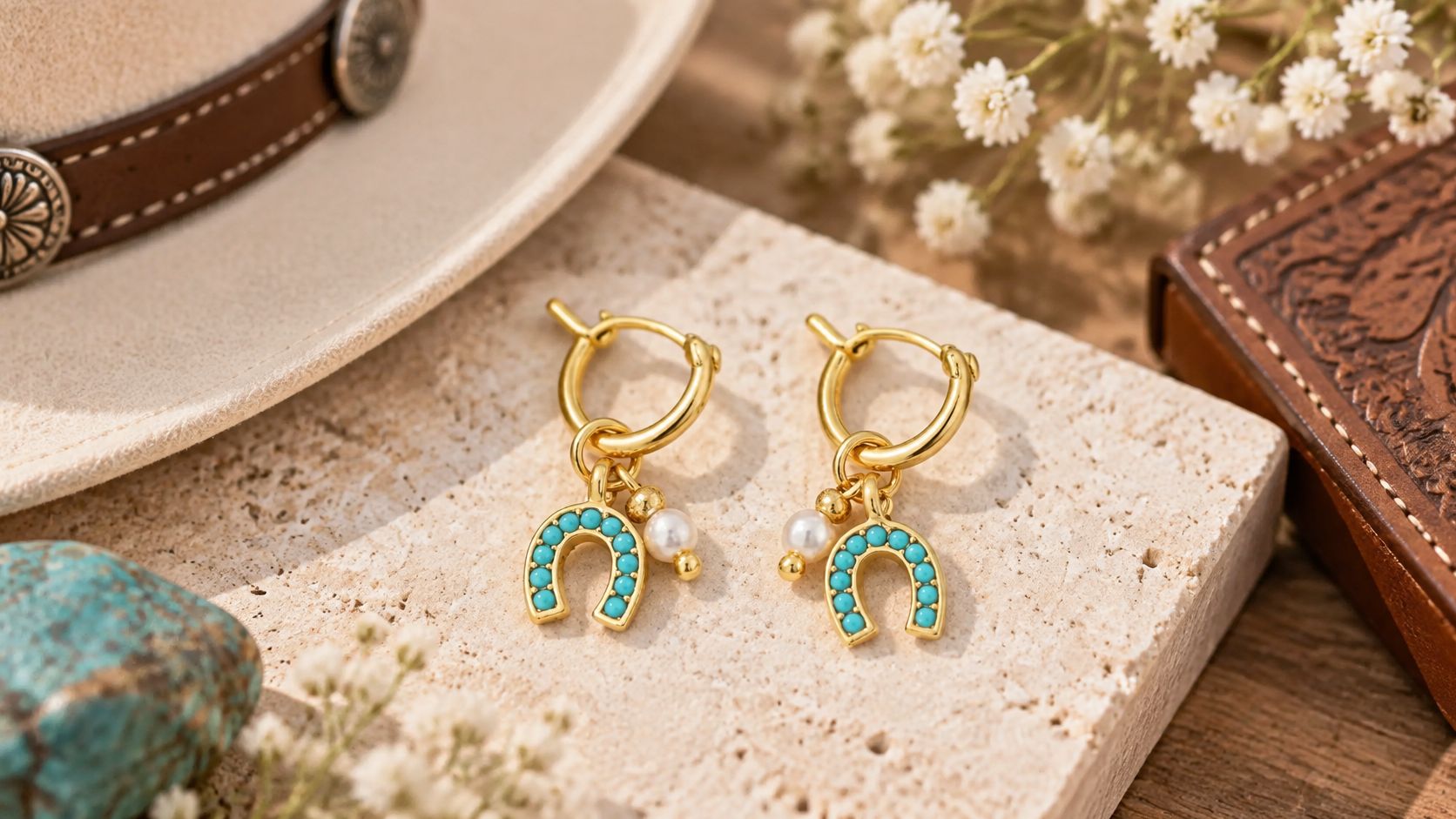
Two details carry most of the weight in that read. A listing that names its treatment is giving you useful information, since stabilization is a routine, commonly disclosed part of the turquoise market. For sensitive ears, the post and back material matter more than the stone or a general hypoallergenic claim.
For a wedding-related present, Texas Old Town's bridal gift guide offers a broader occasion-based reference. Let the recipient's own style steer the choice, since a keepsake lands best when it suits the person wearing it.
Before checkout, confirm the stone description and any stated treatment, the fastening material, the care notes, and the return terms. A pair she can verify and wear comfortably gives her more than a dramatic shape she has to guess about.
Bridle Up Hope Shop offers horse-themed jewelry and gifts in English and Western styles. Visit Bridle Up Hope Shop to browse equestrian earrings, match each listing against the stone, treatment, and metal details above, and pick a pair for your everyday rotation or your next gift.
Deje un comentario