


If a horse could disappear from a novel without changing the story, is it really a horse book? A horse on the cover might promise riding adventures, yet the animal inside may do little more than bring two people together.
When you're searching for horse books fiction readers will enjoy, the horse's importance and the credibility of its behavior are better guides than the cover alone. A picture book, a rescue story, and a literary Western can all offer meaningful encounters with horses, but they ask readers to notice different things.
Table of Contents
- Which Horse Fiction Fits Your Reader
- Defining Horse Fiction and Its Core Genres
- Realism Levels and the Story Types They Suit
- Checking a Horse Novel for Welfare and Accuracy
- Classic and Modern Horse Novels Across Eras
- Choose Your Next Horse Book in Four Steps
Which Horse Fiction Fits Your Reader
Starting points by reader type
| Reader | Start With | The Horse's Role | Reading Level |
|---|---|---|---|
| Young children | Picture books about horse friendship | Companion and friend | Ages 4-8 |
| Pony-loving children | Pony series and riding adventures | Partner in the adventure | Ages 8-12 |
| Teen riders | Competition and rescue novels | Athlete or rescue case | Young adult |
| Adult readers wanting depth | Literary and historical novels | Central figure or historical archive | Adult |
| Parents revisiting favorites | Classic animal novels | Narrator or moral voice | All ages |
Treat these age bands as starting points, not restrictions. The reader's patience, comfort with difficult subjects, and horse knowledge matter more than the animal on the cover. A confident reader may welcome complicated language but still need support with descriptions of mistreatment.
For younger readers, distinguish between listening and independent reading. A child who enjoys an adult reading a substantial story aloud may prefer a shorter, illustrated book when reading alone. Our guide to horse books for young readers can help parents begin that selection.
Match expertise as well as age
Adults shouldn't have to choose between childish storytelling and horses used mainly as romantic scenery. In Horse Illustrated's discussion of equestrian fiction, some surveyed equestrians preferred young adult fiction because they found more horse-centered material there, while adult novels sometimes supplied “a few horse tidbits” around romance.
That's a useful warning about categorization, not a reason to dismiss romance. A reader seeking relationships may enjoy a stable setting; a working rider may want the training, management, and animal behavior to carry the story. Neither preference maps neatly onto age.
Selection principle: Match the book to the reader's interests and experience, not to an assumption about who horse stories are for.
A beginner may appreciate explanations of tack and stable routines. An experienced rider may find those explanations slow but enjoy a difficult training problem, provided the author treats it credibly.
Before choosing, ask:
- Who will read it? Consider reading stamina and emotional readiness.
- What horse knowledge do they bring? Separate enthusiasm from practical experience.
- Must the horse drive the plot? Decide whether an equestrian atmosphere is enough.
Defining Horse Fiction and Its Core Genres
Horse fiction means stories in which horses do meaningful work in the plot. They may influence a journey, require care, disrupt a rider's ambitions, or provide the viewpoint through which readers encounter human choices.
A horse in such a story is like a crew member on a ship, not the paint on its hull. Remove the crew member and the voyage must change; remove the paint and the voyage continues.
Test whether the horse matters
Use these questions when reading a description or sample:
- Does a response change events? A horse's refusal, flight, approach, or learned response should affect what happens.
- Does its condition shape the stakes? Soundness, fatigue, age, or recovery may limit what humans can reasonably ask.
- Does the story require equine behavior? The animal shouldn't be interchangeable with a car, a trophy, or an attractive setting.
A romance that happens to include a country ride may remain almost unchanged without the horse. By contrast, a horse refusing a jump can force a rider to confront danger, inadequate preparation, or misplaced ambition. The response matters without requiring the horse to plan the lesson.
Narrative importance isn't the same as human-like agency. A horse needn't understand a person's ambitions to alter them. Its physical needs and learned responses can create a compelling story.
Recognize the main genres
Core horse fiction genres and their themes
| Genre | Signature Theme | Example Title |
|---|---|---|
| Pony and children's series | Friendship and first riding skills | Summer Pony |
| Competition novels | Discipline and winning versus welfare | The Black Stallion |
| Horse rescue stories | Recovery and the ethics of care | Brave Old Blue: A Horse Rescue Story |
| Historical fiction | Horses as transport, labor and wartime service | Black Beauty |
| Literary Westerns | Identity, loss and frontier ideals | All the Pretty Horses |
| Horse-narrated and fantasy | Human choices through the animal's view, or magic | A Horse's Tale |
These examples are entry points rather than rigid classifications. Black Beauty, for instance, belongs to the horse-narrated tradition as well as offering a view of working horses in a historical setting.
Pony stories make small achievements meaningful. Learning to approach an unfamiliar pony, accept instruction, or manage disappointment can provide enough tension without an extraordinary rescue. Distinct personalities matter because the young rider must learn that affection doesn't make every pony respond alike.
Competition fiction adds public goals and performance pressure. Look for stories where preparation matters as much as the final result. An especially useful question is whether the rider can recognize progress when entering or finishing an event would be the wrong choice.
Rescue fiction changes the central task from achievement to care. In Colleen Muske's illustrated story in the table, an old horse arrives at a rescue farm alone and unsure, hoping for a forever home. Christopher Thornock's illustrations accompany a premise that invites discussion about unfamiliar places, security, and patient care rather than athletic success.
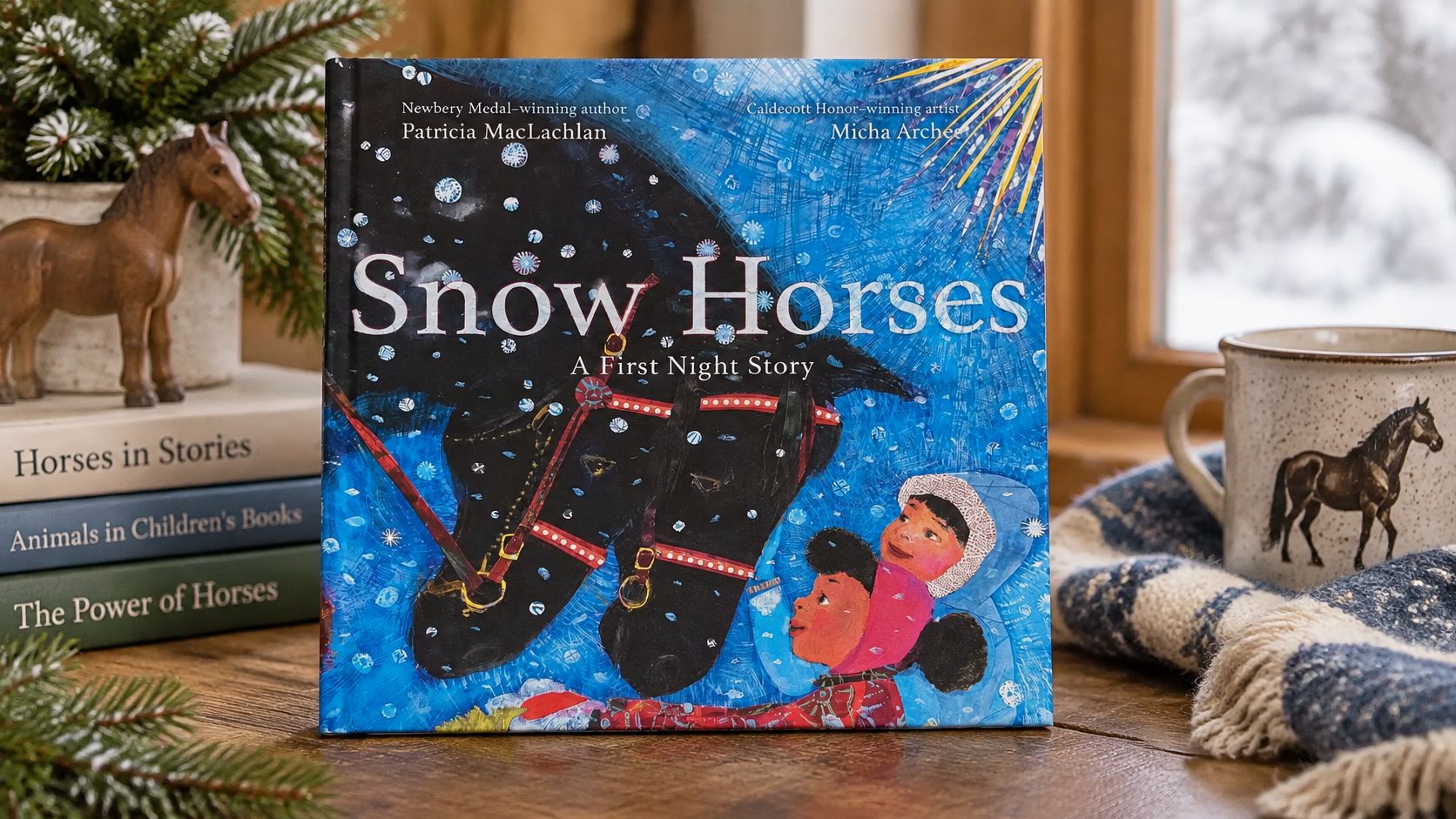
Illustrated horse stories also offer an entry into the category before readers are ready for longer novels.
Look beyond the shelf label
Historical fiction asks what work a horse performed in its particular society. Transport, farming, and wartime service shouldn't feel like interchangeable costumes. The demands placed on the animal should help explain the human characters' choices.
Literary Westerns can use horsemanship to explore competence, independence, belonging, and loss. A journey on horseback makes travel a relationship with a living animal, not just movement across open country.
Horse-narrated stories give readers access to an imagined animal perspective. Fantasy goes further by allowing magic or human-like speech. These are related storytelling tools, but narration alone doesn't make a book fantasy: a writer can give a horse words while grounding its experiences in recognizable animal needs.
Genres overlap. A competition novel may contain a rescue plot, while a historical journey may also be a coming-of-age story. Across those combinations, bond, loss, responsibility, and freedom provide useful ways to discuss what the horse means beyond its breed or appearance.
Realism Levels and the Story Types They Suit
A believable horse is a more useful teacher of horse behavior. Fantasy can be equally worthwhile reading, so long as readers know they are entering an invented world rather than receiving practical insight into animals.
Realism is a spectrum that measures how closely a story follows equine behavior. Two questions locate any book on it: how much does the horse matter to the plot, and how credibly does it behave? The right choice depends on whether you want to encourage close observation, discuss moral choices, or enjoy imaginative play.
Realism levels by story type
| Story Type | Horse Behavior | Best For | Watch For |
|---|---|---|---|
| Realistic working horse | Behavior explained by training and environment | Empathy and observation | Romantic bonds that defy horse behavior |
| Competition novel | Shows, training and performance pressure | Riders and competitive readers | Winning overshadowing welfare |
| Historical research | Period-accurate roles and care | Adult and history readers | Anachronistic horse handling |
| Talking or narrating horse | Human-like speech or inner thoughts | Imaginative and moral storytelling | Human motives assigned to horses |
| Fantasy horse | Magical abilities | Imaginative play | Confusing myth with equine biology |
Separate perspective from biology
A horse that deliberately devises a rescue because it understands a rider's moral worth asks readers to accept more than an animal responding to familiar cues. A horse that bolts in response to pain or fear offers a different kind of explanation. The important distinction is what the story claims the animal understands.
Animal characters can still provide valuable opportunities to discuss mental states. A study summarized by ScienceDaily tested more than 100 children aged 5–10 on theory-of-mind abilities after stories featuring animal or human characters, supporting their consideration as a way into reasoning about beliefs and emotions, not a blanket claim that every animal story teaches empathy.
Try asking what information each character possesses. A rider may know the trailer is taking a horse somewhere safe, while the horse encounters unfamiliar sounds, movement, and separation. Readers can consider that difference without deciding the horse understands the destination.
A narrator's vocabulary belongs to the author. The experiences beneath it should still make sense for the animal.
Human-like dialogue can serve a story's moral questions beautifully. What it cannot do is provide evidence about equine cognition, so judge it by what it adds to the plot.
For a child, identify the book's imaginative rules before reading. For a knowledgeable rider, inspect whether realistic claims hold up beyond familiar terminology. Choose realism deliberately, just as you'd choose reading difficulty or subject matter.
Checking a Horse Novel for Welfare and Accuracy
A persuasive stable scene needs more than correctly named equipment. Look for connections between what happens to the horse, how it responds, and what the humans do next.
In a Literary Hub examination of fictional horses, an equine neuroscientist and trainer challenges the attribution of complex, intentional rescue reasoning to horses. The practical lesson is to inspect explanations, not merely admire dramatic outcomes.
Use these checks before recommending
- Look for observable causes. Does the author connect behavior to posture, pain, scent, training history, or surroundings? For example, a horse becoming watchful in an unfamiliar yard is better explained through what it encounters than through an unsupported claim that it distrusts a villain.
- Follow the consequences of injury and exertion. Rescue, racing, and veterinary scenes need clear cause and effect. If a horse becomes lame, ask whether the characters change their plans rather than wait for an emotionally convenient recovery.
- Examine ordinary care and boundaries. Grooming, ownership, retirement, and handling deserve attention even when they aren't dramatic. A plausible scene might show a handler pausing and reassessing when a horse resists touch, rather than treating stillness as proof of willing participation.
- Identify needs beyond the human character's goal. Does the horse receive rest, companionship, and appropriate care even when these complicate the plot? A retired animal should matter beyond the rider's disappointment at losing a competition partner.
- Check what supports the accuracy label. An author's interest in riding isn't equivalent to qualified review. Unless equine professionals have reviewed the text, describe its approach as realistic or detail-focused rather than certifying it as scientifically accurate.
Write a spoiler-light welfare note
Scholarship on children's equestrian fiction and animal welfare examines the tension between anthropomorphizing horses and representing their distinct needs. That distinction helps a family or educator describe a book without retelling its ending.
A useful note identifies what the story handles well, what it simplifies, and how it treats distress. For a hypothetical rescue novel, you might note that the story acknowledges fear during relocation, compresses the recovery process, and includes mistreatment that deserves adult discussion.
Ask readers:
- Immediate needs: What does the horse need in this scene?
- Human responsibility: What would a careful owner do differently?
- Evidence: Which details support your interpretation of the horse's response?
Finish by watching for these red flags:
- Sudden recoveries: An injury disappears when the climax requires athletic effort.
- Moral reasoning: A supposedly realistic horse judges human goodness and plans accordingly.
- Disposable suffering: Pain exists only to shock readers or improve a person's character.
Classic and Modern Horse Novels Across Eras
Start with a working horse's imagined account of human treatment, then follow the category toward literary journeys and historical investigation. The changes reveal how broadly writers can use an equine subject without reducing it to scenery.
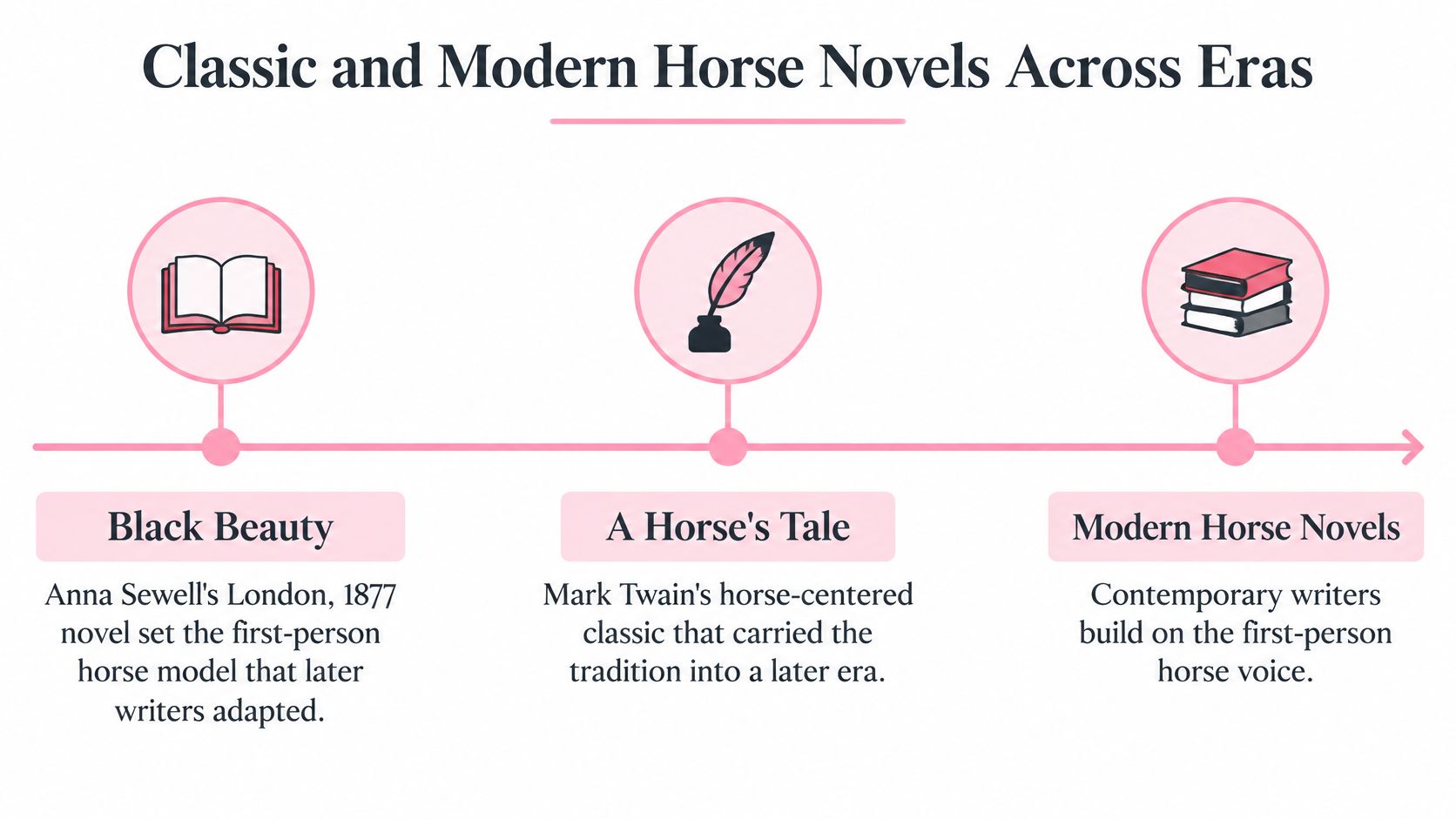
The timeline offers an overview of that progression.
From an animal's testimony to a moral lens
Anna Sewell's Black Beauty established an enduring model: let readers encounter human conduct through the horse affected by it. Jarrold & Sons published the novel in London on 24 November 1877, and later worldwide sales estimates exceed 50 million copies, according to the publication history of Black Beauty.
Its importance lies in making work and treatment part of the animal's story, rather than merely the owner's circumstances. The novel's longevity also offers parents a reason to revisit it thoughtfully, not assume that familiarity makes every episode easy for children.
Mark Twain's A Horse's Tale carries the tradition into satire and social observation. The University of Pennsylvania's Online Books Page catalog records its publication by Harper and Brothers in London and New York in 1907. Here, equine experience supplies a moral lens through which readers can question human behavior.
Reading invitation: Notice who gets to explain an event, and whose suffering the explanation leaves out.
From a horseback journey to a historical archive
Cormac McCarthy's All the Pretty Horses makes horsemanship integral to a coming-of-age journey. Published in 1992, it follows 16-year-old Texan John Grady Cole into Mexico with Lacey Rawlins and won the 1992 National Book Award for Fiction and National Book Critics Circle Award for Fiction, as the Penguin Random House reading guide records.
The horses enable mobility and independence, but the story also tests the frontier ideal those freedoms seem to promise. It's a useful choice for readers seeking identity, class, and violence within a literary Western rather than a riding-school narrative.
Geraldine Brooks's Horse treats an animal's history as a route into human institutions. Listed by the Anisfield-Wolf Book Awards as a 2023 fiction winner published by Viking, it connects a famous racehorse's nineteenth-century story with later investigations involving art, science, slavery, and race.
The horse becomes both a living subject and a historical archive. Readers considering these broader literary approaches can explore our guide to horse books for adults.
Across eras, writers change the work horses perform and the voices used to represent them. Questions about attachment, power, and welfare remain, but each novel asks readers to examine them from a different position.
Choose Your Next Horse Book in Four Steps
Turn a broad interest into a short purpose. Prioritize a book whose demands and interests suit the person opening it. Use the horse filters developed above as a simple set of rails, much like choosing a trail by the rider's experience rather than by the size of the mountain.
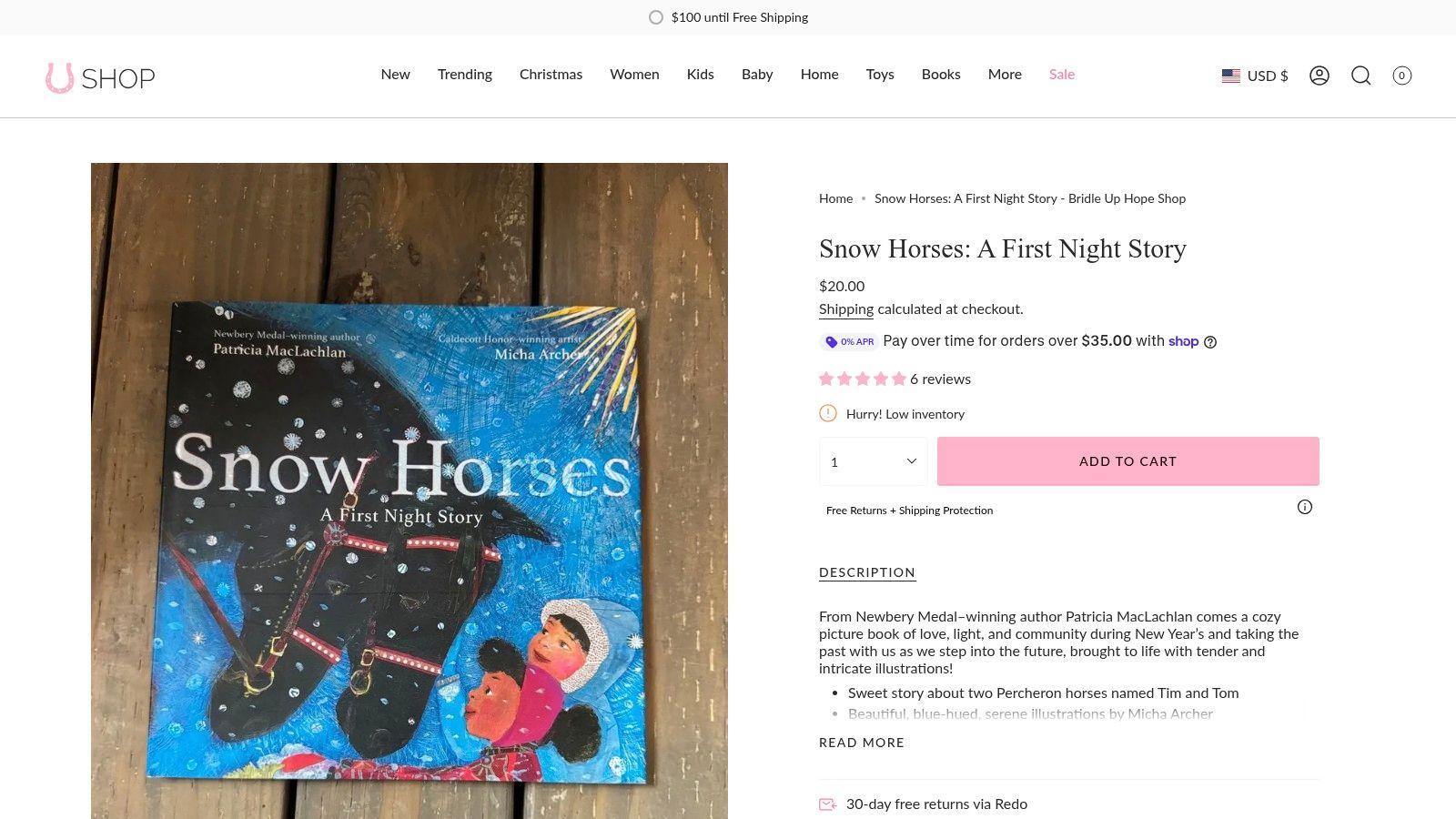
For a picture-book choice, look at the format as well as the description.
- Name the reader precisely. Write a short description such as a beginning reader who loves ponies or an experienced rider seeking literary fiction. Include any subjects they'd rather avoid, especially injury, abandonment, or death.
- Decide how realistic the horse's behavior should be. Choose among recognizable animal behavior, a historical setting, or openly magical storytelling. For shared reading, be ready to distinguish invented abilities from practical horse care.
- Set the horse's required importance. Use the three horse-importance questions from above to judge whether the animal drives the story or only settles into the background. If you want a horse-centered story, a stable address and occasional riding scenes won't be enough.
- Inspect a sample before committing. Read a scene involving handling or care, then assess the prose. Our horse book review guide offers another way to organize your observations.
Make a specific choice
For a shared picture-book reading, Snow Horses: A First Night Story, by Newbery Medal-winning author Patricia MacLachlan, follows the Percheron horses Tim and Tom in a story of community at New Year's. Illustrated by Micha Archer, it's a hardbound picture book of 40 pages. 100% of the profits from this book go to the charity Bridle Up Hope.
If the intended discussion is about arriving somewhere unfamiliar and receiving care, the rescue picture book listed earlier offers another starting point for children ages 5 to 8. Choose between those purposes rather than assuming every illustrated horse story offers the same experience.
Watch the opening minutes of the video below to judge the pacing of the horse scenes before you buy.
Choose one title from your shortlist and read its opening. Keep going if the language invites the reader in and the horse offers something worth noticing.
Bridle Up Hope Shop offers horse picture books and equestrian-themed gifts for readers and horse-loving families. Visit Bridle Up Hope Shop to choose a book that fits your reader's interests, whether you're planning a shared story time or a conversation about caring for horses.
Deje un comentario