


In a peer-reviewed study of older adults, calf circumference was measured at the widest point with participants standing with their feet 20 cm apart and weight evenly distributed; mean calf circumference across the reported groups ranged from 34.9 cm to 36.3 cm, with standard deviations from 2.4 cm to 3.2 cm, according to the National Library of Medicine study. For anyone shopping equestrian boots wide calf sizing, that range is a useful reminder that “average” is a narrow target, and plenty of riders sit outside it before foot width or shaft height enter the discussion.
A standard shaft is built around that average. It can pinch one rider and rattle around another, even when both wear the same shoe size. The global equestrian boots market was valued at USD 1.52 billion in 2024, per Growth Market Reports, yet that dollar figure alone says nothing about whether a boot matches your leg.
Treat wide calf as one axis in a three-axis fit. Foot width decides whether your toes and the ball of your foot can sit flat, calf circumference decides whether the shaft closes without strain, and shaft height decides where the top edge lands behind your knee. I would not size up just to clear the calf; that often buys room at the top while making the foot bed sloppy. A wide calf label gets you to the right page of a catalogue. Fit comes from the three numbers lining up.
Table of Contents
- How to Measure Calves, Feet and Shaft Height
- Calf Size Ranges and What They Mean
- Why Wide Calf Is Only One Fit Measurement
- English and Western Wide-Calf Styles Compared
- Fit Checks for Riding, Layers and Break-In
- Confirm the Fit Before You Buy
How to Measure Calves, Feet and Shaft Height
Four numbers decide whether a tall boot works: the larger of your two calf circumferences, your shaft height, your foot length and your foot width. Take them in one sitting, in riding clothes, and write them down. A soft tape, a sheet of paper and ten minutes are all the kit you need.
- Wear the breeches and socks you ride in. Measure in your normal riding layers rather than over jeans or on a bare leg. Winter breeches and thick socks add real millimetres, and the tape should see the same leg the boot will.
- Stand with your weight even and bend the knee to about 90 degrees. A straight leg lets the calf muscle flatten, while a bent knee brings it up the way it sits in the saddle, which is exactly when a tight shaft shows itself. Rest a hand on a chair if you need the balance.
- Run a soft tape around the fullest part, with gentle tension. Pulling hard compresses the muscle and gives you a number no boot can match. Keep the tape level, snug enough to stay put and loose enough that you can slide a finger underneath.
- Measure both legs and record the larger figure. Left and right rarely match, and the larger measurement is the safer basis for choosing a wide-calf size. Sizing to the smaller calf is how riders end up with a boot that zips on one leg and stops dead on the other.
- Allow half a centimetre for the time of day. The Kramer long riding boot guide recommends adding 0.5 cm to the circumference because calf size increases during the day. Measure in the evening and you can skip the allowance. Measure in the morning and it covers the swelling by suppertime.
- Measure shaft height from the floor to the crease behind the knee. The same guide measures it from the ground to the back of the knee, or to the middle of the kneecap where a brand asks for it that way. Stand with the leg slightly bent. The measuring point has to match the chart's, because a boot built to a back-of-knee standard sits differently on a rider who measured to the kneecap.
- Measure the foot on paper, length and width. Stand on a sheet in your riding sock, mark the heel and the longest toe, then mark the widest points across the ball. Length sets the size, and width decides whether the toe box will tolerate you. A wide calf tells you nothing about foot width.
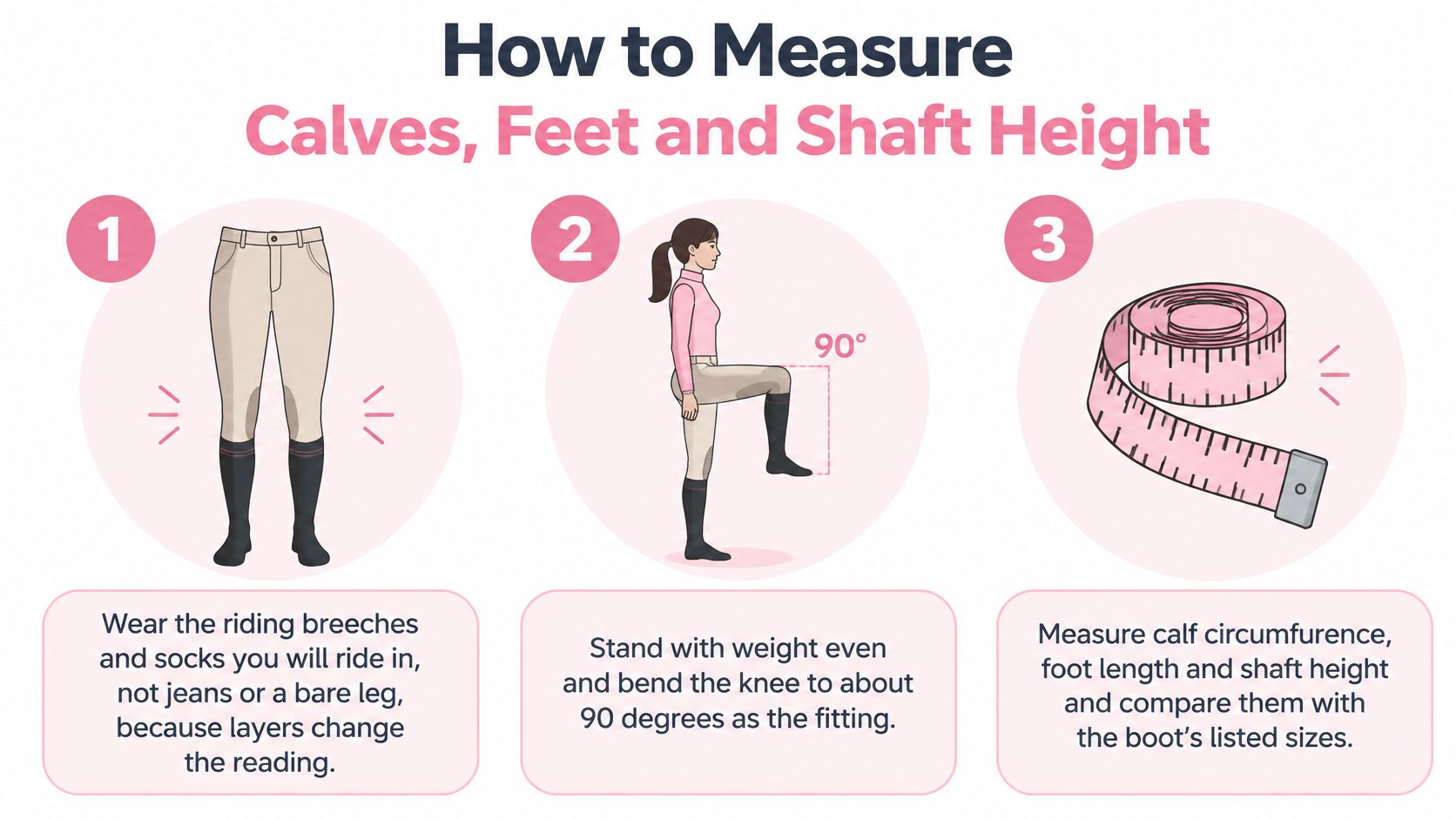
Compare all four figures against the specific brand's chart, and check that the chart's measuring point matches where you put the tape. A chart that asks for a measurement to the kneecap and a rider who measured to the back of the knee are describing two different boots.
One trap worth naming is buying a larger shoe size to gain calf room. Going up a full size adds a modest amount of shaft circumference and a lot of dead space at the toe, so the calf pinches a little less while the foot slides and blisters. If your calf measurement demands more boot, the fix is a wider calf option in your foot size, not a bigger foot size.
Carry the card. A fitter can work with four numbers. "I'm usually a wide" gives them nothing to work with.
Foot width is the axis riders skip most often, and it is the one that turns a good calf fit into a pair of boots you stop wearing. A 2 cm error at the calf can be absorbed by a stretch panel. A 2 cm error at the ball of the foot cannot.
Calf Size Ranges and What They Mean
The bands below are the ones shoppers ask about first. Find the row that matches the larger of your two calf measurements, then use the third column to decide what to check before you add anything to a cart.
| Label | Approximate calf circumference | Check next |
|---|---|---|
| Regular | 34–38 cm | Confirm the listed shaft circumference matches your measurement |
| Wide | 38–42 cm | Compare against the brand chart rather than the label alone |
| Extra wide | More than 42 cm | Check shaft height and zipper strain |
| Between two listed sizes | Choose the next size up | Verify the choice on the manufacturer chart |
Treat the label as a signpost, not a verdict. Landing in the wide band tells you which part of a maker's chart to open. The number that closes a boot is the listed shaft circumference at the shaft height you measured, and that number lives on the product page, not on the label.
General boot-fitting guidance sets the simplest test: the fullest part of your calf should be smaller than both the boot opening and the shaft circumference, per the DSW boot sizing guide. The same source notes that one consumer guide treats 15.5 inches or more at the fullest part as the point to start trying wide-calf styles. That figure comes from general footwear retail rather than equestrian bootmaking, so take it as a nudge toward the wide range, not as a rule that decides your size.
The gap between two listed sizes is where most of the disappointment comes from. If your figure falls between them, take the next size up and then confirm it against the manufacturer's chart, since the chart is the only document that describes the boot you're buying. Half a centimetre too much disappears into a sock. Half a centimetre too little does not go anywhere.
The same calf can be classified two ways. A 39 cm measurement might sit at the top of one maker's regular range and in the middle of another's wide range, and both charts can be correct for the boots they describe. The useful comparison is always your measured calf against the listed circumference at the relevant shaft height.
The label is marketing. The chart is engineering. One tells you who the boot is for. The other tells you whether it will close.
A size range narrows the shortlist. It cannot tell you whether the shaft will sit behind your knee or whether your foot has room in the footbed, which is why the next check has three parts instead of one.
Why Wide Calf Is Only One Fit Measurement
The most expensive mistake in wide-calf fitting is buying the largest calf size available and accepting whatever foot comes with it. A riding boot fits on three separate axes: foot width, calf circumference and shaft height. A boot sold as wide calf can still compress the ball of your foot, let the heel lift, or dig into the back of your knee, as the Discount Equestrian guide to wide-fit riding boots points out. The label describes one axis and ignores the other two.
Riders arrive in combinations. A wide calf with a narrow foot is common, and so is a wide foot with an average calf. Buy the calf size that closes and you may end up with a heel that lifts with every stride, which costs you stability in the saddle far more than a snug shaft ever will. Ankle looseness is harder to fix than calf tightness, because a stretch panel can give you room at the calf but nothing tightens a heel counter.
Two body types expose the problem fastest. Shorter riders with fuller calves often find a tall shaft sitting too high, folding into the knee crease on every rise. Taller riders with slimmer calves buy the same nominal circumference and get a shaft that gapes at the top and slides when they post. The same number produces opposite problems depending on where it sits on the leg.
The three-axis check, in order
- Judge the foot first. Toe box, ball width, heel hold. If the foot does not work, nothing further down the list rescues the boot, and no amount of calf room makes a pinching toe tolerable on a two-hour hack.
- Match the calf to the product chart. Compare your larger measurement plus your layer allowance against the listed shaft circumference, and confirm where on the shaft that measurement was taken.
- Confirm the shaft height against your leg. Floor to crease behind the knee is the figure to compare, and it decides whether the boot reaches properly or folds.
Sizing up in the foot to solve a calf problem is the wrong fix in almost every case. You trade a boot that pinches the calf for one that rubs the heel and lets the ankle roll, and the calf is still tight because the shaft did not change. Change the construction instead: a stretch panel, an adjustable lace or strap, or a different model with more room built in from the start.
Some calves do not suit any tall boot on the market, and forcing one is an expensive way to learn that. Short riding boots worn with horse riding half chaps move the calf fit onto a separate piece that is sized on its own, which sidesteps the fixed shaft entirely and costs far less than a pair of tall boots that almost work.
English and Western Wide-Calf Styles Compared
Both traditions build tall boots for the same functional reason, and both now offer wider shafts. They differ in how the boot closes, where the heel sits, and how much room the shaft carries as standard.
| Feature | English tall boot | Western riding boot |
|---|---|---|
| Shaft | Reaches just below the knee and sits close to the leg | Pull-on shaft, height varies by style |
| Heel | Small defined heel, at least one-half inch | Riding heel, usually higher and more pronounced |
| Sole | Smooth and continuous, with no break between heel and toe | Smooth riding sole; confirm the heel and sole design |
| Wide-calf fit | Check for a wide-calf option, lacing or zipper strain | Check for a wide-calf option or stretch panels |
The safety details matter more than the styling ones. Riding footwear guidance specifies a smooth, continuous sole and a small heel of at least one-half inch, because a sole with a break between heel and toe can increase the risk of the foot catching in the stirrup during a fall, potentially contributing to a rider being dragged, per the Sport is Good riding guide. That applies to both styles and it is not negotiable, because a roomy shaft does not excuse a sole that will not release.
Maximising circumference is not the goal either. The shaft needs to reach near the knee without restricting bending, and the calf needs to close without pinching or hanging loose. A boot that is generous everywhere is a boot that moves, rubs and gives you nothing to brace against.
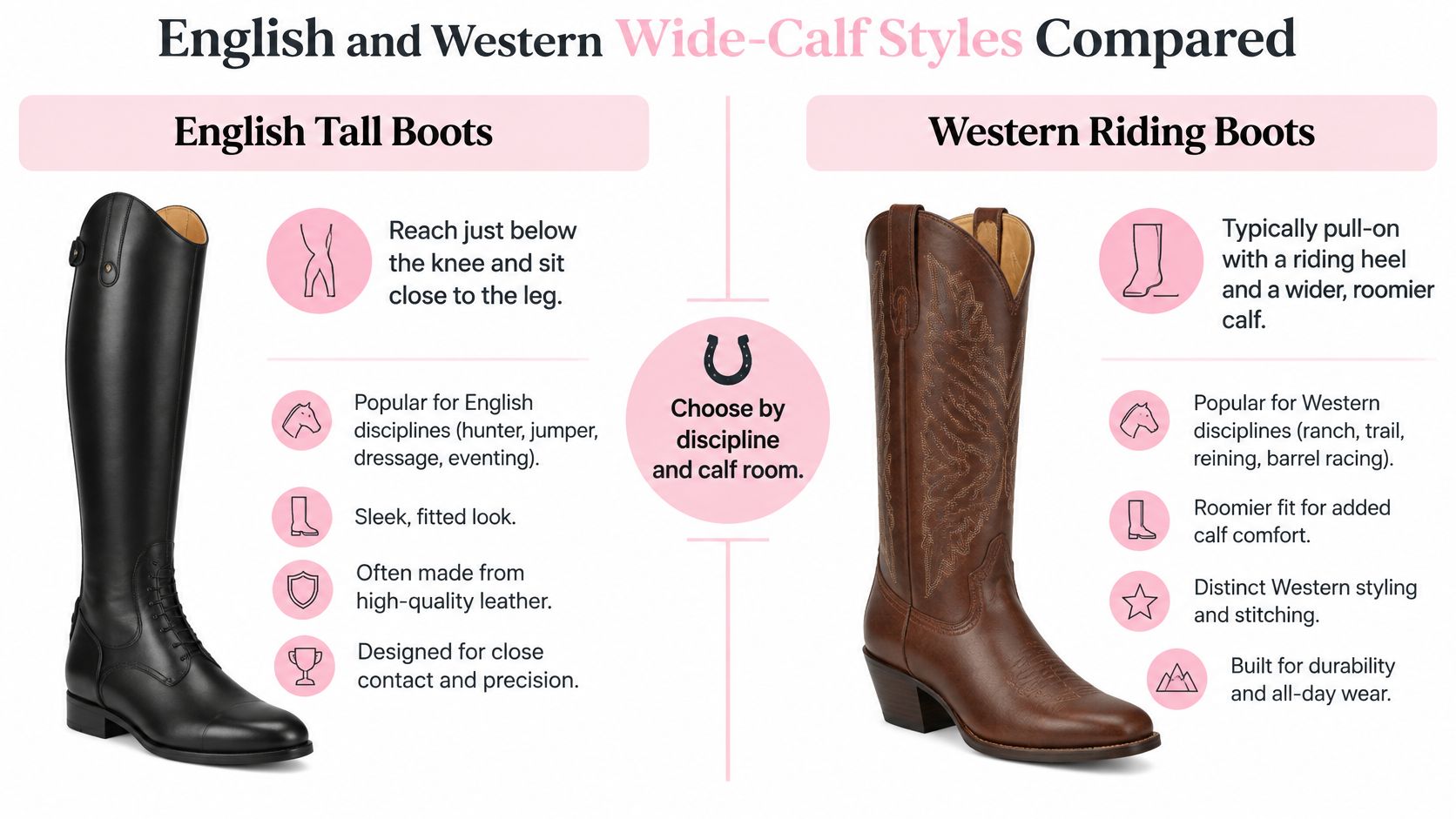
Choose by discipline, not by label
Choose English when your riding is flatwork, jumping or dressage and you want the shaft close to the leg with a small, defined heel. Field boots and dress boots hide their stretch panels well, so a wide-calf version often looks identical to a regular one on the shelf. Read the guide to English riding boots for women before you shortlist a pair.
Choose Western when you ride western, work around the yard, or want a pull-on boot you can get into without a fight. The shaft is usually more forgiving of a fuller calf and the heel is more pronounced. Check the listed calf circumference anyway, because roomier is a description rather than a measurement, and descriptions do not close zips.
In both cases the final test is the same: does the shaft height on the product page match the figure on your card, and does the listed calf circumference leave room for your riding layers?
Fit Checks for Riding, Layers and Break-In
The measurement on your card describes a still leg. A riding boot has to survive mounting, a schooling session and two hours of barn work, and calf circumference shifts with posture, muscle engagement, clothing and socks, as Lucchese's women's riding boot notes make clear. A reading taken on a relaxed leg in thin leggings understates what the boot has to hold.
- Try the boot over your riding socks and breeches. Not jeans, or not jeans alone. Thicker socks and breeches change the fit materially, and a boot that flatters a thin legging can be unwearable in winter kit.
- Stand, bend the knee, then crouch. The shaft should not dig behind the knee or drop away from the leg at the top. If you feel a hard edge at the crease, the shaft is too tall for your leg.
- Sit down and simulate the mount. Swing a leg as though you were getting on. The shaft should stay close without pinching the tendons at the front of the ankle, which is where a boot with the right circumference and the wrong height makes itself known.
- Look hard at the zip. A zipper already at the end of its travel will not improve with wear. Strain at the widest point of the calf is the clearest signal that the boot is a size short, not a season short.
- Walk and watch the heel. Sizing up to solve calf tightness leaves the heel lifting, and a lifting heel destabilises the ankle and rubs through socks on any distance.
- Check circulation after ten minutes. Tingling, numbness or cold toes mean the fit is too tight, whatever the label promised. Take them off and go up a shaft size.
- Know the return window before you wear them outside. Wear them indoors on carpet first, keep the box and the packaging, and photograph the sole if you do try them in the arena.
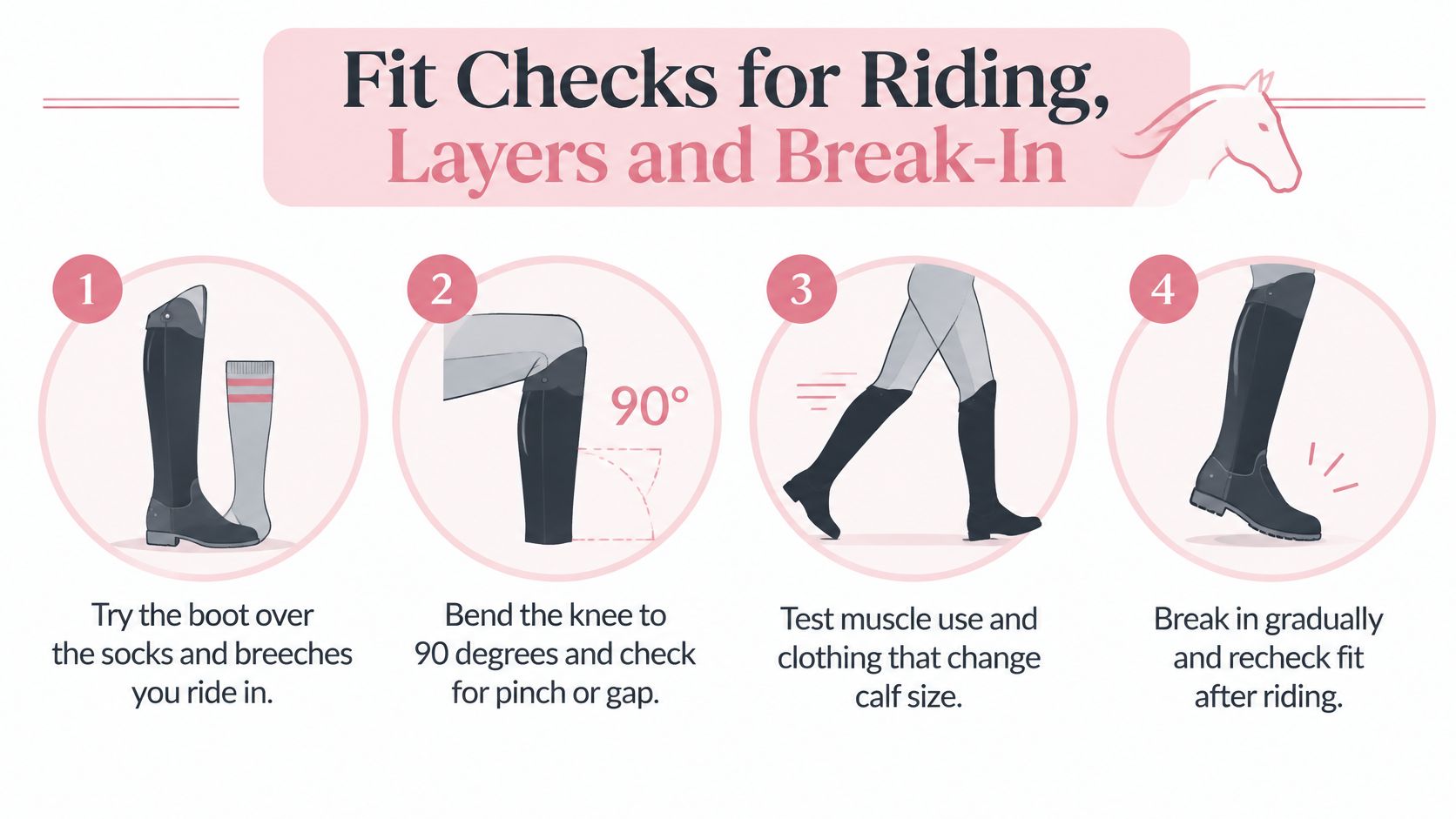
Break-in is real, but it is not a repair service. Leather softens and moulds over a season, and a marginally snug pair on a zip that closes without effort usually settles into a good fit. It is a poor bet when the zip strains or your toes go cold. Full-grain leather gives. Coated uppers and synthetics largely hold their shape, so what feels tight on day one tends to feel tight in March.
A boot that needs a fight to zip on a Tuesday morning will need a bigger fight after a long ride on Saturday.
The test is not whether you found the widest shaft in the catalogue. It is whether the boot stays close and quiet through the layers and movements you ride in.
Confirm the Fit Before You Buy
Two or three candidates whose listed calf circumference and shaft height match your card is the right size of shortlist. More than that and you are guessing. Fewer and you will compromise on the axis that matters most, which is usually calf fit for riders who started this search because a standard shaft would not zip.
Bridle Up Hope Shop is a gift shop for horse lovers that sells English and western designs, so you can look at both styles in one place, and then check each boot against the brand's own sizing chart and your four measurements. Put the pair you like beside your card and compare the listed shaft circumference, shaft height and foot width before anything else. A shaft that looks generous in a photo can still sit a centimetre under your number on paper.
Read the shop's refund and exchange terms before you order rather than assuming a window. Online-exclusive products with limited quantities can be returned or exchanged only according to the Refund Policy, so two minutes of reading before checkout is worth more than a dispute after delivery.
Watching a boot move on a rider shows what a static product photo hides, particularly at the knee and the ankle.
If you are leaning toward a pull-on style, the guide to western riding boots covers what to look for in shaft height and heel profile.
Carry this checklist into the comparison:
- The larger calf measurement, taken in riding layers, plus your 0.5 cm allowance.
- Shaft height, floor to the crease behind the knee.
- Foot length and width, measured on paper in a riding sock.
- The style you ride, English or western, so the heel and sole suit your discipline.
- The policy terms, read on the site before checkout rather than after delivery.
Four numbers and a chart beat a label every time. A boot that matches your card on all three axes will still be working in a year. The pair that only matched your calf measurement will be at the back of the tack room by spring.
Bridle Up Hope Shop carries English and western styles for riders and the layers that go under them, and 100% of annual net profits go to the Bridle Up Hope foundation, which supports girls and women through horses and habits. Bring your four measurements to Bridle Up Hope Shop and check each pair's listed shaft and calf figures before you order. A short shortlist and a read of the return terms will get you a boot that fits on the first try.

Deje un comentario