


At a 2011 study of 705 packed lunches across nine Texas childcare locations, researchers measured 1,361 perishable food items and found only 22 of them, 1.6%, sitting below 39.2°F (4°C). The average perishable item was 63.7°F (17.6°C), and more than 90% of lunches containing perishable food reached unsafe temperatures, including lunches packed in insulated plastic bags, according to USDA Food Safety and Inspection Service guidance on keeping bag lunches safe.
No one has run that study on cow print lunch bags, and nobody needs to. A print is ink on fabric. Insulation, cold sources and cleanability decide whether the yogurt is still safe at noon, and a black and white cow pattern contributes exactly nothing to any of the three.
That gap between how a bag looks and how it performs is where most buying decisions go wrong. Here's how I judge a bag from its listing, before spending anything on it.
Table of Contents
- Cow Print Lunch Bag Specs That Keep Food Cold
- Cow Print Lunch Bag Materials and What Each Does
- Choosing the Right Size for Kids and Adults
- What Changes and What Doesn't
- How to Pack a Lunch So It Stays Cold
- Cleaning and Care Without Ruining the Print
- Matching Cow Print Sets for Lunch and School
- Choose Your Bag and Where to Buy It Ethically
Cow Print Lunch Bag Specs That Keep Food Cold
Two cow print lunch bags can share the same spotted shell and perform nothing alike. The difference sits in the listing details: the insulation layer, the liner, the seams and the closure. A bag that matches a monogrammed backpack perfectly can still let a yogurt cup drift toward room temperature by eleven in the morning.
Warm food can make a child sick, and a bag that fails at its one real job costs more than its price tag suggests.
The line I buy by: if a listing can't tell me what sits between the outer fabric and the liner, it's a tote bag with a print on it.
Buying criteria and what to look for
| Criterion | What to look for | Why it matters |
|---|---|---|
| Insulation | A multi-layer or insulated build bonded between shell and interior, not thin single-layer fabric | Slows heat gain so food stays out of the bacterial danger zone |
| Cold sources | Room for two frozen gel packs, one above and one below the food | Cold on both faces of the meal, not just the bottom |
| Interior liner | Smooth, non-absorbent and wipe-clean | Resists spills, odor and the residue that collects in cloth |
| Seams | Sealed or reinforced stitching with no raw edges in the base | Limits leaks and hidden crevices where bacteria collect |
| Closure | A zip or roll-top that closes fully across the opening | Keeps condensation and leaks contained |
| Size | Fits containers upright with cold packs touching the food | Packs only cool the meal they touch |
| Care label | Clear wipe-clean or machine-wash instructions plus drying guidance | Prevents liner damage from heat, harsh chemicals or machine drying |
Insulation comes first because it sets the ceiling on everything else. A useful bag has a foam or foil layer bonded between the shell and the liner, and that layer should run up the sides and across the lid rather than sitting only in the base. Listings that show a shiny silver interior and call it thermal, without ever naming an insulation layer, are describing a coated fabric bag. It keeps crumbs in and cold out.
Seams and closure are the quiet failure points. Stitched seams with raw edges wick spilled juice into the padding, where it stays damp and starts to smell within a week of daily use. Taped or sealed seams and a zip that runs the full length of the opening keep condensation where you can wipe it. A roll-top does the same job if the folds are stiff enough to stay folded.
The three questions I ask of any cow print listing
- Does it name the insulation? "Thermal lining" alone says nothing. Foam, foil, or a stated multi-layer build is an answer.
- Will it hold two frozen packs around the food? If the bag only fits one slim pack under the containers, it isn't built for a full day.
- Does it say how to clean the liner? Wipe-clean or machine-washable with drying notes. Silence here usually means an unlined interior.
Two clear answers and one maybe earns a closer look. Three blanks means the price covers the spots and nothing under them, so pack accordingly.
Cow Print Lunch Bag Materials and What Each Does
The print lives on the shell, so it tells you nothing about what sits underneath. Three layers do the actual work, and each one answers a different question.
Shell, liner, insulation
- Shell: polyester, nylon and canvas all take a print well. Check whether the exterior is coated or water-resistant. A coated shell sheds condensation from a cold pack; uncoated canvas soaks it up and stays damp until you actively dry it.
- Liner: a film liner, often labeled PEVA or PU-coated, wipes clean in seconds but can crack if you fold the bag while damp and store it compressed. A cotton or unlined interior feels softer and holds milk, juice and odor, so it needs a real wash rather than a wipe.
- Insulation: usually a foil or foam layer between shell and liner. A listing that names no insulation layer should be treated as uninsulated, whatever the photo suggests.
Print durability follows the fabric and the dye. Prints on dark polyester tend to hold color through hot-water washing, while light cotton prints fade faster and can bleed onto a pale liner over a school year of cleaning.
The working rule: a listing that states the shell fabric, the liner type and the insulation layer has given you enough to judge everything else on the checklist.
Choosing the Right Size for Kids and Adults
Size follows the lunch, not the print. A bag has to hold the containers, a drink and two cold packs upright, with enough slack that nothing gets crushed and enough contact that the packs chill the food.
A concrete benchmark helps. The Katie Van Slyke Mini Cows Lunch Bag is listed in 2026 at $29.95, measuring 10 inches wide by 9 inches high with a capacity of 1.75 gallons, or 6.5 litres (Katie Van Slyke). That puts it in school-lunch territory. Whether it covers your lunch is a question only your own containers answer, so run the measurement below before treating any litre figure as a guarantee.
Lunch bag size by lunch type
| Lunch type | Typical capacity | Reference bag |
|---|---|---|
| Small snack or preschool lunch | About 3-4 L | No published reference at this size; match the listed capacity to your measured stack |
| Standard school lunch with two cold packs | About 6-7 L | Katie Van Slyke Mini Cows Lunch Bag, 6.5 L (1.75 gal) |
| Adult lunch with containers and cold packs | About 8-10 L | No published reference here; compare litre figures across listings |
| Meal prep or large lunch with drink | 10 L or more | Measure the full stack first, then match the litre figure |
Measure your lunch before you buy
Stack the containers you pack, add the cold packs, and run a tape over the height and width of the pile. Then compare that to the litre figure on the listing rather than to the lifestyle photo, because litres are the only measure that travels cleanly between brands.
Two failure modes cost you cold food. Packed too full, the lid won't close flat, air can't circulate, and the packs get pressed away from the food they're supposed to chill. Packed too loose, containers slide, food tips into the walls, and the empty air warms faster than a full bag does.
If you want a second, smaller bag for after-school snacks, check the capacity listed on our Junior Lunchbox product page against that same measured stack instead of assuming it matches the school bag you already own.
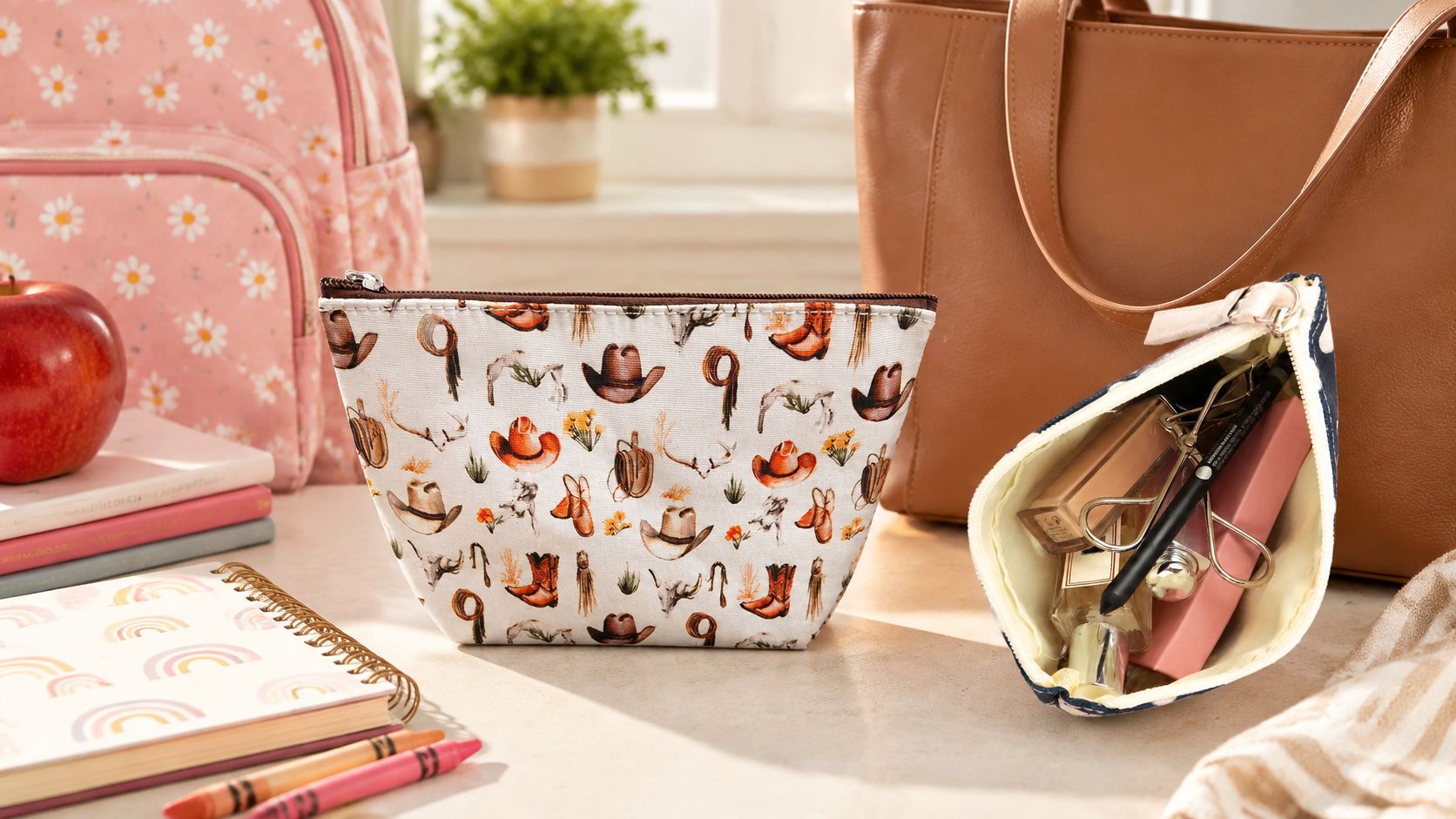
For utensils, napkins and dry extras that ride alongside the insulated bag, the Western Cowboy Pouch is listed at $14 in a single variant, described for makeup, toiletries and small accessories. Check the listing for its dimensions before counting on it for a specific kit, and keep it to dry goods, since nothing in that description is insulated.
A quick rule that saves a return: if your measured stack plus two packs doesn't fit with a finger's width to spare, size up.
What Changes and What Doesn't
A cow print lunch bag earns the print only after the cold side is proven. The fixed requirements are the ones in the spec table: insulation named and bonded through the sides, a smooth liner that wipes without cracking, and a closure that seals flat.
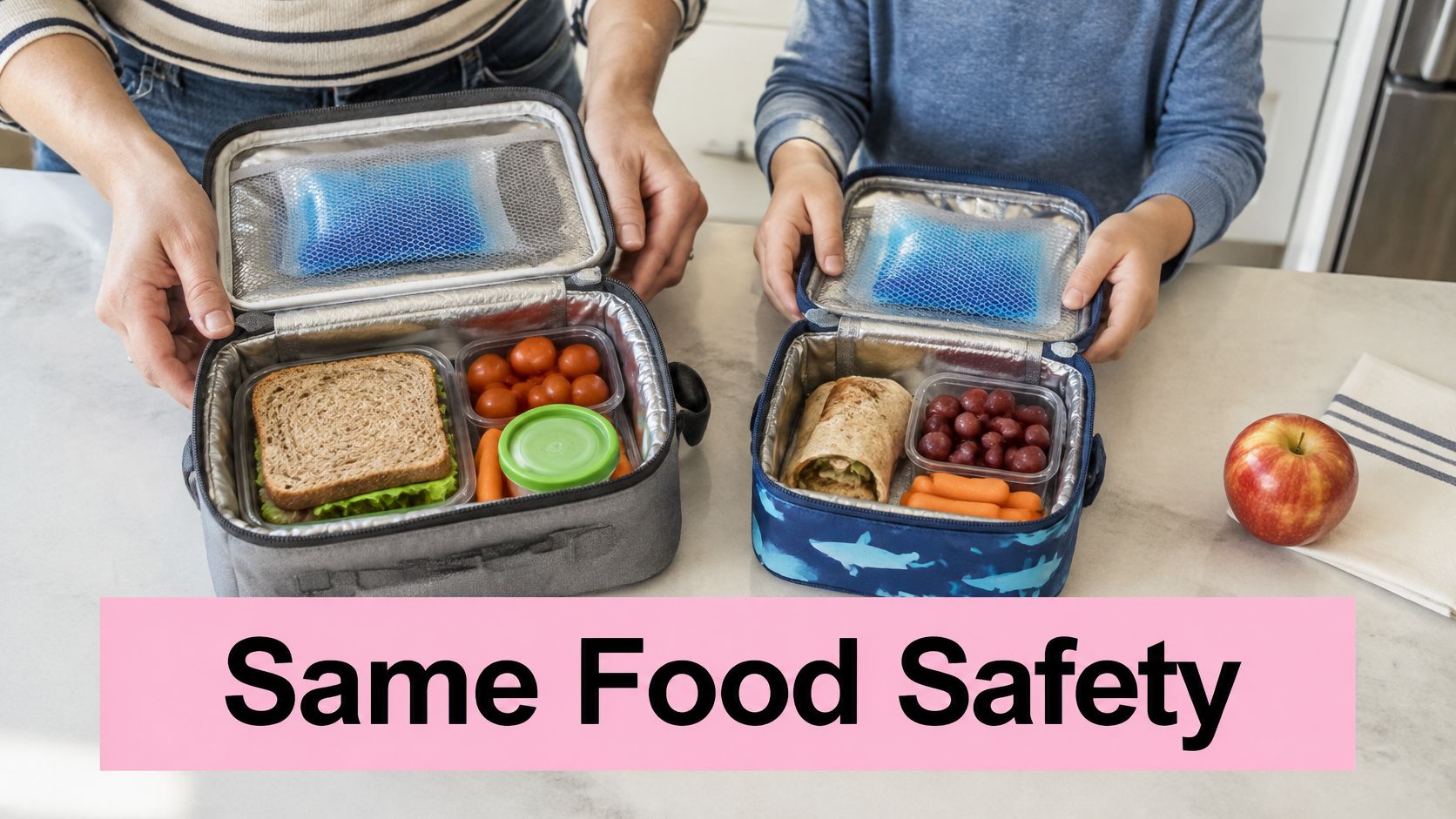
For a child, the difference is handling under pressure. At lunch, with a queue behind them and a milk carton already open, a stiff zip that small hands can run alone beats a buckle or roll top that needs two thumbs. The carry has to fit real school logistics: short handle, low bulk, and a shape that slides into a backpack instead of banging knees on the stairs. Busy print hides crumbs, which keeps the bag looking tidy and also makes skipped wipe-downs easier to miss.
For an adult, the difference is commute geometry and restraint. A flat handle or longer strap should sit well on a train and let the bag stand by a desk without tipping yoghurt into the seam. The print can stay; a smaller repeat or quieter placement reads better in an office kitchen.
Cleaning load splits by menu. Children's bags collect crackers, half-eaten snacks and juice, so daily wiping and a weekly deeper clean stay realistic. Adult bags carry leftovers more often, and a bag emptied only on Fridays can smell by Wednesday.
If insulation, liner and closure pass, both buyers can choose the same cow print and part ways on size.
How to Pack a Lunch So It Stays Cold
Insulation only slows heat gain. It cannot pull a warm sandwich back down to a safe temperature, no matter how thick the foam is or how good the print looks. The bag is half the system, and the packing is the other half, the half that gets rushed at 7am.
Here's the routine laid out in six steps.
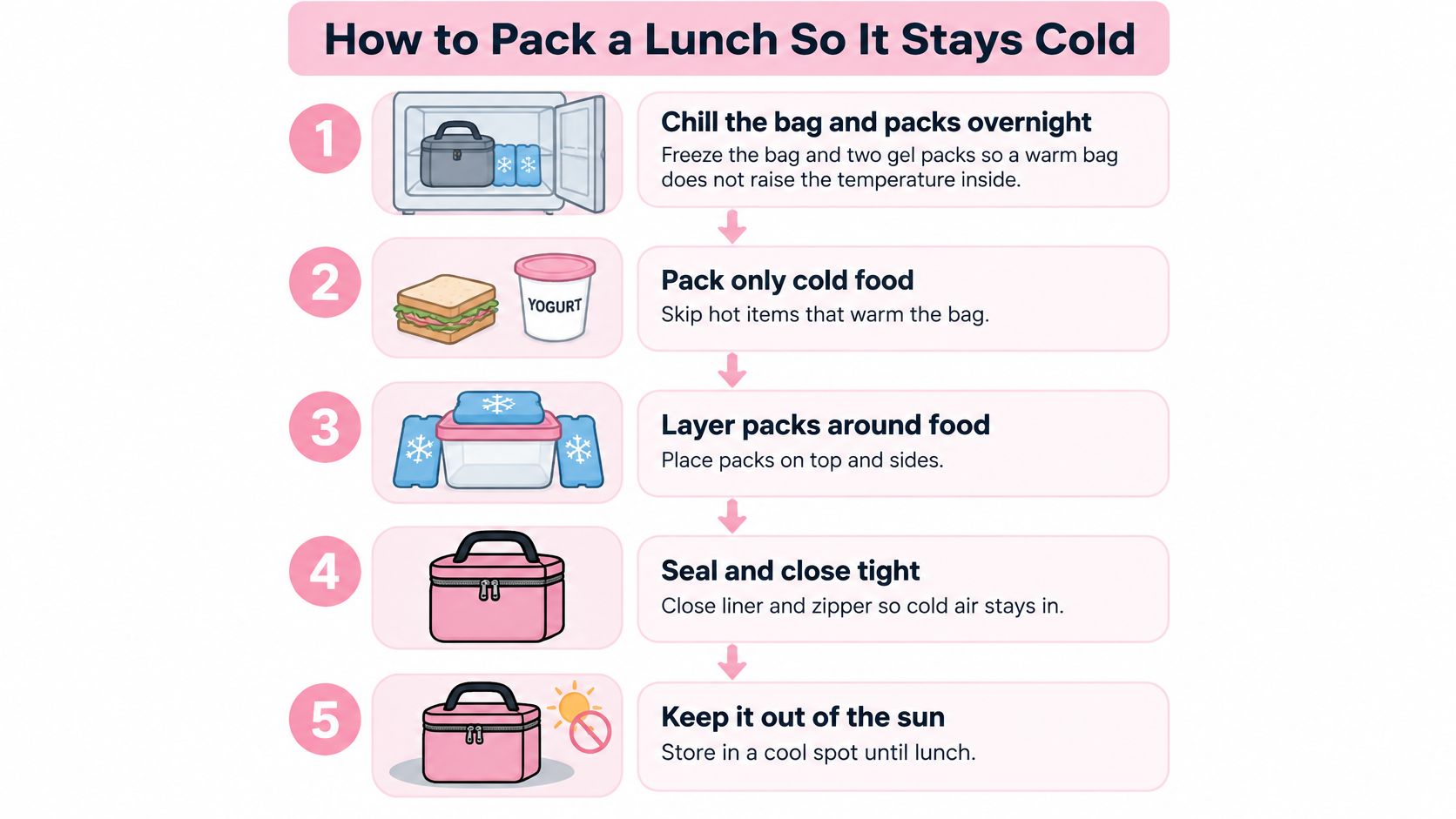
- Chill the bag and the packs overnight. Store the bag and two frozen gel packs in the freezer or fridge. A bag pulled warm off a hook raises the temperature of everything you put in it, which is a common slip on a rushed morning.
- Pack only cold food. Start with food that's been refrigerated until the moment it goes in. Adding a warm leftover straight from the stove pushes the whole bag up.
- Layer the packs around the food. One below, one above. The mistake is tucking a single pack under a tall container: the top half of that lunch never gets cold.
- Fill the space, not the ceiling. Containers should stand upright with little room to slide, and the lid should close flat. Overstuffing keeps air from reaching the packs.
- Add a frozen drink or water bottle as a third cold source if the bag has room for it. By lunchtime it has thawed into a cold drink, so it does two jobs.
- Close it fully and keep it out of the sun. A bag left on a car seat undoes an hour of good packing.
In August 2022 the USDA advised families to replace ordinary brown paper bags with insulated lunch bags for perishable foods, to pack cold lunches with at least two cold sources positioned around the food, and to keep hot meals at or above 140°F in an insulated container. The time limits matter more than the look of the bag: bacteria multiply rapidly between 40°F and 140°F, and food held in that range for more than two hours, or more than one hour when outdoor temperatures exceed 90°F, may become unsafe (USDA school lunch guidance).
For the dry side of the lunch, browse grab-and-go snack ideas from Just Cook It, then keep those items away from sweating packs in a separate container such as the Twist Snack Stacker in the Howdy print so crackers don't go soft against a wet gel pack.
If you'd rather watch the process than read it, this short walkthrough covers the same ground.
Judge the result by temperature, not by feel. A food thermometer pushed into the lunch should read at or below 40°F at noon, and the packs should still be cold with some firmness left. If the gel pack is warm and sloshy and the food reads above 40°F, treat that lunch as suspect rather than fine.
Cleaning and Care Without Ruining the Print
A cow print hides what a plain liner shows you. Milk residue, a smear of yogurt, a slow leak from a juice box: all of it disappears into the pattern until the smell arrives days later. That is the honest trade-off of a busy print, and it is why the care routine matters more on a patterned bag than a plain one.
FDA guidance for multi-use food containers calls for cleanable inner surfaces, smoothly bonded seams, and no physical defects that could collect food particles, dirt or organic matter. For food-contact surfaces that hold time- and temperature-controlled food, the FDA Food Code requires cleaning at least every four hours during continuous use (FDA). A home lunch bag gets unpacked once a day rather than held in continuous service, so a daily wipe-down plus a weekly deep clean is the workable translation of that standard.
Cleaning and replacement schedule
| Task | How often | How to do it |
|---|---|---|
| Empty and wipe interior | Daily | Hot soapy water on a cloth, working the seams and corners where crumbs lodge |
| Air-dry fully | Daily | Leave it open and unzipped until completely dry, never folded shut while damp |
| Deep clean liner | Weekly | Mild soap on a soft cloth, checking seams, folds and the base for residue |
| Odor or mold check | Weekly | Smell the interior and look into the corners and around the closure |
| Replace the bag | When damage appears | Odor that survives cleaning, mold, a torn liner or insulation that no longer holds cold |
Stay with hand-washing on a printed bag. Mild soap, a soft cloth and air-drying protect the print and the bonded seams, while abrasive pads and harsh cleaners do the two things you least want: dull the pattern and open channels where residue settles in.
Handling a leak from raw meat or dairy
Empty the bag completely and throw out any packaging that touched the leaked food rather than reusing it. Wipe the interior with hot soapy water, rinse the cloth and wipe again, then check the seam at the base where liquid pools. Leave the bag open until it is bone dry, because closing a damp bag traps moisture inside the insulation and that is where the smell starts.
A detail worth knowing: the insulation layer, not the liner, is usually what keeps a smell. If the odor returns within a day of a proper wash, moisture has reached the padding and no amount of wiping will fix it.
The same washing and drying logic applies to other printed canvas pieces in the house, and our care ideas for a horse canvas bag walk through keeping fabric bags fresh between washes.
When to replace the bag
Retire the bag when the odor comes back after a full wash and dry, when you find mold in a seam or under a fold, when the liner is torn or peeling, or when the bag stops holding a cold pack through a morning. A cow print that still looks crisp is not evidence the bag still works, because the failure hides in the padding you cannot see.
Matching Cow Print Sets for Lunch and School
A coordinated kit works when each piece has a defined job. Buy the accessories first, and you can end up with a handsome set that still lacks the one feature lunch needs: insulation.
- Start with the lunch bag. It carries the perishable food, so its insulation sets the standard for the rest of the set.
- Choose the drink bottle next. Check that the cap closes securely and that the bottle fits the bag's sleeve, lunch compartment or school backpack before matching the print.
- Give the pouch a narrow role. Use a pouch or utensil case for forks, napkins and shelf-stable snacks so every accessory has a clear place in the routine.
- Check print scale before you commit. A bold cow print on the bag reads best against solid-color accessories. Two prints at different scales fight each other.
- For adults, go quieter. A smaller repeat or one printed piece next to a plain commuter bag looks deliberate rather than costumed.
When browsing Bridle Up Hope Shop's catalog, compare the measurements on each listing before buying. A pouch sized for a handbag can look right online and still be too shallow for a sandwich box or a full-size fork.
On a school morning, the routine is simple: lunch goes into the insulated bag, the bottle goes where it fits securely, and the pouch takes the small dry pieces. Everything leaves the house coordinated, with each item doing the job it was bought to do.
Choose Your Bag and Where to Buy It Ethically
Before you order, confirm seven things on the listing: a named insulation layer, room for two cold sources, a wipe-clean liner, sealed or reinforced seams, a closure that seals fully, a size that matches your measured lunch stack, and a care label that explains how to wash and dry the liner. If any answer is missing, ask the seller about the insulation before you pay, not after.
Price deserves context. In 2026, 4imprint listed its cow-design Paws and Claws lunch bag at $6.39 each for 75 units, falling to $3.75 each at 5,000 units (4imprint). That is bulk promotional pricing, and at that tier you are buying a printed bag rather than a thermal specification. Cheap is fine if the spec holds. Cheap with no spec is a print.
The environmental case is narrower than most marketing suggests. The EPA encourages consumers to reduce the number of bags they use, reuse bags and recycle them when they can no longer be used, but it also says it does not have information establishing the environmental benefits of paper versus plastic bags (EPA). The defensible claim for a reusable cow print bag is repeated use replacing repeated single-use bags, and that only holds if you carry it most school days and keep the liner clean enough to keep insulating.
Bridle Up Hope Shop donates 100% of annual net profits to the Bridle Up Hope foundation, which supports girls and women through horses and habits. Online-exclusive products with limited quantities can be returned or exchanged only according to the Refund Policy, and shipping, taxes and discount codes are calculated at checkout.
Check the listing against the criteria, measure a test lunch, then order.
For the matching side of the kit, Bridle Up Hope Shop stocks cow print and western bags and accessories, so you can coordinate a pouch, bottle carrier or backpack around an insulated lunch bag that passed your checks. If you're building a lunch kit that keeps food cold, buy the bag on its spec sheet first and the print second. Visit Bridle Up Hope Shop to compare the pieces and read the details on each listing before you buy.
Deje un comentario