


Some riders choose a horsemanship book because it's famous. A better question is: what should this book help you notice, feel, or do differently at the barn? The best horsemanship books serve different purposes. Some improve rider balance, some explain horse communication, some develop timing and feel, and others provide scientific or academic foundations.
This list ranks seven titles as a guided path from accessible starting points to advanced study. The ranking considers practical usefulness, clarity, depth, transferability, and audience fit, but you don't have to read every book in order. Choose the title that matches your next goal. For a book gift, Bridle Up Hope Shop is a relevant source for the featured title, along with complementary equestrian gifts. Its charitable model directs 100% of annual net profits to the Bridle Up Hope foundation, which supports girls and women through horses and habits.
Table of Contents
- 1. Life Lessons From a Ranch Horse by Mark Rashid
- 2. Centered Riding by Sally Swift
- 3. True Horsemanship Through Feel by Bill Dorrance and Leslie Desmond
- 4. The Man Who Listens to Horses by Monty Roberts
- 5. Horse Speak by Sharon Wilsie and Gretchen Vogel
- 6. Horse Brain, Human Brain by Janet L. Jones
- 7. Equitation Science, Second Edition
- Top 7 Horsemanship Books Comparison
- Build a Reading List That Becomes Better Horsemanship
1. Life Lessons From a Ranch Horse by Mark Rashid
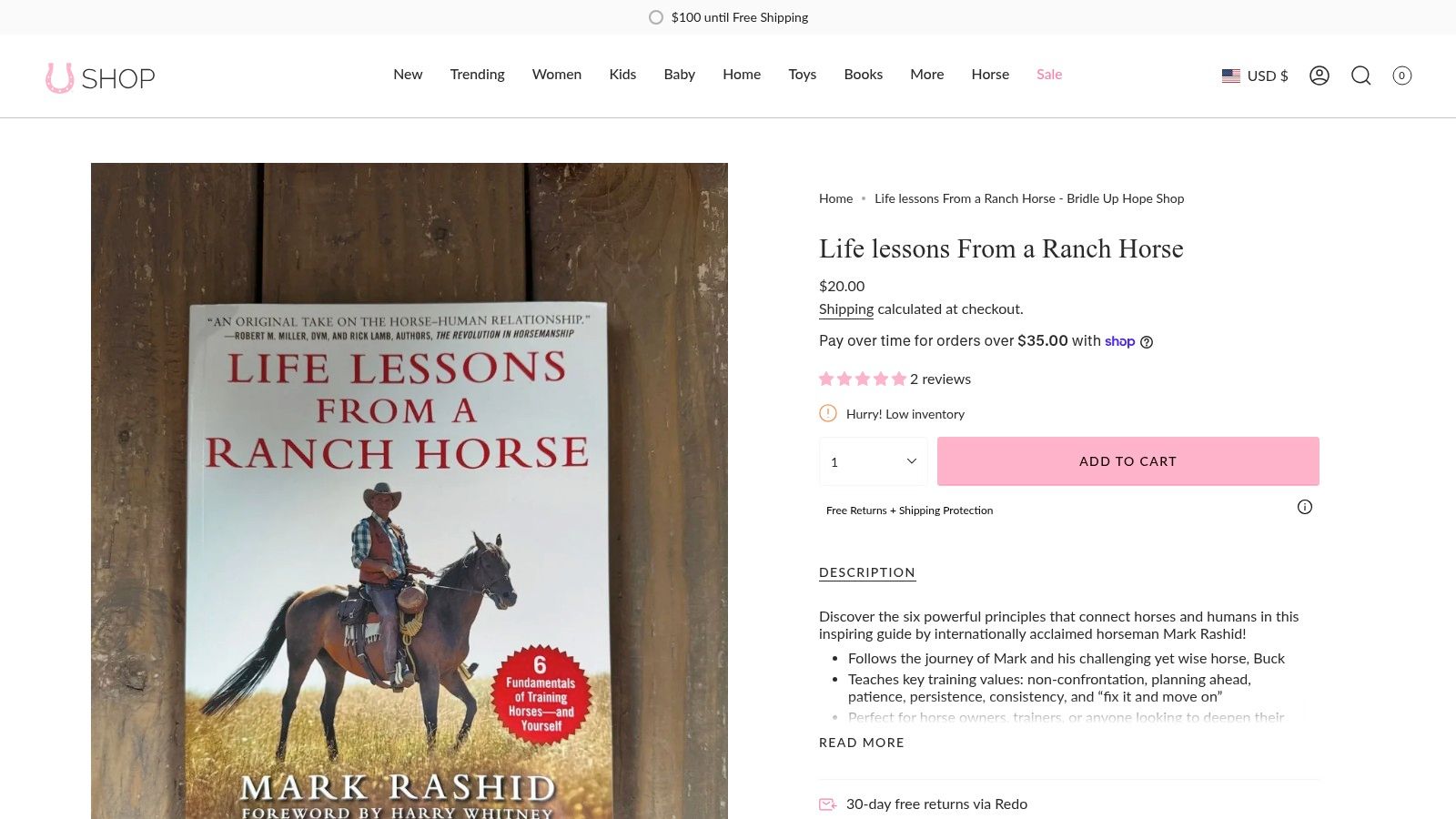
A rider who keeps searching for a new technique may need something more basic: better timing, clearer preparation, and less confrontation. Life Lessons From a Ranch Horse begins with those everyday decisions. Mark Rashid presents six foundational principles, including non-confrontation, planning ahead, patience, persistence, consistency, and timing with feel.
The book is especially useful when a familiar problem keeps returning. A horse rushes through a transition, braces during a halt, or loses confidence in a new exercise. Instead of offering a gimmicky correction, Rashid's approach encourages the rider to examine what happened before the problem appeared, what signal the horse received, and whether the rider allowed enough time for a correct response.
The print edition listed by Bridle Up Hope Shop is 208 pages, which makes it approachable for riders who want substance without committing to a dense textbook.
What you'll practice at the barn
Choose one recurring interaction, such as leading from the stall, picking up a hoof, mounting, or asking for a downward transition. Before changing equipment or adding pressure, write down your plan. Ask for the response clearly, release when the horse tries, and assess whether your timing helped the horse understand.
Practical rule: Change one part of the conversation at a time. You can't tell what helped if you alter your posture, rein length, speed, and pressure together.
The book works well for riders, trainers, and thoughtful gift recipients in both English and Western settings. It also makes a meaningful present because the purchase supports Bridle Up Hope's charitable mission. Pair it with a journal for recording training observations, or browse Bridle Up Hope's guide to horse books for adults for additional reading ideas.
The main trade-off is access. The shop page identifies a print edition but doesn't specify ebook or audio availability, and overseas buyers should check current shipping options. For a rider who wants calmer, more effective communication rather than a collection of quick fixes, this is the strongest first choice.
2. Centered Riding by Sally Swift
Many training problems begin with a rider who is gripping, holding the breath, tipping forward, or carrying uneven weight. Centered Riding addresses the person in the saddle before asking for more from the horse. Sally Swift's method uses body awareness, breathing, imagery, and balanced alignment to help riders develop a quieter physical conversation.
The concepts apply across disciplines because they don't depend on a particular bit, saddle style, or movement. An English rider working on a balanced trot and a Western rider trying to soften through a lope can both examine the same basic questions: Is the pelvis neutral? Is the trunk stable without becoming rigid? Are the hands connected to the body rather than working independently?
The publisher's page for Centered Riding presents the book as a long-standing resource, and its illustrations support readers who learn best through visual images.
The barn application
Start at the halt. Notice where your weight rests, soften your jaw, breathe into your lower ribs, and allow your eyes to take in the whole space rather than staring at one point. Then walk and observe whether your horse's rhythm changes when your breathing and balance become more consistent.
This isn't a horse-training manual, so riders looking for a detailed groundwork progression will need another title alongside it. Its illustrations and examples also come from an older publishing era, which may feel less contemporary than newer biomechanics resources.
Still, the book earns its place near the beginning of a reading path because rider balance affects communication before the rider gives a deliberate aid. A useful gift recipient is a beginner who feels tense, an adult returning to riding, or an experienced rider who has reached a plateau. Add a riding journal or a comfortable horse-themed accessory, and encourage the reader to test one body-awareness exercise during a supervised lesson.
3. True Horsemanship Through Feel by Bill Dorrance and Leslie Desmond
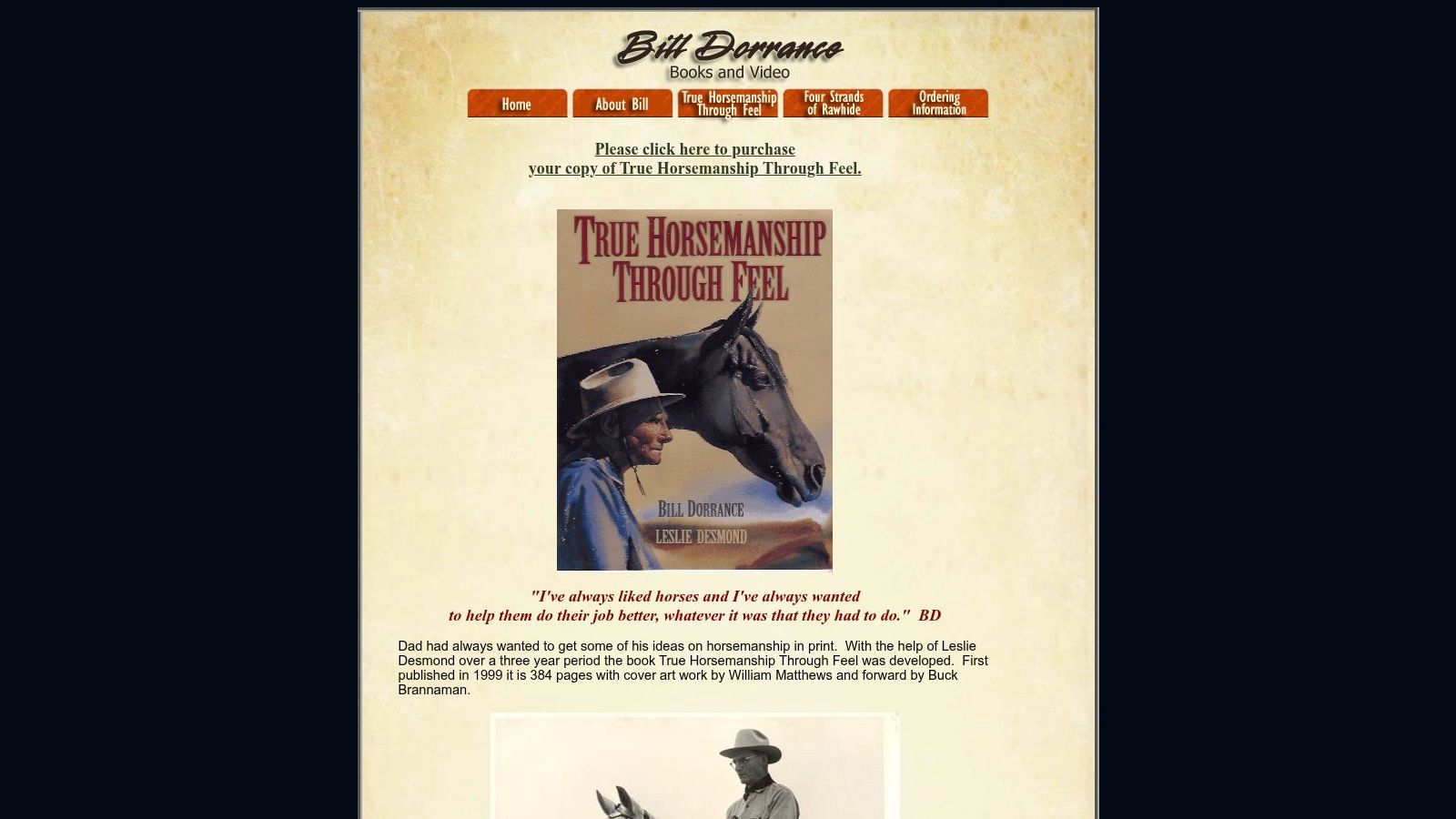
Some books explain what to do. True Horsemanship Through Feel asks the rider to become more observant before doing anything at all. Bill Dorrance and Leslie Desmond build their teaching around feel, timing, and the ability to notice small changes in a horse's attention, balance, and willingness.
The work has strong Western and ranch-horsemanship roots, but its central ideas travel well. A dressage rider, roper, trail rider, or groundwork student can study how a horse responds to a change in pressure, a shift in the handler's position, or a release at the right moment. The extensive illustrations and detailed scenarios reward slow reading rather than casual browsing.
Why advanced readers return to it
Use one scenario as a lesson rather than trying to copy an entire system. For example, observe how your horse changes when you approach, lead, turn, stop, or ask for a yield. Keep your request small enough that you can recognize the first correct response, then release without adding unnecessary movement.
The Bill Dorrance book page provides information about this influential title. Availability can be uneven because copies are often out of print, and the narrative style may feel dense to a new rider. That difficulty is part of the value for advanced students, but it also means the book is better suited to shared study with a qualified instructor.
Feel isn't a mysterious talent reserved for gifted riders. It grows when you notice the horse's response, make a measured adjustment, and pay attention to what changed.
Give this book to an experienced horse person who enjoys returning to foundational material. It can also make a thoughtful gift for an instructor, particularly when paired with a notebook for recording observations from groundwork and riding sessions.
4. The Man Who Listens to Horses by Monty Roberts
A reader who needs motivation before technical detail may connect first with The Man Who Listens to Horses. Monty Roberts tells his story while introducing his Join-Up approach and broader ideas about nonverbal communication. The memoir's narrative format makes it accessible to new riders, returning adults, and horse lovers who haven't yet developed a formal training vocabulary.
Its strongest contribution is emotional and philosophical. The book encourages readers to question force-based habits, pay attention to the horse's signals, and value trust during handling. That starting point matters because welfare, learning, and communication should be part of a rider's education, not an optional addition after performance skills.
A Swedish riding-school study illustrates why accessible explanations matter. Responses from 199 teachers and 368 pupils found a meaningful difference in satisfaction with teaching about horse behavior, welfare, learning, and communication, with pupils reporting satisfaction at approximately 43% to 44%, compared with roughly 63% to 67% among teachers in the published study. A readable memoir won't replace coaching, but it can prompt a learner to ask better questions about timing, pressure, release, safety, and observable behavior.
Read it with a questioning mind
The book is more autobiography and philosophy than a step-by-step training manual. Some autobiographical claims have also been challenged by critics, so readers should avoid treating every story as universal evidence. The publisher's listing for The Man Who Listens to Horses is useful for checking current format options.
After reading a chapter, translate its main idea into a modest barn action. Observe your horse during grooming, notice how your approach changes the horse's posture, and stop before the interaction becomes confusing or stressful. For more adult reading suggestions, Bridle Up Hope also offers a guide to horse books for adults.
This is a meaningful gift for someone beginning to think about humane handling. It works especially well with a journal, a horse-themed mug, or another small item that encourages reflection rather than promising a shortcut.
5. Horse Speak by Sharon Wilsie and Gretchen Vogel
Horse Speak treats daily handling as a conversation. Sharon Wilsie and Gretchen Vogel describe a practical system for observing and responding to equine body language, breath, posture, and intent. Its stepwise exercises make the book useful before, during, and after riding.
The framework is especially helpful for a rider who says, “My horse ignores me,” when the issue may be that the rider is missing early signals. A horse that turns away, tightens through the neck, changes its breathing, or shifts its weight may already be communicating. Learning to notice those changes gives the handler more choices than waiting until the horse becomes difficult to lead, mount, or direct.

A simple way to use it
Pick one routine, such as bringing a horse in from the field. Before reaching for the lead rope, watch the horse's orientation, expression, breathing, and feet. Move slowly enough to notice whether your presence creates relaxation, uncertainty, or avoidance. Then record what happened and compare your interpretation with a knowledgeable instructor.
The book offers photos and illustrations to support the exercises, but the system requires patience. Readers shouldn't expect to memorize a communication framework after one session, and the title gives less attention to mounted performance than a dedicated equitation manual.
The publisher's catalog is a useful place to check availability and related resources. Gift this title to a rider who wants to improve connection during ordinary barn tasks, not only during formal lessons. It also suits a parent, shared-horse rider, or groundwork student because the exercises can be adapted to different levels of mounted experience.
6. Horse Brain, Human Brain by Janet L. Jones
Training becomes clearer when the handler understands how the horse perceives a situation. Horse Brain, Human Brain translates neuroscience and cognition into practical ideas for safer handling, clearer requests, and better problem-solving. Janet L. Jones, PhD, focuses on the gap between what a person intends and what a horse may perceive.
That gap appears in ordinary moments. A rider may think a leg aid is precise while the horse experiences conflicting signals from the seat, hands, and reins. A handler may view a horse's hesitation as stubbornness when the horse is processing an unfamiliar object, changing footing, or an unclear request. The book helps readers replace quick labels with better questions.
Turn theory into a training decision
Read a section, then choose one situation to analyze. What did the horse see? What could the horse feel? Did the handler give the horse enough time to process the request? Was the environment adding pressure? These questions can improve safety without requiring a dramatic change in equipment or technique.
A 2025 narrative review of rider posture supports this kind of practical analysis. The review screened five academic databases, identified 83 records, and included 17 studies. Across the evidence, balanced rider posture was associated with more even saddle-pressure distribution and improved equine gait, while rider asymmetry was linked to uneven loading and poorer performance according to the review.
The book leans toward theory and cognitive science, so it won't provide a drill for every training challenge. It also contains fewer photos than many popular manuals. Give it to an evidence-minded rider, instructor, or barn manager who wants to understand why a method works before applying it. A notebook makes a useful companion because the reader can record the horse's response to each change.
7. Equitation Science, Second Edition
The most advanced title on this list is Equitation Science, Second Edition, by Paul McGreevy, Janne Winther Christensen, Uta König von Borstel, and Andrew McLean. It belongs on a professional or serious student's shelf because it connects horse behavior, learning theory, welfare, equipment effects, rider training, and research methods.
This is not a light weekend read. Its textbook tone requires concentration, but that density is useful when a reader needs a framework for evaluating training claims. Instead of asking only whether a technique is traditional or popular, the student can ask whether the aid is clear, whether the release is timely, whether the horse can respond without confusion, and whether the program protects welfare and safety.

The academic foundation
Use the book to build a repeatable training loop. Establish the rider's alignment, observe the horse's movement and behavior, adjust one variable, and reassess comfort and gait. This approach is more reliable than changing several factors at once and then guessing why the result improved or deteriorated.
The Wiley listing for Equitation Science provides publisher information and excerpts. The book is more expensive and less immediately approachable than a mass-market paperback, so it's best given to an instructor, equine science student, or rider who already enjoys technical study.
For readers comparing traditional horsemanship with evidence-based practice, this title supplies the deepest analytical foundation in the group. It should still be used with qualified coaching, because a book can't see the horse in front of you, assess a saddle's fit, or intervene when a training situation becomes unsafe. Bridle Up Hope also publishes a horse book review resource that can help gift-givers explore related titles.
Top 7 Horsemanship Books Comparison
| Title | Implementation complexity 🔄 | Time & practice required ⚡ | Expected outcomes ⭐📊 | Ideal use cases 📊 | Key advantages 💡 |
|---|---|---|---|---|---|
| Life Lessons From a Ranch Horse, Mark Rashid | Medium, principle-based, practical application 🔄 | Moderate, apply six principles in daily work ⚡ | Improved calm communication and problem solving; practical gains ⭐⭐⭐ 📊 | Riders/trainers seeking straightforward, horse-first solutions; gift buyers 📊 | Respected author, concise actionable principles; proceeds support nonprofit 💡 |
| Centered Riding, Sally Swift | Low–Medium, concept-focused on rider awareness 🔄 | Moderate, body awareness and posture practice ⚡ | Better balance, relaxation, and rider biomechanics ⭐⭐⭐ 📊 | Foundational work for riders breaking plateaus or improving position 📊 | Clear imagery and widely applicable exercises across disciplines 💡 |
| True Horsemanship Through Feel, Bill Dorrance & Leslie Desmond | High, dense, experiential instruction; subtle skills 🔄 | High, sustained practice to develop timing and feel ⚡ | Deep sensitivity, refined timing and subtle communication ⭐⭐⭐⭐ 📊 | Advanced riders, clinicians, or those studying authentic ranch horsemanship 📊 | Comprehensive, time-tested depth and authentic ranch experience 💡 |
| The Man Who Listens to Horses, Monty Roberts | Low, narrative introduction to Join‑Up principles 🔄 | Low–Moderate, inspires low-stress handling but limited drills ⚡ | Increased empathy, motivation toward humane methods; conceptual impact ⭐⭐📊 | New/returning owners wanting inspiration or an intro to Join‑Up 📊 | Highly readable memoir; widely available in multiple formats 💡 |
| Horse Speak, Sharon Wilsie & Gretchen Vogel | Medium, structured 12-step system with exercises 🔄 | High, requires repeated practice to internalize framework ⚡ | Improved daily handling and clearer horse–human signals ⭐⭐⭐📊 | Groundwork, daily handling, preparing horses for riding 📊 | Stepwise exercises, strong photo support, author resources/courses 💡 |
| Horse Brain, Human Brain, Janet L. Jones, PhD | Medium–High, science translated for practice 🔄 | Moderate, apply cognitive concepts to training plans ⚡ | Safer, clearer training; reduced miscommunication; evidence-based gains ⭐⭐⭐📊 | Evidence-minded riders/instructors designing safer training 📊 | Neuroscience-backed explanations useful for problem-solving and safety 💡 |
| Equitation Science, 2nd ed., McGreevy et al. | High, academic, research-dense text; technical 🔄 | High, study and integration into programs required ⚡ | Strong improvements in welfare, safety, and training efficacy ⭐⭐⭐⭐📊 | University courses, instructors, professionals seeking evidence-based practice 📊 | Authoritative, comprehensive, adopted as a course text; research-backed 💡 |
Build a Reading List That Becomes Better Horsemanship
The best reading path depends on what you need to change first. If you're new to horsemanship or returning after time away, begin with The Man Who Listens to Horses for an engaging introduction to humane, trust-based handling, or choose Centered Riding if your immediate challenge is tension, balance, breathing, or body awareness.
Move to Life Lessons From a Ranch Horse when you want practical principles for recurring rider-horse problems. Its focus on planning, patience, consistency, and timing can make everyday interactions more deliberate. Horse Speak belongs beside it when your priority is communication during grooming, leading, groundwork, and other moments that happen before you enter the saddle.
Once you're ready to study subtle responses, read True Horsemanship Through Feel slowly. Don't try to imitate an advanced exercise without support. Instead, use the book to improve your observation of pressure, release, attention, balance, and the first signs that a horse understands or becomes uncertain.
For deeper analysis, choose Horse Brain, Human Brain or Equitation Science, Second Edition. The first explains perception and cognition in a practical way, while the second offers a denser framework for learning theory, welfare, equipment, behavior, and rider education. Together, they can help instructors and serious riders examine not only whether a horse completes an exercise, but also how the horse learns it and what the process costs physically or emotionally.
A strong reading plan turns each title into a small experiment, not a collection of slogans. Choose one principle, discuss it with a qualified trainer, apply it gradually, and observe the horse's behavior, comfort, movement, and recovery. If the horse becomes confused, fearful, resistant, or physically uncomfortable, pause and seek professional help rather than pushing through because a book suggested an exercise.
These titles also make flexible gifts. Pair a training book with a journal for lesson notes, a horse-themed accessory for an adult rider, a children's book or plush horse for a young reader, or a home good for someone who loves equestrian design. Bridle Up Hope Shop offers books alongside apparel, jewelry, accessories, toys, artwork, kitchen items, and home decor in English and Western styles. Because 100% of annual net profits support the Bridle Up Hope foundation, the gift can connect a love of horses with support for girls and women through horses and habits.
Bridle Up Hope Shop offers horse books for adults and children alongside equestrian apparel, jewelry, accessories, toys, journals, and home goods in both English and Western styles. Visit Bridle Up Hope Shop to choose a thoughtful reading gift that supports Bridle Up Hope's charitable mission.
Deje un comentario