


A boot with the deepest tread isn't automatically the safest choice for riding. That advice works on wet concrete, but a heavily lugged outsole can catch in a stirrup when you need your foot to release during a fall. Western riding boots have always involved a compromise between secure movement on the ground and controlled release in the saddle.
The right pair should match your primary work. A riding boot needs a defined heel, a stable shank, a secure instep, and a sole that won't interfere with the stirrup. A barn boot may need more traction, weather resistance, or toe protection. A fashion boot may offer the Western shape without the construction required for either job.
| Boot feature | Riding priority | Barn-work priority | Main trade-off |
|---|---|---|---|
| Defined heel | High | Useful | Supports stirrup control, but may feel less natural for extended walking |
| Smooth or low-profile sole | High | Moderate | Releases from a stirrup more easily, but offers less grip on slick ground |
| Deep lug tread | Limited | High | Improves walking traction, but can catch in a stirrup |
| Firm shank | High | Useful | Stabilizes the foot, but can feel stiff during break-in |
| Reinforced toe | Situational | High | Adds impact protection, but may increase bulk and alter stirrup fit |
| Tall shaft | High | Useful | Protects the lower leg, but must not restrict the calf |
Table of Contents
- The Hidden Safety Trade-offs in Western Footwear
- Anatomy of a Safe and Supportive Riding Boot
- Comparing Heel Heights and Sole Profiles
- Achieving the Correct Fit for Riding Posture
- Material Selection and the Break-in Process
- Matching Footwear to Specific Equestrian Use Cases
- Care Routines and Final Purchasing Checklist
The Hidden Safety Trade-offs in Western Footwear
A rider finishes a lesson, steps onto damp concrete, and immediately notices the advantage of a deep rubber tread. Each step feels planted. That same outsole can create a different risk once the rider is back in the saddle. If the tread catches against the stirrup, the boot may resist the release that helps separate horse and rider during a fall.
This doesn't mean a rubber sole is automatically unsuitable. It means walking traction and stirrup release are competing requirements. Neutral rider-safety guidance recommends a smooth, firm sole, a defined heel of at least 0.5 inches, a solid shank, ankle support, and clearance between the stirrup and the widest part of the boot. The same guidance warns that deep tread can catch in a stirrup, while excessively thick soles can increase the chance of entrapment. (Equisearch's riding boot guidance explains the trade-off in practical terms.)
Practical rule: Choose the least aggressive sole that still suits the ground you actually walk on after dismounting.
Why the traditional shape exists
The Western boot wasn't shaped by fashion alone. Its deeper lineage reaches to Spanish horsemanship in the Americas during the early 1500s, when Spanish colonists and Indigenous Mexican vaqueros developed mounted cattle-handling practices. Mexican vaquero boots influenced North American Western footwear, while European riding styles, including the English Wellington and German Hessian boot, also contributed to the recognizable form. (Zócalo Public Square's history of cowboy boots traces those combined influences.)
In the United States, the modern cowboy boot developed after the Civil War as cattle drives expanded from Texas toward railheads in Kansas. Historical evidence places its recognizable form in the 1870s, although the precise inventor remains disputed. A tall shaft shielded the lower leg from brush, thorns, cattle, and other hazards. The pointed or narrow toe helped the foot enter and leave a stirrup, while the raised, underslung heel reduced the risk of sliding too far forward.
Those details still matter. Before comparing decorative stitching or exotic leather, decide whether the boot will spend meaningful time attached to a saddle. The practical distinctions described in this guide to Western riding apparel are more useful than choosing a boot solely because it looks authentic.
The original safety logic
The Buffalo Bill Center of the West dates the specialized American cowboy boot to approximately 1875 and reports a shaft about 17 inches high. That height helped shield the leg from brush, thorns, snake bites, chafing, and cattle contact. (SATRA's account of Western boot development documents how utility, decoration, and mechanized production shaped the category.)
By the early twentieth century, men, women, and children wore these boots for work, riding, and dancing. Wild West shows, films, country music, and rodeo later turned them into global fashion and heritage items. The appearance changed, but the safety logic didn't. A riding boot earns its name through what it does in a stirrup, not through its embroidery.
Anatomy of a Safe and Supportive Riding Boot
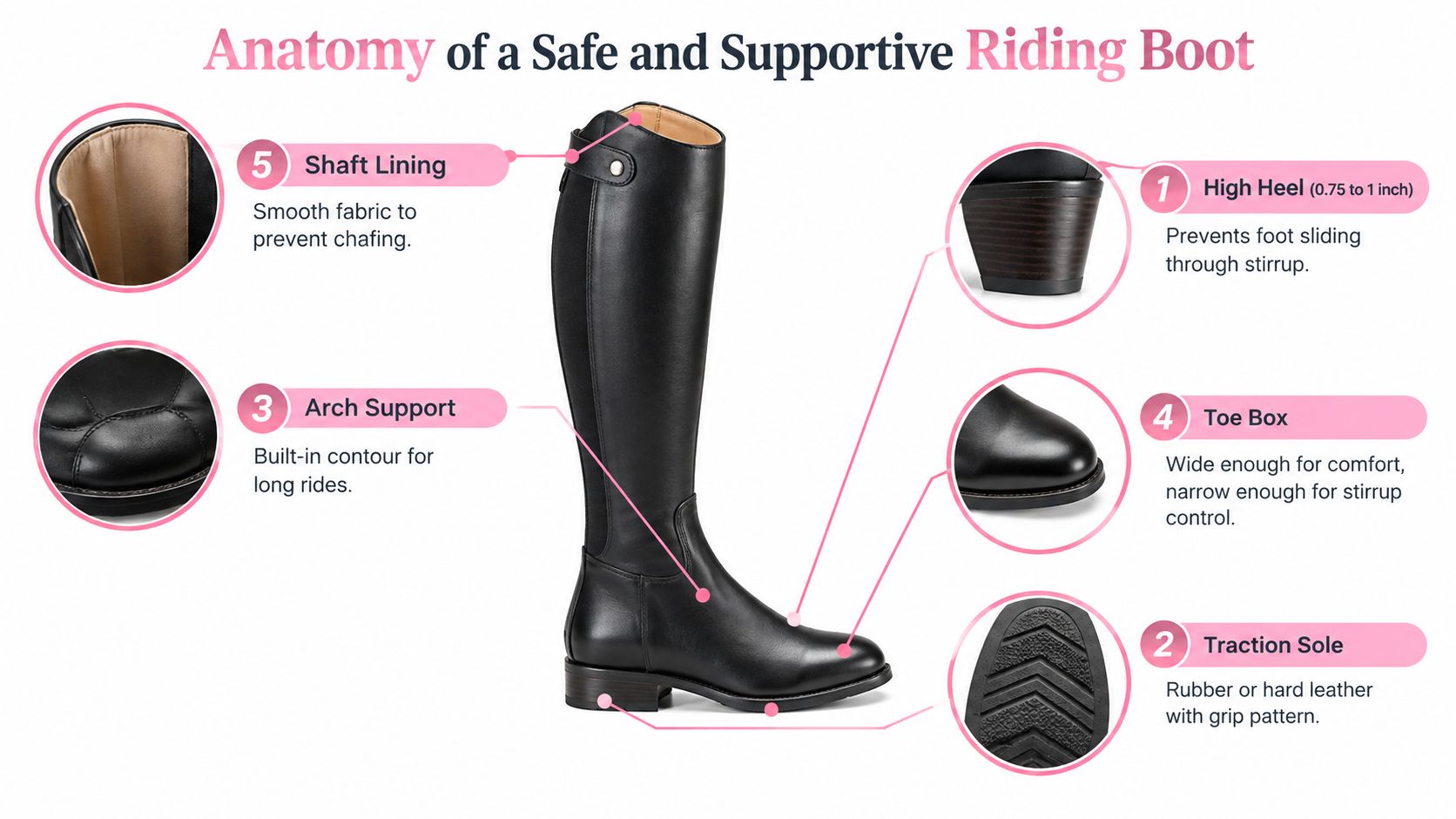
A safe riding boot should be evaluated from the ground up. Decorative shaft stitching can be attractive, but it tells you little about whether the boot will hold the foot securely, distribute pressure through the arch, or release cleanly from a stirrup.
Start with the heel and sole
For mounted use, look for a defined riding heel of approximately 1 to 1.5 inches, or 2.5 to 3.8 cm. The heel creates a physical stop that helps prevent the foot from sliding forward through the stirrup. An underslung profile supports that function without creating the same forward-catching shape associated with some heavier work soles. (CaloriesFit's horseback-riding clothing guidance outlines these riding-specific heel and sole considerations.)
The sole should be relatively smooth or low profile. A leather sole can move easily within a stirrup, while a modest rubber pattern can offer some ground confidence without the deep channels found on work footwear. Don't confuse “more grip” with “more control.” The best sole depends on whether the boot is primarily for arena riding, trail work, or walking around a muddy yard.
Inspect the shank and midsole
The shank is the firm internal structure that runs beneath the arch. A relatively stiff shank helps distribute load during long periods of riding or standing and keeps the foot from collapsing around the stirrup. A flexible walking sole may feel comfortable immediately, but it generally prioritizes ground flex over a stable stirrup platform.
Press and flex the boot carefully. You want resistance through the arch, a clear heel ledge, and a sole that doesn't fold like a casual shoe. A stable foot platform reduces movement inside the boot, which is especially important when the rider is posting, turning, or standing briefly in the stirrups.
Check the shaft and toe
The shaft protects the lower leg from stirrup leathers, brush, and chafing. It should remain stable without squeezing the calf or leaving a large, uncontrolled gap at the top. A smooth lining can reduce rubbing, but no lining compensates for a shaft that's too narrow.
The toe box should let the toes move naturally without pushing against the front when the heel is lowered in a stirrup-like stance. A closed toe is a sensible baseline for riding. A reinforced toe may help with crush protection around horses, but its extra bulk can change the way the foot sits in the stirrup. Treat occupational protection and riding compatibility as separate checks.
Comparing Heel Heights and Sole Profiles
Heel and sole design determine how a boot behaves in two very different places, the stirrup and the ground. Traditional cowboy heels tend to support mounted use, while lower roper heels and walking soles often feel better during long periods on foot.
The traditional underslung heel creates a stop beneath the rear of the foot. It helps keep the foot from sliding too far through the stirrup, and its slanted shape reduces the chance of the foot becoming trapped. A lower roper heel usually feels more natural for walking because it creates less elevation and often pairs with a more flexible sole. That comfort can be valuable, but a very flat or soft profile may provide less stirrup-specific control.
Deep lug soles belong primarily to the walking and work category. They can improve grip on loose soil, wet concrete, or uneven paths, yet those same lugs can catch in a stirrup. A boot with a safety toe may be appropriate for chores around heavy equipment or livestock, but it can feel bulky for precise riding and may alter the fit inside a narrow stirrup.
Heel and Sole Decision Matrix
| Heel/Sole Type | Best Use Case | Stirrup Safety | Walking Comfort |
|---|---|---|---|
| Traditional underslung heel with smooth or low-profile sole | Arena riding, lessons, general mounted work | Strong choice when the boot fits securely and the sole releases cleanly | Moderate, especially on hard or wet ground |
| Moderate riding heel with light rubber pattern | Mixed riding and ordinary barn movement | Suitable when tread stays shallow and the boot doesn't crowd the stirrup | Good for routine walking |
| Lower roper heel with flexible sole | Reining-style movement, casual riding, mixed wear | Acceptable only when the heel remains defined and the foot stays secure | Good, with a more natural walking feel |
| Deep lug work sole | Heavy barn chores, mud, rough ground | Poor choice for routine riding because lugs may catch | Strong grip and ground confidence |
| Safety toe with structured work sole | Occupational protection around impact hazards | Use cautiously, checking toe bulk, sole profile, and stirrup clearance | Useful for work, but often heavier |
Match the sole to the dismount
Arena riders usually benefit from a smoother sole and a clearly defined riding heel. The environment is controlled, so maximum walking traction may add risk without solving a real problem. Trail riders face a harder compromise. They may need more ground confidence after dismounting, but the boot should still keep a defined heel and avoid aggressive tread that crowds the stirrup.
Barn workers should be especially careful about trying to make one pair do everything. A lugged work boot can be excellent for hauling feed or crossing mud and still be the wrong choice for a mounted ride. If you regularly alternate between chores and riding, two purpose-built pairs are safer than forcing one boot to cover incompatible jobs.
A boot can be excellent on the ground and poorly designed for the stirrup. Judge it by the activity, not by its Western silhouette.
Achieving the Correct Fit for Riding Posture
Generic shoe sizing misses the main difficulty with pull-on Western boots. Your foot, calf, instep, socks, and ankle angle all change when you sit in the saddle. A boot that feels acceptable while standing in a shop can pinch the calf, loosen at the heel, or press the toes when the heel drops into the stirrup.
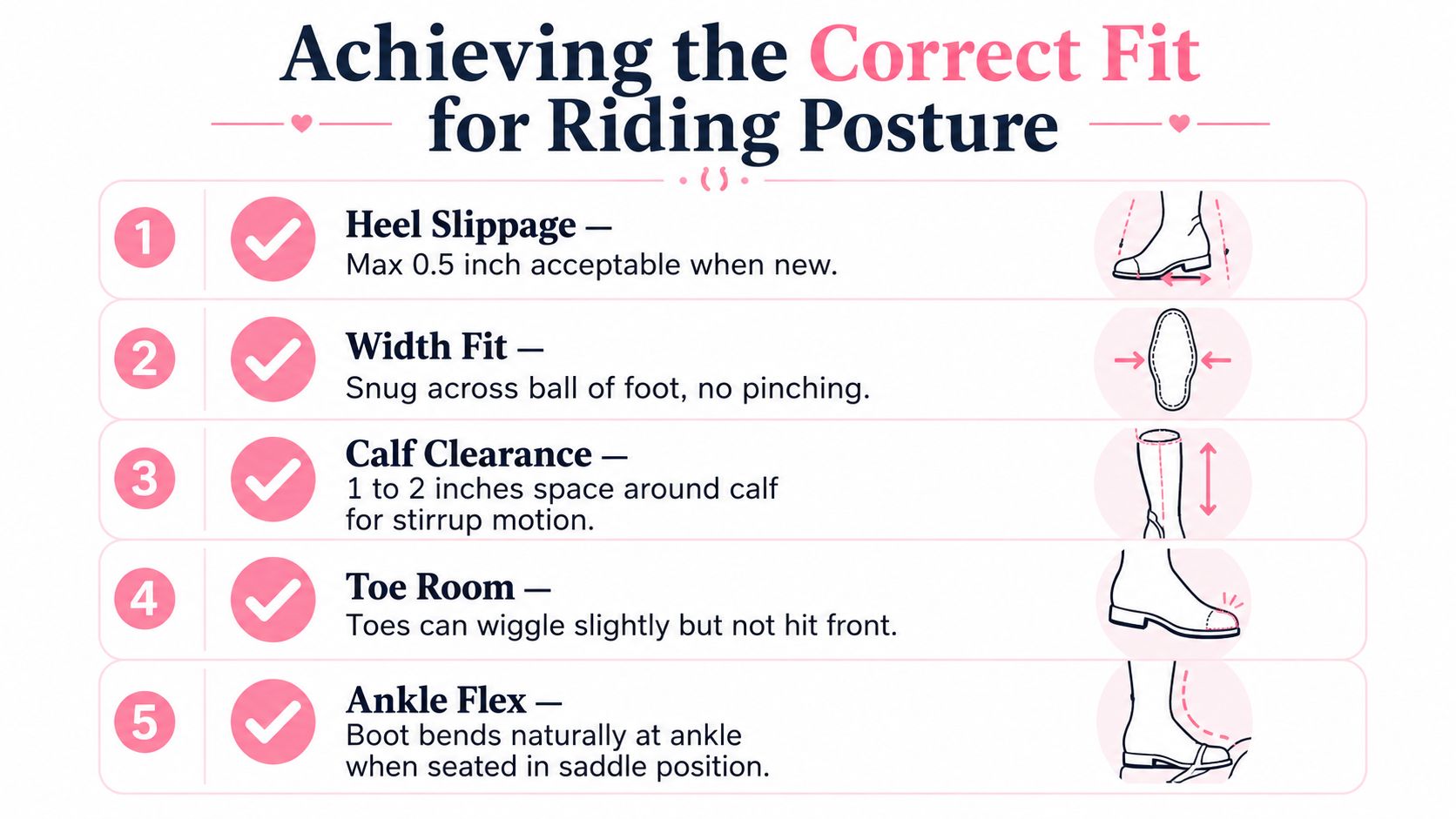
Use a riding-position fitting protocol
- Wear the right sock. Try the boot with the sock thickness you'll use in the saddle. If you ride through winter, don't size around a thin shop sock and hope the leather will create room later.
- Measure the calf while seated. Sit with your knees bent in a riding-like position and measure around the calf where the shaft will sit. A seated measurement reflects muscle position and leg shape more accurately than standing with a straight knee. The shaft should fit closely without restricting circulation or creating pressure behind the knee.
- Check the instep before judging the heel. Pull-on boots often feel tight over the instep at first. Some resistance can be normal, but sharp pressure, numbness, or tingling isn't a break-in issue. The foot should stay secure without excessive instep movement.
- Test the heel in a controlled stance. Slight heel lift can occur with a new pull-on boot as the sole and upper settle. Substantial movement means the boot isn't retaining the heel properly. Walk, bend the ankle, and lower the heel as though placing your foot in a stirrup.
- Check the toe and stirrup relationship. Your toes should wiggle slightly and shouldn't touch the front when the heel is lowered. Confirm that the boot's widest point has adequate clearance inside your stirrup. Independent riding guidance identifies up to 0.5 inches of clearance between the stirrup and the boot's widest point as a useful safety check. (Horse Boarding Atlas's boot buyer guidance discusses calf, heel, instep, and stirrup fit.)
A snug shaft isn't automatically a problem. It becomes a problem when it restricts circulation, causes persistent pain, or prevents the ankle and knee from moving normally. Wide calves may require a different shaft cut, stretch panel, or a model designed with more room. High insteps may make a pull-on boot unsuitable if the wearer must force the foot through the opening or cannot achieve stable heel retention.
Orthotics need their own trial. Remove a factory insole only if the boot's construction allows it, then confirm that the replacement doesn't lift the foot so high that the toe box or instep becomes cramped. Children also need reassessment as their feet grow. A loose boot isn't a safe solution to growth because excess movement can undermine stability.
For readers who spend long hours standing outside riding, clothing and body comfort can affect how you assess footwear. A practical resource on what to wear to a chiropractic appointment can help with general comfort planning, but it doesn't replace a riding-specific boot fit.
Material Selection and the Break-in Process
Full-grain cowhide remains a practical material for riders because its strong outer surface resists abrasion and gradually conforms to the foot. It can handle contact with stirrup leathers, brush, and ordinary barn wear while retaining the structure required for riding. That durability doesn't mean a new boot should feel comfortable everywhere on day one.
One industry test source estimates a break-in period of roughly 5 to 15 hours, although the actual time varies with leather thickness, moisture, and fit. (Horse Boarding Atlas's guide to riding gear provides that estimate.) Treat it as a range, not a deadline. A thick, firm upper may need more gradual wear than a lighter leather, while a poorly fitted boot won't become correct through patience.
Break leather in without weakening the boot
Wear the boots indoors for short periods before taking them on a long ride. This reveals pressure points before a blister, and it lets the leather begin shaping around the instep and heel. Increase wear time gradually, but don't soak the boots or apply uncontrolled heat. Excess moisture can distort leather, soften structural components unevenly, and affect the shape of the heel or shank.
Conditioning can help dry leather remain supple, but it shouldn't be used to disguise an incorrect fit. If the calf opening restricts circulation, the toe box presses the front of the foot, or the heel moves substantially, additional conditioner won't solve the underlying problem.
A useful break-in test is consistency. After several short wears, the boot should feel less resistant at the instep while still holding the heel and arch securely. The shaft may soften slightly, but it shouldn't collapse around the calf. Comfort should improve without sacrificing structure.
Matching Footwear to Specific Equestrian Use Cases
No single boot handles arena riding, trail travel, and heavy barn work equally well. Choose for the activity that places the greatest demand on the boot, then confirm that it remains suitable for secondary tasks. Walking traction and safe stirrup release often pull in opposite directions.
Arena and reining work
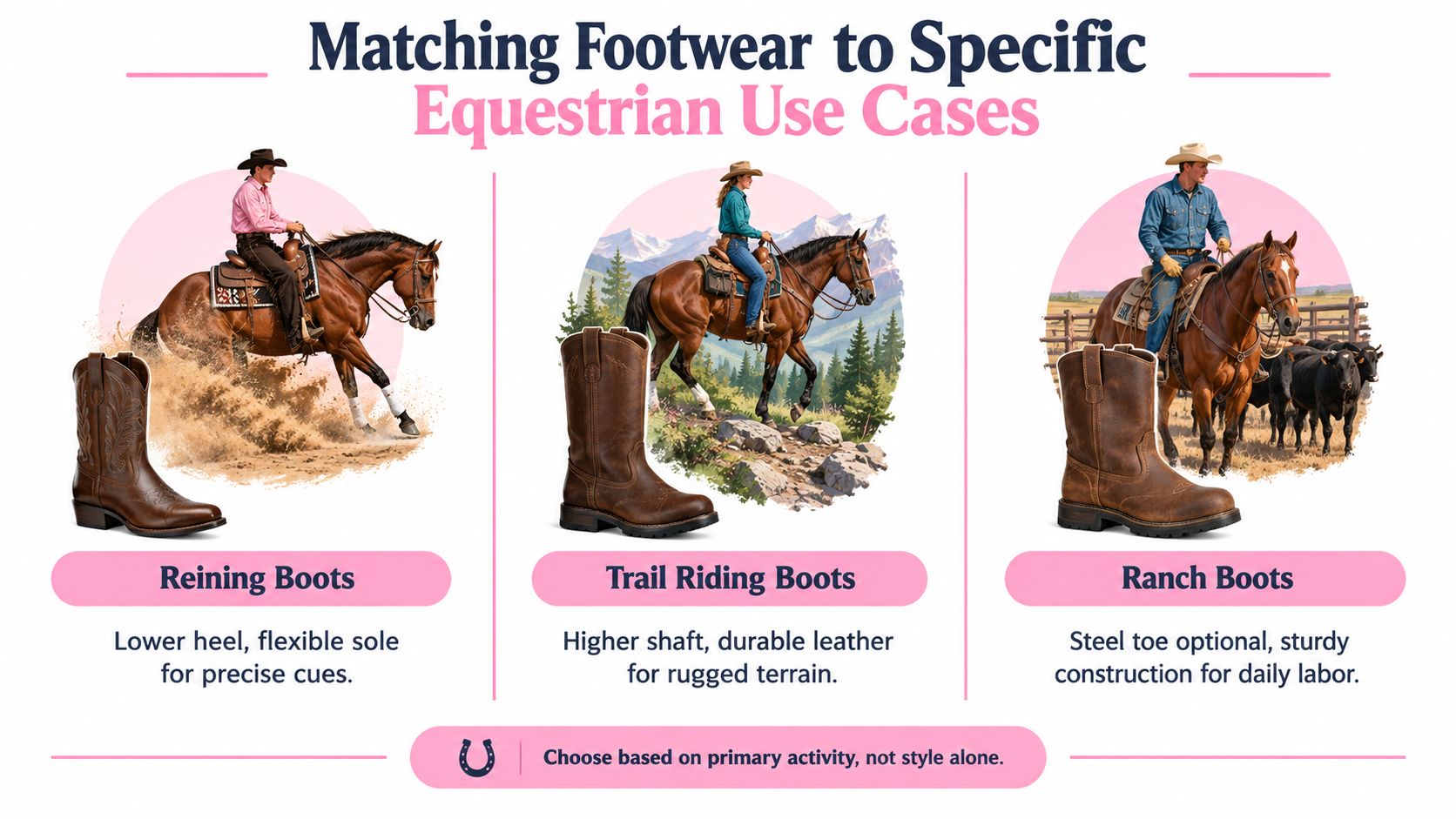
Arena riders need a controlled foot position and predictable movement in the stirrup. Look for a defined riding heel, firm shank, secure instep, and smooth or low-profile sole. A flexible walking boot may feel comfortable while sweeping aisles, yet its soft platform can shift inside the stirrup and make precise leg cues less consistent.
Reining and other disciplines that depend on subtle lower-leg communication generally suit a close, stable boot rather than one that is heavily padded or oversized. A lower heel can work if it remains clearly defined and the boot releases safely from the stirrup. Do not choose a low heel solely because it makes walking easier.
Trail riding
Trail boots must handle brush and uneven ground, so a stable shaft and durable leather matter. Moderate traction helps after dismounting, but aggressive tread can restrict stirrup release. Test the boot in the stirrup before choosing a more textured outsole.
A boot that feels secure on a rocky path may feel cramped or catch in a narrow stirrup. Measure the stirrup opening and boot width together, then practice lifting and releasing the foot. Tread depth alone cannot show whether the combination is safe.
Ranch and barn work
Barn duties expose footwear to mud, wet concrete, equipment, and animal contact. More ground traction or a protective toe may suit those hazards, but riding performance still requires a sole that will not obstruct stirrup release. Standards such as EN ISO 20345 and EN ISO 20346 address protective footwear for occupational hazards (protective footwear standards); assess the toe requirement against the actual work rather than adding it automatically.
A heavy work boot can be unsuitable for mounted use. Deep lugs may catch or crowd the stirrup, while a bulky toe can reduce foot sensitivity and add unnecessary weight. Keep a separate work pair when chores demand that protection, and use a riding pair when the horse is carrying you. Equisearch's riding boot options also separates occupational protection from riding requirements.
Western and English footwear address similar needs through different shapes and construction. This Western and English riding comparison provides useful background, but the practical rule is shared: match the boot to both the stirrup and the work.
Care Routines and Final Purchasing Checklist
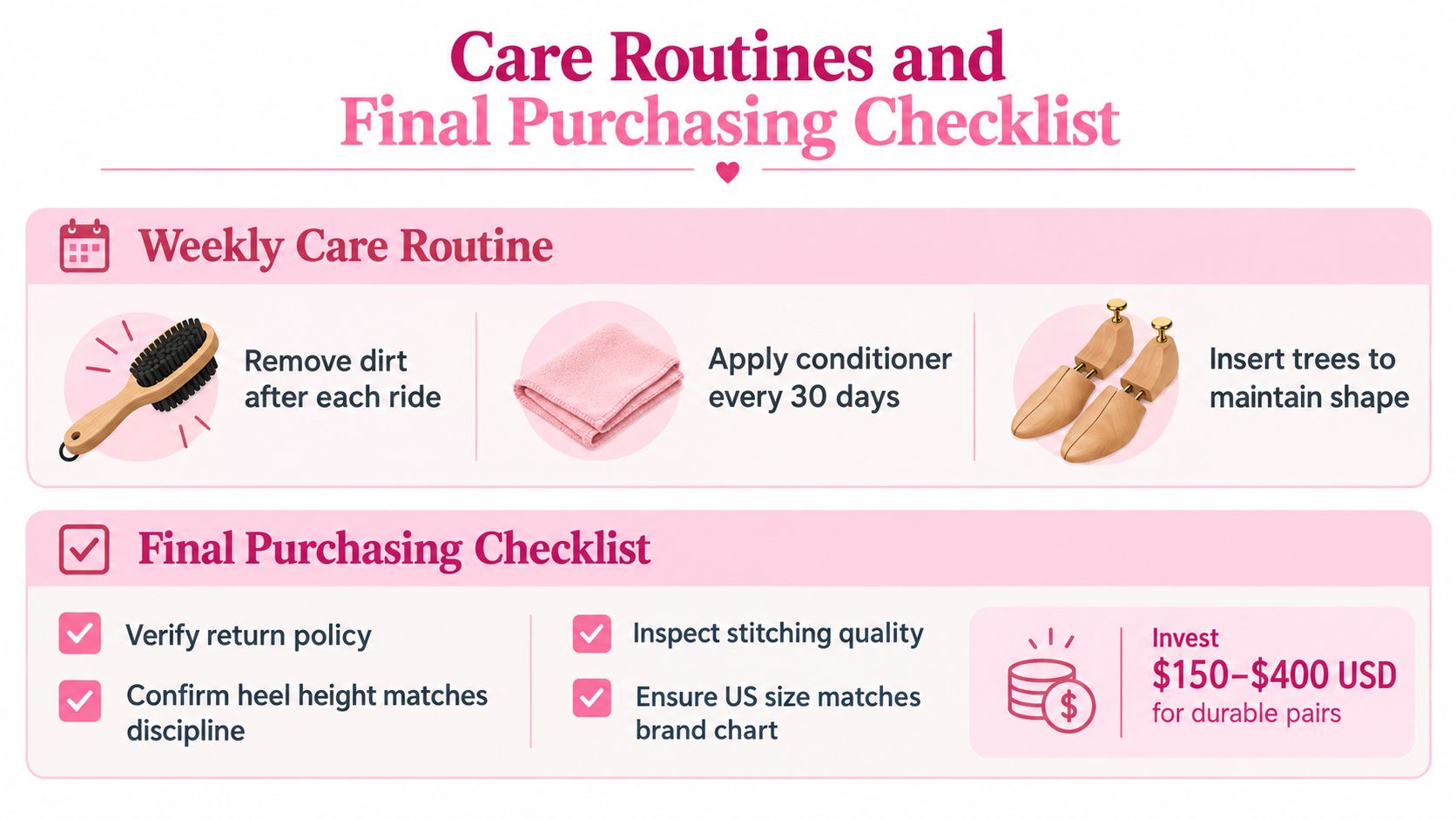
Care starts after every ride. Brush away dried dirt before it hardens around the welt, sole edge, or shaft. Wipe the leather with a suitable cloth, let damp boots dry naturally away from direct heat, and use boot trees or another supportive insert to help the shaft retain its shape.
Conditioning should be occasional rather than excessive. A leather conditioner can help prevent drying and cracking, but too much product can soften the upper and attract dirt. Keep conditioner away from textured soles and hardware unless the manufacturer specifically recommends it. For a basic cleaner, Fiebing's Liquid Glycerine Saddle Soap is one option to consider, provided it suits the boot's leather and finish.
Before you buy
- Confirm the primary activity: Decide whether the boot is for riding, trail dismounts, barn work, or ordinary wear.
- Verify the heel: Look for a defined riding heel and confirm its shape suits your discipline.
- Inspect the sole: Avoid deep tread for routine riding, and check that the sole won't crowd the stirrup.
- Test the shank: Look for firm arch support and a stable midsole rather than a soft, collapsing platform.
- Measure the calf seated: Account for riding posture, circulation, socks, and any calf variation.
- Check the heel and instep: Slight initial movement can settle, but substantial heel lift or an unstable instep means poor fit.
- Protect the toes appropriately: Consider a certified safety toe for occupational hazards, but test its bulk and stirrup compatibility.
- Read the return policy: Online buyers need enough time to test the boots indoors with riding socks and any orthotics.
- Inspect construction: Look at stitching, heel attachment, shaft stability, and the transition between upper and sole.
Foot discomfort can also come from the hours spent standing around a horse, not only from the boot itself. Riders managing soreness after long barn days may find general recovery information, such as these Thermo Recovery Wear recovery sleeves, useful as a complement to proper footwear, rest, and professional medical advice when needed.
Don't purchase a boot because it looks Western enough. Put it in the stirrup, assess the release path, measure the calf in riding posture, and decide whether its construction supports the work you do.
Bridle Up Hope Shop offers equestrian apparel, accessories, boots, books, and horse-themed goods for women, children, and the home, including rider-focused options such as Hope Rider hand-tooled leather boots. Visit Bridle Up Hope Shop to compare Western riding merchandise and support a store whose annual net profits are donated to the Bridle Up Hope foundation.
Leave a comment